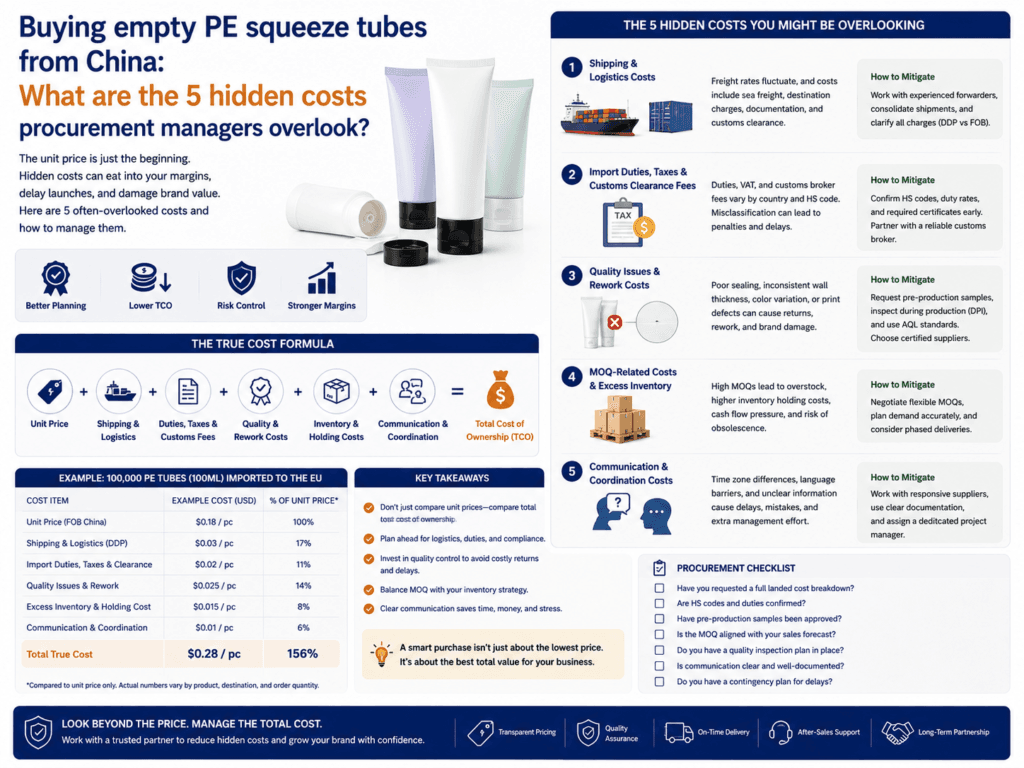
When procurement managers buy empty PE squeeze tubes from China, the lowest quoted unit price is rarely the real landed cost. The five hidden costs most often overlooked are tooling and sample revisions, artwork and printing setup, quality inspection and testing, shipping and import charges, and delays caused by unclear specifications or packaging rework.
PE squeeze tubes are widely used for skincare, sunscreen, facial cleanser, hand cream, body lotion, hair care, toothpaste, hotel amenities, and personal care products. Because many suppliers quote only the basic tube price, buyers may underestimate the total cost of customization, decoration, testing, logistics, and post-production risk.
Quick Answer
The 5 hidden costs procurement managers often overlook when sourcing empty PE squeeze tubes from China are: 1) custom mold and sample modification costs, 2) printing plate, color matching, and artwork setup costs, 3) quality inspection and compatibility testing costs, 4) freight, duties, customs, and local delivery costs, and 5) delay, rework, or rejected-batch costs caused by poor specification control.
| Hidden Cost | Why Buyers Overlook It | Impact on Real Cost |
|---|---|---|
| Tooling and sample revisions | Quote may only include standard tube molds | Higher upfront cost and longer development time |
| Artwork and printing setup | Unit price may not include screen, plate, proofing, or color adjustment | Extra charges before production starts |
| QC and compatibility testing | Buyers may assume basic factory QC is enough | Reduces leakage, color, cap, and formula risk |
| Shipping and import costs | EXW or FOB quote does not equal landed cost | Freight, duty, port charges, and delivery can be significant |
| Delay and rework costs | Poor specifications create artwork, cap, size, or quality changes | Lost launch time, extra samples, urgent freight, rejected goods |
Hidden Cost 1: Tooling, Mold, and Sample Revision Costs
Many PE squeeze tube projects can use existing tube molds, standard diameters, standard caps, and regular head shapes. But once the project requires a custom nozzle, special shoulder, oval tube, octagonal cap, airless head, unique applicator, custom cap shape, or unusual capacity, tooling cost may appear.
| Customization Requirement | Possible Extra Cost | How to Control It |
|---|---|---|
| Custom tube diameter or length | Development and sampling cost | Use standard diameter where possible |
| Special tube head or nozzle | Injection head mold or modification cost | Confirm whether existing head molds are available |
| Custom flip-top or screw cap | Cap mold, color trial, fit testing | Use factory’s existing cap library when practical |
| Applicator head | Metal head, rollerball, silicone tip, or long nozzle development | Confirm compatibility with formula and target MOQ |
| Multiple sample revisions | Extra sample fee, courier fee, and time cost | Prepare precise drawings, artwork, and formula data early |
Procurement note: Before comparing prices, ask whether the quotation is based on existing molds or custom tooling. A low unit price can become expensive if the design needs new mold development.
Hidden Cost 2: Artwork, Printing, and Color Matching Setup
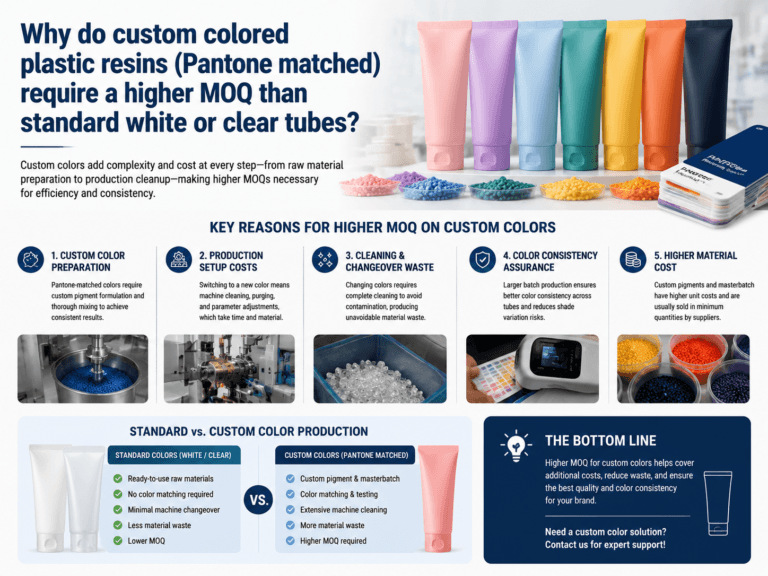
Custom printing is one of the most underestimated cost areas. A tube price may include a basic body, but not all printing methods, color separations, plates, screens, hot stamping molds, proofing rounds, Pantone matching, varnish, soft-touch finish, matte coating, or artwork adjustment.
| Printing Item | Hidden Cost Risk | Procurement Question to Ask |
|---|---|---|
| Silk screen printing | Screen setup cost per color | How many colors are included in the quote? |
| Offset printing | Plate setup and color registration cost | Is the plate fee included or charged separately? |
| Hot stamping | Foil die, foil material, and testing cost | Is the foil area simple or complex? |
| Matte or soft-touch finish | Extra surface coating or treatment cost | Does the finish pass scratch and adhesion tests? |
| Pantone color matching | Multiple trials may be needed | What color tolerance is acceptable? |
| Artwork correction | File adjustment, dieline correction, proofing delay | Are vector files and outlined fonts ready? |
Hidden Cost 3: Quality Inspection and Compatibility Testing
PE squeeze tubes must match the formula, cap, filling process, sealing method, shipping route, and consumer-use scenario. If testing is skipped, the project may face leakage, tube deformation, poor printing adhesion, cap cracking, color difference, tail-seal failure, or formula incompatibility after production.
| Test Item | What It Prevents | Why It Affects Cost |
|---|---|---|
| Leakage test | Cap leakage, orifice leakage, tail-seal leakage | Prevents product loss and rejected shipments |
| Drop and compression test | Damage during shipping and e-commerce handling | Reduces carton damage and return claims |
| Formula compatibility test | Softening, swelling, odor, paneling, delamination | Protects formula stability and packaging integrity |
| Printing adhesion test | Ink peeling, smudging, hot stamping loss | Prevents retail appearance failure |
| Cap torque and thread test | Loose caps, overtightening, thread stripping | Improves assembly and consumer experience |
| Pre-shipment inspection | Color mismatch, quantity error, packing issue | Finds problems before goods leave China |
Hidden Cost 4: Freight, Duties, Customs, and Local Delivery
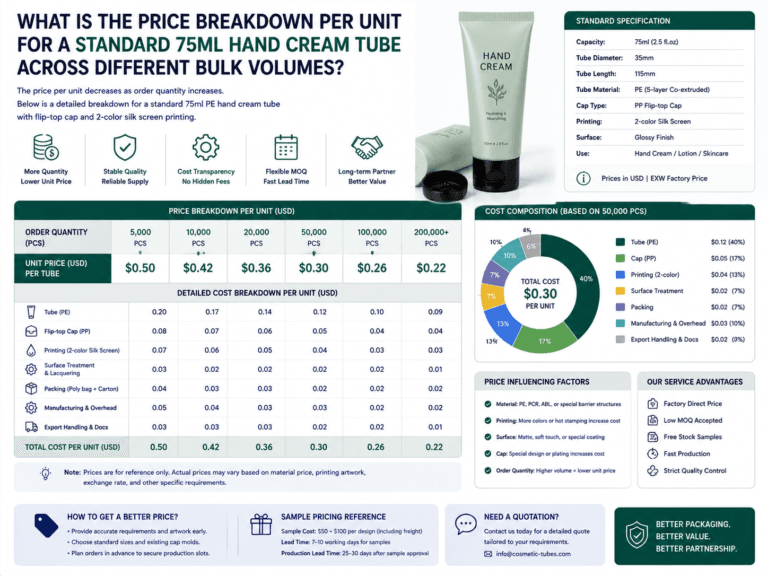
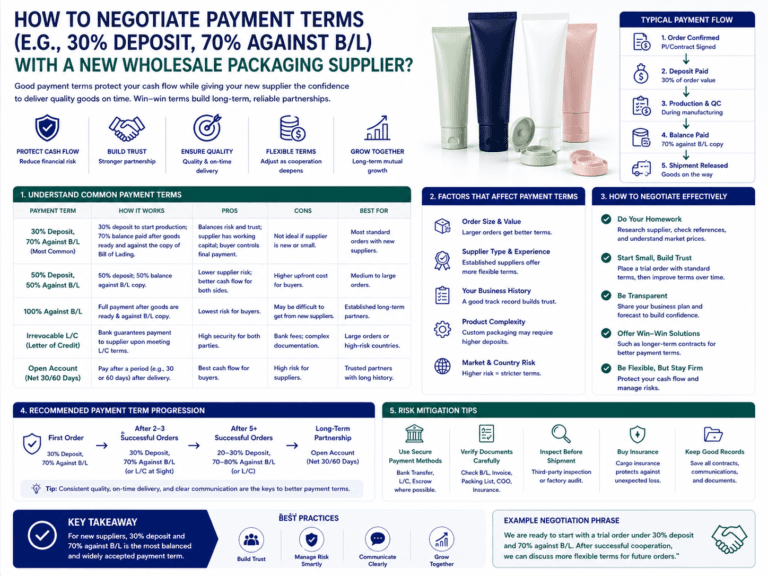
A China supplier may quote EXW, FOB, CIF, DAP, or another trade term. Procurement managers must understand what is included. The factory unit price does not automatically include sea freight, air freight, customs clearance, import duties, taxes, port charges, warehouse fees, local trucking, insurance, or destination handling charges.
| Cost Area | Why It Is Hidden | How to Estimate Better |
|---|---|---|
| Export packing | Special cartons, inner bags, palletizing, or labels may cost extra | Confirm packing method and carton dimensions |
| Sea freight or air freight | Depends on volume, weight, route, and season | Calculate based on CBM and gross weight |
| Customs duty and taxes | Varies by destination country and HS code | Ask importer or broker before order confirmation |
| Destination charges | Port, warehouse, documentation, and handling fees may appear later | Request a landed-cost estimate, not only FOB price |
| Local delivery | Final trucking from port or warehouse is often excluded | Confirm delivery to final warehouse or filling factory |
Hidden Cost 5: Delays, Rework, and Launch Risk
The most expensive hidden cost is often not a line item on the invoice. It is the cost of delay. If tube drawings are unclear, artwork is not print-ready, cap requirements are vague, formula compatibility is not tested, or packing instructions are incomplete, the project can lose weeks or months.
| Delay Cause | Possible Result | Hidden Cost |
|---|---|---|
| Unclear capacity requirement | Tube size does not match filling volume | New samples, new artwork layout, launch delay |
| Wrong cap selection | Leakage, poor airtightness, poor user experience | Cap replacement, extra testing, urgent freight |
| Late artwork changes | Printing plates or screens must be remade | Setup cost and production delay |
| No formula compatibility test | Tube softening, fragrance loss, paneling, leakage | Rejected packaging, reformulation, or redesign |
| Poor packing specification | Carton damage or tube deformation in transit | Claims, sorting, repacking, and customer complaints |
How to Calculate the Real Landed Cost
Instead of comparing only unit prices, procurement managers should calculate the complete landed cost per tube. This gives a more realistic view of supplier competitiveness and prevents unexpected budget increases after production starts.
| Cost Component | Include in Calculation? | Example Items |
|---|---|---|
| Tube unit price | Yes | Tube body, head, cap, standard packing |
| Tooling and sample cost | Yes | Mold, proofing, custom cap, courier samples |
| Decoration setup | Yes | Screen, plate, hot stamping die, color trial |
| Inspection and testing | Yes | Pre-shipment inspection, leakage test, compatibility test |
| Logistics | Yes | Freight, insurance, customs, duty, tax, local delivery |
| Risk allowance | Recommended | Delay, rework, urgent shipping, rejected quantity buffer |
Procurement Checklist Before Requesting a Quote
- Tube capacity: Confirm ml or gram fill volume, formula density, and headspace requirement.
- Tube diameter and length: Confirm retail shelf, filling line, carton, and hand-feel requirements.
- Material structure: Choose standard PE, 2-layer PE, 5-layer EVOH, PCR PE, sugarcane PE, or laminate tube if needed.
- Cap type: Confirm screw cap, flip-top cap, nozzle cap, airless pump, rollerball, or applicator head.
- Decoration: Confirm silk screen, offset, hot stamping, label, matte, glossy, soft-touch, or metallic finish.
- Artwork file: Provide AI, PDF, or EPS vector file with outlined fonts and Pantone references.
- Testing need: Confirm leakage, drop, compression, compatibility, torque, and printing adhesion tests.
- Shipping term: Confirm EXW, FOB, CIF, DAP, DDP, or buyer-arranged freight.
What to Ask a Chinese Tube Supplier
| Question | Why It Matters |
|---|---|
| Does the quote include cap, printing, packing, and setup fees? | Prevents comparing incomplete prices |
| Are standard molds available for this capacity and diameter? | Avoids unnecessary tooling cost |
| What is the sample lead time and sample revision policy? | Controls project timeline and development cost |
| Can you test with our actual formula? | Reduces leakage, compatibility, and barrier risk |
| What is the packing method and carton size? | Helps calculate freight and avoid tube deformation |
| Can you provide pre-shipment inspection photos or reports? | Improves quality control before goods leave China |
| What documents can you provide? | Useful for customs, compliance, retailer review, and internal approval |
How Xinfly Packaging Helps Reduce Hidden Costs
As a cosmetic tube manufacturer, Xinfly Packaging helps buyers reduce hidden costs by reviewing the full packaging system before production: tube material, cap type, formula compatibility, artwork layout, printing method, sample approval, QC testing, packing, and export logistics.
- Existing mold options: Helps reduce unnecessary tooling costs for common capacities and diameters.
- Engineering review: Checks tube size, cap fit, orifice, wall thickness, and formula requirements.
- Decoration support: Helps select cost-effective silk screen, offset, hot stamping, label, matte, or soft-touch finish.
- Sample development: Supports pre-production samples before mass production.
- Quality control: Reviews leakage, printing adhesion, cap compatibility, and packing stability.
- Export support: Helps prepare cartons, documents, and shipping information for international buyers.
Common Mistakes to Avoid
- Choosing only by lowest unit price: The cheapest quote may exclude setup, printing, testing, and logistics.
- Not confirming trade terms: EXW, FOB, CIF, and DDP prices include different responsibilities.
- Ignoring formula compatibility: A tube that works for one cream may fail with sunscreen, essential oil, or cleanser.
- Approving artwork too late: Late changes increase proofing time and printing setup cost.
- Skipping pre-shipment inspection: Problems found after arrival are much harder to solve.
- Underestimating packaging volume: Empty tubes are lightweight but can occupy large carton volume.
Best Practical Recommendation
When buying empty PE squeeze tubes from China, procurement managers should request a complete quotation that separates tube unit price, cap cost, decoration cost, tooling cost, sample cost, packing cost, testing cost, and shipping term. This makes supplier comparison more accurate and prevents unexpected charges after order confirmation.
For skincare, sunscreen, cleanser, lotion, toothpaste, and personal care products, the best approach is to approve samples with the real formula, confirm artwork before production, test cap and tube compatibility, define QC standards, and calculate landed cost before placing the bulk order.
Summary
The five hidden costs of buying empty PE squeeze tubes from China are tooling and sample revision costs, artwork and printing setup costs, quality inspection and compatibility testing costs, shipping and import costs, and delay or rework costs caused by unclear specifications. These costs can significantly affect the final landed price and project timeline.
To control budget and risk, procurement managers should compare complete project costs instead of only unit prices, and work with a tube supplier that can provide engineering review, sample development, printing support, QC testing, and export packaging guidance.
Learn more: PE Tubes, Cosmetic Squeeze Tubes, Empty Squeeze Cosmetic Tubes, Factory Direct vs Trading Company, China Tube Manufacturer vs Local Supplier, Quality Assurance.
Need a Clear Cost Breakdown for Empty PE Squeeze Tubes?
Xinfly Packaging helps procurement teams compare real landed costs, tube materials, cap options, printing methods, sample development, testing requirements, packing plans, and export logistics for custom PE squeeze tube projects from China.