
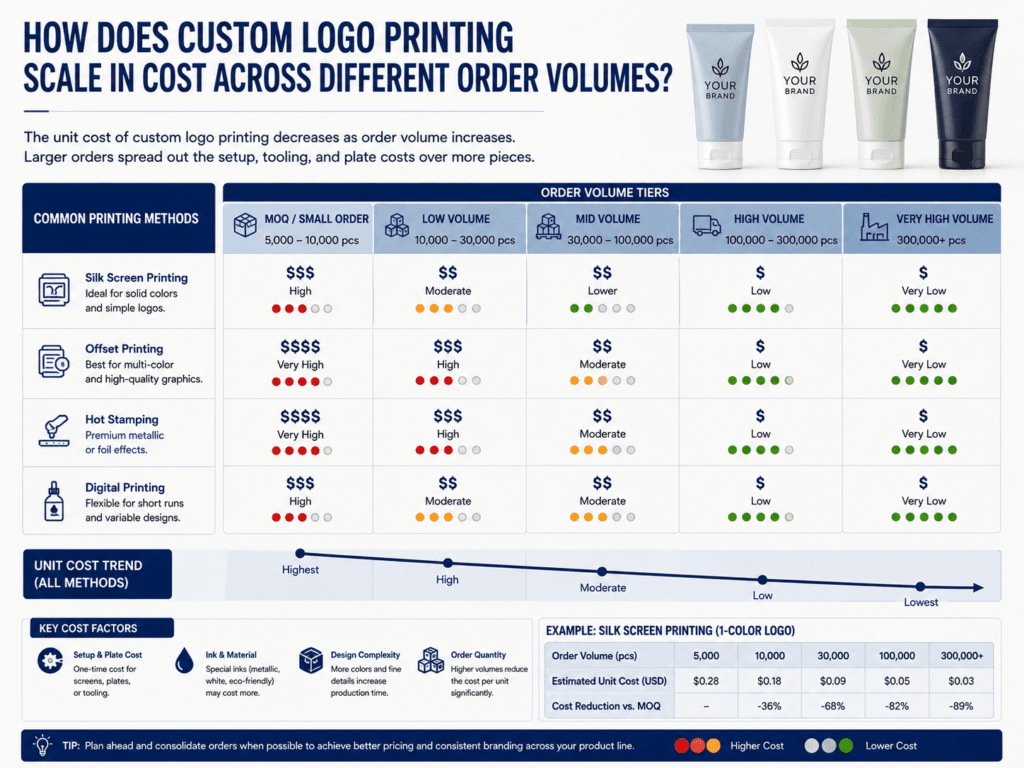
Custom logo printing becomes more cost-efficient as order volume increases because fixed setup costs are spread across more tubes. At MOQ level, the unit price is usually the highest because the order still has to absorb artwork checking, screen or plate preparation, machine setup, color adjustment, startup waste, and production changeover. At higher volumes, those same fixed costs are diluted, so the cost per tube usually drops.
For cosmetic tube projects, the cost curve is shaped by two things: the printing method and the order quantity. In general, short-run printing methods are more flexible but have a higher unit cost, while traditional production printing becomes more competitive once the volume is high enough. That is why MOQ pricing often looks expensive per piece, while larger repeat orders usually deliver much better printing economics.
Why Unit Cost Is Higher at MOQ
| Cost Element | Why It Hits MOQ Orders Harder | Effect on Unit Cost |
|---|---|---|
| Artwork setup | The file still needs preparation and approval even for a small run | Higher cost per tube |
| Screen / plate / cylinder preparation | Traditional print jobs require production setup before printing starts | Fixed cost is spread over fewer units |
| Color matching and test runs | The factory still needs calibration and startup adjustment | Small orders absorb more setup waste per piece |
| Machine changeover | Changing from one job to another takes labor and press time | Raises MOQ pricing noticeably |
| Material procurement minimums | Ink, tubes, caps, and packaging materials may have their own minimums | Reduces flexibility at low quantities |
Why High Volume Lowers the Cost Per Tube
- Setup costs are diluted: The same print setup is spread over many more units.
- Production runs more efficiently: Long runs usually reduce stop-start losses.
- Waste becomes a smaller percentage: Startup and tuning waste matter less when the order is larger.
- Material purchasing becomes stronger: Larger orders often improve sourcing efficiency.
- Traditional printing methods become more competitive: Methods with higher setup cost often become cheaper per unit at scale.
How Printing Method Changes the Cost Curve
| Printing Method | MOQ Behavior | High-Volume Behavior |
|---|---|---|
| Digital printing | Better for short runs and fast design changes | May become less cost-efficient than traditional methods at large volumes |
| Silk screen printing | Setup cost is visible at low volumes | Becomes more attractive when spread across larger runs |
| Offset printing | Usually carries higher setup burden at small quantities | Often more cost-efficient for high-volume, stable artwork jobs |
| Flexo printing | Less favorable for very small customized runs | Often strong for large-volume packaging production |
Typical Cost Logic by Order Stage
| Order Stage | Typical Cost Character | What Brands Usually Notice |
|---|---|---|
| MOQ / first trial order | Highest unit price | Setup charges feel heavy relative to the quantity |
| Medium run | Balanced pricing | Unit cost starts dropping meaningfully |
| High volume / repeat run | Best unit economics | Fixed cost impact becomes much smaller |
What Makes MOQ Printing More Expensive Besides Quantity?
- More colors: Each added color usually increases setup complexity.
- Special finishes: Hot stamping, matte, soft-touch, spot UV, and other effects add cost layers.
- Frequent artwork changes: Multi-SKU low-volume projects reduce printing efficiency.
- Complex color standards: Pantone matching and premium consistency checks can increase setup effort.
- Unstable specifications: Changing tube size, cap, material, or print method increases job complexity.
How to Control Cost at MOQ
| Cost-Saving Approach | Why It Helps |
|---|---|
| Reduce the number of print colors | Lowers setup complexity and preparation cost |
| Use one tube structure across multiple SKUs | Improves purchasing and production efficiency |
| Keep decoration simple | Avoids stacking too many premium finishing charges onto a small run |
| Prepare artwork carefully before production | Reduces revision cost and setup delays |
| Plan for repeat orders | Repeat runs usually deliver better long-term unit economics |
When High Volume Usually Makes the Biggest Difference
The biggest drop in logo-printing cost usually happens when a project moves from “testing quantity” into a more stable production quantity. This is where traditional printing methods begin to outperform short-run flexibility. Once the artwork is fixed, the packaging structure is stable, and the order quantity is high enough, the factory can run longer and more efficiently, which usually lowers the price per tube.
Best Practical Advice for Beauty Brands
If you are launching a new cosmetic tube project, it is normal for the MOQ unit price to feel high. That does not necessarily mean the supplier is expensive. It often reflects the real cost of setup, calibration, and small-run inefficiency. The smarter comparison is not just “price per tube today,” but how the unit cost changes when the order scales from trial quantity to repeat production.
Summary
Custom logo printing usually scales in cost by following a simple rule: the larger the order volume, the lower the unit printing cost. MOQ pricing is higher because setup, screens, plates, changeover, and startup waste are divided across fewer units. High-volume pricing is lower because those same fixed costs are diluted and production runs more efficiently.
In practical cosmetic tube manufacturing, MOQ orders are best for testing and launch validation, while higher-volume orders usually give the best long-term unit economics for custom logo printing.
Learn more: MOQ for Custom Printed Cosmetic Tubes, MOQ in Cosmetic Packaging Meaning, Customize Cosmetic Tubes, Printing Options, Cosmetic Tubes Wholesale, OEM & ODM.
Need the Right MOQ Strategy for Custom Logo Tubes?
Xinfly Packaging helps brands compare MOQ trial runs and high-volume production so they can balance launch flexibility, print quality, and long-term unit cost more effectively.