
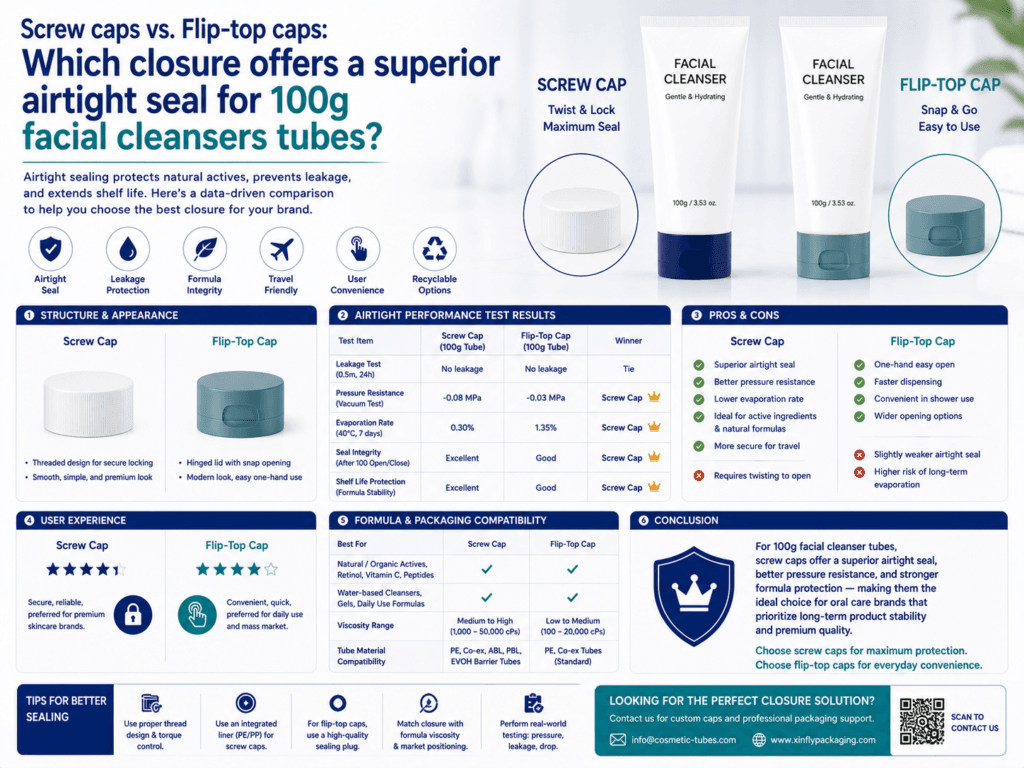
For a 100g facial cleanser tube, a screw cap usually offers a more reliable airtight seal than a standard flip-top cap because it creates stronger thread engagement, higher closing pressure, and better resistance to accidental opening during shipping and daily use. However, a well-engineered flip-top cap with an inner plug seal can still perform very well for facial cleanser packaging, especially when convenience and one-hand use are important.
The best closure choice depends on the cleanser formula, tube diameter, viscosity, foaming tendency, leakage risk, filling method, retail positioning, and user experience. A thick cream cleanser may work well with either cap, while a low-viscosity gel cleanser or foaming cleanser may require stronger sealing control.
Quick Answer
If airtight sealing and leakage prevention are the top priorities, choose a screw cap. If convenience, shower use, and one-hand dispensing are more important, choose a high-quality flip-top cap with inner plug seal. For most 100g facial cleanser tubes, both can work if the cap is matched correctly, but screw caps are generally safer for maximum sealing performance.
| Closure Type | Airtight Seal Level | User Convenience | Best Use |
|---|---|---|---|
| Screw cap | Higher | Moderate; requires twisting | Premium cleansers, travel tubes, leakage-sensitive formulas |
| Flip-top cap | Good if plug seal is well designed | High; easy one-hand opening | Daily facial cleanser, shower use, retail personal care tubes |
| Disc-top cap | Moderate | High | Some lotions and cleansers, but less ideal for strong airtight needs |
Why Screw Caps Usually Seal Better
A screw cap seals by tightening around the tube neck threads. This creates consistent compression between the cap and the tube orifice. Depending on the design, it may also use an inner plug, liner, or sealing ring. Because the closure is mechanically tightened, it is less likely to open accidentally under carton compression, travel pressure, or repeated handling.
- Stronger mechanical lock: Thread engagement holds the cap tightly on the tube neck.
- Better compression seal: The cap can press more firmly against the orifice or sealing land.
- Lower accidental opening risk: Screw caps are less likely to pop open during shipping.
- Better for travel: More secure when tubes are packed inside bags or cartons.
- Good for low-viscosity formulas: Helps reduce leakage risk for gel or liquid cleansers.
Why Flip-Top Caps Are Still Popular
Flip-top caps are widely used for facial cleanser tubes because they are convenient and consumer-friendly. Users can open and close the cap with one hand, which is useful in bathrooms, showers, gyms, and travel kits. A flip-top cap can also stand upright, making it attractive for retail display and daily use.
| Flip-Top Advantage | Why Brands Like It | Engineering Requirement |
|---|---|---|
| One-hand operation | Better user convenience in wet bathroom conditions | Hinge must be durable and easy to open |
| Stand-up display | Good shelf presence and stable bathroom storage | Flat cap base must match tube diameter and fill weight |
| Fast dispensing | Suitable for daily-use cleansers | Outlet size must match formula viscosity |
| Modern personal-care look | Common for mass-market and premium cleanser tubes | Cap color, finish, and snap strength must be controlled |
Airtight Seal Comparison
| Seal Factor | Screw Cap | Flip-Top Cap |
|---|---|---|
| Thread engagement | Strong; cap locks by rotation | Usually no full thread lock on opening panel |
| Inner plug seal | Can be added for high sealing performance | Essential for good leak resistance |
| Resistance to accidental opening | Higher | Depends on snap strength and hinge design |
| Leakage under compression | Lower risk when properly tightened | Higher risk if plug seal or snap lock is weak |
| Consumer closing consistency | Depends on whether user fully tightens cap | Depends on whether user fully snaps cap closed |
Formula Viscosity Changes the Decision
A 100g facial cleanser may be a gel, cream, foam base, scrub, balm cleanser, or low-viscosity liquid cleanser. The thinner the formula, the more important airtight and leak-proof sealing becomes. Thicker formulas are less likely to leak, but they may need a larger outlet and easier cap operation.
| Cleanser Formula | Closure Direction | Reason |
|---|---|---|
| Low-viscosity gel cleanser | Screw cap or high-seal flip-top cap | Formula flows easily and may leak through weak cap paths |
| Medium cream cleanser | Both screw cap and flip-top cap can work | Moderate viscosity gives better dispensing control |
| Thick facial cleanser paste | Flip-top cap often works well | Convenient dispensing and lower leakage risk |
| Foaming cleanser base | Secure cap with good headspace control | Air bubbles and expansion may increase pressure |
| Scrub cleanser | Cap with suitable orifice and clog-resistance | Particles may block small outlets |
Recommended Cap Design for 100g Facial Cleanser Tubes
For a typical 100g facial cleanser tube, the cap should match the tube diameter, shoulder design, product viscosity, and intended use environment. A 35mm or 40mm tube with a stable flip-top cap is common for daily facial cleanser products, while a screw cap may be better for premium, travel, or leakage-sensitive projects.
| Design Requirement | Screw Cap Recommendation | Flip-Top Cap Recommendation |
|---|---|---|
| Airtight seal | Use full thread engagement and optional inner plug or liner | Use strong plug seal, tight snap, and accurate cap/tube matching |
| Bathroom use | Add anti-slip texture or ribbed cap side wall | Use easy-open but secure hinge and snap design |
| Travel safety | Preferred for lower leakage risk | Use only after compression and leakage testing |
| Premium appearance | Use glossy, matte, metallic, or acrylic-style cap | Use flat stand-up cap with clean front alignment |
Cap Orifice and Plug Seal Design
The cap’s sealing performance depends not only on the closure type, but also on the orifice, plug seal, sealing land, cap material, and dimensional tolerance. A poorly designed screw cap can leak, while a well-designed flip-top cap can seal reliably. For facial cleanser tubes, the plug should fit the orifice tightly without making the cap difficult to close.
- Orifice size: Must match formula viscosity and dispensing amount.
- Inner plug fit: The plug should seal the outlet without damaging the tube neck.
- Cap snap strength: Flip-top caps must close firmly and resist accidental opening.
- Thread quality: Screw caps need smooth, accurate thread engagement.
- Cap material stiffness: Too soft may deform; too brittle may crack under impact.
- Tube neck tolerance: Neck dimension must be controlled for stable cap fit.
Leakage Risks During Shipping and Retail Display
| Risk Scenario | Screw Cap Performance | Flip-Top Cap Performance |
|---|---|---|
| Carton compression | Usually more secure if tightened properly | May pop open if snap lock is weak |
| Drop impact | Can crack if cap material is brittle, but seal usually stays closed | Hinge or lid may open if impact direction is unfavorable |
| Cabin pressure / travel pressure | Better for travel-size or leakage-sensitive cleanser tubes | Needs strong plug seal and pressure-cycle validation |
| Retail display upright storage | Good seal, but less convenient for daily opening | Excellent shelf and bathroom convenience if base is stable |
Testing Before Choosing the Final Closure
Closure selection should be confirmed with filled tubes, not only empty packaging. Facial cleanser formulas may contain surfactants, oils, exfoliating particles, fragrance, botanical extracts, or foaming agents that affect leakage, cap cleanliness, and long-term seal stability.
| Test | Purpose | What to Check |
|---|---|---|
| Leakage test | Confirms cap and tail seal resistance | Cap leakage, neck leakage, tail leakage, formula residue |
| Compression test | Simulates carton pressure and travel squeezing | Cap popping, product overflow, tube deformation |
| Drop test | Checks impact resistance during shipping | Cap cracking, hinge damage, leakage, shoulder failure |
| Vacuum or pressure-cycle test | Checks travel and pressure-change performance | Formula oozing, cap seal failure, trapped-air expansion |
| Repeated open-close test | Checks consumer-use durability | Thread wear, hinge fatigue, snap weakness, plug deformation |
| Aging and compatibility test | Checks long-term formula-package interaction | Cap stress cracking, seal loosening, swelling, leakage |
Consumer Experience Comparison
| User Experience Factor | Screw Cap | Flip-Top Cap |
|---|---|---|
| Opening speed | Slower | Faster |
| One-hand use | Less convenient | Better |
| Wet-hand bathroom use | Needs ribbed or textured side wall | More convenient if lid is easy to open |
| Travel confidence | Higher | Good only with strong snap and plug seal |
| Premium ritual feel | Good for luxury and clinical skincare | Good for daily functional skincare and personal care |
When to Choose Screw Caps
- When the formula is low-viscosity, oily, or leakage-sensitive.
- When airtight sealing and travel safety are more important than one-hand use.
- When the product is premium, clinical, or positioned as high-performance skincare.
- When the tube will be shipped internationally or sold through e-commerce.
- When the brand wants stronger resistance to accidental opening.
When to Choose Flip-Top Caps
- When the product is a daily-use facial cleanser for bathroom or shower use.
- When convenience and one-hand dispensing are important selling points.
- When the formula is medium to thick and less likely to leak.
- When the cap base needs to support stand-up retail display.
- When the flip-top cap has a strong inner plug seal and passes leakage testing.
Common Mistakes to Avoid
| Mistake | Problem | Better Approach |
|---|---|---|
| Choosing flip-top only for convenience | May leak if formula is thin or cap seal is weak | Run filled leakage and compression tests |
| Choosing screw cap only for sealing | May reduce user convenience for daily cleanser use | Use ribbed side wall or easy-grip cap design |
| Ignoring orifice size | Too large causes overflow; too small causes clogging | Match orifice to viscosity and dispensing target |
| Skipping repeated-use testing | Cap may loosen or hinge may weaken over time | Test open-close cycles with filled tubes |
| Testing empty tubes only | Does not show real formula leakage behavior | Test with actual facial cleanser formula |
Best Practical Recommendation
For a 100g facial cleanser tube, choose a screw cap if the project requires the strongest airtight seal, better travel safety, or lower leakage risk during e-commerce shipping. Choose a flip-top cap if the product is designed for daily bathroom use and consumer convenience, but make sure the cap has a strong snap closure, accurate inner plug, and reliable leak-test performance.
For most 100g cleanser tubes, a 35mm or 40mm tube with a well-matched flip-top cap can be very practical. For premium, travel, low-viscosity, or leakage-sensitive formulas, a screw cap may be the safer closure choice.
Summary
Screw caps generally offer a superior airtight seal compared with standard flip-top caps because they provide stronger mechanical locking and better compression around the tube neck. Flip-top caps offer better convenience and stand-up display performance, but their airtight performance depends heavily on plug seal design, snap strength, cap tolerance, and formula viscosity.
The final closure should be selected after testing real filled 100g cleanser tubes for leakage, compression, drop impact, pressure cycling, repeated opening and closing, formula compatibility, and retail display stability.
Learn more: Facial Cleanser Tubes, Face Wash Tubes Manufacturer, Caps & Closures, Screw Cap Tubes, Flip Cap Tubes, Quality Assurance.
Need the Right Cap for 100g Facial Cleanser Tubes?
Xinfly Packaging helps brands compare screw caps, flip-top caps, plug seals, orifice sizes, tube diameters, leakage testing, and filling compatibility to create safe, convenient, and retail-ready facial cleanser tube packaging.