
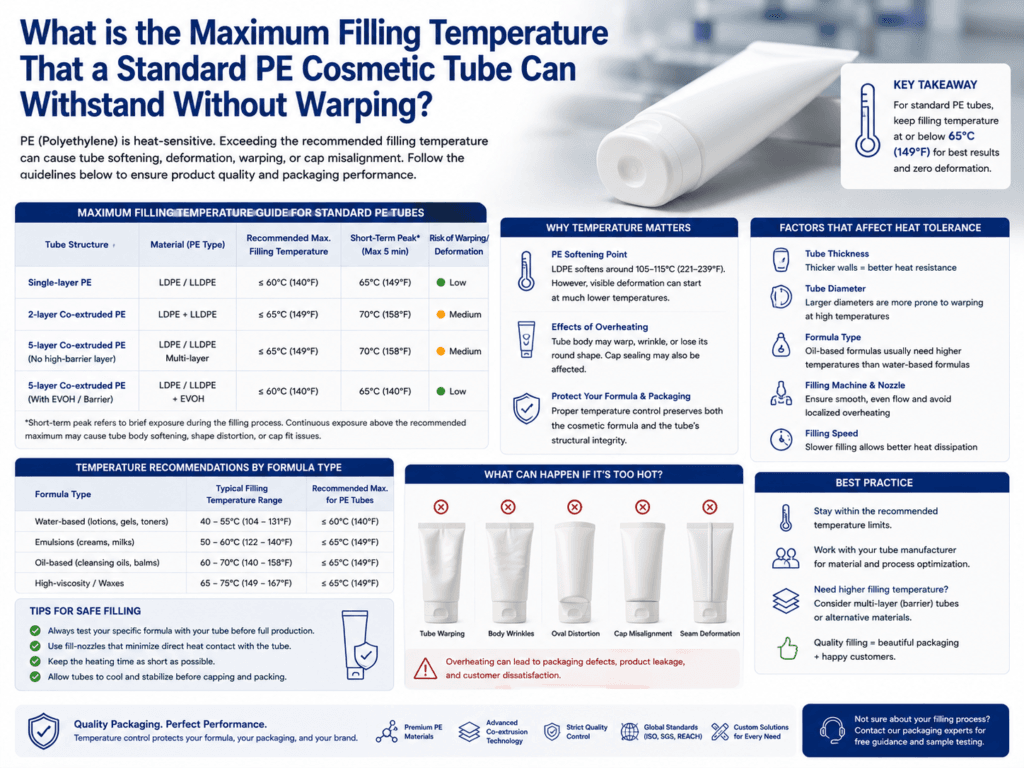
For a standard PE cosmetic tube, the recommended filling temperature is usually below 45°C to 50°C to reduce the risk of warping, paneling, shoulder deformation, tail-seal stress, or print damage. Some PE tubes may tolerate slightly higher short-term temperatures, but hot filling above this range should always be confirmed with real filled-tube testing.
There is no single maximum filling temperature for every PE tube because the result depends on tube material, wall thickness, diameter, layer structure, cap type, formula viscosity, filling speed, cooling condition, and how long the hot formula stays in contact with the tube wall. A 30ml soft hand cream tube and a 250ml body lotion tube may react very differently to the same filling temperature.
Practical Filling Temperature Guide
| Filling Temperature | Risk Level | Packaging Recommendation |
|---|---|---|
| Room temperature – 40°C | Low | Usually safe for most standard PE cosmetic tubes after normal compatibility checks |
| 40°C – 50°C | Moderate | Common practical upper range; confirm tube shape, sealing, and decoration stability |
| 50°C – 60°C | Higher | Requires filled sample testing; thicker wall or stronger structure may be needed |
| Above 60°C | High | Not recommended for standard PE tubes unless specially engineered and validated |
Practical note: For most cosmetic PE tube projects, keep filling temperature as low as the formula process allows. If hot filling is unavoidable, test the real formula in real tubes before confirming mass production.
Why PE Tubes Can Warp During Hot Filling
PE is flexible and squeezable, which makes it ideal for cosmetic tubes. However, this flexibility also means the tube can soften or deform when exposed to heat, especially if the formula is filled hot and the tube is sealed before the product fully cools. As the formula cools, it may shrink, create internal pressure change, or pull the tube wall inward.
| Cause | What Happens | Visible Defect |
|---|---|---|
| Tube wall softening | PE becomes more flexible under heat | Warping, ovality change, dents, uneven body shape |
| Formula cooling shrinkage | Hot formula contracts after filling | Paneling, collapse, inward deformation |
| Insufficient headspace | Overfilled hot formula increases pressure stress | Tail seal stress, leakage, tube swelling |
| Weak shoulder or thin wall | Structural areas cannot resist heat and pressure | Shoulder distortion, neck tilt, cap misalignment |
| Decoration heat sensitivity | Ink, varnish, label, or hot stamping reacts to heat | Smudging, gloss change, peeling, foil defects |
Material Structure Matters
A standard mono-layer PE tube usually has lower heat deformation resistance than a stronger multi-layer or specially formulated PE tube. The wall thickness, resin blend, LDPE/HDPE ratio, and co-extruded structure all influence hot-fill performance. If the formula must be filled hot, the tube structure should be designed for heat stability from the beginning.
| Tube Structure | Hot-Fill Resistance | Best Use |
|---|---|---|
| Soft LDPE-rich PE tube | Lower | Room-temperature filling, soft hand cream, daily skincare |
| LDPE/HDPE balanced PE tube | Better | Products needing more body stiffness and moderate heat resistance |
| 2-layer PE tube | Moderate to good | Daily lotions, cleansers, body care with stronger structure |
| 5-layer co-extruded tube | Project-dependent | Barrier formulas; still requires hot-fill testing |
| Special hot-fill designed tube | Best option for high-temperature filling | Formulas that cannot be cooled before filling |
How Tube Size Affects Hot-Fill Risk
Larger tubes are often more sensitive to hot-fill deformation because they have a bigger wall area and hold more hot formula. A small 30ml tube may cool quickly, while a 200ml or 250ml body lotion tube holds heat longer and may deform more easily if the wall thickness or material structure is not strong enough.
| Tube Size | Hot-Fill Risk | Design Suggestion |
|---|---|---|
| Small tubes: 10ml – 30ml | Lower, faster cooling | Still check shoulder, cap fit, and decoration stability |
| Medium tubes: 50ml – 150ml | Moderate | Use balanced wall thickness and run filled heat tests |
| Large tubes: 200ml – 250ml+ | Higher | Use stronger wall, suitable diameter, and controlled cooling process |
Formula Factors That Increase Warping Risk
- High filling temperature: The longer the tube stays hot, the higher the deformation risk.
- High oil phase: Oil-rich formulas may soften some PE structures or increase compatibility risk.
- High viscosity: Thick formulas hold heat longer and may cool unevenly.
- Formula shrinkage after cooling: Cooling contraction can cause paneling or collapse.
- Low headspace: Overfilling creates pressure stress during cooling and sealing.
- Volatile ingredients: Heat may cause expansion, odor loss, or pressure change.
How to Prevent Warping During Filling
| Prevention Method | How It Helps |
|---|---|
| Cool the formula before filling | Reduces heat exposure to PE wall and decoration |
| Keep filling temperature below 45°C–50°C when possible | Provides a safer practical range for standard PE tubes |
| Use stronger PE structure | Improves body stiffness and resistance to deformation |
| Control headspace | Reduces internal pressure and cooling-related paneling |
| Avoid immediate carton packing while hot | Prevents heat and compression from deforming the tube body |
| Run filled-tube heat testing | Confirms real performance before mass production |
Decoration and Printing Considerations
Hot filling can also affect the outside of the tube. Some inks, varnishes, labels, soft-touch coatings, hot stamping foil, or shrink labels may react to heat. Even if the PE body does not warp, the decoration may lose gloss, become sticky, peel, crack, or shift color after hot filling and cooling.
| Decoration Type | Hot-Fill Concern | Testing Direction |
|---|---|---|
| Offset printing | Ink or varnish may soften if heat exposure is high | Check rub resistance after filling and cooling |
| Silk screen printing | Usually durable, but still depends on curing and surface treatment | Run tape peel and rub tests after heat exposure |
| Hot stamping | Foil may crack or lose adhesion under heat and deformation | Check foil adhesion on filled hot-tested samples |
| Soft-touch coating | May become sticky, glossy, or mark easily under heat | Test surface feel and scratch resistance after aging |
Recommended Tests Before Hot Filling
| Test | Purpose | What to Check |
|---|---|---|
| Hot-fill trial | Checks tube response to actual filling temperature | Warping, shoulder distortion, paneling, leakage |
| Cooling shrinkage test | Checks deformation after formula cools | Body collapse, dents, tail-seal stress |
| Tail seal strength test | Confirms sealing performance after hot filling | Seal peeling, cracking, leakage |
| Cap fit and torque test | Checks whether heat affects neck and cap alignment | Loose cap, tilted neck, poor thread fit |
| Decoration heat resistance test | Checks print and coating stability | Ink smudge, foil cracking, coating stickiness, gloss change |
| Aging and transport test | Checks long-term stability after filling | Paneling, leakage, deformation, carton pressure marks |
Common Mistakes to Avoid
- Assuming PE tubes can handle any cosmetic hot-fill process: Standard PE tubes are not designed for high-temperature filling without validation.
- Testing empty tubes only: Empty tube heat resistance does not equal filled tube hot-fill performance.
- Ignoring cooling shrinkage: Many deformations appear after the formula cools, not during filling.
- Overfilling hot formula: Too little headspace increases pressure and seal stress.
- Packing tubes while still warm: Carton compression can permanently deform softened tubes.
- Forgetting decoration testing: Ink, varnish, foil, and soft-touch coatings may fail even if the tube body survives.
Best Practical Recommendation
For standard PE cosmetic tubes, try to keep the filling temperature below 45°C to 50°C whenever possible. If the formula must be filled at 50°C to 60°C, use a stronger tube structure and run filled-tube tests before mass production. For temperatures above 60°C, standard PE tubes are generally risky unless the tube is specially engineered and validated for that process.
The final safe filling temperature should always be confirmed with the actual tube, real formula, real cap, real decoration, and real filling process.
Summary
A standard PE cosmetic tube can usually handle room-temperature or moderately warm filling, but hot filling can cause warping, paneling, shoulder deformation, tail-seal stress, cap misalignment, or decoration damage. As a practical guideline, keep filling below 45°C–50°C for standard PE tubes. Higher temperatures require project-specific testing and may need a stronger PE blend, thicker wall, 2-layer structure, or special hot-fill design.
To avoid defects, brands should test hot filling with real filled and sealed samples, monitor cooling shrinkage, control headspace, avoid immediate compression while warm, and confirm both tube-body and decoration stability before mass production.
Learn more: PE Tubes, 2-Layer Plastic Tubes, 5-Layer Plastic Tubes, Tube Capacity, Diameter, Length & Thickness, Quality Assurance, Sample Development.
Need PE Tubes Suitable for Warm or Hot Filling?
Xinfly Packaging helps brands evaluate PE tube material, wall thickness, layer structure, cap fit, decoration stability, filling temperature, cooling behavior, and transport performance before mass production.