
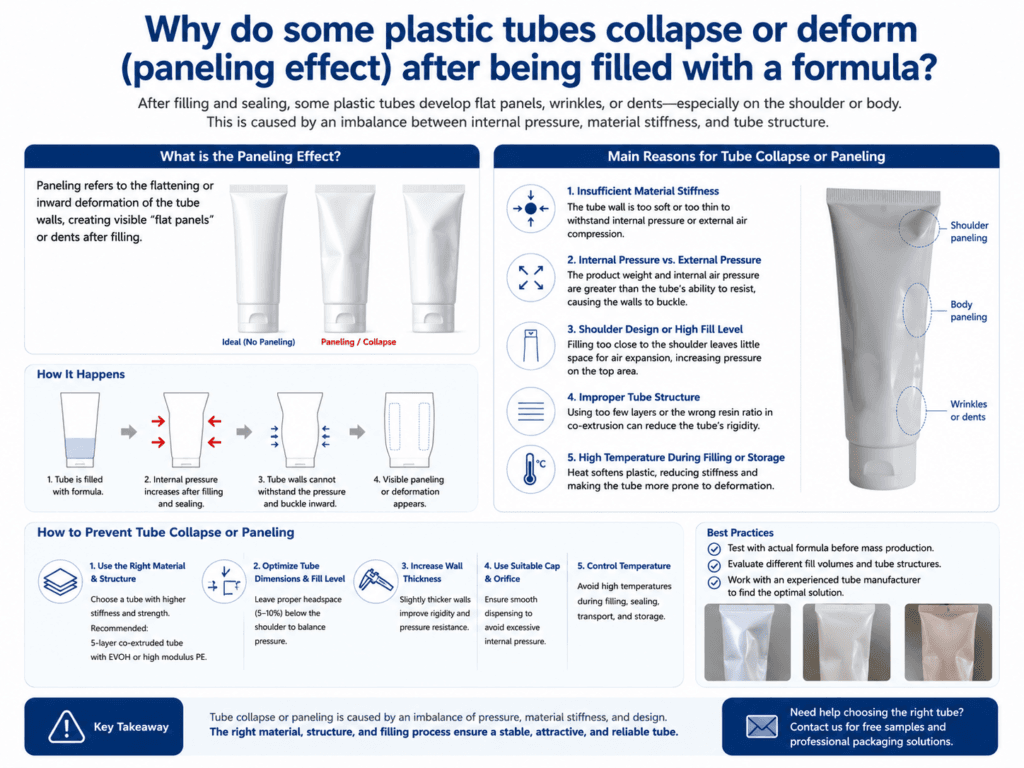
Plastic tubes can collapse or deform after filling because the pressure inside the tube becomes lower than the outside atmospheric pressure. This is often called the paneling effect. Instead of staying round and smooth, the tube body caves inward, forms flat panels, wrinkles, dents, or uneven sidewalls.
In cosmetic tube packaging, paneling is usually caused by a combination of formula behavior, filling temperature, headspace, cooling shrinkage, gas absorption, wall thickness, material stiffness, and barrier performance. It is not only a tube-quality problem. Very often, the tube and formula need to be evaluated together.
What Is the Paneling Effect?
The paneling effect happens when the tube wall is pulled inward by negative internal pressure. After filling and sealing, the volume inside the tube may reduce due to formula cooling, air contraction, ingredient absorption, or product shrinkage. If the tube wall is not strong enough to resist the pressure difference, the body may collapse or deform.
Main Causes of Tube Collapse or Deformation
| Cause | What Happens | Visible Result |
|---|---|---|
| Hot filling followed by cooling | The filled product and trapped air contract as temperature drops | Tube body caves inward after cooling |
| Insufficient headspace | The tube is filled too close to maximum capacity | Tail seal stress, swelling first, then deformation |
| Formula shrinkage after filling | The product volume reduces during settling or cooling | Sidewall dents or flat panels |
| Gas absorption by the formula | Air inside the tube dissolves or is absorbed into the product | Negative pressure pulls the tube inward |
| Tube wall too thin or too soft | The body lacks enough stiffness to resist pressure changes | Wrinkles, collapse, poor shelf appearance |
Why Formulas Can Trigger Paneling
Some formulas are more likely to create pressure imbalance inside the tube. Thick pastes, oil-rich formulas, volatile systems, hot-filled creams, and products with high surfactant content may behave differently after filling. The product may cool, settle, absorb air, release gas, or shrink slightly. Even a small internal volume change can create visible deformation on a flexible plastic tube.
- Hot-filled formulas: Cooling can reduce internal volume and create negative pressure.
- High-density pastes: Settling may change the apparent fill level and internal pressure.
- Oil-based formulas: Some components may interact with tube materials or affect wall flexibility.
- Volatile ingredients: Evaporation or absorption behavior may change internal pressure over time.
- Foamy products: Air bubbles may collapse after sealing and reduce internal volume.
Packaging Factors That Increase Paneling Risk
| Packaging Factor | Why It Matters | Risk Level |
|---|---|---|
| Thin tube wall | Less resistance against inward pressure | High |
| Very soft PE structure | Comfortable squeeze feel but weaker paneling resistance | Medium to high |
| Wrong diameter-to-length ratio | Long narrow tubes may show deformation more easily | Medium |
| Low barrier structure | May allow ingredient loss or oxygen exchange depending on formula | Formula-dependent |
| Overfilling | Leaves too little room for product expansion, contraction, and sealing | High |
How Filling Conditions Affect Tube Shape
Filling temperature and sealing timing are major factors. If the formula is filled warm and sealed immediately, the internal air and product may contract as they cool. This creates a vacuum-like effect inside the tube. If the tube wall is thin or the structure is too flexible, the tube may collapse inward after cooling or during storage.
| Filling Condition | Possible Problem | Prevention Direction |
|---|---|---|
| High filling temperature | Cooling contraction after sealing | Optimize filling temperature and cooling process |
| Sealing too soon after hot filling | Internal pressure drops after cooling | Validate sealing timing and cooling behavior |
| Too little headspace | No room for product movement or pressure balance | Use correct fill volume and headspace allowance |
| Air bubbles in formula | Bubbles collapse after sealing | Deaerate formula before filling where possible |
How to Prevent Tube Collapse or Paneling
- Confirm formula density and filling volume: Do not overfill the tube based only on weight.
- Leave proper headspace: The tube needs enough room for sealing and pressure balance.
- Control filling temperature: Avoid excessive temperature difference between filling and storage.
- Choose suitable wall thickness: Thicker or stiffer walls can resist deformation better.
- Evaluate tube structure: 2-layer or 5-layer structures may provide better dimensional stability for demanding formulas.
- Run filled and sealed aging tests: Check the tube after cooling, storage, transport simulation, and temperature cycling.
When to Consider a Stronger Tube Structure
| Product Situation | Recommended Packaging Direction |
|---|---|
| Formula shrinks noticeably after filling | Increase wall thickness or adjust fill/headspace design |
| Oil-rich or volatile formula | Consider better barrier structure such as 5-layer EVOH |
| Very thick paste | Use suitable diameter, wall softness, and outlet size |
| Hot-filled product | Validate cooling contraction before confirming mass production |
| Premium shelf appearance required | Use stronger tube body design and filled-sample testing |
Testing Methods Before Mass Production
- Filled sample aging test: Store sealed tubes for several weeks to observe deformation.
- Temperature cycling test: Expose tubes to warm and cool conditions to check pressure response.
- Drop and transport simulation: Check whether deformation worsens after handling stress.
- Squeeze recovery test: Confirm whether the tube body returns to shape after use.
- Compatibility test: Check whether the formula softens or changes the tube wall over time.
Common Misunderstandings
| Misunderstanding | Correct Explanation |
|---|---|
| “The tube collapsed, so the tube must be defective.” | Paneling may come from formula shrinkage, filling temperature, or pressure imbalance, not only tube quality. |
| “A softer tube is always better.” | Softness improves squeeze feel but may reduce resistance to paneling. |
| “If the tube fits the weight, the size is correct.” | Weight must be converted into volume, and headspace must be included. |
| “Paneling always appears immediately.” | Some deformation appears only after cooling, storage, transport, or formula settling. |
Best Practical Recommendation
If a plastic tube collapses or shows paneling after filling, do not judge the tube by appearance alone. Review the formula density, fill volume, headspace, filling temperature, sealing timing, wall thickness, and material structure together. The most reliable solution is usually a combination of correct filling tolerance, suitable tube stiffness, proper barrier selection, and real filled-sample testing.
Summary
Plastic tubes collapse or deform after filling when internal pressure becomes lower than external pressure, causing the tube wall to cave inward. This paneling effect can be caused by formula shrinkage, hot-fill cooling contraction, gas absorption, overfilling, insufficient headspace, thin tube walls, or poor compatibility between the formula and tube structure.
To prevent paneling, brands should confirm formula behavior, select the right tube wall thickness and material structure, control filling conditions, leave proper headspace, and test real filled samples before mass production.
Learn more: Tube Capacity, Diameter, Length & Thickness, Match Cosmetic Tube Diameter and Fill Volume, Volume vs. Weight for High-Density Cosmetic Pastes, 5-Layer Plastic Tubes, PE Tubes, Quality Assurance.
Need to Prevent Tube Paneling After Filling?
Xinfly Packaging helps brands evaluate formula density, filling tolerance, tube wall thickness, material structure, and barrier performance to reduce collapse, deformation, and paneling risks in custom cosmetic tubes.