
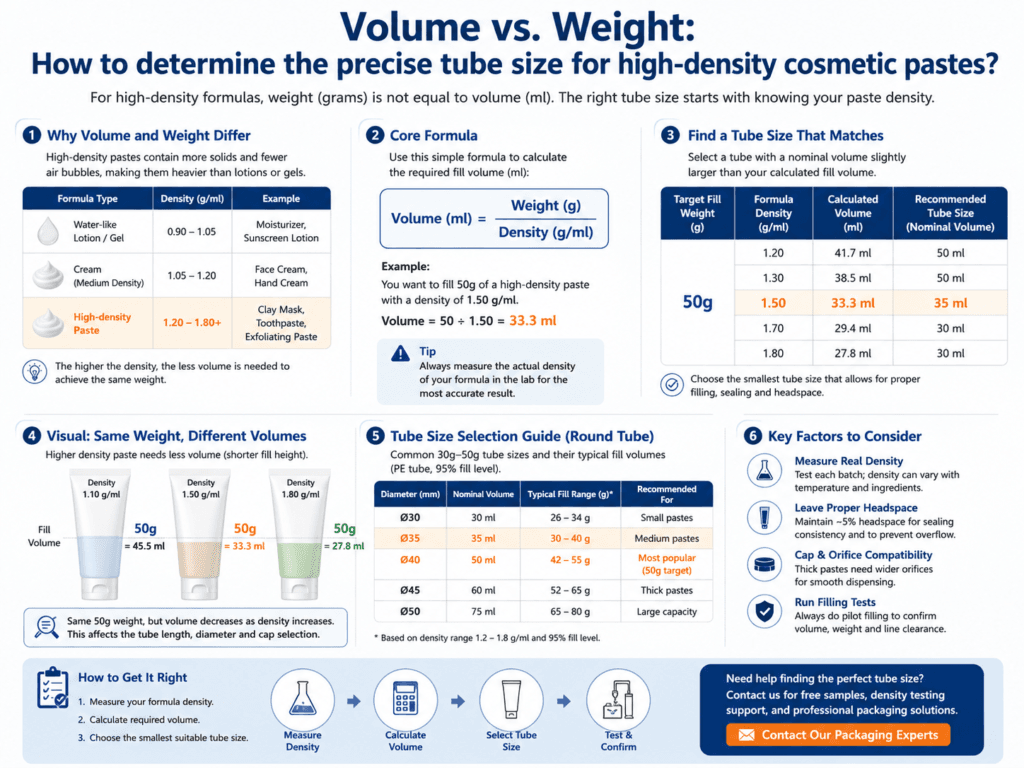
To determine the precise tube size for high-density cosmetic pastes, brands should calculate by volume first, not by weight alone. Tube capacity is normally measured in ml, while many cosmetic formulas are sold by grams. For high-density pastes such as sunscreen, pigment paste, clay mask, toothpaste, poly gel, or thick treatment cream, the same weight may require less volume than a low-density lotion.
The key is to convert the target filling weight into actual filling volume using the product density, then add suitable headspace, shoulder allowance, tail sealing allowance, and filling tolerance. This is why a 50g high-density paste may not need the same tube size as a 50ml lotion.
Why Weight and Volume Are Not the Same
Weight tells you how heavy the formula is. Volume tells you how much physical space it occupies inside the tube. For cosmetic tube sizing, volume is more important because the tube must have enough internal capacity to hold the formula, leave room for sealing, and avoid overfilled or swollen appearance.
Basic conversion logic:
Volume (ml) = Weight (g) ÷ Density (g/ml)
If the paste density is higher than 1.00 g/ml, the same gram weight requires less volume. If the density is lower than 1.00 g/ml, the same gram weight requires more volume.
Example: How Density Changes the Required Tube Capacity
| Target Fill Weight | Formula Density | Approximate Required Volume | Packaging Meaning |
|---|---|---|---|
| 50g | 1.00 g/ml | 50ml | Weight and volume are nearly equal |
| 50g | 1.20 g/ml | About 41.7ml | High-density paste needs less internal volume |
| 50g | 1.35 g/ml | About 37ml | Dense paste may fit into a smaller tube than expected |
| 50g | 0.90 g/ml | About 55.6ml | Low-density formula needs more tube capacity |
Why High-Density Pastes Need Special Tube Sizing
- They weigh more in less space: A dense paste may reach the target gram weight before the tube looks visually full.
- They may be harder to dispense: Thick formulas need suitable tube diameter, wall softness, and orifice size.
- They can trap air during filling: Air pockets can change the apparent fill level and sealing stability.
- They may require more squeezing force: A tube that is too narrow may make the product difficult to use.
- They can stress the tail seal: Overfilling or poor headspace can cause sealing problems.
Key Factors That Affect Final Tube Size
| Factor | Why It Matters | What to Confirm |
|---|---|---|
| Formula density | Converts grams into ml | Actual g/ml value from the formula lab |
| Viscosity | Affects filling, squeezing, and dispensing | Whether the paste flows easily or needs a wider outlet |
| Tube diameter | Affects hand feel, capacity, and squeezing force | Whether the diameter matches formula thickness and brand look |
| Tube length | Controls capacity after diameter is selected | Whether the length leaves enough sealing space |
| Shoulder and cap design | Changes usable internal capacity and dispensing behavior | Neck size, orifice size, flip-top or screw cap |
| Headspace and sealing allowance | Prevents overfilling and tail-seal stress | Real fill test before mass production |
Recommended Sizing Workflow
| Step | What to Do | Why It Helps |
|---|---|---|
| 1 | Confirm target net weight in grams | Defines the commercial fill requirement |
| 2 | Measure formula density in g/ml | Converts weight into actual volume |
| 3 | Calculate required fill volume | Prevents choosing a tube based on guessing |
| 4 | Add headspace and sealing allowance | Protects filling and crimping stability |
| 5 | Select diameter based on viscosity and brand appearance | Balances usability and shelf presence |
| 6 | Run filling, sealing, and squeezing tests | Confirms the final size before production |
Diameter Selection for High-Density Pastes
For high-density cosmetic pastes, diameter is not only a capacity decision. It also affects how easy the product is to squeeze out. A very narrow tube may look elegant, but it can make a thick paste harder to dispense. A wider tube can improve squeezing comfort, create a stronger shelf presence, and allow a larger cap or outlet, but it may also look less compact.
| Paste Type | Common Diameter Direction | Reason |
|---|---|---|
| Thick sunscreen paste | 35mm – 40mm | Better squeezing comfort and more suitable front panel |
| Toothpaste or oral care paste | 25mm – 40mm | Depends on fill weight and outlet style |
| Clay mask or mud mask | 35mm – 50mm | Thicker formulas often benefit from a wider tube body |
| Pigment or color paste | 25mm – 35mm | Controlled dispensing and compact format are often important |
| Poly gel or nail paste | 25mm – 35mm | Small controlled dispensing is usually preferred |
Common Mistakes in Tube Sizing
- Assuming 50g always equals 50ml: This is only true when density is close to 1.00 g/ml.
- Ignoring headspace: A tube should not be filled to its absolute maximum internal capacity.
- Choosing by appearance only: The tube may look good but perform poorly during filling or squeezing.
- Using water as the only test material: Water does not behave like high-density paste during filling.
- Skipping sealed sample testing: Final appearance and usability must be checked after filling and crimping.
Best Practical Recommendation
For high-density cosmetic pastes, first convert the target weight into volume using the real formula density. Then select a tube diameter that supports both capacity and dispensing comfort. After that, adjust the tube length to reach the required fill volume while leaving enough headspace and tail-sealing allowance. The final decision should always be confirmed with real filling and sealed-sample testing.
Summary
To determine the precise tube size for high-density cosmetic pastes, do not rely on weight alone. Use the formula density to convert grams into ml, then choose the tube diameter and length based on capacity, viscosity, headspace, shoulder design, cap type, and tail sealing requirements.
The safest process is: measure density, calculate volume, add filling tolerance, select a practical diameter, adjust length, and verify with real filling tests. This ensures the tube holds the correct net weight while still looking full, sealing properly, and dispensing smoothly.
Learn more: Tube Capacity, Diameter, Length & Thickness, Match Cosmetic Tube Diameter and Fill Volume, Design Area Dimensions, Sunscreen Tubes, Toothpaste Tubes, Pigment Tubes Manufacturer.
Need Accurate Tube Sizing for High-Density Cosmetic Pastes?
Xinfly Packaging helps brands calculate the right tube diameter, length, capacity, cap opening, and filling tolerance based on real formula density and production testing.