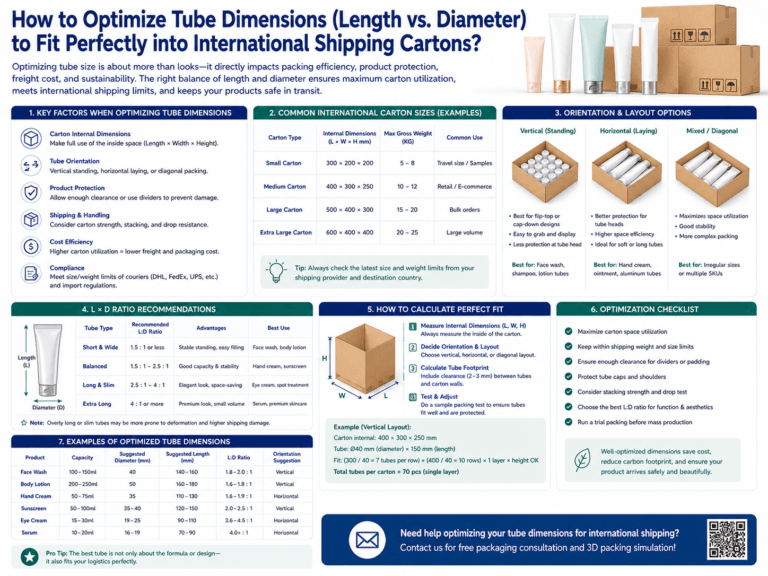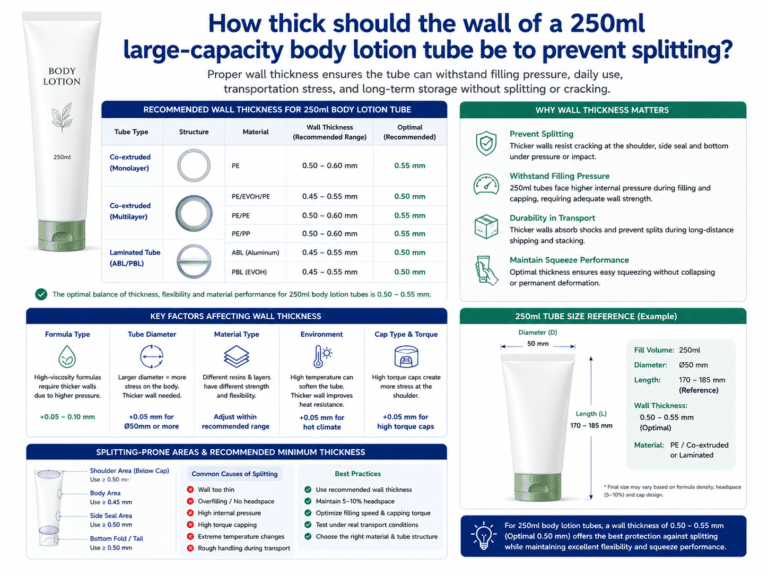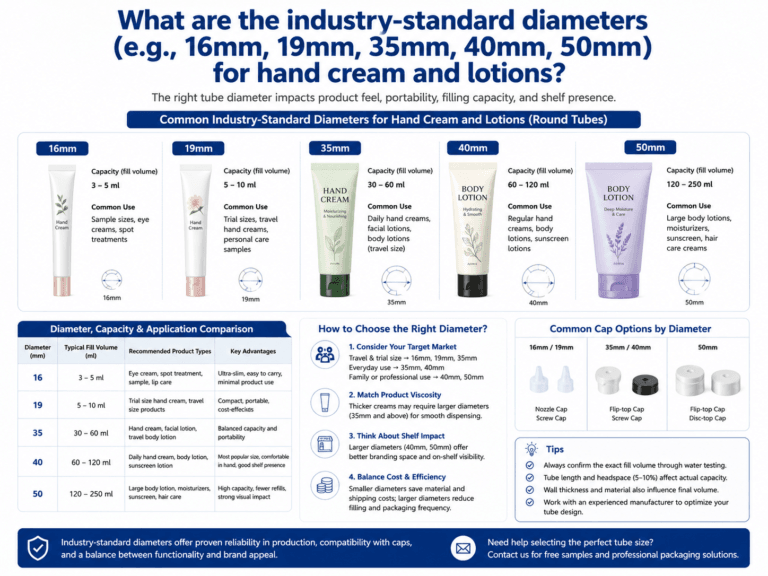

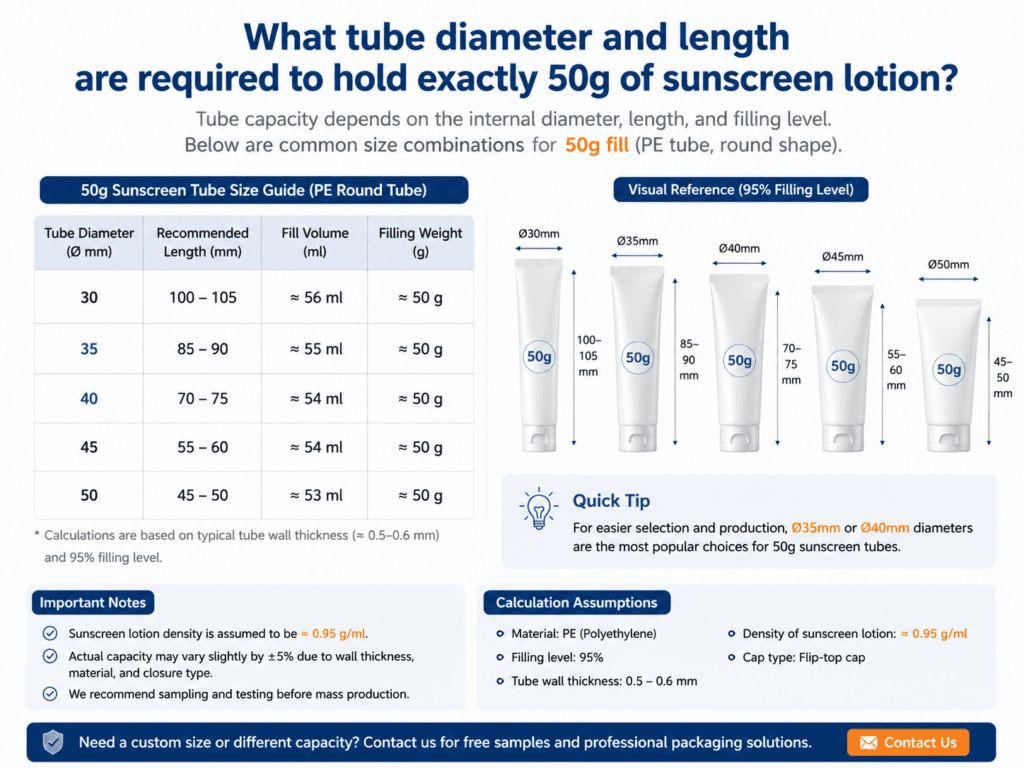
For a 50g sunscreen lotion, a common tube recommendation is usually around 35mm diameter with a tube length of about 110mm to 125mm, depending on the sunscreen density, shoulder design, cap type, and required headspace. However, there is no single universal diameter and length that can hold “exactly 50g” for every sunscreen formula, because 50g is a weight value, while tube capacity is normally calculated by volume.
In practical cosmetic tube packaging, 50g sunscreen lotion is often close to 45ml to 50ml in filling volume, but the exact volume depends on formula density. A thick mineral sunscreen, a lightweight chemical sunscreen, and a water-gel sunscreen may all have different density and flow behavior. That is why the final tube size should always be confirmed by real filling tests, not only by theoretical calculation.
Quick Answer: Recommended Tube Size for 50g Sunscreen
| Fill Weight | Common Tube Diameter | Typical Tube Length Range | Best Use |
|---|---|---|---|
| 50g sunscreen lotion | 35mm | About 110mm – 125mm | Most standard 50g sunscreen tube projects |
| 50g thick mineral sunscreen | 35mm – 40mm | About 105mm – 125mm | Higher-viscosity formulas needing easier squeezing |
| 50g travel or compact sunscreen | 30mm – 35mm | About 120mm – 140mm | Slimmer look, smaller shelf footprint |
Why 50g Cannot Be Calculated by Diameter and Length Alone
Tube capacity is affected by more than the straight cylindrical body. The shoulder area, wall thickness, tail sealing area, cap design, neck size, and filling headspace all reduce or change the usable internal volume. Even if two tubes have the same diameter and total length, their actual filling capacity may be different.
- Formula density matters: 50g does not always equal exactly 50ml.
- Shoulder design matters: A long shoulder may reduce usable fill space.
- Tail sealing allowance matters: Part of the tube length is consumed by crimping and sealing.
- Headspace matters: The tube should not be filled to 100% internal volume.
- Wall thickness matters: Thicker tubes have slightly less internal capacity.
How Formula Density Affects the Tube Size
| Formula Density Example | Approximate Volume for 50g | Packaging Meaning |
|---|---|---|
| 1.00 g/ml | About 50ml | 50g is close to 50ml |
| 1.10 g/ml | About 45.5ml | Same 50g needs less volume |
| 0.95 g/ml | About 52.6ml | Same 50g needs more volume |
Most Common Choice: 35mm Diameter Tube
For most 50g sunscreen lotion products, a 35mm diameter tube is a practical and popular choice. It gives enough internal volume, good hand feel, suitable shelf appearance, and enough front design area for sunscreen branding. It also works well with common flip-top caps or screw caps.
If the formula is very thick, a 40mm tube may feel easier to squeeze and can create a shorter, wider premium look. If the brand wants a slim travel-style tube, a 30mm or 35mm diameter may be chosen with a longer tube body.
Recommended Size by Brand Positioning
| Brand Goal | Recommended Diameter | Recommended Direction |
|---|---|---|
| Standard retail sunscreen | 35mm | Balanced size, good capacity, common market feel |
| Premium skincare sunscreen | 35mm – 40mm | Better hand feel and more front-facing decoration area |
| Travel-friendly sunscreen | 30mm – 35mm | Slimmer profile and easier portability |
| Thick mineral sunscreen | 35mm – 40mm | Better squeezing performance and dispensing comfort |
Why Filling Tests Are Necessary
Even after selecting a diameter and length, the final tube should be tested with the actual sunscreen formula. Sunscreen lotions can vary significantly in viscosity, density, air entrapment, and filling behavior. A tube that looks correct in theory may feel overfilled, underfilled, hard to seal, or difficult to squeeze if the formula is not tested.
Key Checks Before Confirming the Final Size
- Confirm the sunscreen formula density in g/ml
- Convert 50g into actual filling volume
- Select a tube diameter based on capacity and brand appearance
- Allow enough headspace for sealing and squeezing
- Run real filling and sealing tests before mass production
- Check whether the tube still looks full but not swollen after sealing
Best Practical Recommendation
For most 50g sunscreen lotion projects, start with a 35mm diameter tube and adjust the length based on the formula density, shoulder style, cap type, and desired visual proportion. If the formula is very dense or thick, a slightly wider 40mm tube may be better. If the brand wants a slim portable look, a longer 30mm or 35mm tube may be considered.
Summary
A 50g sunscreen lotion usually fits well in a tube around 35mm diameter and approximately 110mm to 125mm in length, but the exact size must be confirmed by formula density and real filling tests. Because grams measure weight and tube capacity is based on volume, manufacturers should convert the formula weight into actual volume before deciding the final tube diameter and length.
The safest approach is to use a 35mm tube as the starting point, confirm the actual sunscreen density, and test filling, sealing, appearance, and squeezing performance before mass production.
Learn more: Tube Capacity, Diameter, Length & Thickness, Match Cosmetic Tube Diameter and Fill Volume, Sunscreen Tubes, Sunscreen Tube Manufacturer, SPF Sunscreen Tube Manufacturer, Sunscreen Tube Packaging Guide.
Need the Right 50g Sunscreen Tube Size?
Xinfly Packaging helps brands calculate suitable tube diameter, length, wall thickness, cap type, and filling tolerance based on the real sunscreen formula and production requirements.