
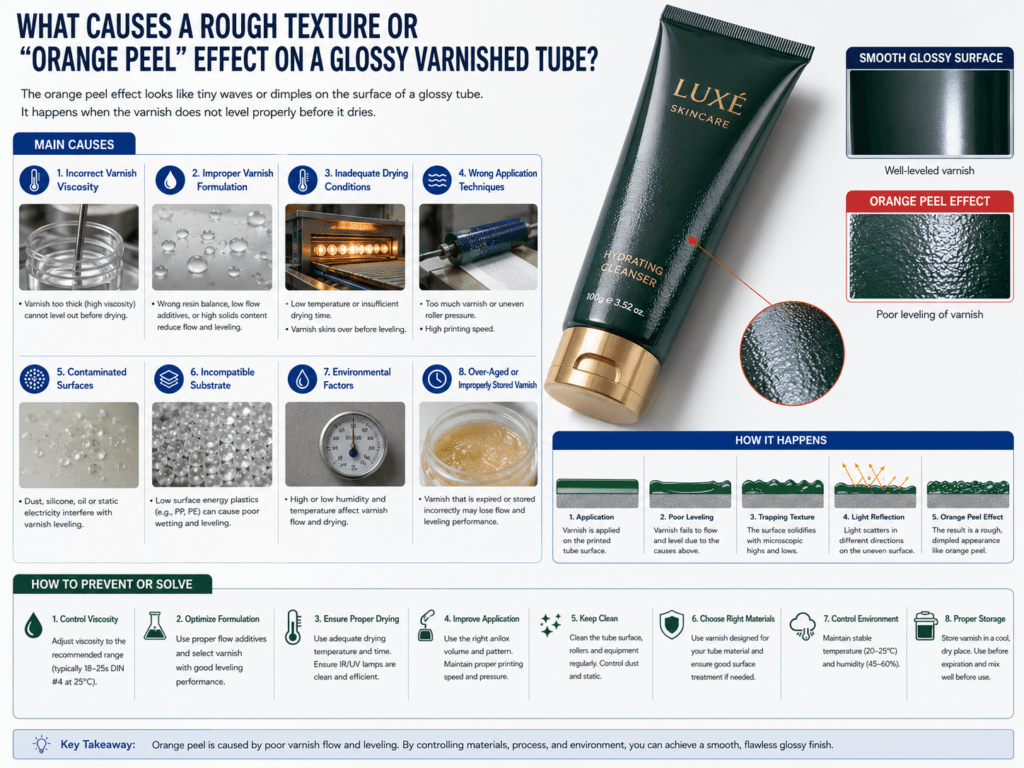
A rough texture or “orange peel” effect on a glossy varnished tube usually happens because the varnish film does not level out smoothly before it cures or dries. Instead of forming a flat glossy surface, the coating freezes with tiny waves, ripples, or uneven texture that looks similar to orange skin.
In cosmetic tube production, this defect is commonly linked to incorrect varnish viscosity, poor leveling, excessive or uneven coating thickness, drying or curing that happens too fast, unsuitable temperature, or unstable application conditions. On a glossy tube, even small surface waviness becomes easy to see because gloss highlights every irregularity.
What Causes the Orange Peel Effect on Glossy Varnished Tubes?
| Cause | What Happens | Visible Result |
|---|---|---|
| Varnish viscosity too high | The coating cannot flow and level properly | Rough, pebbled glossy surface |
| Drying or curing too fast | The surface sets before the varnish can flatten | Frozen wave-like texture |
| Poor leveling properties | The varnish lacks enough flow to form a smooth film | Uneven gloss and orange peel appearance |
| Uneven coating thickness | Some zones receive too much or too little varnish | Patchy gloss and rough texture |
| High temperature or strong airflow | Solvent or reactive system flashes off too quickly | Surface skins over before leveling finishes |
Why Glossy Tubes Show This Defect More Clearly
- Gloss amplifies surface waviness: The smoother the expected finish, the easier it is to notice defects.
- Reflected light reveals irregularity: Orange peel may look minor in normal light but obvious under angled light.
- Premium packaging is visually unforgiving: Beauty brands expect clear, mirror-like gloss, so texture defects stand out immediately.
Common Process Conditions That Trigger Orange Peel
| Process Condition | Why It Increases Risk |
|---|---|
| Coating too thick | The film becomes harder to level uniformly |
| Coating too thin | The surface may not flow enough to hide texture |
| Wrong thinner or solvent balance | Evaporation speed may be too fast for proper leveling |
| Hot production environment | Accelerates drying before the film smooths out |
| Poor application control | Creates non-uniform varnish laydown on the tube body |
How Factories Prevent Orange Peel on Glossy Varnished Tubes
- Adjust varnish viscosity correctly: The coating must have enough flow to level without becoming unstable.
- Control the coating amount: A balanced film build is essential for smooth gloss.
- Improve leveling performance: The varnish system must be suitable for the tube substrate and production speed.
- Avoid excessively fast drying: The film needs time to settle before final cure.
- Keep temperature and airflow stable: Extreme heat or air movement can make the surface set too early.
- Validate the application setup: Tube coating on curved flexible packaging needs stable process control, not just a good varnish formula.
Most Common Failure Scenarios
| Failure Scenario | Likely Root Cause |
|---|---|
| The whole tube looks pebbled under light | General leveling failure or viscosity problem |
| Only some areas look rough | Uneven coating laydown or local drying differences |
| Gloss looks strong but not smooth | Surface cured before it had time to level fully |
| Orange peel appears after a process change | Temperature, thinner, coating weight, or machine setting changed |
Best Practical Advice for Cosmetic Tube Projects
If a brand wants a premium glossy varnished tube, the varnish should be treated as a leveling-sensitive finish, not just a shine layer. The surface must stay smooth from application through final curing. That means the best result depends on the full process: varnish chemistry, coating thickness, temperature, airflow, and line setup all need to be controlled together.
Summary
A rough texture or orange peel effect on a glossy varnished tube happens when the varnish film cannot level smoothly before it sets. The most common causes are high viscosity, poor leveling, uneven coating thickness, overly fast drying or curing, and unstable production temperature or airflow.
To prevent it, factories usually optimize viscosity, coating weight, leveling behavior, and curing conditions so the glossy film has enough time to flatten into a smooth, high-quality finish.
Learn more: Surface Finishing, Tube Decoration, Printing Options, Matte Finish vs Glossy vs Soft-Touch Tubes, Quality Assurance, Customize Cosmetic Tubes.
Need a Smoother Gloss Finish on Cosmetic Tubes?
Xinfly Packaging helps brands optimize coating viscosity, leveling, curing, and surface-finishing process control to reduce orange peel defects and improve premium gloss appearance.