
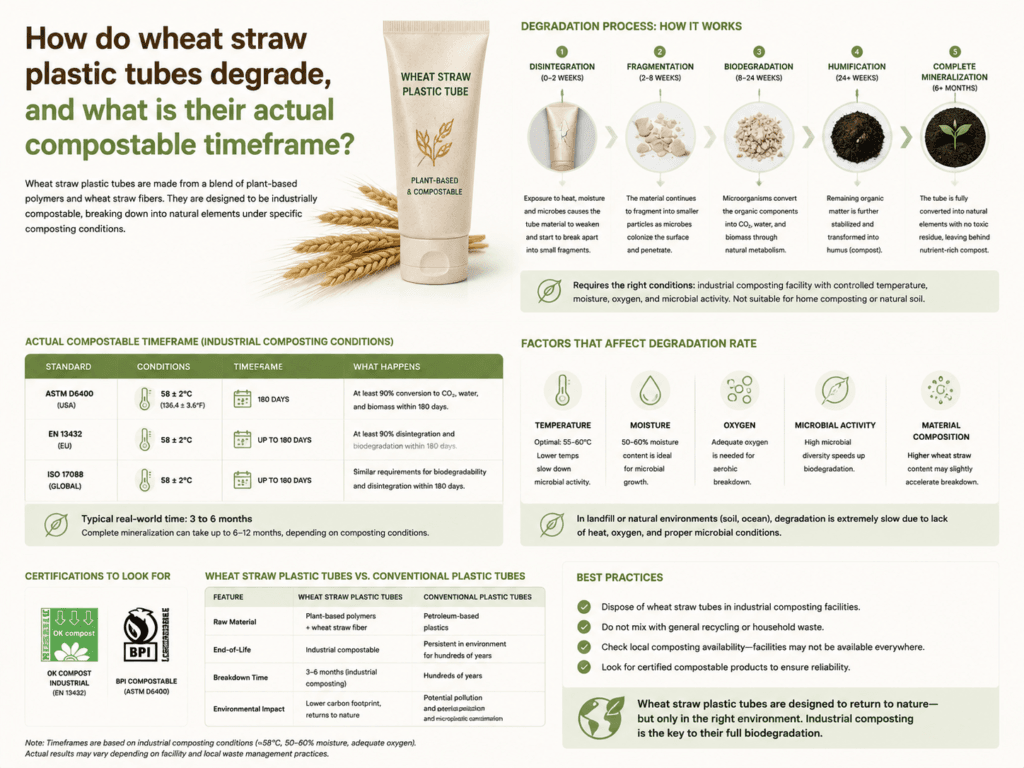
Wheat straw plastic tubes degrade differently depending on their exact material structure and processing method. Most “wheat straw tubes” on the market are not 100% natural fiber packaging, but a composite of wheat straw fiber + PP/PE plastic. This means they are typically partially bio-based, not fully compostable in home environments.
Because of this hybrid structure, their degradation time is closer to conventional bioplastic or composite plastics rather than fully certified compostable materials.
How Wheat Straw Tubes Degrade
| Stage | Process | Description |
|---|---|---|
| 1. Natural Fiber Breakdown | Fiber exposure | Wheat straw fibers slowly degrade under moisture and microbial activity |
| 2. Plastic Matrix Fragmentation | Physical breakdown | PE/PP component does not biodegrade, only fragments over time |
| 3. Environmental Weathering | UV + heat exposure | Material becomes brittle and breaks into micro-particles |
Actual Compostable Timeframe
| Environment | Estimated Time | Result |
|---|---|---|
| Industrial composting (if certified blend) | 6–12 months (only certified compostable versions) | Partial breakdown of bio components |
| Natural soil environment | 2–5 years | Fiber degrades, plastic remains partially |
| Landfill conditions | 5–20+ years | Very slow degradation due to low oxygen |
| Marine environment | Indefinite / very slow | Breaks into microplastics, does not fully compost |
Important Clarification
- Most wheat straw cosmetic tubes are not fully compostable unless certified (EN13432 / ASTM D6400).
- They are mainly designed as bio-based reduced-plastic alternatives, not full biodegradable solutions.
- The plastic component (PE/PP) does not biodegrade in natural conditions.
- Industrial composting is only effective for specially engineered compostable grades.
Advantages of Wheat Straw Tubes
- Reduces fossil plastic usage by incorporating renewable fibers
- Improves eco-friendly brand positioning
- Lightweight and cost-effective compared to full bioplastics
- Suitable for hand cream, lotion, and personal care products
Limitations to Consider
- Not fully biodegradable in most real-world environments
- Recycling streams may still classify it as mixed plastic
- Durability and barrier performance are similar to standard PE/PP tubes
- Compostability claims depend heavily on certification status
Summary
Wheat straw plastic tubes degrade slowly, and their real compostable performance depends on whether they are certified compostable materials or standard fiber-plastic composites. In most cases, they are partially degradable bio-based packaging rather than fully compostable solutions.
Industrial compostable versions may break down in 6–12 months, but typical wheat straw cosmetic tubes in natural environments can take several years and still leave behind plastic residues.
Learn more: Wheat Straw Tubes, Sustainable Packaging, Biodegradable vs Recyclable Tubes, Cosmetic Tube Materials.
Need Eco-Friendly Tube Solutions?
Xinfly Packaging provides wheat straw, sugarcane, PCR, and other sustainable cosmetic tube options tailored for eco-conscious beauty brands.