
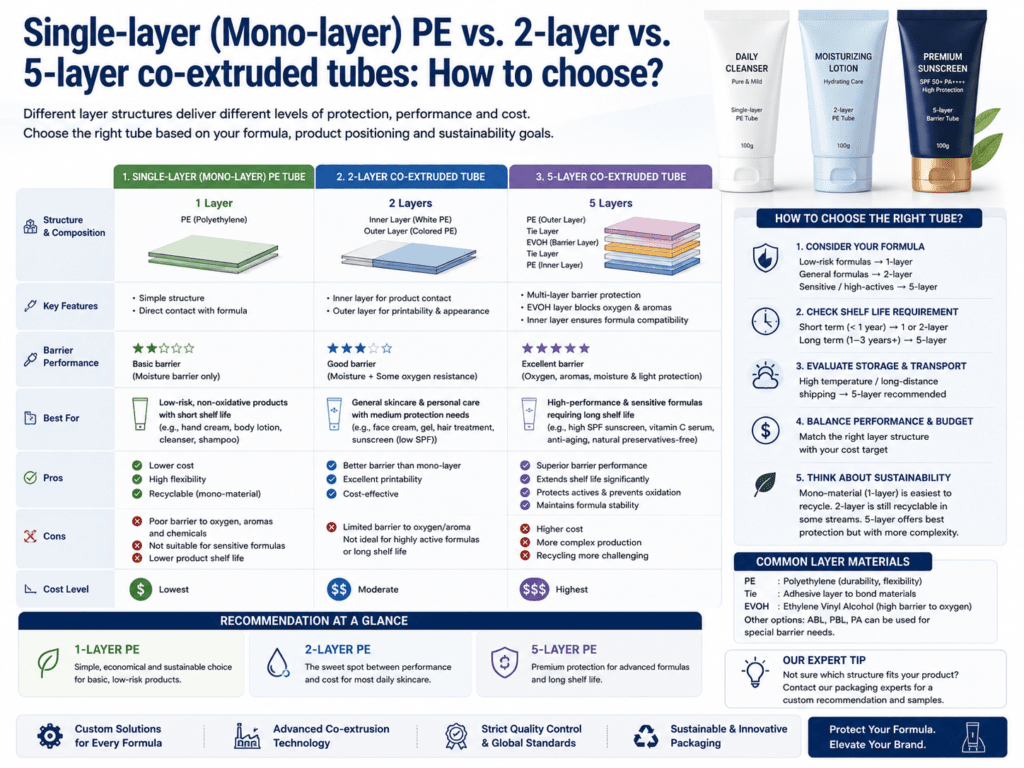
The right choice between single-layer (mono-layer) PE, 2-layer PE, and 5-layer co-extruded tubes depends on four things: your formula sensitivity, required shelf life, target cost, and recyclability goal. In simple terms, mono-layer PE is best for basic stable formulas and cost-sensitive projects, 2-layer tubes are a practical middle option for everyday creams and cleansers, and 5-layer co-extruded tubes are usually the best choice for formulas that need stronger oxygen and aroma barrier protection.
Many brands choose the wrong tube by focusing only on appearance or price. But tube structure directly affects how well the package protects your formula from oxygen, odor loss, ingredient migration, and long-term storage changes. That is why the right answer is not “which tube is best?” but “which tube matches the formula and business goal best?”
Quick Comparison: Mono-layer vs. 2-layer vs. 5-layer Tubes
| Tube Type | Main Structure | Barrier Level | Typical Cost | Best For |
|---|---|---|---|---|
| Single-layer (Mono-layer) PE | One PE material layer | Basic | Lowest | Stable formulas, simple cleansers, lotions, hand creams |
| 2-layer PE | Two PE-based layers | Low to moderate | Low to medium | Everyday skincare and personal care with modest protection needs |
| 5-layer co-extruded tube | PE outer / PE inner + tie layers + barrier layer such as EVOH | High | Highest | Sunscreen, active skincare, fragrance-sensitive or oxygen-sensitive formulas |
What Is a Single-Layer (Mono-Layer) PE Tube?
A mono-layer PE tube is made from one main PE material structure. It is the simplest tube type in this comparison and is often chosen for products that do not require strong barrier protection. These tubes are usually more cost-effective, easier to process, and often more favorable for simpler recycling systems when the structure remains mono-material.
- Main advantage: Lower cost and simpler structure
- Main limitation: Limited oxygen and aroma barrier
- Best for: Stable cleansers, basic creams, body lotion, hand cream, short-to-medium shelf-life products
What Is a 2-Layer Tube?
A 2-layer PE tube adds another layer compared with mono-layer construction. It is usually chosen when the brand wants a step up in tube strength or structure, but does not need the higher barrier level of a true multi-layer barrier tube. In practical terms, 2-layer tubes often sit between mono-layer and 5-layer options in both cost and performance.
- Main advantage: Better structural balance than mono-layer while staying more economical than 5-layer
- Main limitation: Still not a strong high-barrier solution for sensitive actives
- Best for: Face wash, moisturizing cream, hand cream, masks, daily skincare with moderate protection needs
What Is a 5-Layer Co-Extruded Tube?
A 5-layer co-extruded tube usually includes an outer PE layer, an inner PE layer, adhesive tie layers, and a central barrier layer such as EVOH. This structure is designed to reduce oxygen transmission and better protect sensitive formulas. It is usually chosen for products where formula stability matters more than having the lowest packaging cost.
- Main advantage: Stronger barrier against oxygen, odor loss, and ingredient migration
- Main limitation: Higher cost and more complex recyclability compared with simpler mono-material structures
- Best for: Sunscreen, vitamin-rich skincare, anti-aging cream, sensitive actives, fragrance-sensitive products, functional personal care
How to Choose Based on Formula Type
| Formula Type | Recommended Tube Structure | Reason |
|---|---|---|
| Basic facial cleanser | Mono-layer or 2-layer | Usually stable and does not need high barrier protection |
| Hand cream / body lotion | 2-layer in many cases | Good balance between cost and practical protection |
| Sunscreen | 5-layer co-extruded | Better barrier helps protect performance-sensitive formulas |
| Vitamin C / retinol / active skincare | 5-layer co-extruded | Active ingredients often benefit from stronger oxygen barrier |
| Short-life promotional product | Mono-layer | Cost efficiency may be more important than premium barrier |
How to Choose Based on Business Goal
| Business Goal | Better Choice | Why |
|---|---|---|
| Lowest packaging cost | Mono-layer PE | Simplest structure and lowest material complexity |
| Balanced cost and performance | 2-layer PE | Useful middle option for many daily-use products |
| Maximum formula protection | 5-layer co-extruded | Best barrier in this comparison |
| Better mono-material recyclability story | Mono-layer PE | Simpler material structure is generally easier to position for recycling systems |
| Premium functional skincare line | 5-layer co-extruded | Protection often matters more than lowest cost |
Main Trade-Offs to Understand
- More layers usually mean better barrier, but higher cost.
- Simpler mono-material structures are usually easier from a recyclability point of view, but offer less protection.
- Not every formula needs 5-layer protection. Over-specifying the tube can raise cost without real benefit.
- Not every product is safe in a mono-layer tube. Under-specifying the tube can shorten shelf life or reduce formula stability.
Best Practical Recommendation
If your product is a basic cleanser, lotion, or hand cream, start by evaluating mono-layer or 2-layer tubes. If your formula contains sensitive actives, volatile fragrance, SPF ingredients, or oxidation-prone components, move directly to a 5-layer co-extruded structure. If your brand needs a balance between economy and protection, 2-layer is often the most practical middle ground.
Summary
The best way to choose between single-layer PE, 2-layer PE, and 5-layer co-extruded tubes is to match the tube structure to the formula’s protection needs. Mono-layer PE is best for simple stable products and lower cost. 2-layer tubes are a good middle option for everyday skincare and personal care. 5-layer co-extruded tubes are the best choice when barrier performance is critical.
In cosmetic packaging, the right structure is the one that protects the formula enough without adding unnecessary complexity or cost.
Learn more: 2-Layer vs 5-Layer Plastic Tubes, Co-Extruded Cosmetic Tubes Guide, PE Tubes, 5-Layer Plastic Tubes, 2-Layer Plastic Tubes, How to Choose Cosmetic Tube Materials.
Need Help Choosing the Right Tube Layer Structure?
Xinfly Packaging helps brands compare mono-layer, 2-layer, and 5-layer co-extruded tubes based on formula sensitivity, shelf-life target, barrier needs, recyclability goals, and project budget.