
Aluminum Tubes vs ABL Tubes: Which Barrier Packaging Is Better?
For pharmaceutical cream, toothpaste, hair color, sunscreen, skincare and functional cosmetic products, choosing the right high-barrier tube is critical. Both aluminum tubes and ABL tubes provide strong protection, but they are designed for different product requirements, filling methods, brand positioning and user experiences.
Aluminum tubes use a collapsible full-aluminum structure with excellent barrier properties, while ABL tubes use aluminum barrier laminate technology to combine strong protection with plastic-layer flexibility, better decoration options and efficient mass production.
Why This Comparison Matters for Packaging Buyers
Many buyers simply ask for “aluminum tube packaging,” but in real purchasing projects, the correct choice depends on formula stability, tube appearance, filling compatibility, MOQ, cost, recyclability expectations and consumer usage habits.
The Real Purchasing Problem
If a formula needs maximum protection against oxygen, moisture, light or solvent migration, aluminum tubes may be the safest choice. But if the brand also needs better printing quality, modern cosmetic appearance, easier mass production and a smoother retail presentation, ABL tubes may be more practical.
Choosing the wrong structure can lead to packaging deformation, poor shelf appearance, leakage risk, incompatible filling performance or unnecessary cost.
Xinfly Packaging’s Approach
Jiangsu Xinfly Packaging Co.,Ltd. helps global beauty and personal care brands evaluate tube structure based on the actual product formula. We compare aluminum tubes, ABL tubes, PBL tubes, EVOH barrier tubes, PE tubes and PCR options according to barrier performance, decoration requirement, tube feel, filling process and budget.
Related guide: How to Choose Cosmetic Tube Materials
What Are Aluminum Tubes?
Aluminum tubes are collapsible metal tubes made primarily from aluminum. They are widely used for products that require strong protection and controlled dispensing after opening.
Maximum Barrier Protection
Full aluminum tubes provide excellent protection against oxygen, moisture, light and external contamination. Once squeezed, the tube collapses and helps reduce air backflow, which is valuable for sensitive formulas and products that need extended protection during use.
- Excellent oxygen and moisture barrier
- Strong light protection for sensitive contents
- Good option for pharmaceutical cream, ointment and hair color
- Collapsible body reduces air return after dispensing
When Aluminum Tubes Make Sense
Aluminum tubes are suitable when formula protection is the first priority and visible tube creasing is acceptable. They are often used for ointments, medicated creams, essential oil-based balms, industrial pastes, hair color and certain high-active formulations.
Related page: Aluminum Cosmetic Tubes Manufacturer
What Are ABL Tubes?
ABL means Aluminum Barrier Laminate. It is a laminated tube structure that uses an aluminum foil barrier layer between plastic layers.
High Barrier with Better Decoration Flexibility
ABL tubes are designed to provide strong barrier performance while keeping the advantages of laminate tube manufacturing. Compared with full aluminum tubes, ABL tubes can offer better surface printing, more consistent tube body appearance, wider decoration options and stronger compatibility with modern cosmetic and personal care branding.
- Aluminum foil barrier layer inside laminate structure
- Good protection for toothpaste, sunscreen and OTC cream
- Better decoration options than many full aluminum tubes
- Suitable for large-scale retail and export packaging projects
When ABL Tubes Make Sense
ABL tubes are a strong option when the product needs high barrier protection, but the brand also wants improved print quality, stable mass production and a retail-friendly appearance. They are especially common in toothpaste, derma-care cream, sunscreen, facial cleanser and personal care packaging.
Related page: ABL Tubes Manufacturer
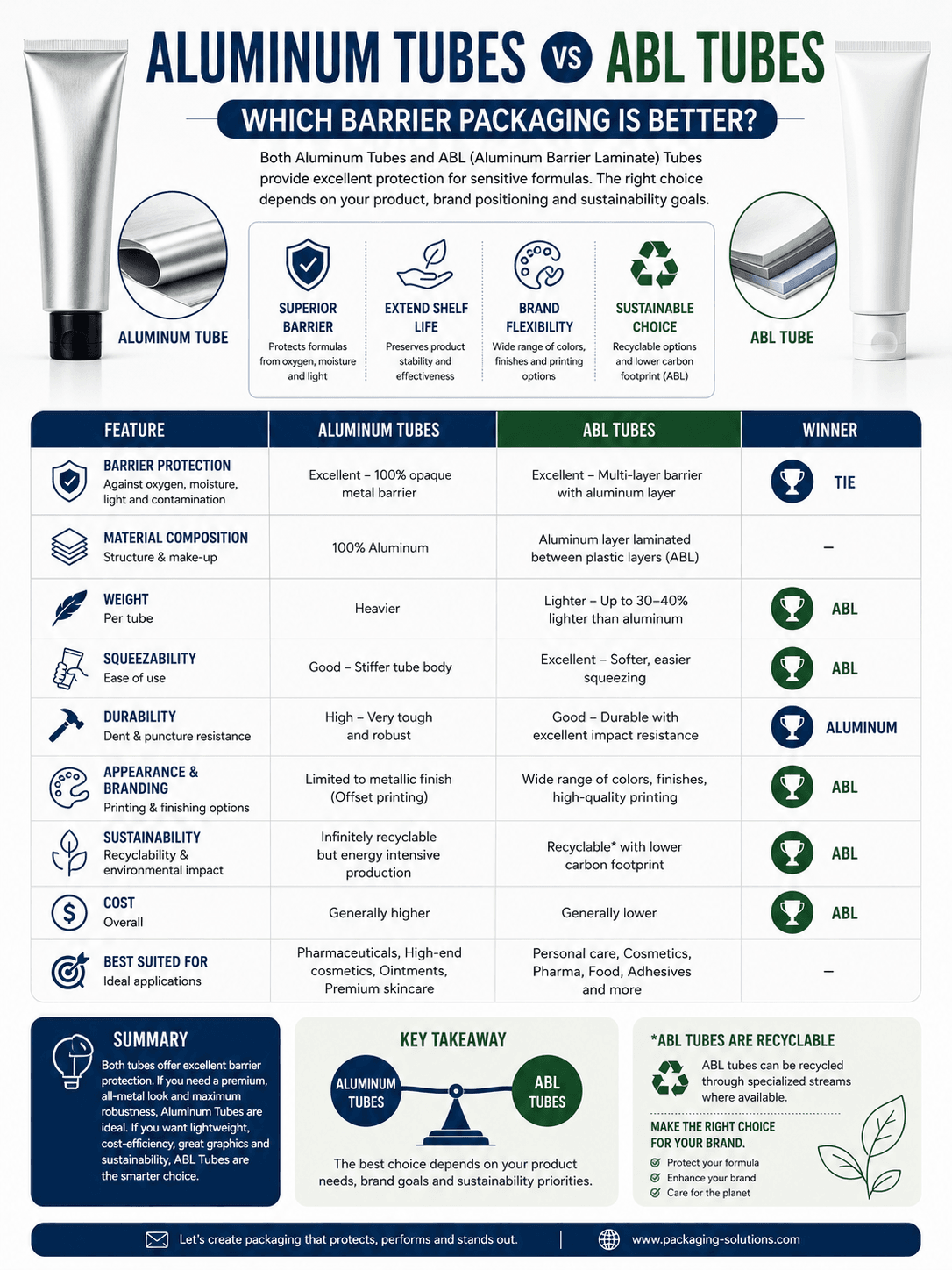
Aluminum Tubes vs ABL Tubes: Detailed Comparison
The best choice depends on whether your project prioritizes maximum protection, premium appearance, decoration flexibility, filling efficiency or total packaging cost.
| Comparison Point | Aluminum Tubes | ABL Tubes | Xinfly Packaging Recommendation |
|---|---|---|---|
| Structure | Full aluminum collapsible tube body | Aluminum foil barrier laminated with plastic layers | Choose aluminum for full metal protection; choose ABL for high-barrier laminate performance. |
| Barrier Performance | Excellent barrier against oxygen, moisture and light | Very good barrier due to aluminum foil layer | Both are high-barrier options. Aluminum is stronger for maximum protection, while ABL is more balanced. |
| Tube Appearance | Metallic, collapsible and more likely to show permanent creases | Cleaner laminate appearance with better retail presentation | For premium cosmetic shelf display, ABL is usually easier to brand. |
| Squeeze Feel | Collapses after squeezing and does not recover | More flexible laminate feel with better body control | Aluminum is suitable for controlled dispensing; ABL is better for consumer-friendly daily use. |
| Printing & Decoration | Can be printed, but decoration complexity may be more limited | Supports strong printing, hot stamping, matte finish and retail design effects | ABL is usually better for modern cosmetic and oral care branding. |
| Common Applications | Ointment, pharmaceutical cream, hair color, balm, specialty paste | Toothpaste, sunscreen, skincare, derma-care, facial cleanser | Match the structure to formula sensitivity and consumer usage scenario. |
| Cost Consideration | Depends on aluminum thickness, coating, nozzle, cap and printing | Depends on laminate structure, diameter, cap, printing and MOQ | Compare complete project cost, including decoration, tooling, samples and packing. |
| Best For | Maximum barrier and collapsible dispensing | High barrier plus better shelf appearance and printing flexibility | Aluminum is formula-protection focused; ABL is brand-and-barrier balanced. |
Application Scenarios: When to Choose Aluminum or ABL Tubes
Different products require different barrier performance, squeeze behavior, decoration effects and shelf presentation. Below are common purchasing scenarios for global brands.
Aluminum Cosmetic Tubes
Aluminum tubes are suitable for balms, ointments, essential oil-based formulas and specialty cosmetic products that require maximum protection and controlled dispensing.
ABL Tubes
ABL tubes are suitable for brands that need aluminum barrier protection with better printing, stronger retail appearance and more efficient mass production.
Toothpaste Tubes
ABL tubes are widely used for toothpaste because they balance barrier performance, body stability, decoration quality and large-scale production efficiency.
Hair Color Tubes
Hair color and chemical formulas often require stronger barrier protection. Aluminum tubes are common for maximum protection, while ABL may be considered for branded retail projects.
High Barrier Cosmetic Tubes
For sensitive skincare, sunscreen, derma-care and functional formulas, Xinfly can compare aluminum, ABL, PBL and EVOH structures based on real formula risk.
Sunscreen Tubes
ABL tubes can be used for SPF products requiring stronger barrier protection, while other options such as EVOH or PBL may be better for flexible cosmetic appearance.
Custom Aluminum & ABL Tube Specifications
Xinfly Packaging supports customized high-barrier tube projects based on formula type, filling volume, brand design and target market requirements.
| Specification | Available Options | Why It Matters |
|---|---|---|
| Tube Structure | Aluminum tubes, ABL tubes, PBL tubes, EVOH tubes, PE tubes, PCR tubes | Determines barrier performance, appearance, squeeze feel and sustainability positioning. |
| Capacity | 5ml, 10ml, 15ml, 30ml, 50ml, 60ml, 75ml, 100ml, 150ml, 200ml or custom volume | Should match product dosage, retail pricing, shipment weight and user scenario. |
| Diameter | 19mm, 22mm, 25mm, 30mm, 35mm, 40mm, 45mm, 50mm and custom sizes | Diameter affects filling volume, artwork layout, hand feel and cap compatibility. |
| Cap & Closure | Screw cap, flip-top cap, nozzle cap, acrylic cap, special dispensing cap | Closure should match formula viscosity, outlet control and end-user convenience. |
| Decoration | Offset printing, silk screen printing, hot stamping, labeling, matte or glossy finish | Decoration quality affects brand positioning, shelf impact and consumer trust. |
| Testing Support | Leakage test, sealing test, drop test, compatibility review, appearance inspection | Testing helps reduce risks before mass production and international shipment. |
Why Choose Xinfly Packaging for High-Barrier Tube Projects?
Jiangsu Xinfly Packaging Co.,Ltd. is a professional cosmetic tubes supplier providing custom PE, PCR, ABL and PBL tube packaging solutions for global beauty brands.
How Xinfly Reduces Packaging Development Risk
High-barrier packaging is not only about choosing a material. It requires matching product formula, tube structure, filling method, decoration process and quality control.
Material Engineering Support
We compare aluminum, ABL, PBL, EVOH, PE and PCR structures according to barrier requirement, appearance target and product category.
Design & Decoration Review
Our team reviews artwork, printing method, color matching, hot stamping area, coating effect and design feasibility before sampling.
Production Feasibility Check
We evaluate MOQ, tube diameter, cap matching, filling line compatibility, sealing performance and packing method before mass production.
How to Customize Aluminum or ABL Tubes with Xinfly
A structured development process helps customers avoid material mismatch, design delays and quality issues.
Share Requirements
Provide product type, capacity, formula features, artwork and target quantity.
Structure Advice
Compare aluminum, ABL and other barrier structures based on formula risk.
Sample Development
Confirm tube size, cap style, decoration, surface finish and printing effect.
Mass Production
Control material, printing, tube forming, cap matching and packing consistency.
Quality & Shipping
Final inspection, leakage testing, packing verification and export support.
How Xinfly Packaging Ensures Quality
Quality control is built into the full process from raw material selection to final shipment inspection.
Incoming Material Inspection
We check aluminum material, laminate structure, resin quality, color standards and cap components before production starts.
Process Control
During production, we monitor tube dimensions, printing registration, sealing strength, shoulder quality, cap fit and surface appearance.
Final Shipment Review
Before shipment, we verify leakage performance, packing quantity, carton protection, visual defects and export packing requirements.
Frequently Asked Questions About Aluminum Tubes and ABL Tubes
Below are some of the most common questions we receive from cosmetic, pharmaceutical, oral care and personal care brands when selecting high-barrier packaging.
1. What is the main difference between Aluminum Tubes and ABL Tubes?
Aluminum tubes are made from a full aluminum structure, while ABL tubes use an aluminum foil barrier layer laminated between plastic layers. Aluminum tubes provide maximum protection, whereas ABL tubes balance barrier performance with better appearance and decoration flexibility.
2. Which offers better barrier performance?
Full aluminum tubes generally provide the strongest protection against oxygen, moisture and light. ABL tubes also offer excellent barrier performance and are suitable for many cosmetic and oral care products.
3. Which is better for toothpaste packaging?
ABL tubes are widely used in toothpaste packaging because they combine strong barrier performance, attractive printing quality and efficient mass production.
4. Which is better for pharmaceutical creams?
Aluminum tubes are commonly preferred for ointments and pharmaceutical creams because their collapsible structure reduces air return after dispensing and provides excellent protection.
5. Are Aluminum Tubes suitable for cosmetic products?
Yes. Aluminum tubes are suitable for premium skincare balms, hand creams, eye treatments, essential oil-based products and specialty formulations requiring maximum protection.
6. Do ABL Tubes support high-quality printing?
Yes. ABL tubes provide a stable laminate surface that supports offset printing, silk screen printing, hot stamping, matte finishes and other premium decoration techniques.
7. Which option is better for luxury branding?
ABL tubes are often preferred for luxury cosmetic brands because they provide excellent shelf appearance, consistent graphics and premium decoration possibilities.
8. Can Xinfly Packaging provide custom tube diameters?
Yes. We support custom diameters ranging from 19mm to 60mm, depending on the product category and filling volume requirements.
9. What capacities are available?
Capacities typically range from 5ml to 250ml, including travel-size, retail-size and professional-use packaging formats.
10. What certifications does Xinfly Packaging offer?
Xinfly Packaging supports ISO certification, SGS testing, RoHS compliance and PCR Plastic GRS certification depending on project requirements and material structures.
11. Can I request samples before mass production?
Yes. We recommend sample evaluation before mass production to verify barrier performance, decoration quality, filling compatibility and user experience.
12. How do I choose between Aluminum and ABL Tubes?
The best choice depends on formula sensitivity, barrier requirements, brand positioning, decoration needs, filling process and budget. Our engineering team can review your project and recommend the most suitable solution.
Need Expert Advice on High-Barrier Tube Packaging?
Whether you are packaging pharmaceutical creams, toothpaste, sunscreen, skincare, hair color or specialty formulations, Xinfly Packaging can help you compare Aluminum Tubes, ABL Tubes, PBL Tubes and EVOH Barrier Tubes based on real product requirements rather than generic material specifications.
Request Free Packaging Consultation View Certifications