
Published: .
Technical review: pending.
A sunscreen tube cap drainage check helps a buyer decide whether the outside of a flip cap carries rinse water back to a counter or into the next handling step. A controlled rinse gives the team a way to identify where the water sits and when it is released. The thumb recess, hinge pocket and underside of the stand-up base deserve separate observations. Agree on the intended storage position and the consequence of a late drop before asking the supplier to revise the closure. This guide gives packaging buyers a short rinse trial and a record they can use to compare two assembled samples.
Define Where the Tube Will Get Wet
Start With the Handling Sequence
Choose the actual setting that matters to the product brief. At an outdoor shower a user may rinse the outside, close the cap and return the tube to a ledge. At a bathroom sink the same tube may be lifted immediately after being set down. Ask which face normally points up, whether the ledge is flat or sloped and when water transfer would matter. Write down one primary sequence. An extra storage position can be a separate row in the test plan so the team can distinguish the two situations.
Define the Assembled Sample
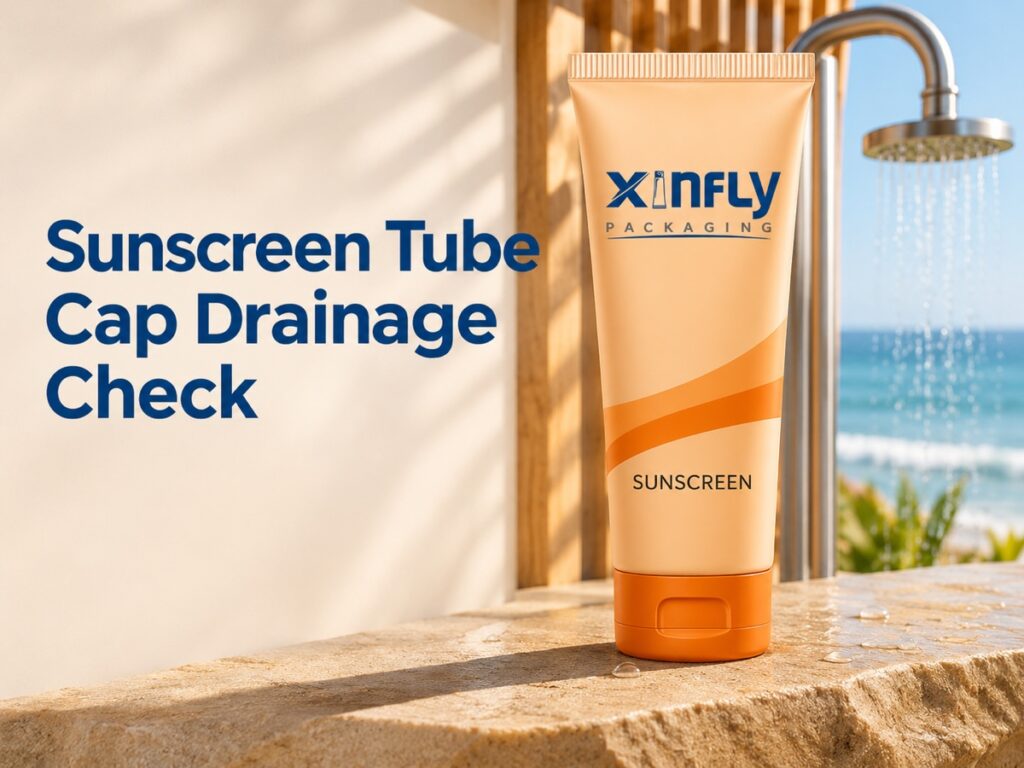
Request a tube with the shoulder, cap and finish being quoted. For sunscreen tube packaging, record the proposed body format and pair it with a cap drawing and a sample identifier. The illustration shows a rounded apricot plastic barrier laminate body with a molded shoulder, a straight sealed tail and a short orange stand-up flip cap. Its tonal bands are proposed as offset artwork on the laminate sleeve, with a separately checked brand mark. Confirm the intended print and finish through a physical proof. This keeps the description useful even when the sample differs from the illustrated option.
Agree What Counts as Water Transfer
Define the moment at which a drop becomes a concern. For a display intended to stay tidy, the check might be a visible drop onto a clean card when a closed tube is lifted at the agreed observation time. For a tube handled near clothing, the team may want to compare the transfer onto a defined cloth after picking the tube up. An observation to investigate could also be a recess that stays visibly wet under the chosen conditions. The buyer and supplier can turn the observation into a project criterion once they see repeatable results.
Map the Water Traps
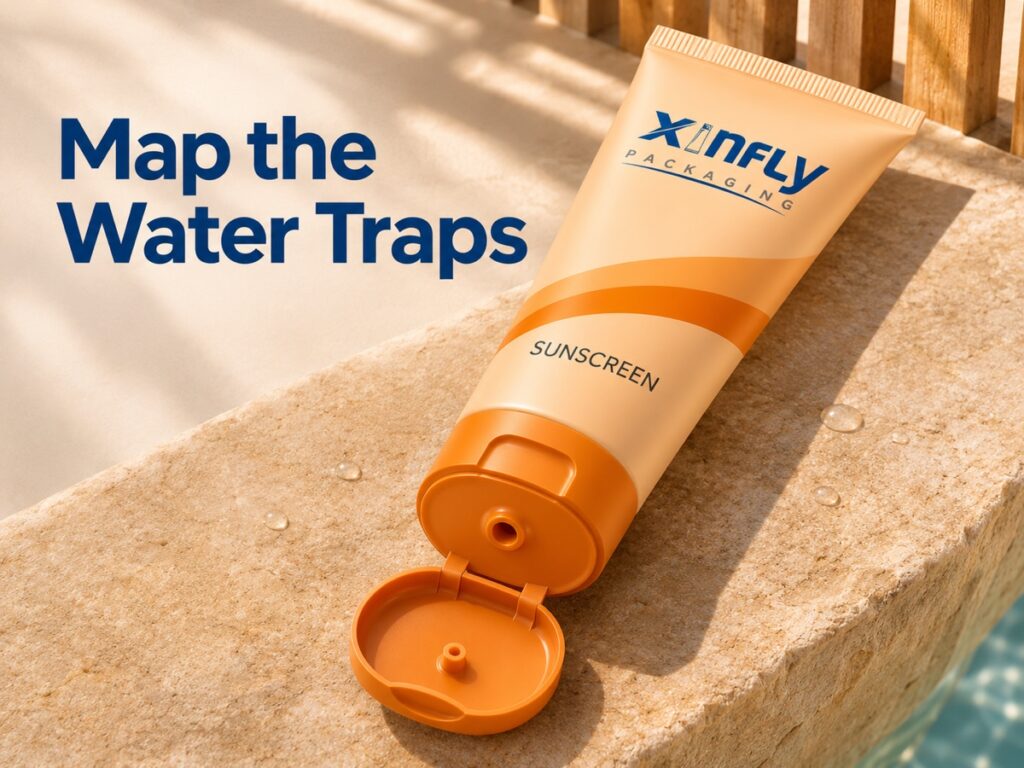
Look at the closure on an unused sample and identify surfaces that a reviewer can actually see. Photograph the thumb recess and hinge pocket from repeatable angles. Include the base rim and any concave area inside the contact ring. A cap may look simple from the side while the underside has a different shape. Mark these locations on a photo of the actual assembly so the people doing the trial describe the same feature. In a quotation, ask which recesses or channels belong to the nominated cap revision and which require a different tool or part number.
Record Each Reservoir Independently
After the rinse, use the same specified angle and light to look at each external zone. If a hinge edge hides a drop, let the agreed handling step reveal it and record the first place it appears. Name both the location and the action that released it. An external droplet region, a wet outlet and visible product residue belong to different observations. Use the project leakage or closure review to investigate observations at the outlet or sealing interface that need a separate decision.
| Feature | What to locate on the dry unit | What to record after the rinse |
|---|---|---|
| Thumb recess | Face of the closure and bottom of the recess | Visible bead, wet film or drop released at pickup |
| Hinge pocket | Back edge, groove and area beside the lid | Time or handling step at which water reappears |
| Base contact rim | Outer ring and enclosed recess underneath | Wet mark left on the standing surface or transferred later |
| Skirt and shoulder edge | Visible boundary around the assembled parts | First visible drop location and the side facing down |
| Pickup contact | Surface touched in the intended grip | Transfer to the selected card or cloth after the specified wait |
Compare the Same Features on Alternatives
A buyer comparing stand-up and flip-top tube closures can use an underside sketch to distinguish the proposed features. Ask for views that show where the cap contacts the counter and where the hinge can be seen. Compare the current candidate and any revised one with the same fill state and body outline where feasible. If both the shoulder and cap change, log both revisions and treat them as complete assemblies for approval. This gives the quality team a record it can use again when an approved part is replaced.
Run a Rinse and Drain Trial

Give the reviewer a fixed start condition and a short sequence. Start with dry closed units and photographs showing the caps clean and seated. Use a consistent clean-water source, rinse direction and exposure time. Agree whether the rinse represents a brief pass under running water or a stated amount poured over the outside. Keep the conditions the same across candidates and record water temperature or flow if either matters to the decision. Handle wet samples over a suitable surface, with separate positions for the units and the clean cards.
Use a Drain Position That Matches the Brief
Start the observation clock at the same event, such as the end of the rinse. Set each unit on its assigned surface and orientation. For a stand-up unit, identify cap-down storage and the actual type of ledge or a representative flat tile. If sideways storage is also relevant, use a separate trial or a fresh unit. Ask the reviewer to keep the body position stable until the agreed pickup. Compare first observations and later observations as separate fields so a late drop remains visible in the decision record.
Compare a Dry Control and Equivalent Handling
Set aside a dry control from the same sample group in the same orientation. Photograph its contact patch before the wet trial if the counter may leave a mark itself. Handle wet candidates with the same motion and contact material. If the team compares transfer to a cloth, agree the cloth type, point of contact and whether it touches the base only. Assign a fresh area to each sample. Capture any change in procedure as an exception and repeat under the agreed conditions before a supplier decision.
| Record entry | What the team agrees or observes | How the buyer uses it |
|---|---|---|
| Sample identity | Part revision, cap profile, body, fill state and unit ID | Links results to the exact quoted assembly |
| Rinse setup | Exposure, direction, water source and start event | Makes candidate comparisons repeatable |
| Standing condition | Surface, orientation and observation interval | Represents the chosen storage or handling case |
| Observed zone | Bead, film, drip or transfer and first visible location | Directs engineering to a specific closure feature |
| Control and exception | Dry control result and any handling departure | Shows when a repeat is needed |
| Disposition | Accepted condition, revision requested, or repeat instruction | Keeps the chosen cap and test basis in the approval record |
Review the Record Before Choosing a Cap
Compare like conditions side by side. If both candidates leave a similar early mark but one releases a drop on pickup, ask the supplier to review the geometry near the observed release site. Confirm whether the feature can be changed while retaining the intended fit and opening function. If the difference disappears when the same sample is tested again, resolve the handling or observation method before drawing a conclusion. Ask the reviewer to preserve the best photos alongside the agreed condition and the observed variation.
Put the Drainage Check in the RFQ
Ask for the Proposed Cap and Sample State
For 50ml sunscreen tubes with flip-top caps, request the actual closure drawing, neck match, cap finish, body outline and whether the sample is delivered empty or filled by the project filler. Treat the nominal volume as a separate project input. On a comparison sheet for custom sunscreen squeeze tubes, identify each cap revision and the cost items associated with supplying an alternate sample. Ask which component will change if the trial calls for a shallower recess or a different base. The sunscreen tube material and closure guide provides context for keeping the cap discussion connected to the selected tube build.
Retain the Chosen Configuration
Keep an approved dry pack, the rinse record and the relevant assembly sketch with the purchasing specification. If a later order uses a revised cap or surface finish, identify the original observation that justified the selection and the sample condition that should be repeated. Include the filler if the cap-to-neck assembly or availability of the production fill could affect what is supplied. Use separate identifiers for any samples tested on different surfaces or with a different storage direction.
Frequently Asked Questions
Should the first sample be empty or filled?
Use empty units for an initial look at the shape. For the purchasing decision, agree a like-for-like condition that represents the intended handling. A filled unit can sit or be picked up differently. Record the filler, fill state and the closure position used in the final comparison.
What if I find water around the hinge after lifting the tube?
Record where it first appeared, the pickup motion and the time since the rinse. Check the same feature on comparable units before asking the supplier about a geometry change. If the hinge is difficult to see, add a consistent view of the back edge to the photo record.
Can I use any surface for the drain check?
Choose a surface that represents the planned use or create a defined reference, such as a flat tile. Record the material, slope and starting condition. A wet counter, a dry card and an absorbent mat produce different observations, so identify each condition explicitly.
How do I decide when to observe water transfer?
Use the handling sequence to choose the observation time. A user who lifts the tube immediately may need a different check from a unit left on a ledge. Put the start event and interval in the sample brief so the supplier can repeat the same timing.
What should the converter receive with a revised cap request?
Send the closure drawing or its reference, photographs of the observed wet area, the standing position and the step that released a drop. State which surface, use routine and packaging configuration the approval will cover. Include the actual body and cap sample IDs.
Conclusion
Approve sunscreen tube cap drainage with a repeatable exterior rinse and a named storage position. Use the first worksheet to identify the location and the second to compare open observations from equivalent assembled samples. If retaining or releasing exterior water affects the intended handling, preserve the observation when requesting a closure change. Share your sample state, drawing and preferred closure with Xinfly Packaging when you request a sunscreen tube sample quote.