
Published: .
Technical review: pending. Project-specific specifications and sample acceptance require confirmation by the responsible technical team.
A hotel amenity tube case label record connects the outside of a shipping case to the item and packing information inside it. A receiving team may see several similar cartons before anyone handles a single tube. “Shampoo tubes” is a useful description, but it may not distinguish the approved artwork, the packaging supply state or the specific order being received.
This guide proposes business identification fields and an exception record for buyers, packaging suppliers and receiving teams. It is not a consumer-label, transport-law or barcode specification. Any mandatory shipping or market information needs its own responsible review. The immediate purchasing decision is simpler: what information must a receiver be able to match to the order before accepting the case into the intended stock location?
Begin with the receiving task
Ask the intended receiving site what it needs to identify a case without opening every inner pack. The answer may differ between a contract filler receiving empty packaging and a hotel distributor receiving finished amenities. Name the receiving operation and the goods being ordered before designing the label.
For hotel shampoo and conditioner tubes, record the agreed product description and item code. Do not use cap colour as the only identifier. Similar-looking packaging can belong to different artwork versions, capacities or purchase orders. The outside record should resolve the specific distinctions that matter to the receiver.
State empty packaging or filled amenities
An empty printed tube and a finished shampoo product are different supplied items. Put the agreed supply description into the ordering record and confirm how it should appear on the case label. Do not let an image of a finished amenity imply that a packaging-only quote includes formula, filling or finished-product services.
The same distinction applies to samples and order documentation. A receiving instruction written for finished goods should not automatically be reused for empty tubes sent to a filler. Ask the parties to identify which records and handling decisions belong to the actual supply arrangement.
Use a stable item identifier
Agree the item code used by the buyer and the corresponding supplier reference. Keep a cross-reference if they differ. Avoid changing an identifier merely because a short description is edited for readability. The receiver needs to know whether a new code represents a new item or a corrected description of the same item.
For an enquiry about 30ml squeeze tubes for hotel amenities, capacity is one useful field, but it does not replace the item identifier. Include the selected body and closure configuration in the underlying specification. The label can refer to that specification without repeating every technical detail on the outside of the carton.
Keep artwork version separate from the item name
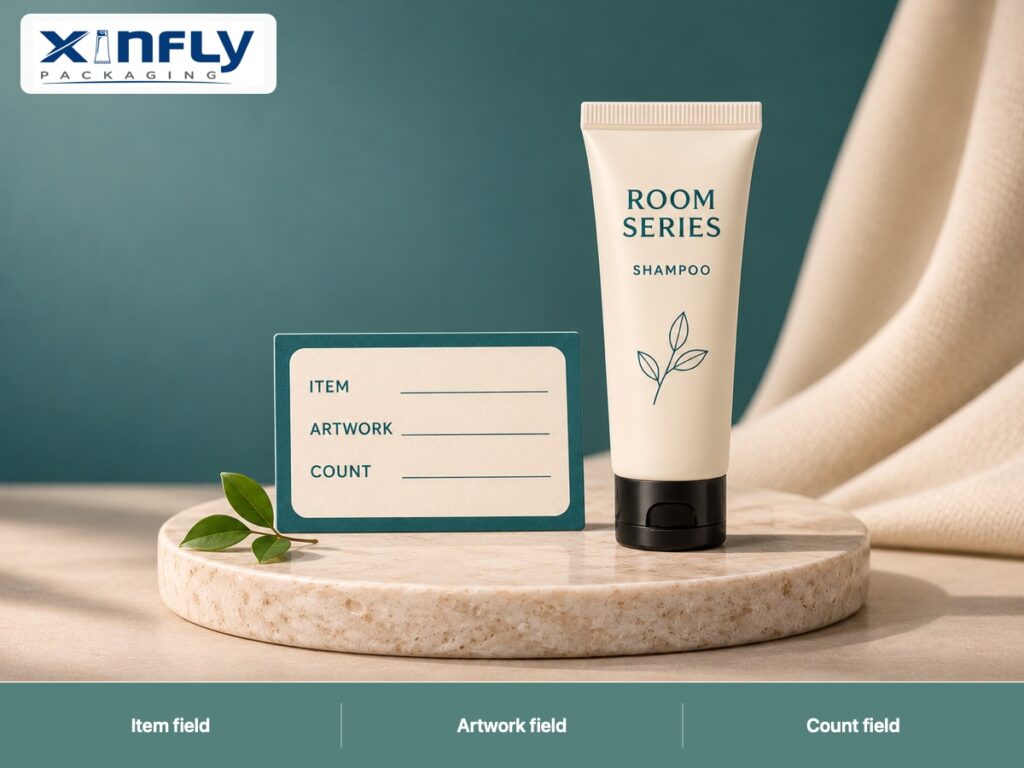
Record the approved tube artwork reference in a separate field or clearly connected packing record. A name such as “Room Series Shampoo” may remain unchanged through several artwork revisions. The record should make it possible to identify which approved design was intended for the packed goods.
Ask how the supplier links its printed-tube identification to the case information. Avoid assuming that the same revision code must be printed directly on every commercial design. Agree the traceability arrangement and the documents used, rather than adding an unreviewed mark to the tube artwork.
| Information | Purchasing question | Linked record |
|---|---|---|
| Buyer and supplier item references | Which supplied item does this case contain? | Current item cross-reference |
| Goods description | Empty packaging or agreed finished goods? | Purchase specification |
| Tube artwork reference | Which approved tube design is packed? | Artwork release record |
| Order reference | Which order or agreed release does it belong to? | Purchase order or call-off |
| Packing count and unit | How many of which unit are declared? | Approved packing record |
| Case identifier | Which individual case is being checked? | Case list or dispatch record |
| Applicable lot reference | Which supplier-defined lot record applies? | Agreed traceability documentation |
| Receiving destination | Which approved receiving location applies? | Delivery instruction |
| Label revision | Which label layout and data rules were approved? | Label proof and release record |
Make the count and unit unmistakable
Write the unit next to the declared quantity. A count might describe individual empty tubes, inner bags, retail cartons or complete amenity sets. These are not interchangeable. The purchasing record should identify which unit is being counted and how it connects to the actual packed item.
If both an inner-pack count and a total unit count are shown, confirm their meaning and relationship. The receiver should not have to guess whether “100” means 100 tubes or 100 packs containing several tubes. Keep any agreed inner-pack arrangement in the packing specification that supports the label.
Treat partial cases as an explicit condition
Ask how a case containing less than the usual agreed count will be identified. Its outside information should reflect the actual packed quantity under the agreed rules. Do not let an unchanged standard label imply that a partial case is full.
For example, a fictional order might have full cases declared as 200 individual empty tubes and a final case declared as 80. Those numbers illustrate a record distinction only. They do not represent a Xinfly packing capacity, minimum order or approved carton size. Confirm the project’s actual packing arrangement separately.
Distinguish the shipping case from the retail carton
An outer case and a printed retail carton serve different identification tasks. The retail design may carry the product’s consumer-facing artwork, while the shipping case helps the receiving operation connect a group of items to the dispatch record. Identify which packaging level each proof describes.
If the project includes printed cosmetic retail cartons, keep their artwork and item references connected to the packed tube. A receiving label should not silently refer to a carton design that has already been replaced. Ask the packing record to identify the actual combination supplied.
Identify mixed contents without hiding the detail
If a case intentionally contains more than one item, decide how its label points to the complete contents record. A single product description may not be enough. The buyer and receiver should agree whether the outside label lists the items or points to an attached case-specific document.
This article does not choose a mixed-case packing plan. It asks how the chosen plan remains identifiable at receiving. Keep the case identifier, contents record and declared counts connected so a receiver can find the right information before allocating the goods.
Approve the label layout and the data separately
A layout proof can show the size, order and readability of fields. The data review checks what will actually populate them. Approving the appearance of a sample label should not be treated as approval of every future order number, quantity or lot reference.
Ask who supplies each field and who generates the label. Some information comes from the buyer’s order, while other information may be assigned during packing. Record the source and release responsibility for each field so the supplier does not have to invent missing data near dispatch.
Review a complete example before release
Request an example using representative project data, clearly marked as a proof. Check whether the receiver can connect it to the proposed item and packing record. If a sample contains fictional values, keep them visibly separate from the production data source so they cannot be copied into a shipment.
Review the physical reading situation too. Ask where the label will be placed and what could obscure it. Any handling, transport or barcode requirements need confirmation by the appropriate parties. A visually tidy label alone does not demonstrate compliance with those requirements.
Set an exception route for receiving
Agree what happens when a case arrives with information that cannot be matched to the order. The receiver should know whom to contact and which reference to retain. Record the affected case identity and the uncertainty before relabelling, opening or reallocating the goods.
Connect the issue to the agreed packing inspection requirements. A business identification mismatch and a physical packaging defect can require different reviews. Record the actual observation so the responsible team can decide the appropriate action, rather than treating every uncertainty as the same type of rejection.
| Observation | Information to retain | Decision requiring an owner |
|---|---|---|
| Item code cannot be matched | Case identifier, label image and order reference | Identify the supplied item before allocation |
| Artwork reference differs | Declared version and expected release record | Confirm the actual packed design |
| Quantity unit is unclear | Exact label wording and packing document | Clarify the declared count basis |
| Partial case is not identified | Case reference and available count records | Resolve the actual quantity |
| Label is unreadable | Location and unaltered photograph | Obtain an authorised replacement record |
| Mixed contents record is missing | Case identifier and related dispatch documents | Supply the case-specific contents information |
| Case appears relabelled | Both visible records and receiving observation | Explain and authorise the current identification |
| Destination does not match | Delivery document and receiving-site reference | Confirm routing before further movement |

Preserve the history when a label changes
A corrected label should remain connected to the original case and the reason for correction. Ask who may authorise the change and how the dispatch or receiving record will be updated. Do not cover an unresolved discrepancy with a new label simply to make the case look consistent.
Keep the old observation, new information and approval together. This gives the buyer a way to distinguish a documented clerical correction from an unexplained change in item identity. The record does not prove the contents by itself; it makes the decision and its basis retrievable.
Carry the agreed fields into the RFQ
For hotel shampoo tubes, send the proposed label fields together with the actual supply description, item references and receiving requirements. Ask the supplier to confirm the proposed labelling and packing-record arrangement, including any work or materials needing separate quotation.
Xinfly Packaging can review a hotel tube enquiry with the selected tube, cap, artwork and packing requirements. Include the receiving contact’s agreed information needs so the project discussion covers the handoff as well as the appearance of the individual tube.
Frequently Asked Questions
Is the product name enough on an outer case?
It may leave important distinctions unresolved. Agree the item code, supply state, artwork link and count information needed by the actual receiving operation. Keep the label connected to the order and packing record.
Should a label say pieces or sets?
Use the unit that matches the declared quantity and supplied item. If several counting levels are shown, define their relationship. Do not let a set count be interpreted as a count of individual tubes.
Does this checklist cover mandatory shipping labels?
No. It proposes business identification fields for purchasing and receiving. Transport, market, carrier and barcode requirements require their own applicable review. Do not treat this worksheet as a compliance specification.
Can a partial case use the normal full-case label?
The declared information must accurately describe the agreed actual packing record. Decide how partial status and quantity will be shown before dispatch. A receiver should not need to discover the difference after stock allocation.
Who should approve a corrected case label?
Name the authorised owner in the project’s handling rules. Retain the original discrepancy, corrected information and approval reference. The appropriate owner depends on the order and receiving arrangement.
Conclusion
A useful hotel amenity case label links a readable outside identifier to the current item, artwork and packing record. Define quantity units, partial-case treatment and the receiving exception route before dispatch. These decisions help the supplier and receiver work from the same purchasing information.