Published: .
Technical review: pending. Project-specific specifications and sample acceptance require confirmation by the responsible technical team.
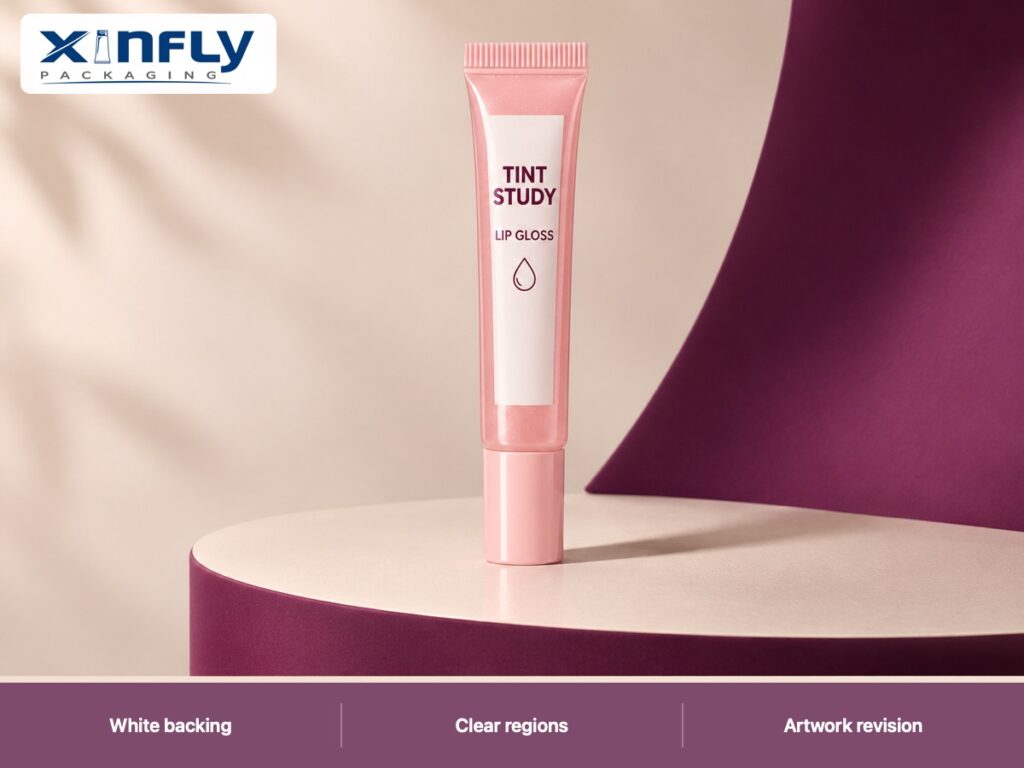
A lip gloss tube white ink backing brief should show which parts of the design have white underneath them and which parts remain clear. Sending a coloured visual alone leaves an important purchasing choice unresolved. A white area in the file might mean printed white ink, the appearance of a white viewing background, or an unprinted opening through which the product will be visible.
For buyers of custom lip gloss tubes, that ambiguity affects what the supplier samples and prices. This guide provides a backing-mask checklist and a physical-sample review record. It treats the proposed ink arrangement as a project option requiring supplier confirmation. It does not specify an opacity value, printing recipe or guaranteed colour result.
Separate three different uses of white
Start by identifying the white tube material, any visible white artwork and any white backing beneath coloured artwork. These can look similar in a flat presentation but describe different things. A white-coloured tube is a substrate choice. A white word or graphic is part of the visible design. A white backing is an additional printed area supporting another part of that design.
When sourcing lip gloss squeeze tubes, give each of those choices its own description. The product category establishes the type of pack being discussed. It does not establish whether a particular printing process, tube colour or backing arrangement is available for your selected configuration.
Mark intentional transparent areas
Identify every area that should remain free of the proposed white backing. This may be a side window, a band around the tube or a region surrounding the front design. Describe the intent on a marked artwork copy rather than relying on the phrase “clear tube”. A clear tube can still carry a large printed white panel.
Keep the transparent region visible in both the artwork discussion and the sample request. If the design team later expands the front panel, the supplier should be able to see whether the change also alters the intended window. This is an artwork decision to confirm before the relevant printing preparation is released.
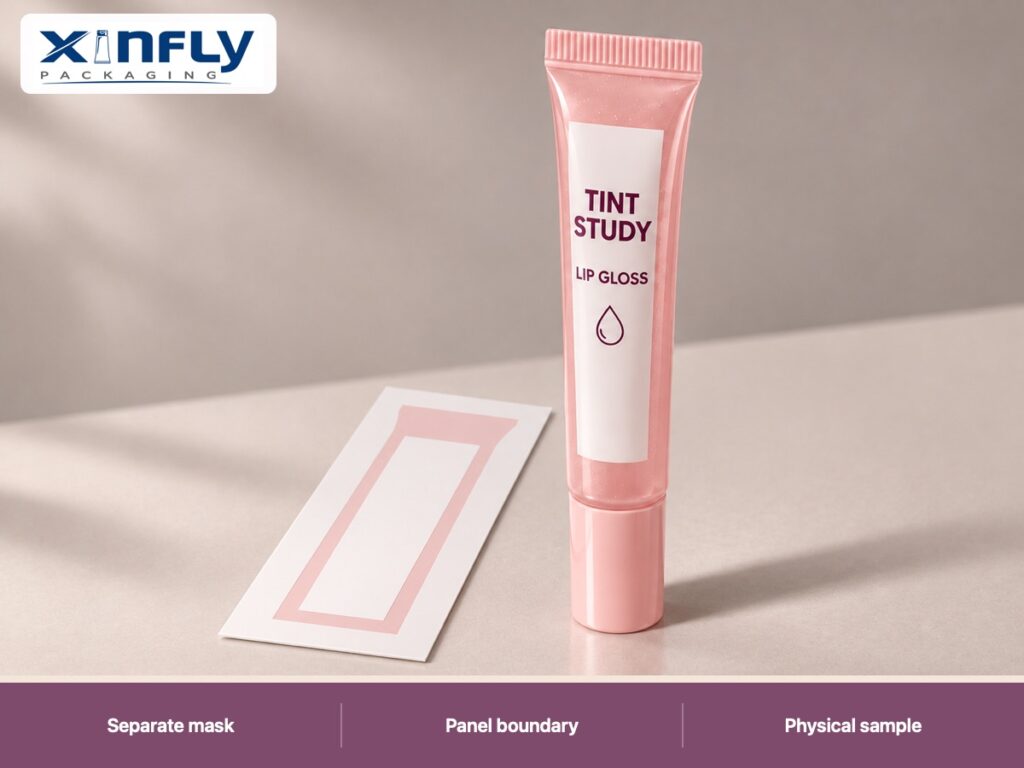
Send a separate backing mask
Ask the printer which file convention it requires for a white-ink separation. Provide a clearly named mask or separation using that agreed convention. Keep the mask connected to the same artwork revision as the visible design. A separate file is useful only when the recipient knows which version it belongs to.
Adobe’s colour-separation preview guidance describes reviewing individual colour separations before output. Use that type of file review to ask what the supplier will receive. A software preview does not establish the physical appearance or production suitability of a printed cosmetic tube.
Make the mask readable to a second person
Include a simple key explaining what the marked areas mean. For example, distinguish “white backing requested here” from “no white backing requested here”. Do not assume that every technical mark or light grey object in an artwork document should print. Ask the supplier to identify the actual output interpretation in its reply.
For 10ml lip gloss squeeze tubes, the small available surface makes a full-size review useful. An enlarged screenshot can hide how a narrow unprinted margin reads on the curved body. Retain a full-size reference alongside any enlarged detail used to explain the mask.
| Field | What the buyer supplies | What the supplier should confirm |
|---|---|---|
| Tube substrate | Selected body material and colour reference | Proposed tube configuration and sample status |
| Visible design | Current artwork file and revision | File accepted for the stated process |
| White backing | Separately identified mask or separation | How that information will be output |
| Clear regions | Marked areas intended to remain without backing | Interpretation of their boundaries |
| Visible white elements | Words or graphics intended to print white | Whether they share or require separate treatment |
| Colour layers | Named design colours or agreed colour specification | Proposed decoration arrangement |
| Edge relationship | Marked relationship between backing and colour | Feasible approach and any proposed adjustment |
| Sample request | Physical sample configuration and review purpose | What the sample can represent |
Confirm the proposed printing arrangement
Ask which decoration process the supplier proposes for the selected body. Record the white backing and coloured design as explicit parts of that proposal. Avoid translating a visual preference into a press instruction without the printer’s review. The buyer defines the desired appearance; the supplier needs to explain how it proposes to produce a suitable sample.
Xinfly’s cosmetic tube printing and decoration options provide the commercial discussion point for that enquiry. Confirm the actual process, ink arrangement and finish against the chosen tube. Do not assume that an option shown for another structure can be transferred without review.
Keep equipment examples within their scope
Roland DG’s white-base documentation explains a white base for transparent or dark media in its specified printing workflow. It illustrates why the white information deserves separate treatment. It is not evidence that Xinfly uses that equipment, software convention or process for your tube.
Use the principle to frame a question: which parts of this design need a white backing in the supplier’s proposed process? Let the supplier identify the practical file requirements and sample route. Keep any unconfirmed arrangement labelled as an enquiry option.
Resolve edges before approving the visual
Where the backing ends relative to the coloured design is a specific approval item. Ask for an enlarged marked detail if the supplier proposes changing that relationship. The response should connect the proposed adjustment to a named location, not simply say that the artwork has been optimised.
Do not insert an arbitrary overlap, inset or registration tolerance into the purchase specification. Those values depend on the proposed process and design. Request the printer’s recommendation, then review the resulting physical sample against the agreed artwork. Record the accepted relationship in a way that can be traced later.
Include small text and line work
A broad panel and a fine line may need different conversations. Identify the small text, line graphics and borders that are important to the brand. Ask which of them sit over white backing and whether the proposed output preserves their intended relationship.
Keep legibility and backing coverage as separate observations. A word can be correctly spelled while its background treatment remains wrong for the design. Conversely, a backing panel can occupy the intended area while the text needs an artwork correction. Separate findings make the supplier’s next action clearer.
Request a sample that answers the question
State whether you need a demonstration of file interpretation, a physical decoration sample on the proposed body, or a sample representing the intended production arrangement. Ask the supplier to describe any differences from the proposed order. A sample can be useful even when it has limitations, provided those limitations are visible in the review record.
For 10 mL lip gloss tube sample enquiries, identify the cap, body and artwork reference together. A decorated tube in a different body colour cannot automatically stand in for a clear-body backing review. Ask which conclusions the supplied sample is intended to support.
Record empty and filled sample states
If product appearance through the tube matters to the design, agree whether a filled sample is needed and who will prepare it. Identify the formula or approved appearance reference used. Do not treat a simulated fill, a coloured card or a digital rendering as an actual formula sample.
The same review can retain observations for an empty tube and a filled assembly, with each state named. This helps the team distinguish the printed backing from whatever is visible behind an unprinted region. It does not establish formula compatibility, shelf life or a quantified optical property.
| Review item | Record with the sample | Decision or follow-up |
|---|---|---|
| Sample identity | Supplier reference and artwork revision | Is this the intended sample version? |
| Body condition | Material reference, colour and empty or filled state | Does the review describe the ordered configuration? |
| Backing presence | Locations where white is visibly present | Accept location or request a marked correction |
| Clear region | Locations intended to remain without white backing | Accept window interpretation or revise it |
| Boundary appearance | Identified panel and graphic edges | Resolve specific locations with the printer |
| Text and lines | Full-size observations of named elements | Correct artwork or request another sample |
| Viewing record | Agreed lighting, background and comparison reference | Repeat under the agreed conditions if unclear |
| Approval scope | Named items accepted and items still open | State what may proceed and what remains pending |
Keep the comparison conditions consistent
Agree the viewing background, lighting and comparison reference before people review the sample in different locations. Keep those conditions with the observations. This makes a follow-up conversation easier when two reviewers describe the same sample differently.
Photographs can help locate an issue, but they should identify the sample and the conditions in which they were made. Use an arrow or marked duplicate to point out a boundary rather than adjusting the image until it looks preferred. Retain the unaltered reference photograph when it forms part of the purchasing record.
Avoid converting appearance notes into measurements
Write “backing extends into the marked window” when that is what the reviewer observed. Do not convert that statement into an opacity percentage or colour-difference value without an agreed measurement method and actual data. Similarly, a photograph on a dark background is not a laboratory result.
If the project needs a numerical requirement, ask the responsible technical team to select the method, specimen condition, reporting format and acceptance basis. Keep that separate from the initial artwork worksheet. The worksheet helps define the question; it does not supply missing test evidence.
Make the quote match the approved scope
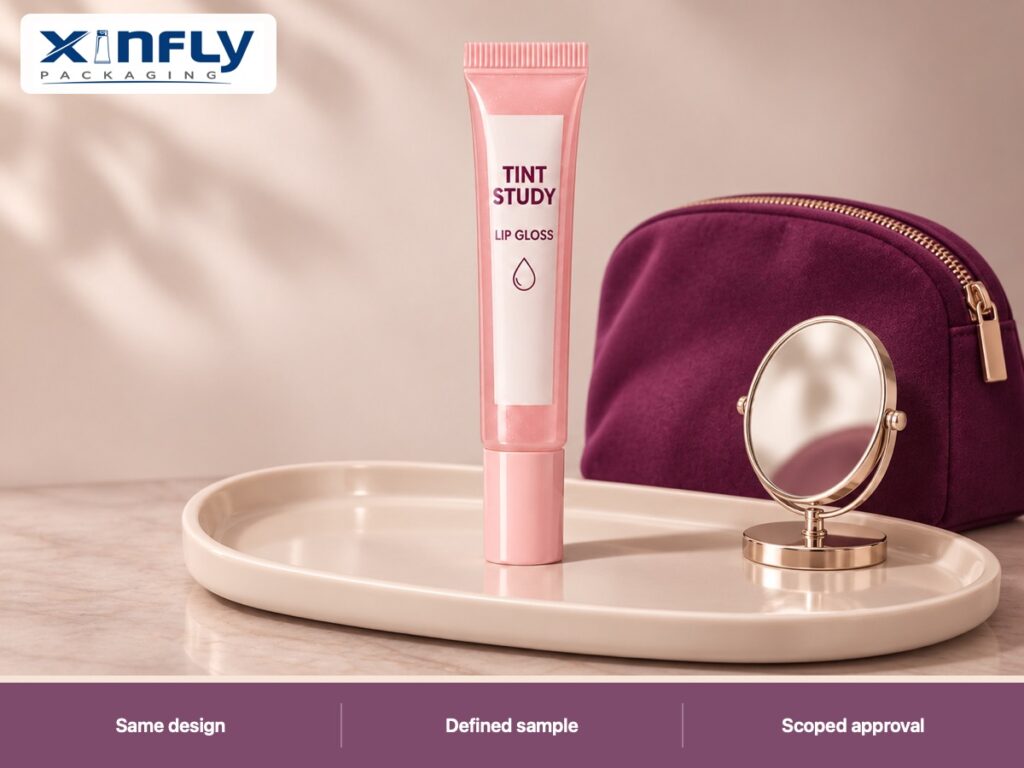
Ask the quotation to identify the proposed body, decoration process, white-backing arrangement, artwork version and sample work. Clarify which preparation or sample items are included and which need separate confirmation. Do not infer price, minimum quantity or timing from the number of colours shown in the visual.
When the backing mask changes, ask whether the change affects the existing quote or sample plan. Keep the commercial reply with the revised artwork. A useful enquiry package contains the visible design, backing mask, clear-window notes and the specific physical sample requested, all under one current revision.
Give Xinfly a reviewable enquiry
Send the selected tube reference, proposed capacity, cap style, body colour and current artwork with your marked backing request. Name the unresolved decisions clearly. Xinfly Packaging can review the project enquiry and confirm the proposed decoration and sample options before you approve the order-specific specification.
Frequently Asked Questions
Is a white screen background the same as white ink?
No. A display background can make a clear or unprinted region appear white. Ask the artwork provider and printer to identify the actual white-ink separation and the areas intended to remain unprinted.
Can the visible white text and the backing use one file?
Ask the printer how it requires the information to be supplied. Keep both functions identifiable even if the output workflow combines them. The important point is a clear, agreed interpretation tied to the artwork revision.
Does a white-backing mask prove the final colour?
It records intended coverage. Physical appearance still needs the appropriate sample review, with the proposed tube, decoration arrangement and viewing conditions identified. A file alone does not provide a measured colour result.
Should every clear lip gloss tube have full white backing?
That is a design and production question for the specific project. Full coverage may conflict with an intended transparent window. Mark the desired regions and ask the supplier to confirm a feasible sample proposal.
What should stay pending when the sample differs from production?
Keep any affected conclusion open. Record the differences in body, printing process, finish or artwork, and ask for the evidence needed to resolve them. Do not treat a limited sample approval as acceptance of unrepresented features.
Conclusion
A useful white-backing brief connects the visible design, a readable backing mask and the physical sample that will be reviewed. Keep clear windows, boundary relationships and sample limitations explicit. That gives the buyer and printer a concrete basis for approving the proposed lip gloss tube decoration.