Published: .
Two airless eye cream samples arrive with the same nominal capacity. One produces a visible amount after a few presses; the other behaves differently. A quick video makes one look better, but it does not tell you whether the formula, preparation, handling and actuation were comparable. Before choosing the pump, give that first-use experience a useful record.
An airless eye cream tube first dispense record separates the start-up sequence from later output measurements. For the packaging mechanism, begin with Xinfly Packaging’s airless pump tubes. The worksheet below helps you define a sample comparison with your supplier and filler. It does not supply a universal priming limit, dosage promise or result for an available pump.
Decide What the First-Use Review Should Answer
Separate First Visible Output from Later Dispensing
Count the actuation on which product first becomes visible using the definition agreed for the trial. Keep that count separate from the mass collected on later strokes. A pump can show some product before the collected amounts become suitable for your intended output review. Decide what each observation means before reducing the sequence to a single average.
Ask the packaging, formula and quality owners which criteria matter for the actual project. They may need to consider opening instructions, start-up behavior, subsequent dispensing or other use conditions. The buyer’s job is to ensure those questions remain identifiable in the sample brief, rather than treating “dispenses well” as a complete approval statement.
Agree What Counts as One Actuation
Specify how the reviewer operates the actual pump, following the agreed instructions. Record the intended stroke action, release and interval, along with orientation and other relevant conditions. Do not compare one reviewer’s short repeated taps with another’s different operating action and assume that the mechanism alone explains the difference.
If the intended user instructions require a particular preparation step, document it and evaluate it as part of the relevant plan. Avoid inventing instructions during the comparison to make a sample appear to perform better. The proposed pack and its use instructions need to remain connected to the same reviewed configuration.
Identify the Complete Sample Before Measuring
Keep Pump and Tube References Together
Record the body, pump, collar, outlet and protective cap references relevant to the assembly. Include its nominal capacity and drawing revision. For airless pump tubes for eye cream, the application name is only the beginning of the brief. The actual assembly and formula are needed to decide what the sample comparison should cover.
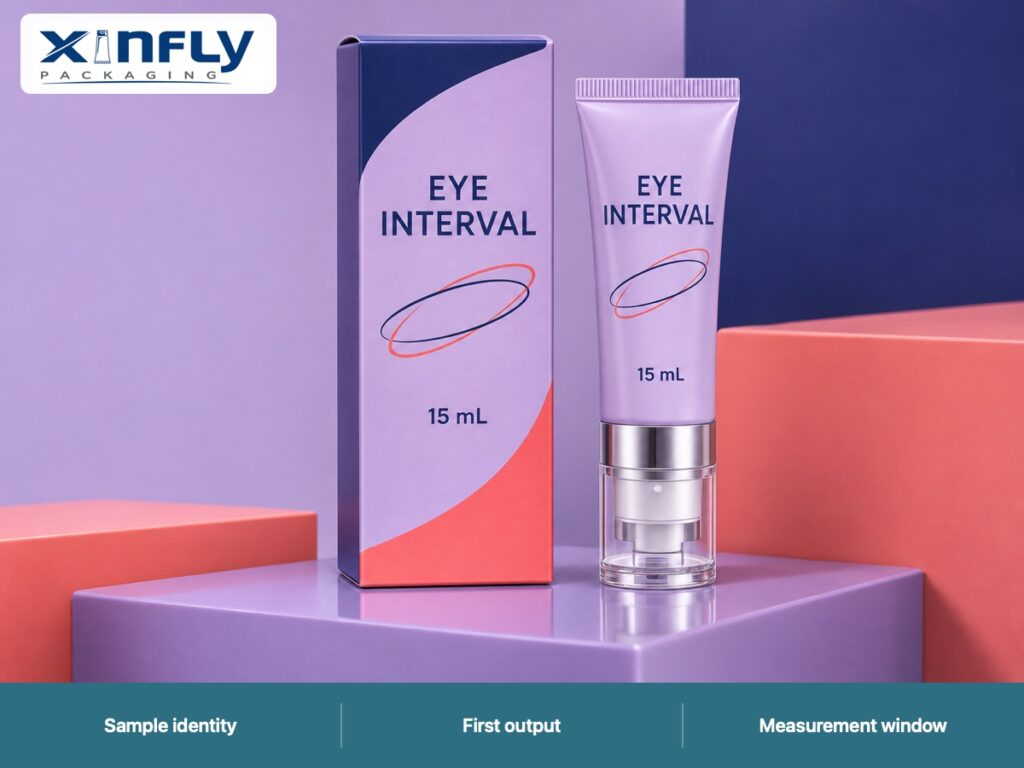
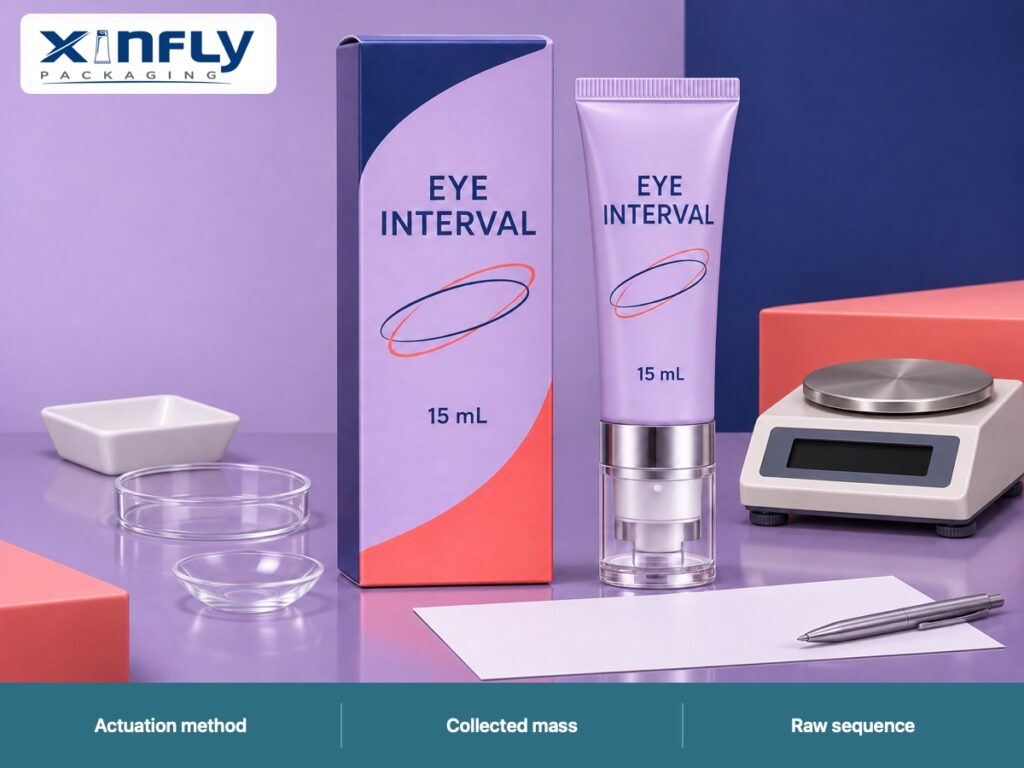
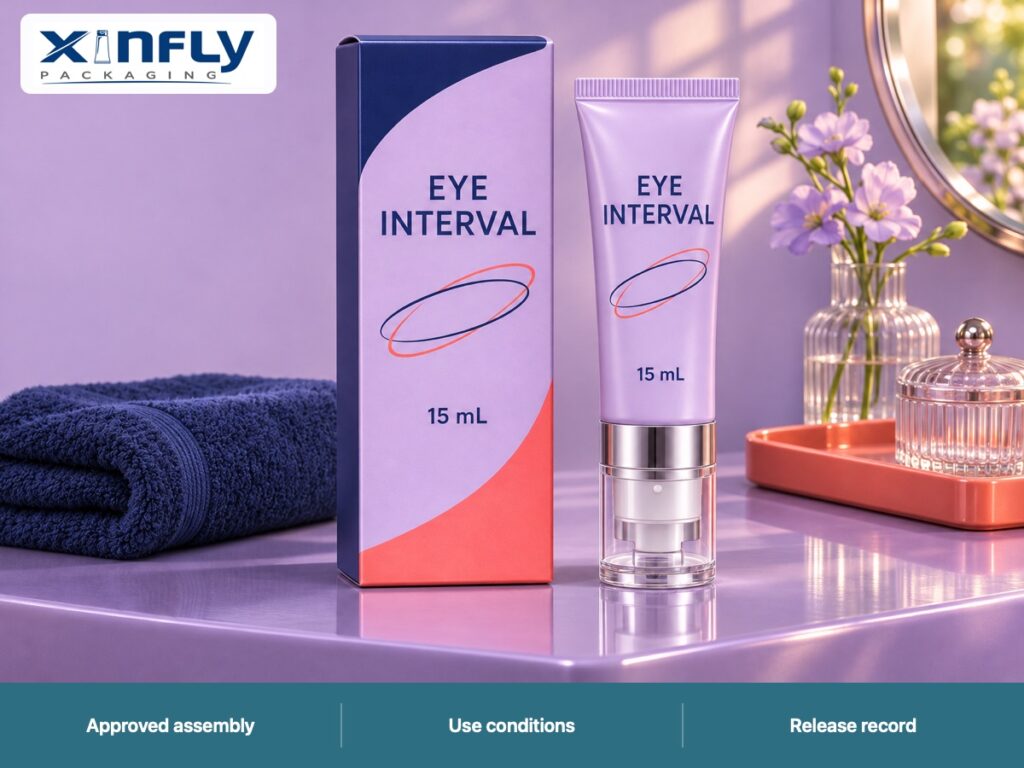
The EYE INTERVAL illustrations show a nominal 15 mL lavender PE body, molded shoulder, straight sealed display tail, silver-colored pump collar, white actuator and clear cylindrical overcap. Navy and coral screen-printed orbital artwork coordinates with the printed carton. These pictures illustrate a packaging concept. They do not show measured priming performance or establish a qualified eye cream-and-pump combination.
Record Formula and Preparation History
Identify the formula revision, representative batch and preparation state. Ask the filler which filling and handling information is relevant to the comparison, including any preparation or rest period defined in the trial plan. Keep the actual values and their basis. Do not borrow a viscosity description from another product just because both formulas are marketed as eye cream.
Distinguish New Samples from Previously Operated Ones
An already operated pump and a fresh sample do not have the same start-up history. Label them separately. Record whether the sample has been pressed before, how it was stored and whether the earlier sequence is known. If the history is uncertain, keep that uncertainty visible instead of calling the next observed stroke “first use.”
Record the Sequence Before Calculating an Average
Use an Illustrative Log to See the Difference
The following six-stroke sequence is invented for arithmetic explanation. It is not a test of EYE INTERVAL, a Xinfly performance result or a target pump specification. Assume the entries represent net mass actually collected on each numbered actuation under one defined example method. In a real trial, retain the method, sample identity and actual observations together.
| Actuation number | Assumed collected mass | Observation in this example |
|---|---|---|
| 1 | 0.00 g | No collected product in the example log |
| 2 | 0.00 g | No collected product in the example log |
| 3 | 0.04 g | First positive collected mass in the example |
| 4 | 0.08 g | Later output recorded separately |
| 5 | 0.10 g | Later output recorded separately |
| 6 | 0.10 g | Later output recorded separately |
Keep the Observation Window in the Result
The six entries total 0.32 g, so the average across all six is about 0.0533 g per actuation. The last three total 0.28 g, giving about 0.0933 g per actuation for that selected window. Neither calculation changes the original observations. They summarize different portions of the sequence, which is why the window belongs beside the average.
The example’s first positive collected mass occurs on actuation three. That does not make three an acceptable priming limit, and two similar later entries do not prove stable long-term output. The project needs its own definitions and acceptance plan. Keep the raw sequence so a reviewer can see exactly what the chosen summary includes and excludes.
Do Not Convert Mass into Volume Without the Right Information
A mass collected in grams is not automatically the same number of milliliters. If the decision requires a volume estimate, obtain the appropriate density information for the actual formula and conditions. Keep any conversion separate from the measured mass log. Likewise, nominal tube capacity does not determine the pump’s output per stroke.
Make Collection and Measurement Comparable
Define the Tare and Collection Approach
Have the responsible team agree how output will be collected and measured. Identify the container or collection surface, tare approach, balance capability and handling method relevant to the trial. If material remains on the outlet or collection tool, document how the procedure treats it. Otherwise, “output mass” can mean different things in two supplier reports.
Avoid counting product as both collected and retained elsewhere in the same calculation. The worksheet should state what the measurement includes. It should also distinguish zero from a missing reading or an observation below the agreed measurement capability. Do not enter an invented zero simply because a reviewer could not obtain a useful value.
Retain Individual Sample Results
If several samples are reviewed, keep their sequences separate before creating any summary. A group average can hide one sample with a different start-up pattern. Ask the quality owner to define the sampling and acceptance approach appropriate to the project. This guide does not prescribe sample quantities or a statistical acceptance rule from an illustrative six-stroke log.
| Comparison field | What to agree or record | Why it matters |
|---|---|---|
| Assembly identity | Tube, pump and relevant component references | Keeps the result tied to a complete reviewed pack |
| Formula identity | Formula revision and representative batch | Makes different products distinguishable in the record |
| Sample history | Filling, preparation, storage and prior operation | Separates first-use and previously operated samples |
| Actuation method | Agreed operating action, interval and orientation | Makes the comparison method visible |
| Measurement basis | Collection, tare, units and relevant balance capability | Defines what each output entry represents |
| Reported result | First-output observation, raw sequence and stated averaging window | Prevents unlike summaries being compared |
| Acceptance scope | Project criteria, findings and responsible release owner | Connects observations to the actual purchasing decision |
Keep Start-Up Behavior Separate from Other Qualification
Ask for Evidence Beyond the First Few Strokes
The first-dispense record answers a start-up question for the reviewed samples and conditions. It does not establish shelf life, full-pack evacuation, formula protection or performance throughout the product’s use. Ask the responsible teams which other work the intended product requires. Keep those results in their own records rather than expanding the scope of a short dispensing exercise.
For airless tube packaging, avoid interpreting the category name as a promise of zero air exposure, sterility or universal compatibility. Request evidence relevant to the actual assembly and product. The appearance of a silver collar or clear overcap cannot establish the mechanism’s internal materials or qualify it for a particular formula.
Review Restart Behavior as a Separate Condition
If behavior after a pause matters to the project, define that condition explicitly with the responsible team. Record the duration, storage orientation and prior operating history. Label the resulting observations as a restart review rather than combining them with the fresh-sample priming count. Clear labels make comparison easier without prescribing a universal waiting period.
Use the Results to Ask Better Purchasing Questions
Compare Proposals with the Same Method
Ask suppliers what their output figures describe: mass or volume, which formula, what preparation and which measurement window. A nominal pump figure may be useful context, but it does not replace a representative sample review for your intended product. Request clarification when two proposals summarize different conditions instead of ranking the numbers directly.
For custom airless pump tubes, send the target product, assembly preference, nominal fill, intended use and the specific dispensing question. Use sample development to discuss which sample states and trial responsibilities are available. Confirm quantities, costs and timing for the actual project rather than assuming a different tube’s sampling arrangement will apply.
Freeze the Assembly Before Finalizing the Carton
Keep final exterior dimensions, protective cap and pump configuration connected to the selected tube. If the mechanism changes during sample review, check whether the outer package still fits and protects the intended assembly. A carton designed around an earlier sample should not be assumed suitable merely because the nominal fill remains 15 mL.
Retain the approved references, raw observations, calculation windows and actual release decisions together. For a proposal review, send Xinfly Packaging your airless sample brief with the formula information and filler’s requirements. A well-defined first-use question gives the team a practical starting point for comparing samples and identifying unresolved work.
Frequently Asked Questions
How many presses should an airless eye cream tube need before dispensing?
There is no universal limit in this guide. Define the criterion for the actual assembly, formula and intended use with the responsible teams. Record the first-output observation under the agreed method rather than applying the hypothetical example as a specification.
Can I compare two suppliers’ average output figures directly?
First compare their units, formula, sample preparation, actuation method and averaging window. Different summaries can describe different questions. Request the relevant conditions and representative sample evidence before treating the figures as an equivalent purchasing comparison.
Does an empty sample demonstrate priming with my formula?
An empty component can support assembly and appearance review, but it cannot demonstrate dispensing with the intended formula. Agree the necessary filled-sample preparation and responsibilities for the actual comparison. Keep any empty-sample approval limited to the features reviewed.
Are similar outputs on two strokes proof of consistent performance?
Two similar observations do not establish performance across all samples or the entire pack. Use the project’s agreed sampling, conditions and acceptance plan. Retain the sequence and review scope so a short observation is not mistaken for a broader qualification.
What should trigger another first-dispense review?
Ask the responsible owners to assess relevant changes to the pump, tube assembly, formula, filling route or preparation conditions. Identify the affected specification and order. Keep fresh-sample and restart questions distinct when deciding what needs to be reviewed again.
Conclusion
A useful priming record preserves the sequence behind the average. Identify the assembly and formula, agree the actuation and measurement method, and report first output separately from later dispensing. That gives Xinfly Packaging, your filler and your buying team a clearer basis for choosing which airless eye cream tube proposal should move to the next approval stage.