
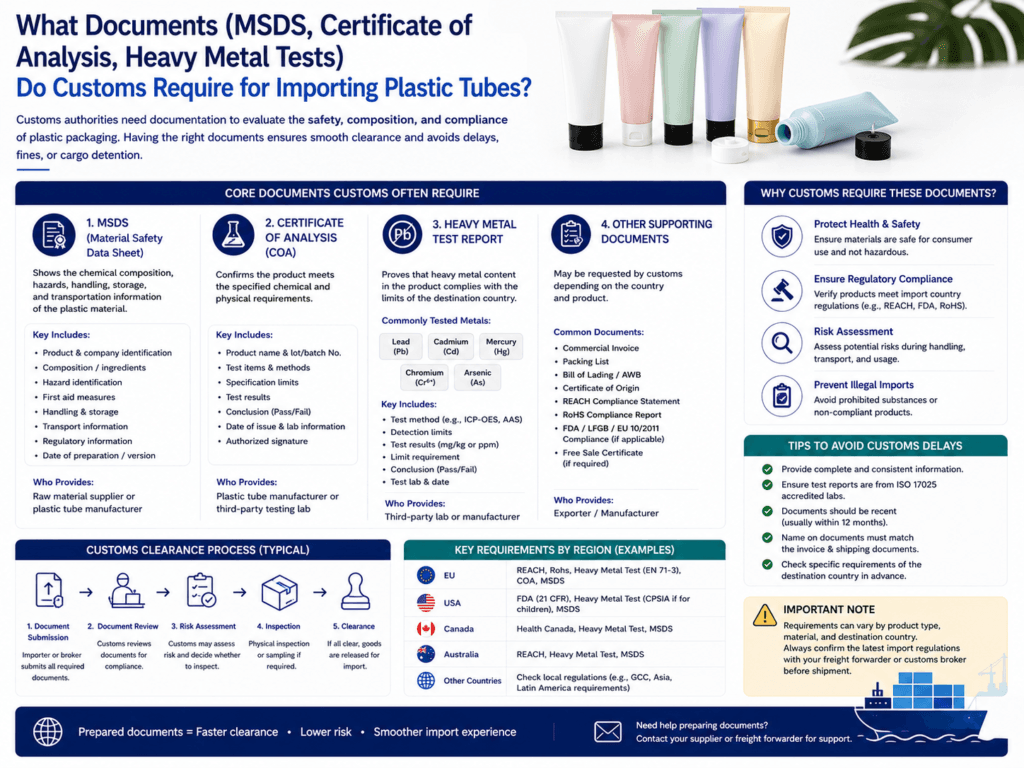
For most shipments of empty plastic cosmetic tubes, customs normally requires commercial shipping and declaration documents rather than a full technical testing package. The core documents usually include a commercial invoice, packing list, bill of lading or air waybill, customs declaration, HS code, country-of-origin information, and any import license or product-specific permit required by the destination country.
Documents such as an MSDS or SDS, Certificate of Analysis, heavy-metal test report, REACH report, RoHS report, food-contact declaration, or material certificate may still be requested by the importer, customs broker, carrier, retailer, brand, or market-surveillance authority. However, they are not automatically required for every shipment of empty PE, PCR, ABL, PBL, or PP packaging components.
Quick Answer
Commercial invoice, packing list, transport document, HS classification, customs declaration, and origin information are the usual core customs documents. An MSDS is generally used to demonstrate chemical hazard or non-hazard status. A Certificate of Analysis confirms batch-specific material or product results. Heavy-metal testing supports packaging safety or market-compliance requirements. These technical documents are usually supporting documents rather than universal customs-entry documents for ordinary empty plastic tubes.
| Document | Usually Required for Customs? | Main Purpose |
|---|---|---|
| Commercial invoice | Yes, in most international imports | Declares seller, buyer, goods, quantity, value, currency, origin, and trade terms |
| Packing list | Usually | Shows carton count, quantities, net weight, gross weight, dimensions, and packing details |
| Bill of lading or air waybill | Yes | Identifies the shipment, carrier, consignor, consignee, route, and transport details |
| MSDS or SDS | Not normally for standard non-hazardous empty tubes | Communicates chemical hazards or supports a non-hazardous declaration |
| Certificate of Analysis | Not normally a routine customs document | Provides batch-specific test results or material properties |
| Heavy-metal test report | Market- or product-specific | Supports restrictions on lead, cadmium, mercury, chromium, or other regulated substances |
Which Documents Are Normally Needed for Customs Clearance?
Commercial Invoice
Used to establish transaction value, buyer and seller details, product description, quantity, currency, Incoterm, origin, and tariff classification.
Packing List
Shows how the empty tubes are packed, including cartons, quantities, weights, dimensions, pallet information, and shipping marks.
Transport Document
A bill of lading, sea waybill, or air waybill connects the commercial documents to the physical shipment and carrier.
Customs Declaration
The importer or customs broker declares the goods, tariff code, value, origin, duty, and other required entry data.
Country-of-Origin Evidence
May be needed for normal origin declaration, preferential tariff treatment, trade remedies, or origin marking requirements.
Importer-Specific Permits
Some markets or product applications may require permits, registrations, conformity documents, or importer declarations.
1. Commercial Invoice Requirements
The product description on the invoice should be specific enough for customs classification. Descriptions such as “plastic products,” “samples,” or “packaging” may be too vague and can lead to customs questions or delays.
| Invoice Item | Recommended Information |
|---|---|
| Product description | Empty PE cosmetic squeeze tubes with PP caps, unfilled, for cosmetic packaging |
| Material | PE, multi-layer PE/EVOH, ABL, PBL, PCR PE, PP cap, or other applicable material |
| Quantity | Total pieces and quantity by SKU, size, color, and artwork |
| Unit and total value | Commercial unit price, total declared value, and currency |
| Country of origin | Actual manufacturing country, such as China or Thailand |
| HS code | Code confirmed by the importer or licensed customs broker |
| Incoterm | EXW, FOB, CIF, DAP, DDP, or other agreed trade term |
Important: The exporter can suggest an HS code, but the importer of record is normally responsible for confirming the correct tariff classification in the destination country.
2. Packing List Requirements
The packing list should match the commercial invoice and transport document. Differences in carton quantity, gross weight, product description, or consignee details can delay customs clearance.
| Packing Detail | Why Customs or the Broker Needs It |
|---|---|
| Number of cartons | Allows physical shipment verification |
| Pieces per carton | Confirms total imported quantity |
| Net and gross weight | Supports declaration and transport verification |
| Carton dimensions | Supports freight, warehouse, and inspection calculations |
| Pallet information | Shows pallet count, type, dimensions, and total loading configuration |
| SKU and carton marks | Helps identify different tube sizes, colors, and printed designs |
3. Bill of Lading or Air Waybill
The bill of lading is normally used for ocean shipments, while an air waybill is used for air shipments. The description and carton count should be consistent with the invoice and packing list.
- Shipper: Exporting factory or trading entity.
- Consignee: Importer, buyer, or designated receiving party.
- Notify party: Customs broker, importer, or other designated contact.
- Cargo description: Empty plastic cosmetic packaging tubes and closures.
- Package count: Total cartons, pallets, or other shipping units.
- Container details: Container number and seal number for full-container shipments.
Is an MSDS Required for Empty Plastic Tubes?
An MSDS, now more commonly called an SDS, is not usually a standard customs requirement for ordinary empty plastic tubes made from non-hazardous PE or PP. Empty molded or extruded plastic tubes are normally treated as finished articles rather than hazardous chemical substances or mixtures.
However, an SDS or non-hazardous declaration may still be requested by a freight forwarder, airline, courier, customs broker, port, warehouse, or customs officer—especially when the product description is unclear or the shipment includes coatings, inks, adhesives, chemicals, or unidentified samples.
| Shipment Situation | MSDS/SDS Likelihood | Recommended Document |
|---|---|---|
| Standard empty PE tubes with PP caps | Usually low | Material declaration or non-hazardous statement if requested |
| Printed empty cosmetic tubes | Usually low to moderate | Finished-product declaration; ink SDS may be requested separately |
| Uncured ink, coating, adhesive, or chemical shipped separately | Higher | Current SDS for each chemical product |
| Air or express courier shipment | May be requested more often | SDS or non-dangerous-goods declaration |
| Plastic samples with unclear material | Moderate | Material composition statement and non-hazardous declaration |
MSDS vs. Material Declaration
| Document | Main Use | Best for Empty Tubes? |
|---|---|---|
| SDS/MSDS | Hazard classification, handling, storage, transport, and emergency information | Only when requested or when hazardous chemical content is relevant |
| Material declaration | Identifies PE, PP, EVOH, aluminum barrier, PCR content, pigments, or other materials | Often more relevant for finished empty packaging |
| Non-hazardous declaration | States that the finished packaging is non-dangerous for transportation | Useful for carriers, couriers, and unclear sample shipments |
| Technical data sheet | Describes physical properties and intended use | Useful as supporting information |
What Is a Certificate of Analysis?
A Certificate of Analysis, or COA, reports the results of specified tests for a particular material or production batch. It may include resin identification, melt-flow properties, density, color, dimensions, weight, heavy-metal results, or other agreed quality data.
A COA is usually a buyer, quality, or compliance document rather than a routine customs-clearance requirement for empty cosmetic tubes. Customs may request it when the product classification, material composition, claimed recycled content, safety, or declared description needs additional verification.
| COA Type | Possible Information | Issued By |
|---|---|---|
| Raw-material COA | Resin grade, density, melt-flow index, additives, and batch number | Resin or laminate supplier |
| Finished-component COA | Dimensions, weight, color, functional tests, and lot traceability | Tube manufacturer |
| Third-party laboratory report | Heavy metals, restricted substances, migration, or material identification | Independent accredited laboratory |
| Certificate of Conformity | Statement that the shipment meets agreed specifications | Manufacturer or authorized quality department |
Is a Certificate of Analysis Required by Customs?
Usually not for ordinary empty plastic cosmetic tubes. It may become relevant in the following situations:
- The customs officer questions the material composition or declared HS classification.
- The importer claims a recycled-content, bio-based, or special-material status.
- The packaging is intended for pharmaceutical, food-contact, medical, or regulated product use.
- The destination market requires evidence of restricted-substance compliance.
- The importer, retailer, contract filler, or brand has its own technical documentation requirements.
- The goods are sampled by customs or a market-surveillance authority for laboratory verification.
Are Heavy-Metal Test Reports Required?
Heavy-metal test reports are not normally required for every customs entry of empty plastic cosmetic tubes. They are more commonly requested to demonstrate product or packaging compliance, particularly when pigments, inks, metallic coatings, hot-stamping foils, recycled materials, or metal applicator components are used.
| Packaging Component | Heavy-Metal Risk Focus | Testing Priority |
|---|---|---|
| PE or PP tube body | Pigments, color masterbatch, fillers, and recycled feedstock | Moderate for custom colors or PCR materials |
| Printing ink | Lead, cadmium, mercury, chromium, and other restricted substances | Higher for bright, metallic, or special-effect inks |
| Hot-stamping foil | Metallic pigments, coatings, adhesives, and backing layers | Moderate to high for premium decoration |
| Electroplated or metal-jacketed cap | Metal substrate, plating chemistry, coatings, and migration risk | High when required by the destination market or customer |
| PCR plastic | Unknown contaminants or mixed post-consumer feedstock | Higher than controlled virgin resin |
| Zinc-alloy applicator | Metal composition, plating, nickel release, lead, or coating stability | High for eye-area or direct-contact applicators |
Which Heavy Metals Are Commonly Tested?
The required test panel depends on the destination market and product application. A buyer may request total-content or migration testing for substances such as:
- Lead
- Cadmium
- Mercury
- Hexavalent chromium
- Arsenic
- Antimony
- Barium
- Selenium
- Nickel or nickel release for metal applicators
- Other substances specified by the importer, retailer, or destination regulation
Testing note: “Heavy-metal compliant” is too vague for a purchase contract. The buyer should identify the substances, test method, detection limits, laboratory requirements, applicable regulation, and acceptance limits.
Other Documents Customs or Importers May Request
| Document | When It May Be Needed | Main Purpose |
|---|---|---|
| Certificate of Origin | Preferential tariff, trade agreement, customs request, or buyer requirement | Confirms where the tubes were manufactured |
| REACH report or declaration | EU customers or restricted-substance programs | Supports chemical-substance compliance |
| RoHS report | Customer specification or packaging used with electrical-related products | Supports restricted-substance limits |
| Food-contact declaration | Oral care, food, supplements, or packaging treated as food-contact material | Supports applicable food-contact requirements |
| GRS or recycled-content certificate | PCR packaging claims | Supports recycled-material traceability |
| Bio-based material declaration | Sugarcane PE or renewable-content claims | Supports material-origin claims |
| Phthalate or BPA test | Buyer, retailer, or market-specific requirement | Supports restricted-chemical compliance |
| Non-dangerous-goods declaration | Carrier, airline, courier, or customs request | Confirms transport classification |
Documents for Different Tube Materials
| Tube Material | Recommended Supporting Documents |
|---|---|
| Standard PE tube | Material declaration, resin specification, non-hazardous declaration if requested |
| Five-layer EVOH tube | Layer-structure declaration, material specification, compatibility documentation |
| PCR PE tube | Recycled-content declaration, GRS or other traceability document, odor and restricted-substance tests |
| Sugarcane PE tube | Bio-based content or raw-material declaration, supplier certificate, chain-of-custody support if claimed |
| ABL tube | Laminate structure, aluminum-layer declaration, material and heavy-metal reports when required |
| PBL tube | Laminate structure, barrier-layer specification, restricted-substance report when required |
| Metal applicator tube | Metal composition, plating declaration, heavy-metal report, corrosion and compatibility tests |
Does the Intended Product Affect Documentation?
Yes. Customs and regulatory expectations may differ depending on whether the tubes will be used for ordinary cosmetics, oral care, OTC-style products, pharmaceuticals, food, medical products, or industrial chemicals.
| Intended Use | Possible Additional Documentation |
|---|---|
| General skincare or personal care | Material declaration, restricted-substance reports, buyer-specific compliance documents |
| Toothpaste or oral care | Food-contact or oral-contact support, heavy-metal and migration testing where required |
| Pharmaceutical or OTC product | Stricter material, quality, compatibility, tamper-evident, and regulatory documentation |
| Food or supplement packaging | Applicable food-contact declaration and migration testing |
| Industrial chemical packaging | SDS, dangerous-goods classification, chemical resistance, and transport documentation |
| Hotel amenities | Standard customs documents plus buyer or hotel-group compliance requirements |
Documents for Samples and No-Charge Shipments
Free samples still require an accurate customs declaration. Writing “no commercial value” does not mean the shipment can be declared with no value. Customs may require a reasonable value for duty and statistical purposes.
- Issue a pro forma invoice for samples when no commercial sale occurs.
- State “samples for evaluation, not for resale” when accurate.
- Declare a reasonable customs value.
- Describe the goods as empty plastic cosmetic tube samples.
- State the actual country of origin.
- Include material and non-hazardous information when requested by the courier.
- Avoid descriptions such as “gift,” “plastic items,” or “free goods” without product details.
Common Causes of Customs Delays
| Problem | Why It Causes Delay | Prevention |
|---|---|---|
| Vague product description | Customs cannot confirm classification or intended use | Describe empty tubes, materials, caps, and application clearly |
| Invoice and packing-list mismatch | Quantity, carton, or weight data appear inconsistent | Cross-check all documents before shipment |
| Incorrect HS code | Duty, restrictions, or product category may be wrong | Confirm classification with the importer or customs broker |
| Missing country of origin | Customs cannot apply correct tariff or trade measures | State origin consistently on documents and markings |
| Unclear PCR or bio-based claim | Customs or buyer requests supporting proof | Prepare traceability and material certificates before shipping |
| MSDS requested after cargo arrival | Carrier or customs cannot verify hazard status | Prepare a material or non-hazardous declaration in advance |
Recommended Documentation Package
Core Customs File
Commercial invoice, packing list, bill of lading or air waybill, HS code confirmation, country-of-origin statement, customs declaration data, and any required import permit.
Technical Support File
Material declaration, technical data sheet, Certificate of Conformity, batch COA if agreed, heavy-metal or restricted-substance reports, and non-hazardous declaration.
Sustainability File
PCR certificate, GRS documentation, ocean-bound plastic evidence, bio-based declaration, or other traceability documents supporting environmental claims.
Quality File
Approved PPS, dimensional inspection, AQL report, leakage test, cap compatibility report, printing adhesion test, and carton inspection.
What Should Be Included in a Material Declaration?
| Declaration Item | Example |
|---|---|
| Product | Empty cosmetic squeeze tube with closure |
| Tube body material | LDPE/LLDPE/HDPE blend or multi-layer PE/EVOH structure |
| Closure material | PP screw cap or PP flip-top cap |
| Decoration | Silk-screen ink, offset ink, varnish, or hot-stamping foil |
| Hazard status | Finished article is not classified as dangerous goods for ordinary transportation, subject to applicable review |
| Intended use | Empty primary packaging for cosmetic or personal care products |
| Country of manufacture | China or Thailand |
Who Should Confirm the Final Document List?
The importer of record and its customs broker should confirm the final customs documents before shipment. The tube manufacturer should provide accurate product, material, origin, quantity, packing, and technical information, but destination-country customs requirements are normally controlled by the importer’s local authorities.
- Manufacturer: Supplies invoice, packing list, origin, product description, material declarations, and available test reports.
- Freight forwarder: Confirms transport and carrier-document requirements.
- Customs broker: Confirms tariff classification, import-entry documents, duties, and local clearance procedures.
- Importer of record: Holds responsibility for accurate declaration and destination-market compliance.
- Brand or compliance team: Confirms product-specific safety, quality, and restricted-substance documents.
Common Mistakes to Avoid
- Assuming an MSDS is always mandatory: It is not normally a universal customs document for finished non-hazardous plastic tubes.
- Assuming an MSDS is never needed: Carriers or customs may request hazard-status evidence for unclear shipments.
- Calling a generic specification a COA: A true COA should identify the tested batch and actual results.
- Using old test reports: Reports should match the current material, color, decoration, supplier, and production structure.
- Testing only the PE body: Caps, inks, foil, coatings, adhesives, and metal applicators may create separate compliance risks.
- Printing unsupported sustainability claims: PCR, ocean plastic, and bio-based claims need traceable documentation.
- Allowing document inconsistencies: Invoice, packing list, bill of lading, origin, weights, and quantities should match.
Best Practical Recommendation
Before shipping empty plastic cosmetic tubes, ask the importer or customs broker for a destination-specific document checklist. Prepare the standard commercial documents first, then maintain a technical file containing material declarations, non-hazardous information, COA or conformity documents, heavy-metal testing, restricted-substance reports, and sustainability certificates where applicable.
For ordinary empty PE tubes with PP caps, customs generally focuses on classification, origin, value, quantity, and shipping records. For PCR tubes, metal applicators, ABL structures, special coatings, oral-care packaging, pharmaceutical packaging, or shipments containing chemicals, additional supporting documents are more likely to be requested.
Summary
The normal customs documents for importing empty plastic tubes are the commercial invoice, packing list, bill of lading or air waybill, customs declaration, HS classification, country-of-origin information, and any destination-specific permit.
MSDS/SDS, Certificate of Analysis, and heavy-metal test reports are supporting technical documents rather than universal customs requirements for standard empty cosmetic tubes. Their necessity depends on the material, decoration, intended use, transportation method, importer requirements, and destination-market regulations.
Learn more: Quality Assurance, Certifications, Cosmetic Tube Materials, PCR Cosmetic Tubes, Hidden Costs of Importing Empty PE Tubes, Contact Xinfly Packaging.
Need Export Documents for Custom Cosmetic Tubes?
Xinfly Packaging supports international buyers with commercial invoices, packing lists, product descriptions, material declarations, Certificates of Conformity, available test reports, quality records, carton data, and export documentation for custom cosmetic tube shipments.