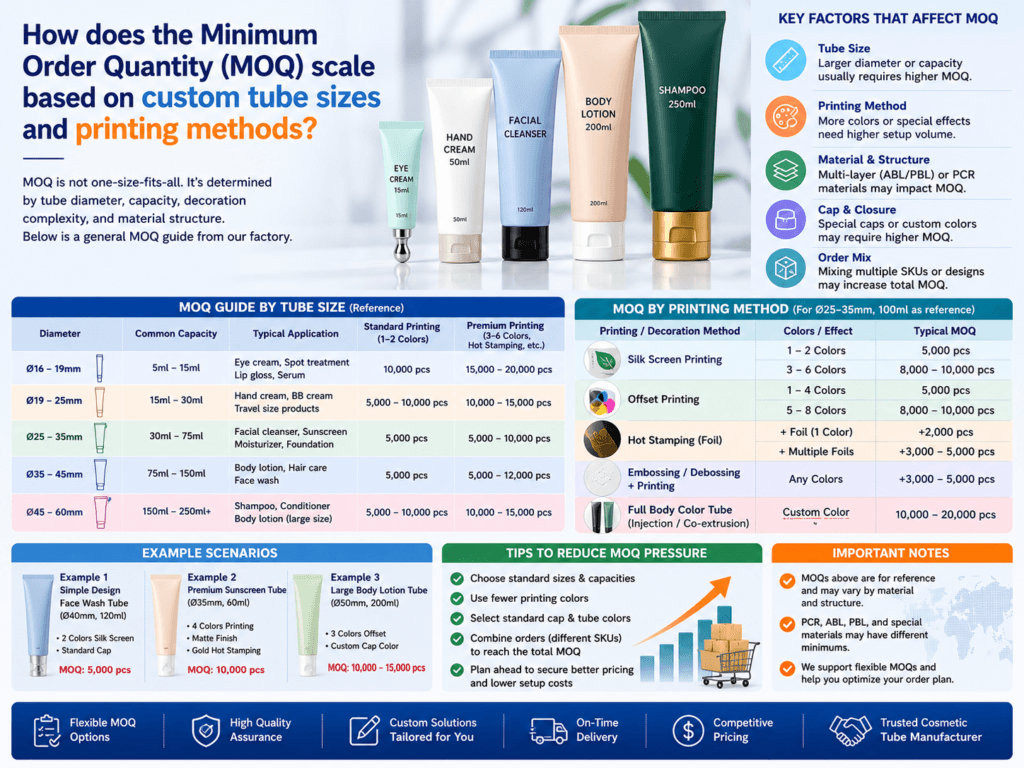
The minimum order quantity for custom cosmetic tubes generally increases as the tube structure, size, color, printing method, and number of artwork versions become more customized. A standard-size PE tube with an existing mold and simple one-color printing may start from around 5,000 pieces, while special diameters, custom caps, multi-layer materials, premium decoration, or multiple SKUs may require 10,000 pieces or more.
MOQ is not determined by tube capacity alone. A 30ml tube can have a higher MOQ than a 100ml tube if it requires a new mold, custom applicator, several print colors, or multiple artwork changes. The factory must consider material preparation, extrusion efficiency, printing setup, color changeover, cap molding, quality inspection, and production loss.
Quick Answer
For many custom cosmetic tube projects, the practical MOQ is approximately 5,000 pieces per size, color, and artwork. Standard tubes with simple decoration may sometimes support a more flexible trial quantity. Custom tube diameters, special caps, PCR or barrier materials, offset printing, multiple silk-screen colors, hot stamping, soft-touch finishes, and several artwork versions usually increase the MOQ.
| Tube Configuration | Typical MOQ Direction | Main Reason |
|---|---|---|
| Standard tube size, stock color, no printing | Lowest and most flexible | Existing molds and minimal setup |
| Standard size with custom color | Usually around 5,000 pcs or more | Custom material and color preparation |
| Standard size with simple printing | Usually around 5,000 pcs per artwork | Printing setup and production efficiency |
| Special diameter or custom tube head | Often 10,000 pcs or more | Tooling, machine setup, and dedicated production |
| Multiple colors, finishes, or artwork versions | Calculated separately for each SKU | Repeated changeovers, setup, and quality control |
Why Cosmetic Tube Manufacturers Set MOQs
Cosmetic tubes are manufactured through several connected processes. The factory must prepare resin, match color, extrude the tube body, form the shoulder and neck, manufacture or source caps, print the artwork, apply surface treatments, inspect the tubes, and pack them. Each process has a minimum efficient production quantity.
- Material preparation: Custom resin blends and color masterbatch require a minimum batch size.
- Machine setup: Extrusion and printing equipment must be cleaned, adjusted, and calibrated.
- Printing setup: Screens, plates, inks, foil dies, and registration settings create fixed costs.
- Production loss: Trial pieces, color adjustment, startup waste, and QC samples reduce usable output.
- Cap production: Custom PP cap colors or designs may have a separate injection-molding MOQ.
- Inspection efficiency: Small batches may require almost the same QC setup as larger orders.
How Tube Size Affects MOQ
Standard diameters are easier to produce because factories already have tube head molds, caps, holders, printing fixtures, and packing experience for these specifications. Unusual sizes may require tooling changes or dedicated production scheduling.
| Tube Size Requirement | MOQ Effect | Procurement Recommendation |
|---|---|---|
| Standard diameter and standard length | Lower MOQ | Use an existing mold and adjust length for the required capacity |
| Standard diameter with custom length | Small or moderate MOQ increase | Confirm that the selected capacity and headspace remain suitable |
| Unusual diameter | Higher MOQ and possible tooling cost | Compare nearby standard diameters before developing a new mold |
| Oval or flat-oval tube | Higher MOQ | Confirm oval tooling, cap shape, and printing registration early |
| Large-capacity tube | May require higher MOQ | Check wall thickness, cap base, carton volume, and filling-line fit |
| Mini or sample-size tube | May still require standard production MOQ | Small tube size does not automatically mean a small order quantity |
Typical MOQ Direction by Standard Tube Diameter
| Tube Diameter | Common Capacity Range | MOQ Direction | Typical Applications |
|---|---|---|---|
| Ø16mm–Ø19mm | 3ml–15ml | Standard MOQ may still apply despite small size | Eye cream, lip treatment, spot treatment, hotel samples |
| Ø22mm–Ø25mm | 10ml–30ml | Usually flexible with existing molds | Eye cream, hand cream, travel skincare |
| Ø30mm–Ø35mm | 30ml–100ml | Common standard MOQ | Sunscreen, hand cream, skincare, facial cleanser |
| Ø40mm | 80ml–150ml | Common standard MOQ | Face wash, sunscreen, body care, treatment cream |
| Ø50mm | 150ml–300ml | May require more material and carton planning | Body lotion, shampoo, conditioner, hair masks |
Engineer’s note: Using a standard diameter and changing only the tube length is often the most cost-effective way to achieve a custom fill capacity without increasing tooling cost or MOQ.
How Tube Material Affects MOQ
Material structure can significantly affect the production quantity. Standard mono-layer or two-layer PE is usually easier to arrange than special PCR ratios, sugarcane PE, five-layer EVOH, ABL, PBL, or other custom barrier structures.
| Tube Material | MOQ Direction | Why |
|---|---|---|
| Standard PE | Lowest or standard MOQ | Widely available material and stable extrusion process |
| Two-layer PE | Standard to moderate | Additional layer control and material preparation |
| Five-layer EVOH PE | Moderate to higher | Multiple resin layers and dedicated co-extrusion setup |
| PCR PE | Depends on PCR percentage and color | Custom blending, odor, color, and batch consistency control |
| Sugarcane PE | Moderate to higher | Special material sourcing and production scheduling |
| ABL or PBL laminate | Usually higher than basic PE projects | Laminated web printing, side-seam production, and material batch size |
How Custom Tube Color Affects MOQ
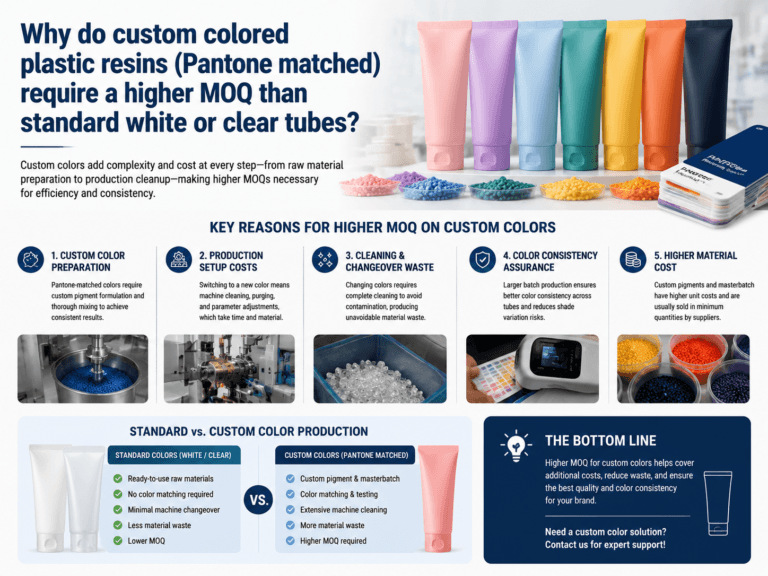
A standard white, natural, transparent, or common stock color is usually easier to produce. A custom Pantone tube body requires color masterbatch preparation and extrusion-line cleaning. Very light, metallic, pearlized, translucent, or PCR-based colors may require additional trials and a higher minimum batch.
| Color Requirement | MOQ Effect | Quality Consideration |
|---|---|---|
| Standard white | Lowest | Stable and widely available |
| Standard transparent or natural | Low to standard | Clarity depends on material structure |
| Custom Pantone color | Standard to higher MOQ | Needs color trial and batch-tolerance approval |
| Pearlized or metallic tube body | Higher | Special pigments and surface consistency are required |
| PCR natural color | Project-specific | Color variation may be accepted as part of the recycled appearance |
| Several body colors in one order | MOQ often applies per color | Each color requires separate material and machine setup |
MOQ by Printing Method
Printing method is one of the biggest MOQ drivers. Every artwork color, screen, plate, foil die, coating, and changeover creates setup cost and production loss. Simple artwork generally supports a lower MOQ than complex, multi-process decoration.
| Printing Method | Typical MOQ Direction | Reason |
|---|---|---|
| No printing / blank tubes | Lowest and most flexible | No artwork setup or printing changeover |
| One-color silk screen | Lower custom-print MOQ | One screen and simpler registration |
| Two- or three-color silk screen | Standard to higher | Separate screens, drying, and registration for each color |
| Offset printing | Standard to higher | Plate preparation and economical run length are required |
| Digital printing | Potentially lower for qualified small runs | Less plate setup, but suitability depends on tube size and equipment |
| Hot stamping | Adds to the base printing MOQ | Foil die, foil setup, alignment, and extra production pass |
| Shrink sleeve or label | Project-specific | Separate label supplier MOQ and application process |
Silk Screen Printing MOQ
Silk screen printing is commonly used for premium logos and solid colors. MOQ normally increases with the number of colors because every color needs its own screen, ink preparation, drying step, and registration adjustment.
| Silk Screen Configuration | MOQ Direction | Cost and Setup Impact |
|---|---|---|
| One color, one side | Most flexible | Simple screen and short setup |
| One color, front and back | Low to standard | More print coverage and registration control |
| Two colors | Standard | Two screens and two printing passes |
| Three or more colors | Higher | Complex registration and longer production time |
| Silk screen plus hot stamping | Higher | Additional foil die, alignment, and inspection |
Offset Printing MOQ
Offset printing is suitable for detailed graphics, gradients, fine text, and larger artwork coverage. It usually has more setup than simple silk screen printing, so factories prefer a sufficient order quantity to distribute plate preparation and startup waste across the production run.
- Plate setup: Each artwork requires production preparation.
- Color calibration: CMYK or spot colors must be balanced before stable printing begins.
- Startup waste: Initial tubes may be used for registration and color adjustment.
- Artwork versions: Every design version may be treated as a separate printing run.
- Varnish or coating: Additional finishing creates another process and setup requirement.
Can Digital Printing Reduce MOQ?
Digital printing may reduce the setup burden for short runs because it does not always require traditional plates or screens. However, not every tube diameter, material, artwork, finish, or factory line supports digital tube printing. Unit costs may also be higher than conventional printing at larger quantities.
| Digital Printing Advantage | Limitation | Best Application |
|---|---|---|
| Lower setup for short runs | Higher unit cost at scale | Launch quantities, market testing, seasonal products |
| Supports detailed graphics | Color and adhesion must be validated | Complex artwork and multiple designs |
| Faster artwork changeover | Not available for every tube specification | Several low-volume SKUs with the same tube size |
| No traditional screen per color | Special coating or pretreatment may be required | Projects where flexibility is more important than lowest unit price |
How Hot Stamping and Premium Finishes Affect MOQ
Hot stamping, spot UV, soft-touch coating, matte varnish, pearl effects, metallic finishes, and other premium treatments usually increase MOQ because they add independent production stages and quality risks.
| Decoration | MOQ Impact | Key Quality Risk |
|---|---|---|
| Gold or silver hot stamping | Moderate increase | Foil cracking, alignment, incomplete transfer |
| Matte varnish | Moderate increase | Uneven finish, scratch resistance, ink compatibility |
| Soft-touch coating | Higher | Adhesion, staining, formula resistance, production yield |
| Spot UV | Higher | Registration with underlying artwork |
| Multiple decoration processes | Highest | Repeated handling and higher rejection rate |
How Multiple Artworks and SKUs Affect MOQ
MOQ usually applies per artwork, body color, cap color, or specification—not only to the combined purchase quantity. Ordering 10,000 tubes divided into five different designs does not always meet a 5,000-piece MOQ because each design may require its own printing setup.
| Order Structure | MOQ Treatment | Reason |
|---|---|---|
| One size, one color, one artwork | Most efficient | One complete production and printing run |
| One size, one color, three artworks | MOQ may apply to each artwork | Three printing setups and artwork controls |
| One size, three body colors | MOQ generally applies per color | Separate extrusion batches and line cleaning |
| Three capacities with the same artwork style | MOQ applies per size | Different molds, print fixtures, and production settings |
| Same tube with different labels | May support more flexibility | Tube production stays the same while labels change |
Does a Custom Cap Increase MOQ?
Yes. A standard stock cap is usually the easiest option for low-MOQ projects. Custom cap colors, dual-color injection, octagonal shapes, metal jackets, special applicators, or new closure molds can raise the minimum quantity.
| Cap Requirement | MOQ Direction | Reason |
|---|---|---|
| Standard white stock cap | Lowest | Existing inventory or routine production |
| Custom Pantone PP cap | Standard to higher | Dedicated resin color and injection run |
| Dual-color molded cap | Higher | Complex tooling and two-color molding process |
| Gold electroplated or metal-jacketed cap | Higher | Secondary decoration and stricter QC |
| Custom cap mold | Highest development commitment | Tooling investment and dedicated production efficiency |
Examples of How MOQ Scales
| Example Project | Likely MOQ Direction | Why |
|---|---|---|
| 50ml white PE tube, white screw cap, one-color silk screen | Around the standard starting MOQ | Existing mold and simple decoration |
| 100ml custom-color EVOH tube, flip-top cap, three-color printing | Higher | Barrier extrusion, custom color, cap color, and several print passes |
| 15ml eye cream tube with zinc-alloy applicator | Higher and component-dependent | Special applicator, assembly, leakage, and compatibility testing |
| 30ml tube with five different artworks | MOQ may apply per artwork | Separate printing setup for each SKU |
| 200ml body lotion tube with standard cap and label | Potentially more flexible | Standard tube can be produced once while label versions vary |
How to Reduce MOQ Without Sacrificing Quality
- Use an existing mold: Select a standard diameter, shoulder, neck, and cap.
- Choose one common tube color: Use artwork or labels to distinguish products.
- Reduce printing colors: Use one- or two-color silk screen instead of several print passes.
- Use labels for multiple SKUs: Produce one standard tube and vary the labels in smaller quantities.
- Use a stock cap color: White, black, or natural caps can reduce injection setup requirements.
- Combine demand: Use the same tube platform across several products or future reorders.
- Start with digital printing: Where available, it may support a smaller launch run.
When a Higher MOQ Is More Economical
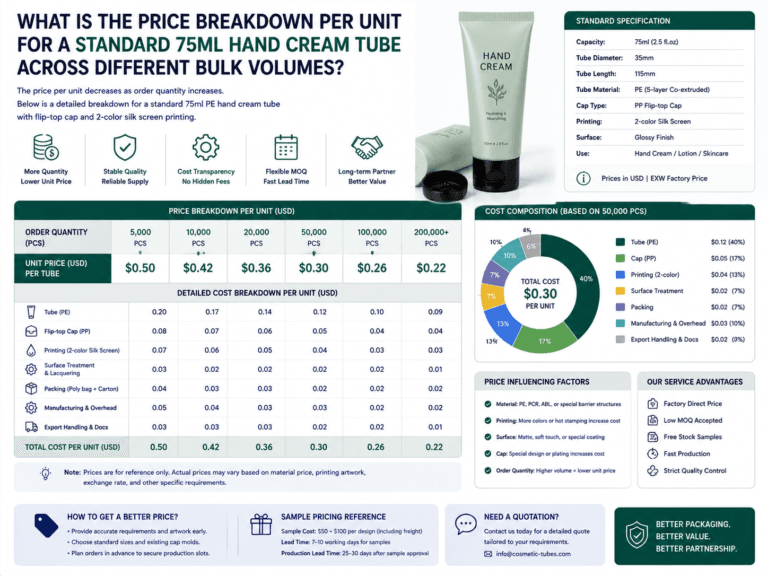
A lower MOQ does not always create the lowest total cost. At higher quantities, fixed setup charges are spread across more units, material purchasing becomes more efficient, production loss represents a smaller percentage, and freight cost per tube may decrease.
| Quantity Effect | Lower Quantity | Higher Quantity |
|---|---|---|
| Unit price | Usually higher | Usually lower |
| Setup cost per unit | High | Lower |
| Customization flexibility | Limited | More options may become economical |
| Inventory risk | Lower | Higher |
| Reorder frequency | More frequent | Less frequent |
Information Needed for an Accurate MOQ Quote
A manufacturer cannot calculate an accurate MOQ from capacity alone. Procurement managers should provide the complete tube specification when requesting a quotation.
- Fill capacity: State ml or grams and provide formula density if possible.
- Tube diameter and length: Confirm whether a standard size is acceptable.
- Material structure: PE, PCR PE, sugarcane PE, EVOH, ABL, or PBL.
- Tube body color: Standard white, transparent, custom Pantone, pearlized, or PCR natural.
- Cap specification: Screw cap, flip-top, nozzle, applicator, cap color, and orifice.
- Printing method: Silk screen, offset, digital, label, hot stamping, or combined decoration.
- Number of artworks: State the quantity required for each individual design.
- Estimated annual volume: Helps the factory propose the most economical production route.
Common MOQ Misunderstandings
| Misunderstanding | Reality |
|---|---|
| “The total order is 10,000, so five designs can each have 2,000.” | Each artwork may require its own MOQ because every design needs a separate printing setup. |
| “A smaller tube should have a smaller MOQ.” | Small tubes use less material, but setup, molding, printing, and QC requirements remain. |
| “Changing the tube length does not affect production.” | Length is flexible, but artwork, filling capacity, tail-seal zone, and packing must be recalculated. |
| “A custom cap color has no effect on MOQ.” | Custom cap colors usually require a dedicated injection batch and color preparation. |
| “Digital printing always supports very small orders.” | Availability depends on tube material, size, artwork, and the manufacturer’s equipment. |
Best Practical Recommendation
For the most flexible MOQ, choose an existing tube diameter, standard PE material, one tube body color, a stock cap, and one- or two-color printing. Use the same tube structure across several products and differentiate SKUs through artwork, labels, or small color accents where practical.
If the project requires a custom mold, five-layer EVOH structure, special PCR ratio, dual-color cap, metallic applicator, several artworks, or multiple premium decoration processes, plan for a higher MOQ and compare the total annual volume rather than only the first launch order.
Summary
The MOQ for custom cosmetic tubes scales according to tube size, mold availability, material structure, body color, cap type, printing method, decoration complexity, and number of SKUs. Standard tubes with simple printing generally support the lowest MOQ, while non-standard sizes, custom components, multiple colors, and premium finishes require larger production runs.
A practical starting point for many custom tube projects is around 5,000 pieces per size, color, and artwork. However, the final MOQ should be confirmed after the factory reviews the complete packaging specification and manufacturing process.
Learn more: Custom Cosmetic Tubes, Cosmetic Squeeze Tubes, Printing Options, Tube Decoration, Cosmetic Tube Materials, Customization.
Need an Accurate MOQ for Your Custom Cosmetic Tubes?
Xinfly Packaging helps brands calculate practical MOQs based on tube capacity, diameter, material, cap style, body color, artwork quantity, printing process, decoration method, and annual purchasing volume.