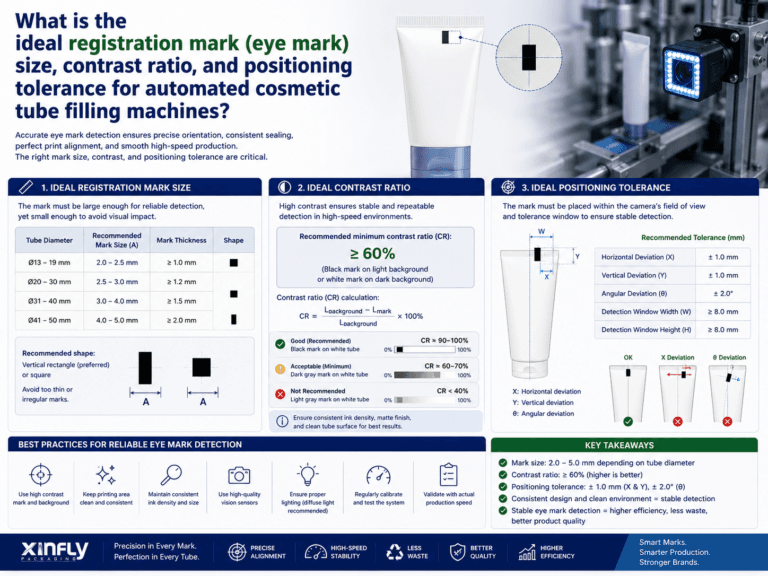

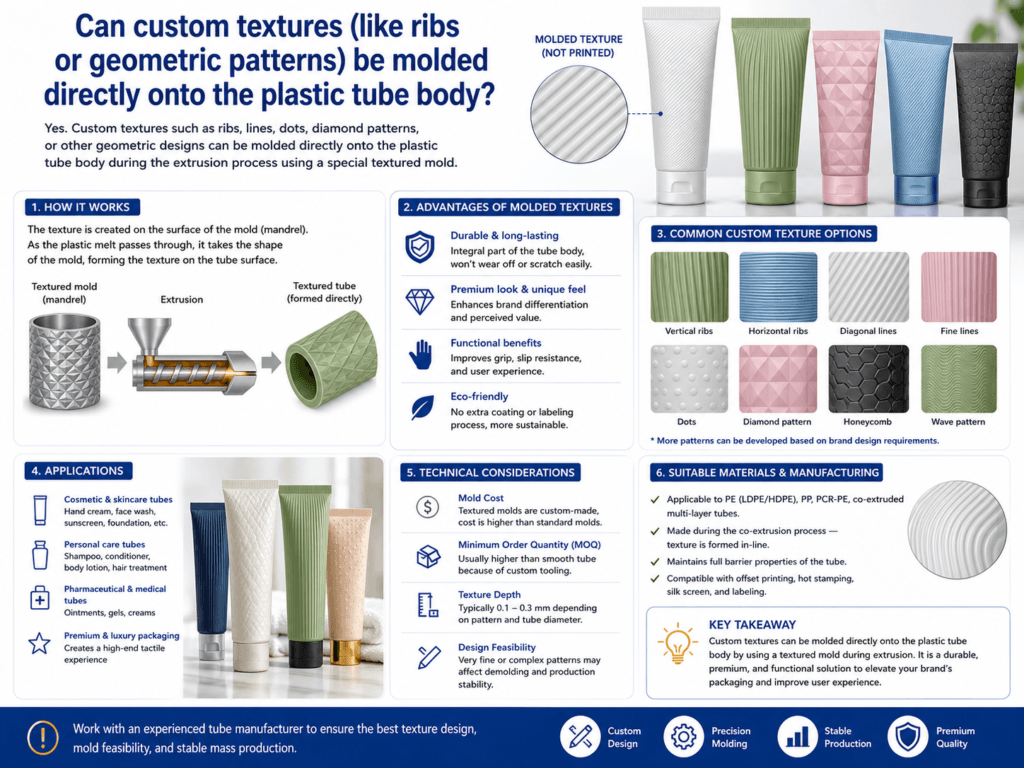
Yes, custom textures such as ribs, grip lines, diamond patterns, geometric embossing, or tactile surface effects can be created on plastic cosmetic tube packaging, but the available method depends on where the texture is located and how deep the pattern needs to be. For most squeeze tubes, textures are usually added through mold design, embossing, special surface finishing, printing effects, or secondary decoration rather than by simply changing the normal extrusion body.
A cosmetic tube body is different from a rigid injection-molded bottle. The tube body is usually extruded as a flexible cylinder or oval sleeve, then headed, printed, capped, filled, and sealed. Because of this process, deep molded patterns on the full tube body require careful engineering, tooling review, squeeze-force testing, artwork planning, and production feasibility confirmation.
Can Textures Be Molded Directly Onto the Tube Body?
In some cases, yes, but with limits. Texture can be created directly on certain areas of the plastic tube, especially the shoulder, head, cap, applicator, or molded component. For the flexible tube body, deep molded textures are more challenging because the body is extruded, thin-walled, and designed to squeeze smoothly. Shallow tactile effects, grip ribs, partial embossing, or decoration-based texture are usually more practical than deep molded relief across the whole body.
| Tube Area | Texture Feasibility | Common Method |
|---|---|---|
| Tube body | Possible, but limited by extrusion, flexibility, and printing | Shallow embossing, surface texture, printed tactile varnish, custom forming |
| Shoulder | More feasible | Custom head mold or shoulder tooling |
| Cap | Highly feasible | Injection mold texture, ribs, matte surface, geometric grip pattern |
| Applicator head | Feasible for special functions | Custom molded applicator, massage ribs, silicone tip, cooling head design |
| Label or decoration layer | Very feasible | Raised varnish, spot UV, silk screen thickness, tactile coating |
Most Practical Ways to Create Texture on Cosmetic Tubes
| Texture Method | How It Works | Best For |
|---|---|---|
| Custom molded cap texture | Ribs or geometric patterns are built into the cap mold | Grip improvement, premium cap design, anti-slip function |
| Custom shoulder or head mold | Texture is molded into the tube head or shoulder area | Premium shape design, applicator identity, tactile brand detail |
| Raised silk screen printing | Thicker ink creates a raised tactile pattern on the surface | Logos, dots, ribs, small texture zones, premium decoration |
| Spot UV or tactile varnish | Glossy or raised varnish creates contrast and touch effect | Geometric patterns, luxury skincare tubes, selective texture |
| Embossed or textured label | Texture is added to a label or sleeve layer | Complex patterns, short-run customization, special retail effects |
| Special tube body forming | Tube body is engineered with shallow structural texture | Custom projects with higher MOQ and tooling review |
Why Full-Body Molded Texture Is More Difficult
Unlike caps or rigid bottles, a cosmetic tube body must remain flexible, printable, sealable, and easy to squeeze. If ribs or geometric patterns are too deep, they may create weak points, uneven wall thickness, stress concentration, printing distortion, poor squeeze recovery, or filling-line instability.
- Tube body is extruded: The main body is not normally injection molded like a cap.
- Wall thickness must stay uniform: Deep patterns can create thin or thick areas.
- Squeeze performance may change: Ribs can make the tube harder, uneven, or less comfortable to squeeze.
- Printing can become distorted: Logos and small text may not sit cleanly over textured surfaces.
- Tail sealing must stay stable: Texture near the tail area can interfere with heat sealing or crimping.
- Tooling cost increases: Custom texture often requires new molds, trials, and more QC control.
Engineer’s note: If the goal is mainly better grip, textured caps, matte finish, soft-touch coating, raised printing, or partial grip zones are often more practical than deep full-body molded ribs.
Design Options by Brand Goal
| Brand Goal | Recommended Texture Solution | Reason |
|---|---|---|
| Better hand grip | Ribbed cap, matte surface, soft-touch finish, partial raised pattern | Improves handling without weakening the tube body |
| Premium tactile identity | Raised silk screen, spot UV, geometric varnish pattern | Adds texture while keeping the tube body smooth and printable |
| Functional massage effect | Custom applicator head or molded shoulder feature | Texture is placed where it supports product use |
| Luxury visual differentiation | Embossed label, hot stamping, pearlized finish, selective texture | Creates premium shelf presence with lower structural risk |
| Unique industrial design | Custom body shape or shallow molded body texture | Requires higher tooling budget, sample testing, and MOQ planning |
Texture Depth and Pattern Size Matter
Not every texture design is suitable for a flexible tube. Large, smooth, shallow patterns are easier to produce than very fine, deep, sharp, or closely spaced geometric details. A texture that looks beautiful in a 3D rendering may not perform well after extrusion, printing, filling, squeezing, and shipping.
| Texture Design | Production Risk | Recommendation |
|---|---|---|
| Shallow ribs | Lower to moderate | Good for grip zones if wall stability is confirmed |
| Fine micro-patterns | Moderate to high | Better created with coating, printing, or label effects |
| Deep geometric relief | High | Requires tooling review and physical prototypes |
| Sharp corners | High | Avoid because they can create stress concentration and printing issues |
| Texture near tail seal | High | Keep the tail sealing zone smooth and clean |
Effect on Printing and Decoration
Texture can make decoration more difficult. Offset printing, silk screen printing, hot stamping, labeling, and spot UV all require stable surface contact. If the tube body has raised ribs or uneven geometry, the printing plate or screen may not transfer artwork evenly, and hot stamping foil may crack or leave gaps.
| Decoration Method | Texture Concern | Best Practice |
|---|---|---|
| Offset printing | Uneven texture can reduce print consistency | Keep the main artwork area smooth |
| Silk screen printing | Can create raised texture, but needs controlled artwork | Use for logos, dots, ribs, and selective tactile effects |
| Hot stamping | Foil needs smooth pressure contact | Avoid foil on deep textured areas |
| Spot UV | Works well for selective texture | Use geometric patterns on smooth tube surface |
| Labels or sleeves | Can carry complex texture effects | Good option for special patterns or shorter projects |
Effect on Squeeze Feel and Tube Strength
Texture changes how a tube bends under pressure. Ribs may improve grip but can also make the tube stiffer. Deep geometric patterns may create stress points where the wall bends repeatedly. For daily-use skincare, hand cream, sunscreen, and lotion tubes, the texture must not make the package uncomfortable or difficult to dispense.
- Raised ribs: Can improve grip but may increase squeeze force.
- Deep patterns: May weaken the body if wall thickness becomes uneven.
- Soft-touch finish: Improves grip without changing tube structure too much.
- Matte texture: Gives a premium hand feel but should be tested for scratch and stain resistance.
- Partial texture zones: Safer than full-body structural texture for most cosmetic tubes.
Where Should Texture Be Placed?
| Texture Location | Recommended or Not? | Reason |
|---|---|---|
| Cap side wall | Recommended | Improves opening grip and is easy to mold in injection tooling |
| Shoulder area | Possible | Good for custom design, but requires special head mold |
| Central front panel | Use carefully | Must not interfere with logo, claims, and print readability |
| Side grip zones | Good option | Can improve hand grip while keeping the front panel clean |
| Tail sealing area | Not recommended | Texture can weaken or contaminate sealing contact |
Tooling and MOQ Considerations
Custom textures usually increase tooling cost and development time. A textured cap may require a new cap mold. A custom shoulder texture may require a new tube head mold. Full-body structural texture may require a more complex development process and higher MOQ because it affects extrusion, forming, printing, filling, and QC.
| Customization Type | Tooling Requirement | Project Suitability |
|---|---|---|
| Textured cap | New or modified cap mold | Good for medium to large-volume projects |
| Custom shoulder pattern | Custom head mold | Good for premium product lines |
| Raised printing texture | Printing screen or decoration setup | More flexible and lower tooling pressure |
| Embossed label texture | Label tooling or label supplier setup | Good for shorter runs and special editions |
| Full-body molded texture | Highest tooling and validation requirement | Best for high-volume hero products |
Testing Before Mass Production
| Test | Purpose | What to Check |
|---|---|---|
| Squeeze force test | Checks whether texture changes dispensing comfort | Initial squeeze force, repeated squeeze feel, product flow |
| Wall thickness inspection | Confirms texture does not create weak points | Thin spots, uneven thickness, stress concentration |
| Print registration test | Checks artwork quality on textured or patterned surface | Logo alignment, small text clarity, foil transfer |
| Drop and compression test | Checks shipping and retail durability | Cracking, dents, pattern damage, leakage |
| Rub and scratch test | Checks tactile coating or raised decoration durability | Wear marks, coating peeling, texture loss |
| Filled compatibility test | Checks real product effect on textured structure | Deformation, paneling, swelling, delamination |
Common Mistakes to Avoid
- Designing deep texture without engineering review: It may look good in a rendering but fail in extrusion, printing, or filling.
- Putting texture in the tail sealing zone: This can weaken sealing and increase leakage risk.
- Ignoring squeeze force: Ribs and geometric patterns can make the tube harder to use.
- Printing small text over texture: Fine claims may become distorted or unreadable.
- Using sharp pattern corners: These can create stress points and cracking risk.
- Skipping filled samples: Empty textured tubes do not show real use, transport, or formula compatibility performance.
Best Practical Recommendation
For most cosmetic tube projects, the safest and most cost-effective way to create a custom tactile effect is to use textured caps, raised silk screen printing, spot UV patterns, soft-touch coating, matte finish, or partial grip zones. These methods improve user experience and shelf differentiation without creating major structural risk in the tube body.
If the brand wants ribs or geometric patterns molded directly into the tube body, start with a shallow pattern, keep the main artwork and tail-sealing zones smooth, confirm wall thickness stability, and approve physical samples with real formula testing before mass production.
Summary
Custom textures such as ribs or geometric patterns can be added to plastic cosmetic tubes, but the method depends on the desired effect and tube area. Caps, shoulders, applicators, raised printing, spot UV, and labels are easier and safer areas for texture design. Full-body molded texture on a flexible tube body is possible only with careful tooling, material, wall thickness, printing, squeeze-force, and filling validation.
The best design should balance tactile feel, grip, premium appearance, production feasibility, artwork clarity, tube strength, sealing safety, and consumer usability.
Learn more: Customize Cosmetic Tubes, Printing Design, Tube Decoration, Surface Finishing, Caps & Closures, Sample Development.
Need Custom Textured Cosmetic Tubes?
Xinfly Packaging helps beauty brands develop textured caps, custom applicator heads, raised printing effects, spot UV patterns, soft-touch finishes, and engineered grip zones for premium cosmetic tube packaging.