
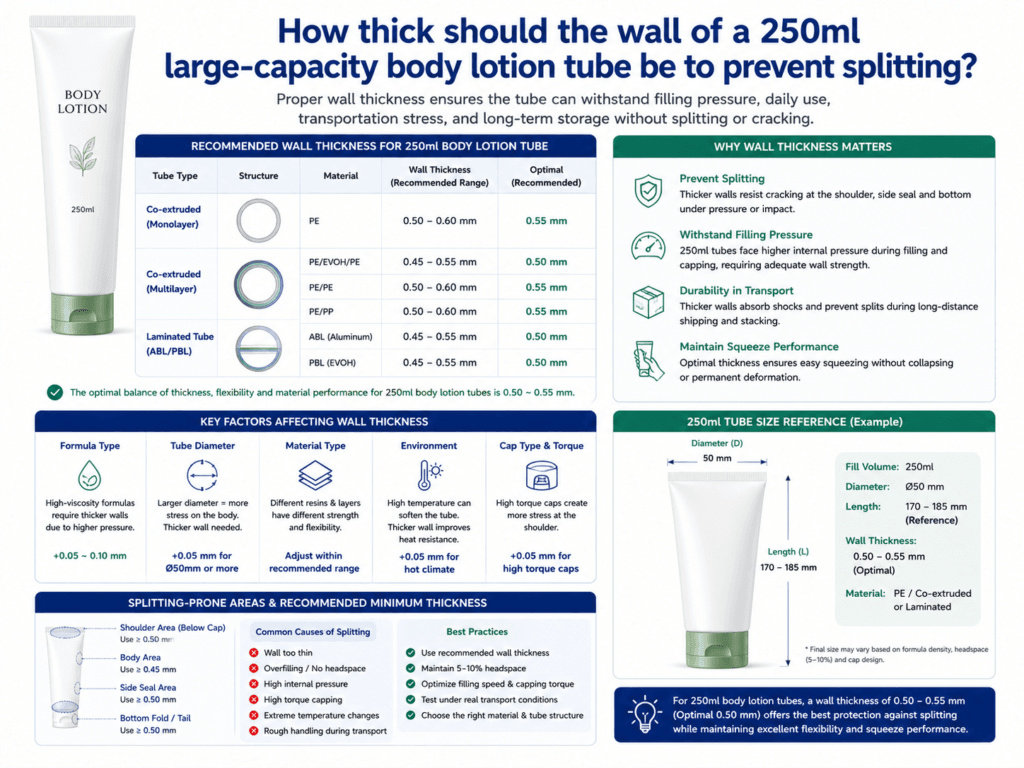
For a 250ml large-capacity body lotion tube, the wall thickness is commonly recommended around 0.55mm to 0.75mm, depending on the tube diameter, PE structure, formula density, shoulder design, and transport requirements. If the formula is heavy, the tube is long, or the product will face e-commerce shipping, a slightly thicker wall or stronger multi-layer structure is usually safer.
There is no single fixed wall thickness that prevents splitting for every 250ml tube. A 50mm diameter tube, a 55mm diameter tube, and a 60mm diameter tube may all hold around 250ml, but their body length, squeezing stress, tail-seal load, and drop-test performance can be different. The safest solution is to combine the right diameter, wall thickness, material structure, and sealing process, then confirm the design through filled-sample testing.
Recommended Wall Thickness for 250ml Body Lotion Tubes
| Tube Capacity | Common Diameter | Suggested Wall Thickness | Packaging Situation |
|---|---|---|---|
| 200ml – 250ml | 50mm | About 0.55mm – 0.65mm | Standard body lotion, cleanser, shampoo, conditioner |
| 250ml | 50mm – 55mm | About 0.60mm – 0.70mm | Large-capacity body lotion with better body strength |
| 250ml+ heavy formula | 55mm – 60mm | About 0.65mm – 0.75mm | Dense lotion, rich cream, e-commerce shipping, high drop-test requirement |
Why Large-Capacity Tubes Are More Likely to Split
A 250ml tube carries more product weight and usually has a larger body surface than small cosmetic tubes. When the tube is squeezed, dropped, packed in cartons, or sealed at the tail, stress concentrates in certain areas. If the wall is too thin, the tube body may split, crack, wrinkle, or fail near the tail seal or shoulder.
- More product weight: A filled 250ml tube is much heavier than a 50ml or 100ml tube.
- Larger deformation area: The body wall bends more during squeezing and transport.
- Higher tail-seal stress: The sealed end must hold more internal product load.
- Greater drop-test risk: Large tubes create stronger impact force when dropped.
- More pressure during cartons stacking: Bulkier tubes may be compressed during warehousing and shipping.
Where Splitting Usually Happens
| Risk Area | Why It Fails | Prevention Direction |
|---|---|---|
| Tail seal area | Heat sealing, crimping, and product pressure concentrate stress | Optimize sealing temperature, tail width, and wall thickness |
| Side body | Thin wall or excessive squeezing may cause body splitting | Use stronger PE structure and proper wall thickness |
| Shoulder connection | Transition area between shoulder and body carries stress | Confirm shoulder welding strength and tube body balance |
| Folded or dented areas | Repeated bending weakens the material locally | Avoid over-soft structures and test squeeze recovery |
How Tube Diameter Affects Wall Thickness
For the same 250ml capacity, a smaller diameter tube needs a longer body, while a larger diameter tube can be shorter. A long narrow tube may have more bending stress, while a wider tube may need stronger body stiffness to prevent deformation. That is why diameter and wall thickness must be designed together.
| Diameter Choice | Design Character | Wall Thickness Consideration |
|---|---|---|
| 50mm | Common large cosmetic tube diameter | Often needs moderate to strong wall thickness for 250ml |
| 55mm | Shorter and stronger visual proportion | Good balance for large body lotion tubes |
| 60mm | Large-capacity, strong shelf presence | May need careful material stiffness control to avoid paneling or poor squeeze feel |
Material Structure Matters as Much as Thickness
Wall thickness alone does not guarantee splitting resistance. A 0.60mm tube with a well-designed PE structure may perform better than a thicker tube with poor material balance. For large body lotion tubes, the resin grade, layer structure, softness, toughness, and sealing performance must all be considered.
- Single-layer PE: Can work for simple formulas but may need sufficient thickness and toughness.
- 2-layer PE: Often gives better structural balance for daily body care tubes.
- 5-layer co-extruded PE / EVOH: Useful when barrier performance and body strength are both required.
- Soft PE blends: Improve squeeze feel but may reduce body stiffness if overused.
- Tougher PE blends: Improve splitting resistance but may feel harder to squeeze.
Factors That Decide the Final Wall Thickness
| Factor | Why It Matters | Design Impact |
|---|---|---|
| Formula density | Heavier formulas increase stress on the tube body and tail seal | May require thicker wall or stronger structure |
| Formula viscosity | Thick lotion needs more squeezing force | Requires balance between softness and strength |
| Filling temperature | Hot filling can create deformation or stress after cooling | Requires filled-sample stability testing |
| Shipping method | E-commerce shipping causes higher drop and compression risk | May require stronger wall and better carton protection |
| Tail sealing method | Poor sealing settings can weaken the tube end | Sealing temperature, pressure, and time must be optimized |
How to Prevent Splitting in 250ml Body Lotion Tubes
- Choose enough wall thickness: For 250ml, avoid using thin small-tube specifications.
- Use a suitable diameter: 50mm to 55mm is often more practical than forcing the capacity into a narrow tube.
- Balance softness and toughness: The tube should squeeze well but not split under pressure.
- Optimize tail sealing: Weak or overheated tail seals can become splitting points.
- Test with the real formula: Water testing does not reflect thick lotion behavior.
- Run drop and compression tests: Large tubes must survive shipping and warehouse handling.
Recommended Testing Before Mass Production
| Test | Purpose | What to Check |
|---|---|---|
| Filled drop test | Checks impact resistance after filling | Body splitting, cap leakage, shoulder failure, tail seal breakage |
| Tail seal strength test | Confirms sealing durability | Seal peeling, cracking, leakage, burst risk |
| Squeeze test | Checks consumer-use durability | Wall cracking, stress whitening, recovery behavior |
| Temperature cycling test | Checks stability under hot and cold conditions | Deformation, paneling, leakage, material stress |
| Carton compression test | Checks storage and transport performance | Tube deformation, shoulder stress, cap pressure marks |
Common Mistakes That Lead to Splitting
- Using a wall thickness designed for smaller tubes: A 250ml tube needs stronger body performance.
- Choosing a tube that is too long and narrow: The body may bend and stress more easily.
- Overfilling the tube: Too little headspace increases internal pressure and tail-seal stress.
- Ignoring formula density: 250ml of dense lotion may be much heavier than expected.
- Skipping drop testing: Large tubes may look fine in the factory but fail during transport.
Best Practical Recommendation
For a 250ml body lotion tube, start with a 50mm to 55mm diameter and a wall thickness around 0.60mm to 0.70mm as a practical design direction. If the formula is dense, the tube is shipped through e-commerce channels, or the brand requires strong drop-test performance, consider moving closer to 0.70mm to 0.75mm or using a stronger multi-layer PE structure.
Summary
A 250ml large-capacity body lotion tube usually needs a stronger wall than smaller cosmetic tubes. A common practical range is about 0.55mm to 0.75mm, with 0.60mm to 0.70mm often used as a balanced starting point for many 250ml body lotion projects.
To prevent splitting, wall thickness must be matched with tube diameter, PE structure, formula density, viscosity, headspace, tail sealing, and transport testing. The final specification should always be confirmed using real filled and sealed samples before mass production.
Learn more: Tube Capacity, Diameter, Length & Thickness, Body Lotion Tubes, Lotion Tube Manufacturer, PE Tubes, 2-Layer Plastic Tubes, Quality Assurance.
Need a Stronger 250ml Body Lotion Tube?
Xinfly Packaging helps brands design large-capacity body lotion tubes with suitable diameter, wall thickness, PE structure, cap type, tail sealing, and transport-test performance to reduce splitting and leakage risk.