
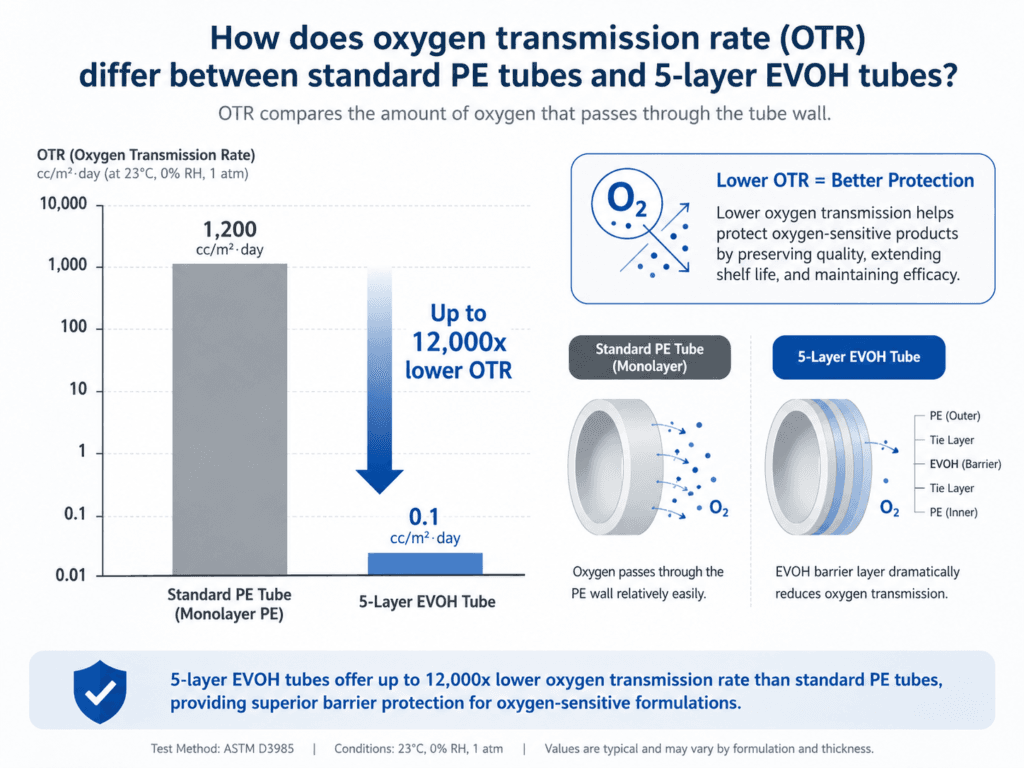
The oxygen transmission rate (OTR) of a standard PE tube is usually much higher than that of a 5-layer EVOH tube. In practical packaging terms, this means oxygen can pass through a normal PE tube much more easily, while a 5-layer co-extruded tube with an EVOH barrier layer slows oxygen entry far more effectively.
For cosmetic packaging, this difference matters because oxygen exposure can affect formula stability, fragrance retention, color, and shelf life. A standard PE tube is often suitable for stable daily-use products, but a 5-layer EVOH tube is usually preferred when the formula is more sensitive to oxidation or aroma loss.
What Is OTR?
OTR stands for Oxygen Transmission Rate. It measures how much oxygen passes through a packaging material over a defined area and time under specified test conditions. In simple terms, a lower OTR means better oxygen barrier protection.
Standard PE Tubes vs. 5-Layer EVOH Tubes
| Tube Type | Typical OTR Behavior | Barrier Level | Best For |
|---|---|---|---|
| Standard PE tube | Higher oxygen transmission | Basic barrier | Stable formulas, cleansers, lotions, simple creams |
| 5-layer EVOH tube | Much lower oxygen transmission | High barrier | Sunscreen, active skincare, fragrance-sensitive or oxidation-sensitive products |
Why the OTR Difference Is So Large
- PE is a general-purpose flexible packaging material: It is useful, economical, and easy to process, but its oxygen barrier is limited.
- EVOH is a dedicated barrier material: It is specifically used to block oxygen much more effectively than PE.
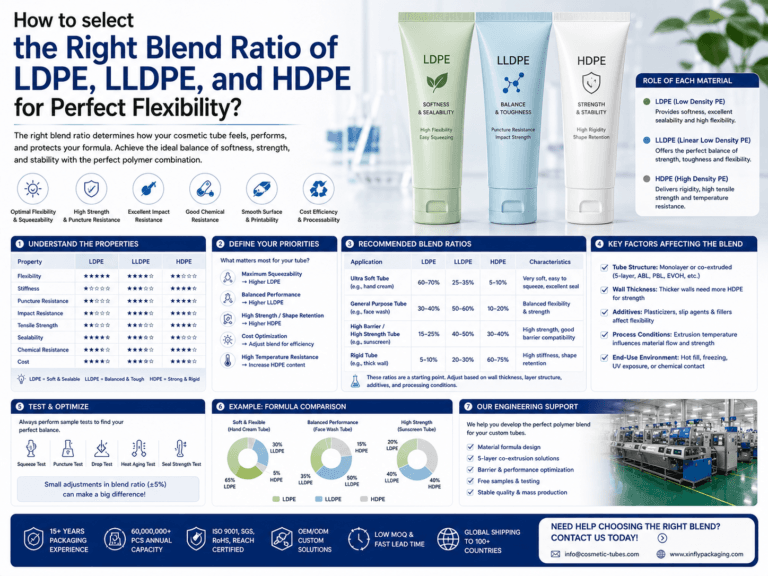
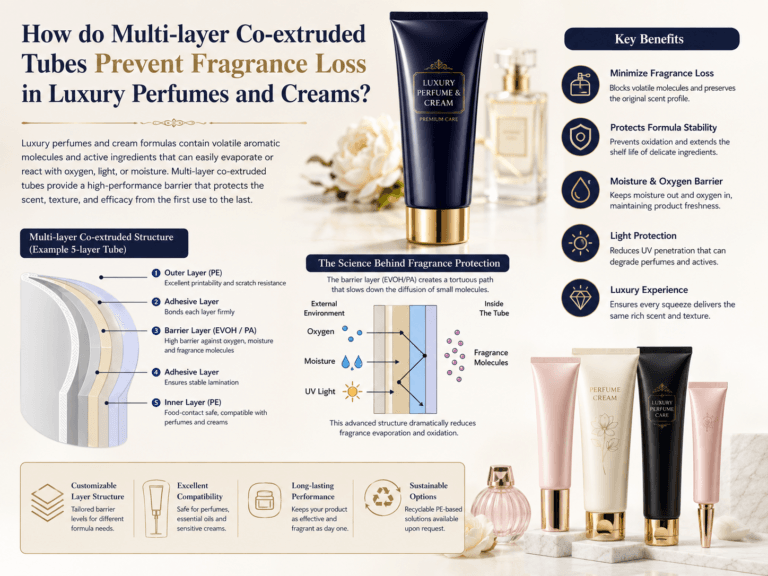
- In a 5-layer tube, EVOH sits inside the structure as the functional barrier core: The surrounding PE layers provide flexibility, sealing, and appearance, while EVOH provides the oxygen barrier.
Important Note About Comparing OTR Values
OTR should not be compared using one simplified number unless the test conditions are the same. The result depends on factors such as wall thickness, EVOH grade, EVOH thickness, temperature, humidity, and test standard. That is why suppliers usually compare PE and EVOH tubes by barrier level and application suitability, not by one universal OTR number alone.
Practical OTR Difference in Packaging Terms
| Packaging Question | Standard PE Tube | 5-Layer EVOH Tube |
|---|---|---|
| Oxygen protection | Moderate to low | High |
| Formula stability support | Suitable for basic products | Better for oxygen-sensitive formulas |
| Aroma retention | More limited | Better fragrance retention |
| Shelf-life support | More suitable for stable products | More suitable for premium or sensitive products |
When Standard PE Is Usually Enough
- Basic facial cleanser
- Body lotion
- Hand cream with stable formula system
- Shorter shelf-life or lower-sensitivity cosmetic products
When 5-Layer EVOH Is Usually Better
- Sunscreen formulas
- Vitamin-rich or active skincare
- Oil-based formulas with oxidation sensitivity
- Fragrance-sensitive or aroma-rich cosmetic products
- Premium products targeting longer shelf life and stronger package protection
Why Brands Choose EVOH Tubes Even If They Cost More
| Reason | Why It Matters |
|---|---|
| Lower OTR | Better protection against oxygen entering the package |
| More stable formula performance | Helps preserve product quality over time |
| Improved fragrance retention | Supports premium sensory experience |
| Stronger premium positioning | Suitable for functional and higher-value skincare packaging |
Best Practical Recommendation
If the product is a simple and stable formula, a standard PE tube may be enough. If the product is oxygen-sensitive, fragrance-sensitive, or positioned as a premium performance formula, a 5-layer EVOH tube is usually the better barrier choice. The decision should be based on formula sensitivity, desired shelf life, and packaging performance target, not on tube appearance alone.
Summary
The OTR of a standard PE tube is generally much higher than the OTR of a 5-layer EVOH tube. In practical terms, this means a standard PE tube allows more oxygen to pass through, while a 5-layer EVOH tube provides much stronger protection against oxygen entry.
For cosmetic packaging, this difference is especially important for products such as sunscreen, active skincare, oil-based formulas, and fragrance-sensitive formulas where barrier performance directly supports shelf life and product quality.
Learn more: What Is EVOH Barrier Material?, EVOH Barrier Tubes Manufacturer, 5-Layer Plastic Tubes, PE Tubes, Co-Extruded Cosmetic Tubes Guide, How to Choose Cosmetic Tube Materials.
Need the Right Barrier Tube for Your Formula?
Xinfly Packaging helps brands choose between standard PE and EVOH barrier tube structures based on oxygen sensitivity, shelf-life targets, fragrance retention needs, and packaging budget.