
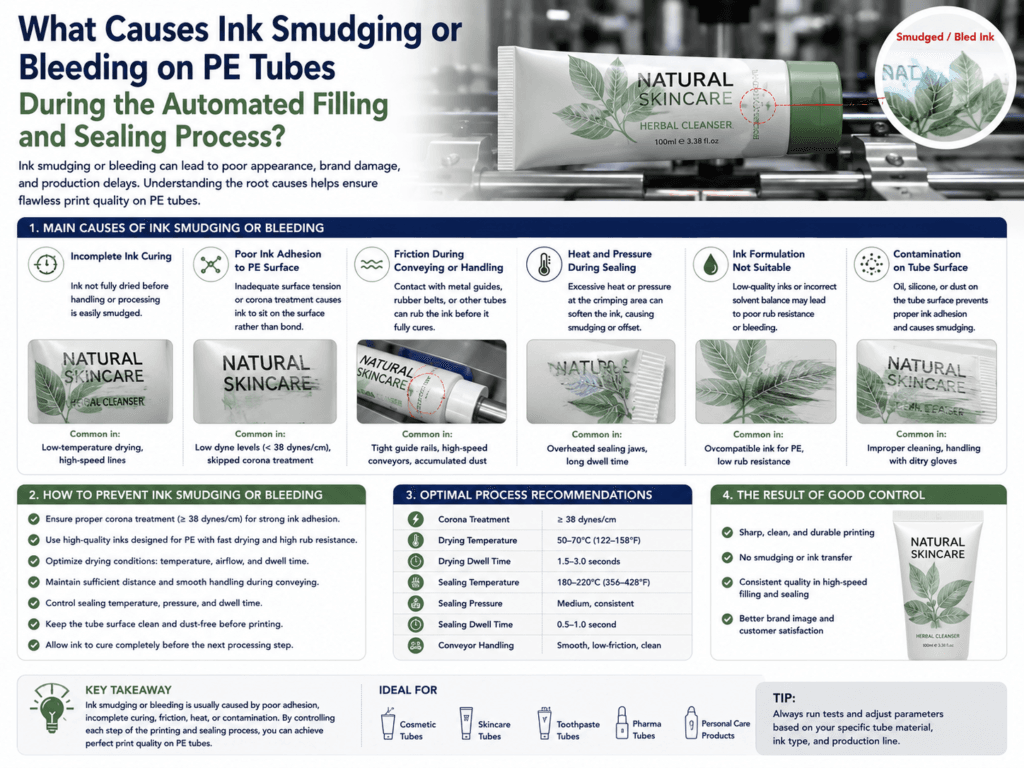
Ink smudging or bleeding on PE tubes during the automated filling and sealing process usually happens because the printed ink has not fully bonded, fully cured, or fully resisted the heat, friction, pressure, and contamination generated on the production line. In practical tube production, the most common root causes are insufficient ink drying or curing, weak adhesion on low-surface-energy PE, excessive mechanical rubbing during transport on the line, contamination from product or sealing equipment, and heat or pressure that is too aggressive near the sealing area.
PE tubes are especially sensitive because polyethylene has naturally low surface energy, so printing performance depends heavily on proper surface treatment, the right ink system, and stable curing. If the ink film is still soft when the tube enters filling, sealing, tail folding, conveyor contact, or capping movement, the print can smear, offset, or blur even if it looked acceptable immediately after printing.
Main Causes of Ink Smudging or Bleeding During Filling and Sealing
| Cause | What Happens on the Line | Typical Result |
|---|---|---|
| Incomplete drying or curing | Ink film stays soft before automated handling | Smearing, offsetting, blurred graphics |
| Weak adhesion on PE surface | Ink does not bond strongly to the tube wall | Rubbing damage, peeling, bleeding edges |
| Too much friction during conveying or handling | Printed area rubs against guides, belts, or other tubes | Scuff marks and color drag |
| Heat or pressure near sealing zone | Ink softens or deforms close to the tail-seal area | Smudging or distortion around the seal |
| Contamination from product, oil, dust, or grease | Foreign material interferes with print stability | Localized smear, staining, weak adhesion |
| Ink viscosity or process instability | Ink transfers or spreads unpredictably | Bleeding, mottling, fuzzy image edges |
Why PE Tubes Are More Sensitive
- Low surface energy: If PE is not properly treated, ink cannot wet and anchor evenly, which increases smearing risk.
- Flexible tube body: The tube bends, squeezes, and rubs more easily than rigid packaging during line movement.
- Heat sealing stress: Sealing temperature and pressure must be controlled carefully because too much heat or pressure can damage nearby print.
- Fast automation: Higher line speed leaves less margin if curing, handling, or ink resistance is not fully validated.
Most Common Failure Scenarios
| Failure Scenario | Likely Root Cause |
|---|---|
| Print smears when tubes touch each other on the line | Ink not fully cured or line friction too high |
| Color drags near the tube tail after sealing | Seal heat or pressure is affecting the printed zone |
| Edges look fuzzy after filling | Weak adhesion, soft ink film, or too much ink laydown |
| Only some tubes smear, not all | Uneven curing, contamination, or inconsistent surface treatment |
| Ink looks fine after printing but fails later in production | Insufficient post-print resistance to handling, friction, or heat |
How Manufacturers Prevent Smudging and Bleeding
- Ensure complete curing before filling: Inks must be fully dried and resistant before tubes enter automation.
- Improve PE surface treatment: Proper corona or flame treatment raises surface energy and helps the ink bond better.
- Use the correct ink system and viscosity: Wrong viscosity or wrong ink/substrate match can cause uncontrolled spread and weak durability.
- Reduce mechanical rubbing on the line: Tube guides, belts, nests, and contact surfaces should minimize unnecessary abrasion.
- Keep print away from the highest-heat tail area when possible: This lowers the risk of seal-zone distortion or transfer damage.
- Control cleanliness: Dust, grease, product splash, and dirty seal bars can all worsen print defects.
Best Practice Before Mass Production
| Control Check | Why It Is Important |
|---|---|
| Adhesion test after printing | Confirms the ink has bonded properly to the PE surface |
| Cure verification before filling | Ensures the print can survive automated handling |
| Line trial with actual formula | Checks whether filling, sealing, and conveying affect the print |
| Seal-zone inspection | Finds heat-related smudging near the crimp area |
| Transport and abrasion simulation | Confirms the print survives packing and shipment |
Summary
Ink smudging or bleeding on PE tubes during automated filling and sealing is usually caused by incomplete ink curing, poor adhesion on low-surface-energy PE, excessive friction, contamination, or overly aggressive heat and pressure around the sealing area. The best prevention method is to control the full system: surface treatment, ink selection, curing, line handling, and seal-zone design.
Learn more: PE Tubes, Printing Options, Silk Screen Printing Tubes, Offset Printing Tubes, Tube Decoration, Quality Assurance.
Need More Durable Printing for Automated Tube Filling Lines?
Xinfly Packaging helps brands optimize PE tube surface treatment, print durability, and filling-line compatibility to reduce smudging, bleeding, and sealing-related decoration failures.