
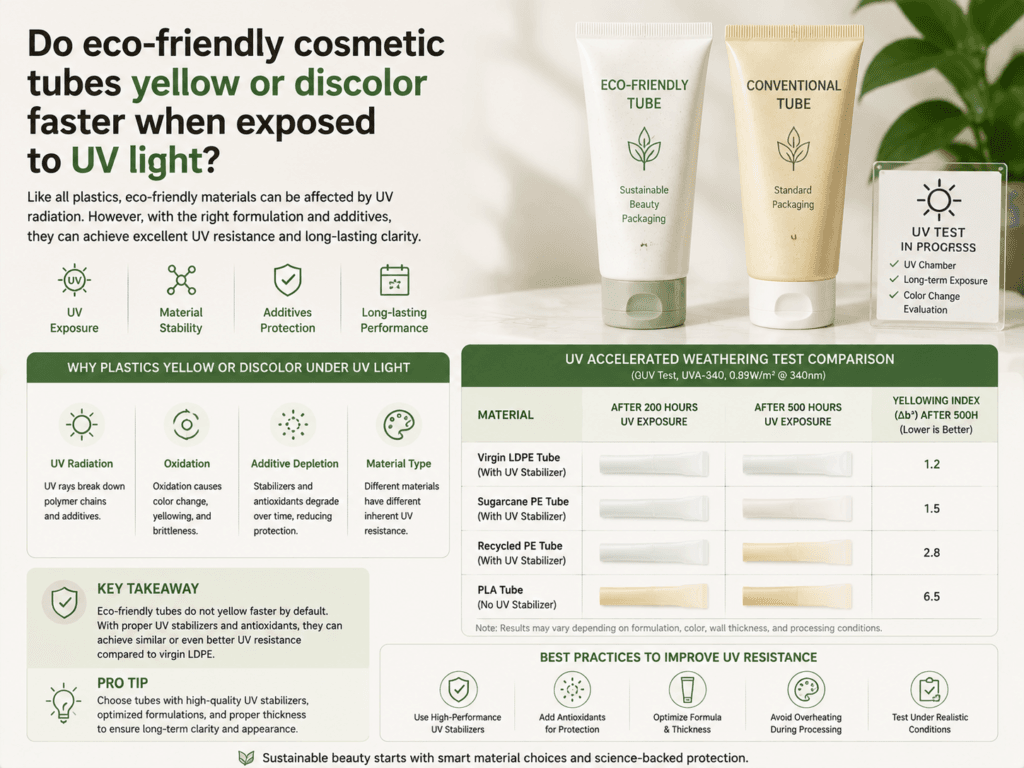
Eco-friendly cosmetic tubes do not inherently yellow or discolor faster under UV exposure than traditional plastic tubes. However, their UV stability depends on the specific material system used—such as PCR, sugarcane-based PE, wheat straw composites, or biodegradable plastics.
In most cases, discoloration risk is driven more by resin quality, additives, and UV stabilizers than by whether the tube is labeled “eco-friendly.”
UV Discoloration Risk Comparison
| Material Type | UV Yellowing Risk | Key Reason |
|---|---|---|
| Virgin PE tubes | Low | Stable polymer chain + UV stabilizers |
| PCR cosmetic tubes | Medium | Recycled content may contain trace impurities |
| Sugarcane-based PE tubes | Low | Chemically identical to virgin PE |
| Wheat straw composite tubes | Medium to high | Natural fibers may react to UV exposure |
| PLA / bio-degradable plastics | High | Lower UV and thermal stability |
Why UV Yellowing Happens
- Polymer oxidation: UV light breaks molecular chains, causing color shifts
- Additive degradation: UV stabilizers weaken over time
- Recycled content variability: PCR materials may contain mixed resin history
- Natural fiber sensitivity: Plant-based fillers can darken or age visually
Do Eco-Friendly Tubes Perform Worse?
- Not necessarily—modern eco tubes can match virgin plastic performance
- Sugarcane PE performs almost identically to standard PE
- PCR performance depends on purification and sorting quality
- Biodegradable materials are more sensitive to UV exposure by design
How Manufacturers Prevent UV Discoloration
- UV stabilizers: Additives that slow down oxidation reactions
- Pigment selection: Opaque or UV-resistant color masterbatches
- Barrier coatings: Protective surface layers reduce exposure
- Material blending: Improving PCR consistency for stable color
- Controlled storage testing: Simulated sunlight aging tests (QUV testing)
Real-World Performance Insight
| Scenario | Expected Result |
|---|---|
| Indoor cosmetic storage | No visible yellowing in most eco materials |
| Retail window exposure | Slight risk for PCR and wheat straw blends over time |
| Outdoor UV exposure | PLA and fiber-based materials degrade faster |
Summary
Eco-friendly cosmetic tubes do not automatically yellow or discolor faster under UV light. Sugarcane-based PE performs similarly to virgin plastic, while PCR materials may show slight variability depending on quality. Wheat straw and biodegradable plastics are more sensitive and may require stronger UV stabilization.
Overall UV stability depends more on formulation, additives, and engineering design than on the “eco” label itself.
Learn more: PCR Tubes, Sugarcane Tubes, Wheat Straw Tubes, Sustainable Packaging.
Need UV-Stable Sustainable Tubes?
Xinfly Packaging designs eco-friendly cosmetic tubes with UV stabilizers and optimized resin systems to ensure long-term color stability and brand appearance.