
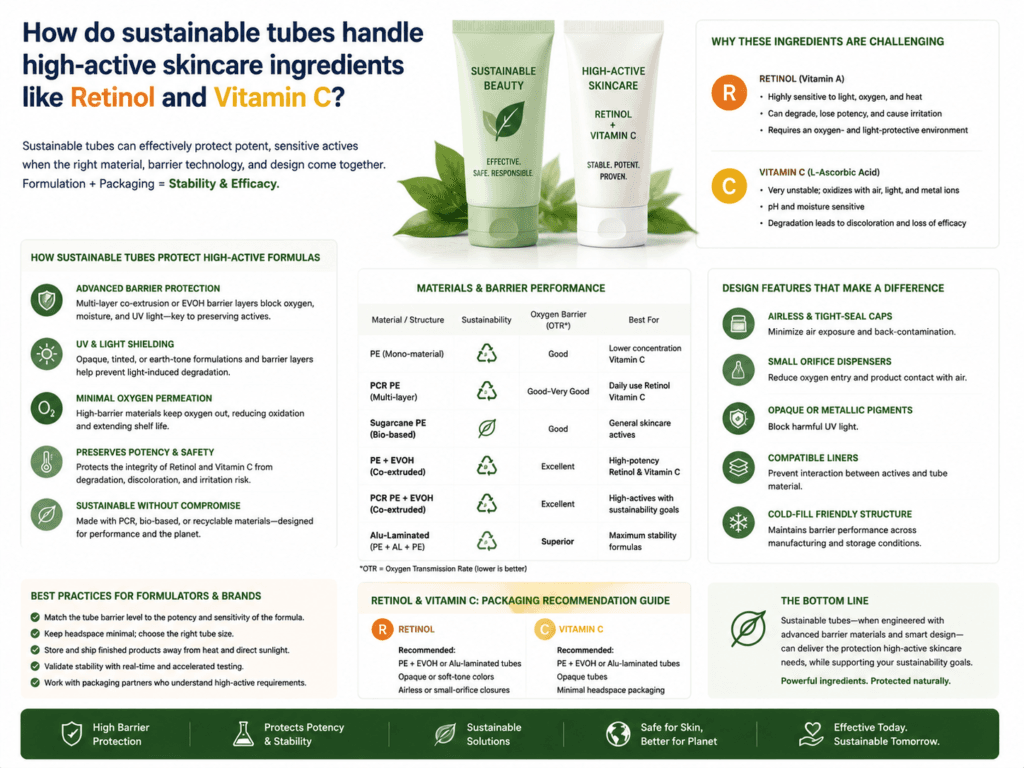
Sustainable cosmetic tubes can safely handle high-active skincare ingredients such as Retinol and Vitamin C, but only when the packaging structure and material system are properly engineered for barrier protection and stability.
Active ingredients like Retinol and Vitamin C are highly sensitive to oxygen, light, and temperature. Therefore, the performance of sustainable tubes depends more on their barrier layer design than on whether the material is eco-friendly.
How Sustainable Tubes Protect Active Ingredients
| Protection Factor | Function in Sustainable Tubes |
|---|---|
| Oxygen barrier | Reduces oxidation of Vitamin C and Retinol degradation |
| Light protection | Opaque or pigmented tubes block UV exposure |
| Moisture control | Prevents formulation instability and phase separation |
| Air exposure reduction | Improved dispensing design limits repeated air contact |
Best Sustainable Tube Structures for Active Ingredients
- EVOH barrier tubes: High oxygen resistance, ideal for Vitamin C serums and Retinol creams
- ABL laminated tubes: Aluminum layer provides strong light and oxygen protection
- PCR mono-material tubes (with barrier design): Balanced sustainability + moderate protection
- Sugarcane PE tubes with EVOH: Bio-based outer layer with functional barrier core
Ingredient Sensitivity Comparison
| Active Ingredient | Main Risk | Recommended Tube Type |
|---|---|---|
| Vitamin C (L-Ascorbic Acid) | Oxidation / color change | EVOH or ABL barrier tubes |
| Retinol | Light & oxygen degradation | Opaque laminated or ABL tubes |
| Niacinamide / peptides | Low sensitivity | PCR or mono-material PE tubes |
Do Sustainable Tubes Reduce Product Performance?
- Not necessarily—performance depends on barrier engineering, not sustainability label
- Modern eco tubes can match traditional packaging with EVOH or aluminum layers
- High PCR content alone does not guarantee good or bad stability
- Proper design ensures shelf-life remains 12–36 months or more
Key Engineering Tips for High-Active Formulas
- Use multi-layer barrier structures for oxygen-sensitive ingredients
- Choose opaque or UV-protective tube colors
- Minimize headspace air exposure with proper filling design
- Conduct accelerated stability testing before mass production
- Match cap system (airless / flip-top) to formula sensitivity
Summary
Sustainable cosmetic tubes can effectively handle high-active skincare ingredients like Retinol and Vitamin C when designed with proper barrier technology such as EVOH or ABL layers. Sustainability does not reduce performance as long as the packaging structure is correctly engineered for oxygen, light, and moisture protection.
In fact, many modern sustainable tube systems now match or even exceed traditional packaging performance when properly optimized.
Learn more: EVOH Barrier Tubes, Aluminum Tubes, Sustainable Packaging, Cosmetic Tube Materials.
Need High-Barrier Sustainable Tubes?
Xinfly Packaging offers EVOH, ABL, PCR, and sugarcane-based tube solutions designed to protect sensitive active skincare ingredients while maintaining sustainability goals.