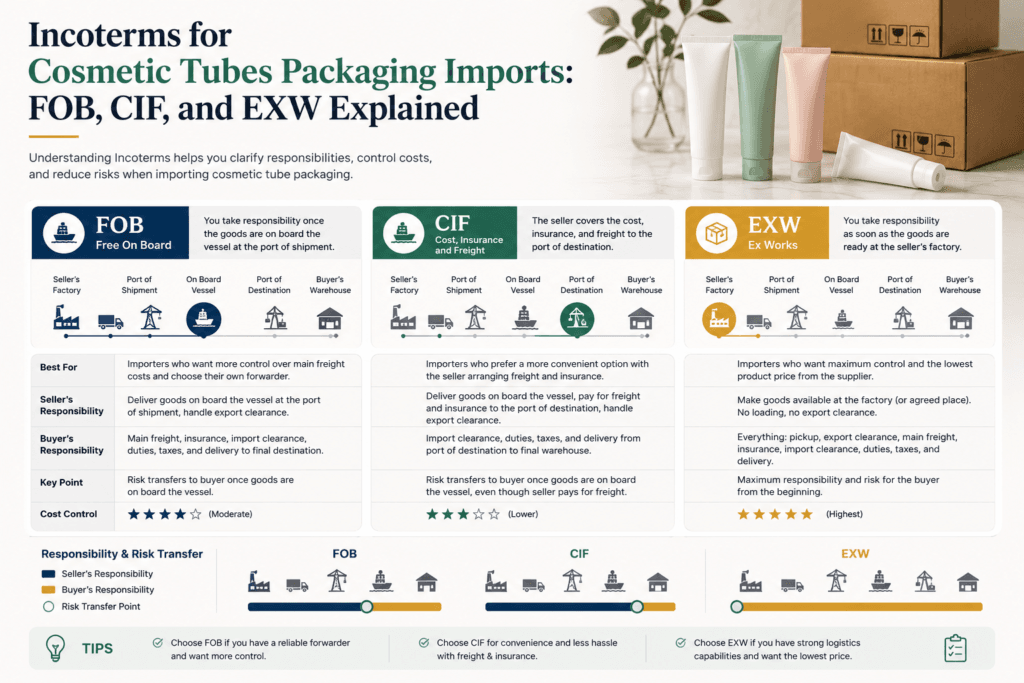
You need to know incoterms when you import cosmetic tubes packaging. Incoterms give clear rules for buyers and sellers. They help you see who pays for each part. They also show when the risk moves from seller to buyer. Incoterms for Cosmetic Tubes help you not make expensive mistakes. The 2020 updates to incoterms make jobs even clearer. For example, the table below shows how incoterms 2020 made cost, insurance, and delivery terms better for importers like you who work with Xinfly Packaging.
| Key Update | Description |
|---|---|
| Costs | Clearer rules about who pays for what, so there is less confusion for importers and exporters. |
| Insurance | Better insurance rules to protect everyone in the trade. |
| Delivery Terms | Clearer delivery rules that help everyone know their job during shipping. |
Key Takeaways
- Incoterms show what buyers and sellers must do in trade. They explain who pays for what and who takes the risk. This helps people not get confused or make expensive mistakes.
- FOB means the buyer is in charge after goods are on the ship. The buyer can choose how to ship and get insurance.
- CIF means the seller pays for shipping and insurance. But the buyer takes the risk when goods are put on the ship.
- EXW makes the buyer do almost everything. The buyer must move the goods, handle customs, and get insurance from the seller’s place.
- Picking the best Incoterm, like DAP or DDP, depends on what you know. It also depends on how much risk you want and how much control you need over importing.
Incoterms for Cosmetic Tubes: What You Need to Know
Incoterms Definition
You should learn about incoterms if you want to import cosmetic tubes. The International Chamber of Commerce made incoterms as rules for trading. These rules help you and your supplier know what to do. Incoterms for cosmetic tubes set rules for shipping, delivery, and payment. They help you avoid confusion and make importing easier.
HS Code
Every product you import has its own code. For cosmetic tubes packaging, the HS code is 3923900000. Customs offices use this code to check your goods. You must put the right HS code on your papers. This helps you clear customs quickly and stops delays.
Why Incoterms Matter for Cosmetic Tubes Packaging
Importing cosmetic tubes packaging has many steps. Incoterms for cosmetic tubes help you handle these steps. Here is how they help your import process:
- Incoterms show who takes care of shipping, customs, and delivery.
- They tell who pays for each part of the trip.
- You know when risk moves from seller to you.
- You can follow rules and avoid customs problems.
Incoterms for cosmetic tubes keep you safe from expensive mistakes. They give clear rules for everyone. You know your job, and your supplier knows theirs. This makes importing easier and safer.
“For the first time, the Incoterms® rules are published both in the traditional format setting out the eleven Incoterms® rules and in a new ‘horizontal’ format setting out the ten articles within each Incoterms® rule under each of the headings listed above in paragraph 53, first for the seller and then for the buyer. Traders can therefore now far more easily see the difference, for example, between the place of delivery in FCA and the place of delivery in DAP; or the items of cost which fall on a buyer in CIF when compared with the items of cost which fall on a buyer in CFR.”
The incoterms 2020 updates give even clearer rules. You can see when risk and cost move from seller to you. You also get better notes and rules for insurance and security. This helps you pick the best incoterms for cosmetic tubes for your needs.
FOB, CIF, EXW: Key Incoterms Explained
When you import cosmetic tubes packaging, you must choose the right incoterms. The three most common options are FOB, CIF, and EXW. Each one changes your responsibility, costs, and risk. Xinfly Packaging often works with these incoterms for cosmetic tubes. Let’s look at each one and see how they affect your import process.
FOB Overview
FOB stands for “Free On Board.” When you use FOB, the seller handles everything until the goods are loaded onto the ship at the port of departure. After that, you take over. This means you pay for ocean freight, insurance, and all costs after loading. If anything happens to the goods after they are on the ship, you bear the risk.
Here is a table that shows who does what under FOB:
| Responsibility | Seller | Buyer |
|---|---|---|
| Manufacturing goods | ✓ | |
| Packing goods | ✓ | |
| Inland transport (to port) | ✓ | |
| Export customs clearance | ✓ | |
| Loading on vessel | ✓ | |
| Ocean freight | ✓ | |
| Marine insurance | ✓ | |
| Unloading at destination | ✓ | |
| Import customs | ✓ | |
| Inland transport at destination | ✓ |
Tip: Under FOB, your costs and risk start once the goods are loaded on the vessel. If the goods get damaged after loading, you must handle the loss.
When you work with Xinfly Packaging and choose FOB, you control the shipping and insurance. You can pick your own freight forwarder and manage the costs associated with transport.
CIF Overview
CIF stands for “Cost, Insurance, and Freight.” With CIF, the seller pays for shipping and insurance to your port. You do not need to arrange ocean freight or insurance. The seller handles export customs and loading. You only take over after the goods arrive at your port.
Here are the main advantages of CIF for cosmetic tubes packaging importers:
| Advantage | Description |
|---|---|
| Convenience | Seller arranges shipping and insurance. |
| Less workload | You do not deal with export formalities. |
| Predictable costs | Freight and insurance costs are included in price. |
| Time saving | Faster for new importers. |
However, you need to know that risk still transfers to you once the goods are loaded on the vessel, not when they arrive at your port. The seller pays for minimum insurance, but it may not cover the full value of your goods. Sometimes, sellers add hidden freight margins, so your costs may be less transparent.
- CIF requires the seller to pay for freight and insurance up to your port.
- You take the risk once the goods are on the ship.
- Insurance may not cover all losses.
- You may pay more if the seller adds extra costs to the freight.
If you choose CIF with Xinfly Packaging, you get a simple process. You pay one price that includes shipping and insurance. This makes it easier to plan your costs, but you should check the insurance coverage.
EXW Overview
EXW stands for “Ex Works.” With EXW, the seller makes the goods available at their warehouse or factory. You handle everything else. You must load the goods, arrange shipping, pay for export and import customs, and cover all costs. You also take on almost all the risk.
Here is a table showing the responsibilities under EXW:
| Party | Responsibilities |
|---|---|
| Seller | – Deliver goods at their warehouse or factory. – Pack goods for export. – Provide invoice and documents. – Help with export licenses if needed. – Give info for insurance. |
| Buyer | – Load goods at pick-up. – Arrange shipping to port. – Prepare export documents. – Pay export fees, port charges, and freight. – Buy insurance. – Pay import duties and customs. – Transport goods to final place and unload. |
EXW gives you the most control but also the most work and risk. You must manage every step and pay all costs associated with transport. If you are new to importing, EXW may be too complex.
Here is how EXW compares to other incoterms in terms of risk:
| Incoterm | Seller’s Responsibilities | Buyer’s Responsibilities | Risk Level |
|---|---|---|---|
| EXW | Makes goods available at warehouse | Loads, ships, customs, insurance, delivery | High |
| FCA | Delivers to carrier | Handles main carriage, insurance | Moderate |
Responsibilities, Costs, and Risks
You need to know when costs and risk move from the seller to you. This helps you avoid mistakes and plan your import budget. Here is a table that shows the transfer points for each incoterm:
| Incoterm | Point of Cost and Risk Transfer |
|---|---|
| EXW | When goods are ready at the seller’s warehouse or factory. |
| FOB | When goods are loaded onto the vessel at the port of departure. |
| CIF | When goods are loaded onto the vessel at the port of departure. |
- With EXW, you pay all costs and take all risk from the start.
- With FOB, you pay and take risk after the goods are on the ship.
- With CIF, you pay for insurance and freight in the price, but risk still moves to you once the goods are loaded.
Note: Always check the details in your contract. Incoterms for cosmetic tubes packaging can change your costs and risk. If you want less work, choose CIF. If you want more control, choose FOB. If you want the lowest price and can handle all steps, choose EXW.
When you import from Xinfly Packaging, ask which incoterms fit your needs. The right choice helps you manage costs, risk, and responsibility. Incoterms 2020 make these rules clear, so you can import with confidence.
DAP and DDP: Incoterms for Cosmetic Tubes Imports
DAP Overview
When you pick DAP, the seller brings your cosmetic tubes packaging to a place you choose. You do not need to worry about shipping or export clearance. The seller takes care of these steps and pays for them. You only start working when the goods reach your site. DAP incoterms help you plan because you know all costs, including shipping and logistics. You can focus on your business while the seller moves the goods from the factory to your filling facility.
- DAP incoterms are good for buyers who can handle import customs clearance.
- You see all costs clearly, so planning is easier.
- The seller pays for shipping and export clearance, so you do not have extra work.
- You must do import customs clearance and pay duties when the goods arrive.
You should think about how the goods will ship. Ocean freight costs less but takes more time. Air freight is faster but costs more.
DDP Overview
DDP gives you the most complete service. The seller does everything, from making the goods to bringing them to you. You do not need to worry about export clearance, shipping, or import customs clearance. The seller pays all costs, including duties and taxes. DDP incoterms make importing easy and stress-free.
- DDP incoterms are popular for online sales and direct-to-consumer orders.
- You avoid customs delays and lower the risk of goods being refused or sent back.
- You get a better experience because the seller handles every step.
Here is a table showing what the seller must do under DDP:
| Obligation | Description |
|---|---|
| Manufacturing | The seller makes the cosmetic tubes. |
| Export customs clearance | The seller finishes all export clearance steps. |
| International freight | The seller pays for shipping to your country. |
| Destination customs clearance | The seller does import customs clearance at your place. |
| Import duties and taxes | The seller pays all import duties and taxes. |
| Final delivery | The seller brings the goods to your address. |
Seller Obligations for Transport and Customs
With DAP and DDP incoterms, the seller does most of the transport and customs work. You do not need to arrange export clearance or shipping. The seller pays for these and makes sure the goods reach your site or warehouse. For DDP, the seller also does import customs clearance and pays all duties. This means you know your costs and have fewer surprises.
- DDP incoterms give you a full import service, including all costs up to delivery.
- The seller must use good logistics partners to avoid customs problems.
- You can trust the seller to handle export clearance and import customs clearance.
Tip: DDP incoterms help you avoid hidden costs and lower your workload. You get a smooth import process and can focus on your business.
Choosing the Right Incoterm for Cosmetic Tubes Packaging
Comparison Table: FOB, CIF, EXW, DAP, DDP
You should look at the main incoterms before picking one for your cosmetic tubes packaging import. The table below shows how the seller and buyer share jobs, costs, and risk for each choice:
| Incoterm | Seller’s Responsibility | Buyer’s Responsibility | Risk Transfer |
|---|---|---|---|
| EXW | Minimal (goods at seller’s premises) | All costs and risks | At seller’s premises |
| FOB | Delivery to port | Freight costs and risk after loading | At loading port |
| CIF | Freight and insurance | Risk after loading | At loading port |
| DAP | Delivery to destination | Unloading and customs | At destination |
| DDP | All costs including customs duties | Minimal | At destination |
This table lets you see who pays for what and when risk moves from seller to buyer. You can use it to plan your import and stop surprises.
Factors to Consider
When you pick an incoterm for your cosmetic tubes packaging, you should think about some key things. These will help you avoid trouble and keep your costs under control:
- Risk transfer: You need to know the exact time risk moves from the seller to you. This helps you protect your goods and get ready for any loss.
- Customs issues: You must get ready for customs checks and paying duties. If you do not do these steps right, you might have delays or extra costs.
- Responsibilities of each party: You should make sure you and the seller both know your jobs. Clear roles stop confusion and surprise costs.
- Shipping costs: Each incoterm changes who pays for shipping, insurance, and delivery. You need to check all costs before you make a deal.
- Import process: Some incoterms make importing easier for you. Others give you more control but also more work.
- Experience level: If you are new to importing, you may want an incoterm where the seller does more steps and pays more costs.
- Transparency: You should ask your supplier for a clear list of all costs. This helps you avoid hidden fees.
Tip: Always ask your supplier, like Xinfly Packaging, to explain the costs for each incoterm. This helps you pick the best one for your business.
You must learn Incoterms before importing cosmetic tubes packaging. Incoterms help you stop mistakes and save money. Each term tells who does each job and when risk changes. The table below shows the main differences:
| Incoterm | Seller’s Responsibility | Buyer’s Responsibility |
|---|---|---|
| EXW | Goods at seller’s location | All transport, insurance, duties |
| DAP | Delivery to agreed place | Customs clearance, import duties |
| DDP | All costs until delivery | None |
Incoterms 2020 make importing safer and easier. You should ask Xinfly Packaging for help. Pick the term that matches your needs and skills.
Frequently Asked Questions About Incoterms for Cosmetic Tube Packaging Imports
Understand FOB, CIF and EXW Incoterms for importing custom cosmetic tubes from China, including freight responsibility, customs clearance, shipping cost control, OEM cosmetic tube manufacturing and export packaging support.
What are Incoterms for cosmetic tube packaging imports?
What does FOB mean when importing cosmetic tubes?
What does CIF mean for cosmetic tube packaging orders?
What does EXW mean when ordering cosmetic tubes from China?
Which Incoterm is best for first-time cosmetic tube importers?
Is FOB better than CIF for cosmetic packaging imports?
When should I choose EXW for cosmetic tube packaging?
Do Incoterms include import duties and taxes?
Can Xinfly Packaging help with cosmetic tube export shipping?
What documents are needed for importing cosmetic tube packaging?
How can I reduce shipping risks for custom cosmetic tubes?
Why choose Xinfly Packaging for cosmetic tube imports?
Need Help Importing Custom Cosmetic Tubes?
Xinfly Packaging helps beauty brands order custom cosmetic tubes from China with clear Incoterms, export documentation support, premium printing, flexible MOQ and reliable OEM cosmetic tube manufacturing.