

Wheat Straw vs PCR Plastic Tubes: Which Sustainable Cosmetic Tube Material Is Better?
Wheat straw tubes and PCR plastic tubes are both popular eco-friendly cosmetic tube options, but they solve different sustainability goals. Wheat straw tubes focus on natural appearance and bio-filled packaging stories, while PCR plastic tubes focus on recycled content and reducing virgin plastic use.
For natural skincare, hotel amenities, hand cream and light personal care products, wheat straw tubes can create a visible eco-friendly impression. For sunscreen, skincare, body care and ESG-driven beauty brands, PCR plastic tubes often provide stronger recycled-content claims and documentation support.
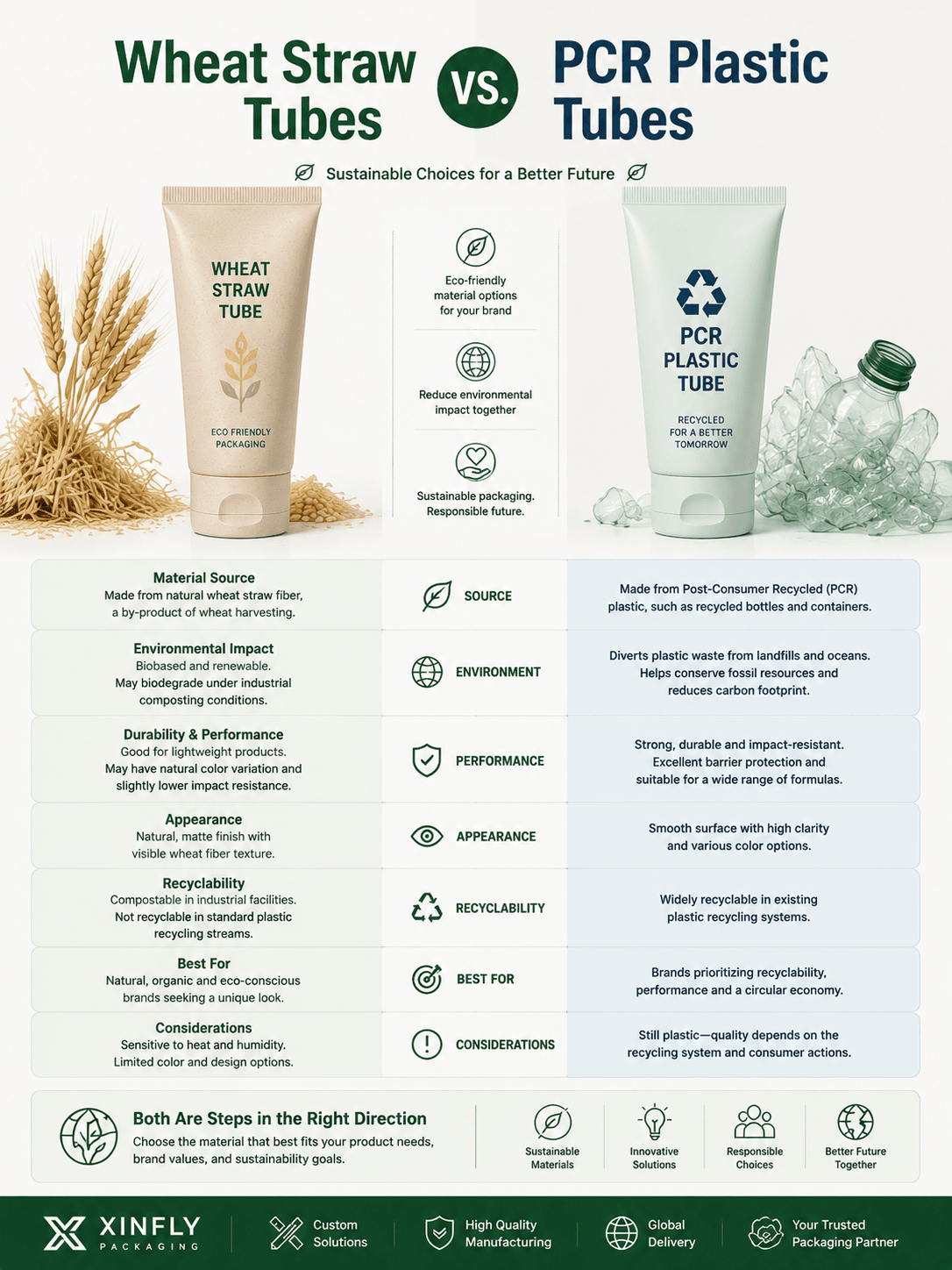
Natural Material Story vs Recycled Content Claim
Many buyers compare wheat straw and PCR plastic because both are promoted as sustainable packaging. However, they represent different sustainability strategies and should not be evaluated by appearance alone.
Wheat Straw Focuses on Natural Visual Identity
Wheat straw cosmetic tubes usually combine plastic resin with wheat straw fiber or bio-filled material. The visible speckled texture helps brands communicate a natural, plant-based and eco-conscious product image.
This makes wheat straw tubes attractive for natural skincare, hotel amenities, hand cream, body lotion and personal care products that rely on a softer environmental story.
PCR Plastic Focuses on Reducing Virgin Plastic
PCR plastic tubes use post-consumer recycled plastic content. The main sustainability message is recycled content, lower use of virgin plastic and support for circular material use.
PCR plastic tubes are often preferred by global beauty brands that need clearer ESG claims, GRS documentation and recycled-content packaging direction.
What Are Wheat Straw Tubes?
Wheat straw tubes are cosmetic tubes made with plastic combined with wheat straw fiber or plant-based filler to create a natural-looking sustainable packaging appearance.
Advantages of Wheat Straw Tubes
- Natural speckled appearance for eco-friendly branding
- Strong visual link to plant-based and clean beauty positioning
- Suitable for hotel amenities, hand cream and natural skincare
- Helps products stand out from standard white or glossy tubes
- Works with simple printing, minimalist artwork and natural colors
When Wheat Straw Tubes Are More Suitable
Choose wheat straw tubes when your brand wants a visible natural material story and a softer sustainable image. They are especially suitable for small personal care products, travel-size amenities, hand cream and clean beauty packaging.
Useful pages: Wheat Straw Plastic Cosmetic Tubes, Wheat Straw Cosmetic Tubes Manufacturer
What Are PCR Plastic Tubes?
PCR plastic tubes use post-consumer recycled plastic content to reduce dependence on virgin plastic in cosmetic tube packaging.
Advantages of PCR Plastic Tubes
- Supports recycled-content packaging claims
- Helps reduce virgin plastic usage in cosmetic packaging
- Can support GRS documentation depending on material and project
- Suitable for skincare, sunscreen, body care and ESG product lines
- Available in different PCR content levels such as 30%, 50% or higher
When PCR Plastic Tubes Are More Suitable
Choose PCR plastic tubes when your brand needs a measurable recycled-content story, sustainability documentation and better alignment with corporate packaging goals.
Useful pages: PCR Plastic Tubes, PCR Cosmetic Tubes Manufacturer
Wheat Straw vs PCR Plastic Tubes: Detailed Comparison
The right choice depends on whether your packaging priority is natural appearance, recycled content, brand storytelling, documentation or formula compatibility.
| Comparison Point | Wheat Straw Tubes | PCR Plastic Tubes | Xinfly Packaging Recommendation |
|---|---|---|---|
| Main Sustainability Message | Natural, plant-filled, eco-conscious appearance | Recycled content and reduced virgin plastic usage | Choose wheat straw for visual eco story; choose PCR for recycled-content claims. |
| Appearance | Natural speckles, warm organic texture | Can look closer to standard plastic, depending on PCR content | Wheat straw gives stronger visible difference; PCR gives stronger documentation value. |
| Documentation | Depends on material source and supplier specification | Can support GRS-related documentation when certified material is used | PCR is better when buyers require recycled-content documentation. |
| Formula Compatibility | Best for stable formulas and low-to-medium sensitivity products | Suitable for broader cosmetic applications after testing | For sunscreen or active skincare, test PCR structure and barrier requirements carefully. |
| Best Applications | Hotel amenities, hand cream, body lotion, natural skincare, personal care | Sunscreen, skincare, body care, hand cream, ESG product lines | Match the material with product category and sustainability claim. |
| Cost | Depends on wheat straw content, tube size and finish | Depends on PCR percentage, certification and recycled resin supply | Compare total value, not only unit price. |
Advantages of Wheat Straw and PCR Plastic Tubes
Understand the sustainability, formula compatibility, and visual appeal of each tube type.
Wheat Straw Tubes
- Natural speckled texture and plant-based aesthetic
- Eco-friendly branding story for personal care and hotel amenities
- Compatible with hand cream, body lotion, natural skincare
- Supports light decoration, minimalistic design and soft-touch finishes
- Communicates sustainable and clean beauty positioning
Learn more: Wheat Straw Plastic Cosmetic Tubes
PCR Plastic Tubes
- Post-consumer recycled content reduces virgin plastic usage
- Supports GRS certification and ESG claims
- Suitable for sunscreen, skincare, body care and personal care brands
- Flexible for high-barrier formulas when combined with EVOH or multi-layer structures
- Available in 30%, 50% or 100% PCR content
Learn more: PCR Plastic Tubes
Wheat Straw vs PCR Plastic: Detailed Comparison
| Feature | Wheat Straw Tubes | PCR Plastic Tubes |
|---|---|---|
| Sustainability Focus | Plant-based, natural appearance, visual eco-story | Recycled content, reduces virgin plastic usage |
| Best Applications | Hand cream, body lotion, hotel amenities, natural skincare | Sunscreen, skincare, body care, high-barrier formulas |
| Appearance | Speckled texture, organic look | Plastic look, may be tinted or opaque |
| Documentation | Depends on material source | Supports GRS, PCR certification for ESG purposes |
| Recyclability | More complex due to multi-component structure | Easier with mono-material PCR or compatible multi-layer |
| Cost | Depends on wheat straw content and finish | Depends on PCR resin price and certification |
Case Studies Using Wheat Straw & PCR Tubes
Explore how Xinfly Packaging applies wheat straw and PCR plastic tubes for cosmetic and personal care products.
PCR Sunscreen Tubes
High-barrier PCR tubes for SPF50 sunscreen and eco-conscious packaging.
View ProjectHand Cream Wheat Straw Tubes
Natural wheat straw tubes for hand cream, emphasizing plant-based eco appeal.
View ProjectFacial Cleanser PCR Tubes
Recycled-content tubes for facial cleanser, supporting sustainability documentation.
View ProjectMoisturizer Wheat Straw Tubes
Eco-friendly wheat straw tubes for natural moisturizer packaging projects.
View ProjectFrequently Asked Questions
Common questions about wheat straw and PCR plastic cosmetic tubes.
1. What are wheat straw tubes?
Wheat straw tubes are plastic tubes filled with wheat straw fibers to create a natural and eco-friendly appearance. Learn more
2. What are PCR plastic tubes?
PCR plastic tubes use post-consumer recycled plastic to reduce virgin plastic use and support sustainability documentation. Learn more
3. Which option is more sustainable?
Both options are sustainable; wheat straw focuses on natural material story, PCR focuses on recycled-content claims.
4. Are wheat straw tubes recyclable?
Depends on the composite material and local recycling facilities; consult Xinfly for recycling guidance. FAQ
5. Are PCR plastic tubes recyclable?
Yes. PCR plastic tubes can be recycled like other PE-based tubes and often come with GRS-certified documentation.
6. Which material has better appearance consistency?
PCR plastic has more uniform color, while wheat straw has natural speckled texture.
7. Which is better for natural skincare?
Wheat straw tubes are preferred for natural and plant-based skincare products.
8. Which is better for sunscreen?
PCR tubes are better for high-barrier formulations and regulatory compliance.
9. Which is more cost-effective?
Costs vary by production volume and material; PCR tubes are generally more stable for large-scale runs.
10. Can wheat straw and PCR be combined?
Yes, hybrid designs are possible to combine natural appearance and recycled content.
11. Does Xinfly Packaging offer both?
Yes. Xinfly manufactures wheat straw tubes and PCR plastic tubes with custom sizes, finishes, and barrier options.
12. How do I choose between wheat straw and PCR plastic tubes?
Choose wheat straw for visual eco-story and natural aesthetic; choose PCR for recycled content and ESG reporting requirements.
Need Wheat Straw or PCR Plastic Tubes?
Xinfly Packaging provides custom sustainable tubes, including wheat straw and PCR plastic tubes, for skincare, sunscreen, personal care, hand cream, body lotion, and other cosmetic applications.
Request Samples & Quote Talk to a Packaging Engineer