

Solving Soft-Touch Coating Peeling: Durable Matte Varnish Application on Liquid Foundation Tubes
A beauty brand contacted Xinfly Packaging after experiencing visible peeling and surface damage on soft-touch coated liquid foundation tubes during handling, filling-line movement, secondary packing, and retail transportation.
The original tube had the premium tactile feel the brand wanted, but the coating system was not sufficiently durable for repeated friction and contact. Our engineering team reviewed the tube material, surface treatment, printing sequence, coating adhesion, curing conditions, and downstream handling requirements before recommending a more durable matte varnish system.
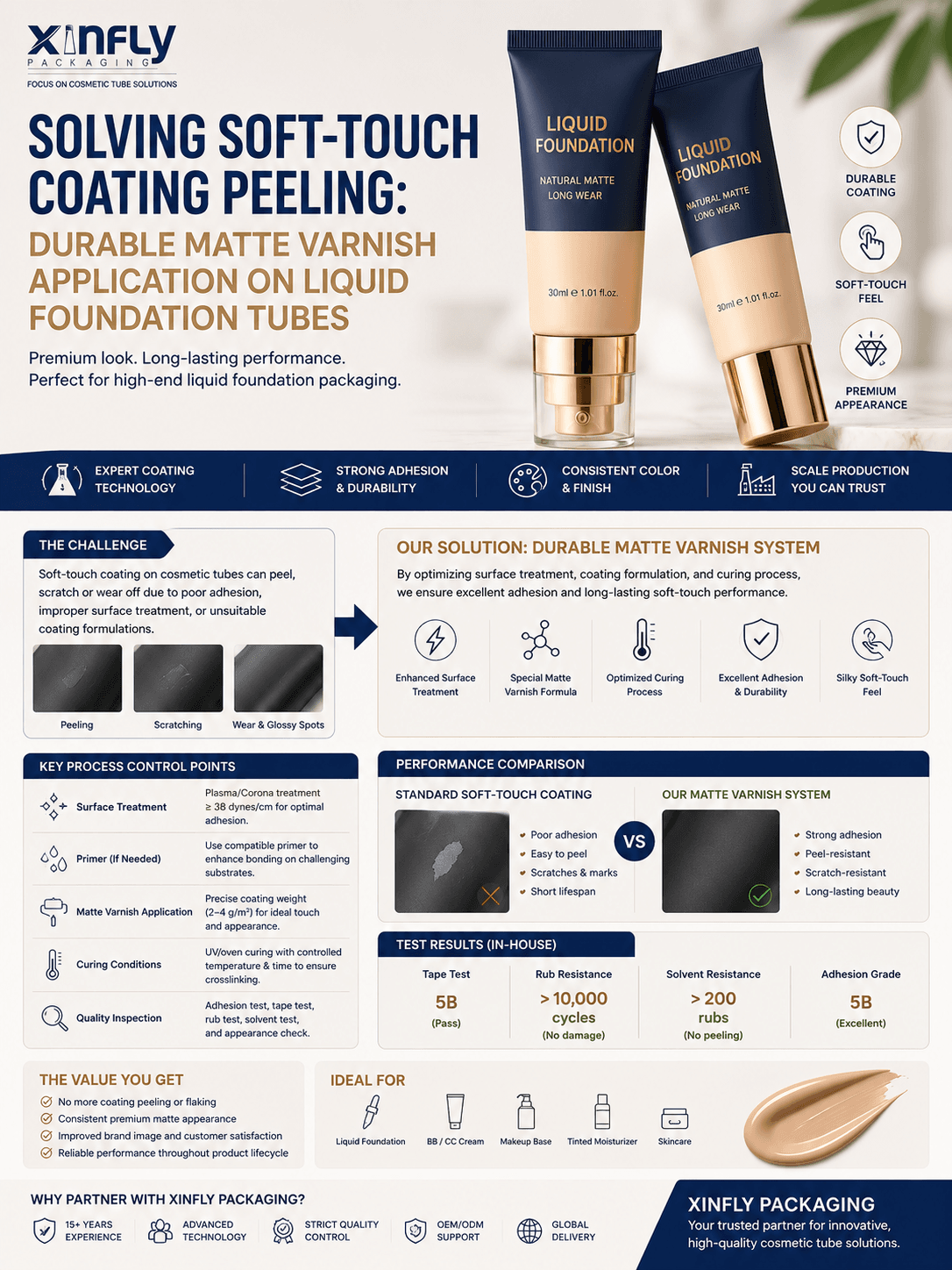
Project Background: Why the Original Soft-Touch Finish Failed
The customer was preparing a premium liquid foundation line with a minimalist matte appearance. The first packaging specification used a soft-touch coating because the brand wanted a smooth, velvety hand feel that reinforced its high-end positioning.
However, after pilot filling and transport simulation, the customer found visible coating damage around high-contact areas of the tube. Scratching and localized peeling were especially noticeable where tubes rubbed against guide rails, trays, cartons, and each other.
Because foundation packaging is repeatedly handled during filling, cap assembly, inspection, packing, warehousing, and final consumer use, surface durability was more important than tactile softness alone.
Based on our experience in foundation tubes, cosmetic tube decoration, surface finishing, and matte varnish vs soft-touch coating, our engineers rebuilt the finishing specification around adhesion strength and abrasion resistance.
Customer Pain Points Before Surface Finish Optimization
Soft-Touch Coating Peeling
- Localized coating lifted after repeated friction.
- Damage was most visible on dark or highly saturated tube colors.
- The peeling reduced the perceived quality of the finished product.
Filling-Line Abrasion
- Tubes contacted metal guides and handling fixtures during filling.
- Repeated movement increased surface friction.
- Packaging needed to survive production handling, not only shelf display.
Luxury Appearance Had to Be Preserved
- The customer still wanted a premium low-gloss matte surface.
- The alternative finish could not look flat, chalky, or inexpensive.
- Logo clarity and color consistency needed to remain stable.
Factory Engineer’s Recommendation: Replace High-Risk Soft Touch with a Durable Matte Varnish System
From a manufacturing perspective, coating failure should not be treated as a simple cosmetic defect. It is usually the result of interaction between substrate surface energy, printing ink, coating chemistry, curing conditions, coating thickness, and downstream friction.
Our engineers recommended changing the finishing system from a soft-touch coating to a more durable matte varnish designed for better abrasion resistance on liquid foundation tubes. The target was to preserve a premium low-gloss appearance while reducing the risk of peeling during filling, assembly, packing, and transportation.
Before varnish application, the PE tube surface needed sufficient treatment to support coating adhesion. We also reviewed the printing and coating sequence so that inks, varnish, and decorative details worked as a compatible system rather than as independent layers.
For brands comparing surface effects, we recommend reviewing Matte Varnish vs Soft Touch Tubes, Matte Finish Tubes, and Cosmetic Tube Printing Options.
Why This Case Was Not Simply “Matte vs Soft Touch”
The project was not about deciding which finish looked better. The purchasing problem was whether the decoration system could survive actual production and distribution conditions while maintaining the brand’s premium appearance.
Performance Before Tactile Effect
The final finish was selected based on abrasion resistance, adhesion, handling durability, and production compatibility rather than touch sensation alone.
Process Compatibility
We evaluated the entire decoration stack, including substrate treatment, printing, curing, varnish application, and subsequent handling.
Retail Appearance Preservation
The durable matte surface retained a premium, low-gloss visual effect while reducing visible scuffing and peeling risks.
Why Soft-Touch Coating Can Peel on PE Foundation Tubes
Soft-touch coating failure is rarely caused by one factor alone. On PE cosmetic tubes, adhesion performance depends on the relationship between substrate surface treatment, printing ink, coating formulation, application thickness, curing conditions, and the amount of mechanical friction the tube receives after decoration.
Insufficient Surface Energy
PE naturally has relatively low surface energy. If surface treatment is inadequate or declines before printing and coating, the decorative layer may not anchor strongly enough to the tube surface.
Ink & Coating Compatibility
A coating can perform well on bare plastic but poorly over a particular ink system. The complete decoration stack should therefore be evaluated as one system rather than testing each layer independently.
Excessive Friction After Decoration
Even visually acceptable tubes can fail later when they rub against filling-line guides, trays, cartons, dividers, or neighboring tubes during packing and transportation.
Why We Switched to a Durable Matte Varnish System
The customer still wanted a sophisticated low-gloss appearance, so changing to a glossy surface was not acceptable. We therefore recommended a matte varnish system that prioritized adhesion and abrasion resistance while retaining the visual character of premium foundation packaging.
Lower Peeling Risk
A properly matched matte varnish can provide a more durable protective layer for applications where repeated rubbing is expected during filling and transportation.
Premium Low-Gloss Appearance
Matte varnish maintains a refined visual finish without requiring the pronounced velvety hand feel associated with soft-touch coatings.
Better Production Practicality
For high-volume foundation tube programs, a durable matte system can provide a better balance between brand appearance, decoration stability, and manufacturing repeatability.
Factory Engineer’s Advice: Control Surface Treatment Before Changing the Coating
When a coating peels, simply changing the varnish supplier may not solve the problem. The first step is to verify whether the tube surface has been treated correctly and whether the treatment level remains suitable when decoration is applied.
For PE tubes, surface activation such as corona treatment is commonly used to improve wettability and adhesion. The actual production window, storage time between treatment and decoration, ink compatibility, and curing conditions should all be controlled consistently.
We also recommend validating the complete decoration system with realistic handling conditions. A finish that passes a visual inspection immediately after coating may still fail once the tube is filled, capped, packed, and subjected to repeated friction.
For deeper technical comparisons, see our pages on matte varnish vs soft-touch coating, cosmetic tube surface finishing, and tube decoration options.
Recommended Quality Checks Before Mass Production
For a foundation tube using a premium matte surface, approval should go beyond matching the reference color and gloss level. The following checks help identify coating risks before large-volume production.
Adhesion Evaluation
- Check coating anchoring after complete curing.
- Review printing-to-varnish compatibility.
- Inspect high-risk edges and transition areas.
Abrasion & Rub Simulation
- Simulate tube-to-tube contact.
- Evaluate friction from cartons and trays.
- Inspect visible scuffing after repeated handling.
Filling-Line Simulation
- Review guide-rail contact points.
- Check cap assembly handling.
- Evaluate packing-line friction before commercial launch.
Soft-Touch Coating vs Durable Matte Varnish for This Project
| Evaluation Point | Original Soft-Touch Finish | Optimized Matte Varnish |
|---|---|---|
| Primary Brand Benefit | Velvety tactile experience | Premium low-gloss visual appearance |
| Main Project Risk | Peeling and visible rubbing damage | Lower risk when properly matched and cured |
| Filling-Line Handling | Required more careful friction control | Better suited to repeated handling for this project |
| Retail Appearance | Premium when undamaged | Premium matte appearance with improved durability focus |
| Best Choice for This Case | Rejected after durability concerns | Selected for production evaluation |
Final Packaging Specifications
The final specification focused on a durable matte liquid foundation tube that retained premium shelf appeal while reducing coating-related quality risk during filling, packing, shipment, and consumer handling.
| Item | Specification |
|---|---|
| Project Type | Liquid Foundation Tube Surface Finish Optimization |
| Application | Liquid Foundation, Makeup Base, BB Cream, CC Cream |
| Tube Material | PE Cosmetic Squeeze Tube |
| Original Surface Finish | Soft-Touch Coating |
| Optimized Finish | Durable Matte Varnish |
| Decoration Options | Offset Printing, Silk Screen Printing, Hot Stamping |
| Engineering Focus | Surface Treatment, Ink Compatibility, Varnish Adhesion, Curing and Abrasion Resistance |
| Quality Focus | Adhesion, Rub Resistance, Filling-Line Handling and Finished Appearance |
| Target Market | Premium Makeup, Private Label Foundation and Clean Beauty Brands |
Services Provided by Xinfly Packaging
For decoration-related projects, Xinfly Packaging supports customers from finish selection through printing approval and mass-production quality control. The objective is to identify coating risks before they become commercial defects.
Surface Engineering
- PE surface treatment review
- Coating adhesion evaluation
- Matte vs soft-touch selection
- Decoration stack compatibility analysis
Artwork & Decoration Support
- Pantone color matching
- Offset and silk screen layout review
- Hot stamping compatibility
- Gloss and matte appearance confirmation
Production Quality Control
- Pre-production sample approval
- Appearance consistency inspection
- Coating defect monitoring
- Finished packaging inspection
Factory Quality & Certification Support
Xinfly Packaging supports global beauty brands with documented quality management and third-party material testing. Customers can review additional factory documentation through our certifications page.
ISO Quality System
Structured production and quality-management procedures for repeat cosmetic packaging orders.
SGS Testing
Third-party testing support is available for relevant packaging materials and compliance documentation.
RoHS Compliance
Packaging documentation can support customers requiring applicable restricted-substance compliance information.
GRS PCR Options
GRS-certified PCR material solutions are available for brands combining surface design with sustainability goals.
Related Foundation Tube & Decoration Solutions
Foundation Tubes
Explore custom tube structures for liquid and cream makeup formulas.
Explore Foundation Tubes →Matte Finish Tubes
Learn about matte cosmetic tube solutions for premium beauty packaging.
Explore Matte Tubes →Printing Options
Compare offset printing, silk screen printing and decorative techniques.
View Printing Options →Surface Finishing
Review available cosmetic tube coating and finishing technologies.
View Surface Finishes →Development Process: From Coating Failure Diagnosis to Production Approval
Instead of immediately replacing the existing finish, Xinfly Packaging first identified where the original surface system was failing. This helped the customer avoid repeating the same coating problem with a different material.
Project Results
The optimized matte varnish system gave the customer the premium visual character required for its liquid foundation range while addressing the durability problems observed with the original soft-touch coating.
The final tube finish performed more consistently through filling-line handling, secondary packing, and transportation evaluation. Just as importantly, the project gave the customer a clearer technical specification for future production rather than relying only on a visual coating reference.
This case demonstrates why cosmetic tube surface finishing should be treated as an engineering decision. For premium makeup packaging, appearance, adhesion, abrasion resistance, printing compatibility, and production conditions must be evaluated together.
Client Feedback
“Our original tubes looked beautiful before filling, but the soft-touch coating became damaged during production handling. Xinfly Packaging identified the surface-finish issue and recommended a matte varnish solution that gave us the visual effect we wanted with much better production durability.”
— Packaging Development Manager, Premium Makeup Brand
Engineer’s Advice for Buyers Specifying Matte or Soft-Touch Foundation Tubes
Do not approve the finish by appearance alone
A beautiful PPS sample does not automatically prove that the coating will survive filling, carton packing, transport vibration, or repeated consumer handling.
Provide the actual downstream process
Tell the tube manufacturer whether the product will pass through automatic filling guides, conveyors, cap assembly equipment, trays, inserts, or tight master cartons.
Test dark colors more carefully
Scuffing, scratches, and coating damage are often more visually obvious on black, navy, burgundy, and other saturated tube colors.
Lock the decoration specification
Mass-production standards should define substrate, treatment, ink system, varnish or coating, curing conditions, color reference, and acceptable appearance limits.
Frequently Asked Questions About Matte Varnish and Soft-Touch Foundation Tubes
1. Why does soft-touch coating peel from cosmetic tubes?
Peeling can result from insufficient surface treatment, poor compatibility between inks and coating, inadequate curing, excessive coating thickness, or repeated abrasion after decoration.
2. Is matte varnish more durable than soft-touch coating?
It can be more suitable for high-contact applications, but durability depends on the complete decoration system, substrate preparation, varnish chemistry, curing, and actual handling conditions.
3. Can matte varnish still look premium?
Yes. A well-controlled matte varnish can create a refined low-gloss appearance suitable for premium foundation, BB cream, CC cream, and skincare packaging.
4. Why is surface treatment important on PE tubes?
PE has relatively low natural surface energy. Proper surface activation improves wetting and helps printing inks and coatings adhere more reliably.
5. Should coating durability be tested before filling?
Yes. Pre-production testing should include adhesion and handling evaluation, and brands should ideally simulate real filling and packing conditions before approving mass production.
6. Can foundation tube printing be combined with matte varnish?
Yes. Offset printing, silk screen printing, and selected hot-stamping details can be combined with matte finishing when the complete decoration stack is properly matched.
7. Can dark-colored tubes use matte varnish?
Yes, but dark surfaces should be inspected carefully because scratches, rubbing marks, gloss variation, and coating defects can be more visible.
8. Can you reproduce an existing matte reference sample?
Yes. Xinfly Packaging can evaluate a physical reference, Pantone target, gloss expectation, printing artwork, and production requirements before preparing samples.
9. What information should we provide for a coating problem?
Useful information includes tube material, color, printing process, coating type, photos of the defect, filling conditions, packing method, storage environment, and where the damage occurs.
10. Can matte tubes use PCR material?
PCR structures can be evaluated, but surface appearance and decoration consistency should be tested because recycled content may affect substrate appearance and processing characteristics.
Continue Exploring Foundation Tube Decoration
For buyers developing premium makeup packaging, the following technical resources can help during specification and supplier evaluation: Matte Varnish vs Soft Touch Tubes, Matte vs Glossy vs Soft Touch, Silk Screen vs Offset Printing, Hot Stamping vs Silk Screen, and our Foundation Tube Manufacturing Solutions.
Having Peeling or Scuffing Problems on Your Cosmetic Tubes?
Send Xinfly Packaging your tube specification, finish requirement, defect photos, and filling or packing conditions. Our engineering team can review whether the problem relates to surface treatment, ink compatibility, coating selection, curing, or downstream abrasion.
We can then develop a matte, soft-touch, glossy, or customized surface-finishing solution around your actual production conditions.