Published: .
Commercial review: pending. The purchaser, supplier and logistics adviser must confirm the quotation, applicable contract terms and destination requirements. This worksheet does not select an Incoterms rule, determine customs treatment or promise a freight rate or delivery date.
Two hotel tube quotations can both include a freight line and still describe different deliveries. One may concern a named logistics facility; another may refer to the buyer's receiving address. A hotel brand's office, its contract filler and the property where guests use the product are not necessarily the same place. Comparing only the final price can hide the difference.
A hotel amenity tube freight delivery place review makes the location and service scope explicit before the purchaser compares proposals. Start with the physical goods being shipped and the exact receiving point. Then ask which services are included, which are excluded and which assumptions could change the quotation. The two worksheets below are original RFQ tools for that discussion.
Identify the Goods and the Quoted Shipment
Confirm Whether the Shipment Contains Empty Packaging
For hotel shampoo and conditioner tubes, distinguish empty packaging from filled guest products in the RFQ. Identify the tube items, assembly state and quantities covered by the quotation. Do not infer filling, sealing or finished-product delivery from the application name on a packaging page. Name the party responsible for any operation that sits outside the supplier's stated scope.
The location matters at that stage. Empty hotel shampoo tubes may be required at a filler or consolidation warehouse rather than a hotel loading bay. A property address on the brand's website is not an instruction to send an empty-packaging shipment there. Request written confirmation of the intended recipient and receiving purpose before asking suppliers to price the route.
Keep the Packing Basis with the Destination
Ask for the proposed carton count, dimensions, gross weight and any pallet arrangement that the freight quotation assumes. Identify whether the supplier's figures are preliminary or confirmed for the agreed packing plan. Keep the item quantities and packing data connected to the quote revision. If a pack configuration changes, ask whether the freight basis needs to be updated.
For an enquiry about 30 mL squeeze tubes for hotel amenities, the nominal tube capacity does not supply the shipping dimensions or packed weight. Nor does it establish a specific carton quantity. Request the actual project packing proposal. Use missing-data fields rather than inserting figures from a different tube or an older shipment.
Write the Delivery Place as a Usable Address
Identify the Recipient and Physical Receiving Point
Record the receiving business, street address, postcode, city and country. Add the warehouse, building, gate or receiving reference when the recipient requires one. Check that the destination description is usable by the person arranging carriage, not just recognisable to the brand's sales team. A city name alone may leave the intended delivery point unresolved.
Keep commercially agreed named-place wording alongside the operational receiving address. They are related records, but do not assume that one field replaces the other. Ask the responsible logistics or commercial team to confirm how they correspond under the actual quotation and contract. This guide does not interpret which place has which contractual effect for an individual trade term.
| Field | Information to provide or confirm | Why the purchaser needs it | Owner to identify |
|---|---|---|---|
| Goods | Empty tube items, assembly state and quantities | Establishes what the quote covers | Purchaser and supplier |
| Receiving business | Exact recipient name and receiving purpose | Distinguishes filler, warehouse and hotel | Buyer |
| Physical address | Street, postcode, city and country | Makes the requested point identifiable | Recipient |
| Site reference | Building, gate or warehouse instructions | Avoids an incomplete operational description | Receiving team |
| Contract wording | Proposed rule, named place and stated version if applicable | Supports a like-for-like commercial review | Commercial or logistics adviser |
| Packing basis | Cartons, dimensions, weights and pallet proposal | Identifies the shipment assumption | Supplier |
| Receiving restrictions | Booking, access, equipment and hours to confirm | Identifies services that may need quotation | Recipient and carrier |
| Exclusions | Separately listed services or charges | Prevents an assumed delivered-price comparison | Supplier and purchaser |
Check the Address Before Sending the RFQ
Ask the recipient to confirm the address and the relevant receiving instructions. Keep the response with the enquiry. If a site uses a third-party logistics provider, confirm the required reference and the actual location rather than assuming that the provider's registered office is the delivery point. Avoid circulating personal contact information beyond the parties that need it for the shipment.
If the destination is not final, say so. Request an indicative quotation against an identified provisional point and ask what information is needed for a firm project response. Do not present a provisional freight figure as though it covers an unspecified door delivery. The unresolved location should remain visible in the comparison sheet.
Separate Trade-Term Wording from Included Services
Preserve the Supplier's Complete Entry
The International Chamber of Commerce describes Incoterms 2020 as rules addressing the allocation of costs, risks and obligations in trade. For a quotation review, retain the supplier's complete proposed rule, named-place wording and stated version. Ask the responsible commercial adviser to resolve an incomplete or unsuitable entry rather than expanding an abbreviation yourself.
Do not reduce the review to a three-letter code. The purchaser still needs the actual goods, route, quotation inclusions and exclusions. Equally, a phrase such as “shipping included” should not be treated as a substitute for complete contract wording. Keep the supplier's statements intact and ask for clarification where the intended scope is not clear.
List Services Instead of Assuming Them
Request an itemised explanation of the included transport and handling scope. Ask which party arranges each required stage and which services the proposal does not include. Route questions about customs, taxes, insurance, unloading or other responsibilities to the relevant adviser and supplier under the actual agreement. This article does not assign those obligations to a particular Incoterm.
The response should identify any assumptions about access, booking or delivery equipment that affect the proposal. An included transport stage does not, by itself, describe every service at the receiving site. Keep each open question visible until the responsible parties confirm it. Do not label a quotation “all inclusive” based only on a total price.
Check the Hotel Receiving Route

Ask the Receiving Team About Practical Constraints
If the delivery is genuinely to a hotel, ask the property's receiving team which entrance, booking process and receiving hours apply. Confirm any stated restrictions on vehicle access, pallet handling or delivery equipment. These are questions for the actual site, not universal hotel requirements. Record the current instructions and ask the logistics provider to confirm whether its quotation covers the requested arrangement.
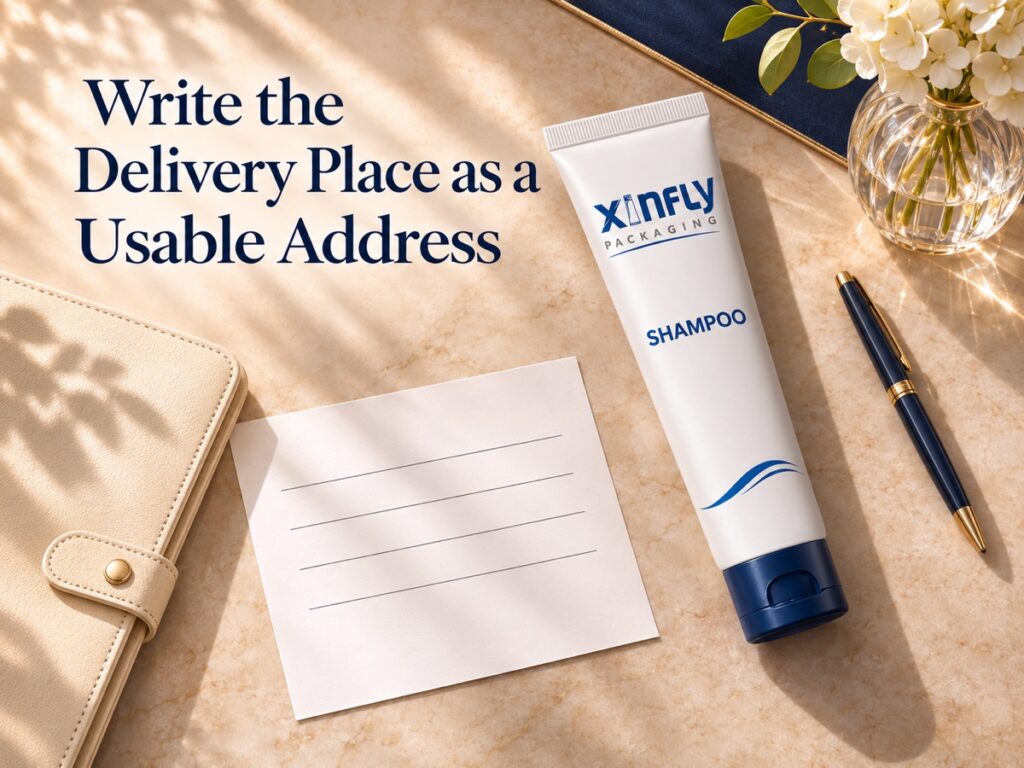
The packaging illustrations show a proposed white PE-style shampoo tube with a moulded shoulder, sealed tail, closed navy flip cap and blue-and-grey screen-print-style artwork. The tube is shown in hospitality and document-review settings. The pictures do not show a completed shipment, confirm a delivery service or represent a stock item available for a particular hotel.
Keep an Intermediate Warehouse Distinct
Where goods move through a filler or consolidation warehouse, identify that receiving point separately from the final property. Ask who is arranging the subsequent movement and whether it forms part of the quotation being compared. Do not merge several stages into a single destination cell unless the responsible parties have explicitly agreed what the combined scope means.
For a Hotel Amenities Tube Supplier enquiry, a concise route description helps the supplier answer the right question. State the current delivery requirement rather than asking for a price to the brand's country and expecting the remaining details to be inferred. Request a revised response if the recipient or route changes before the order is placed.
Compare Quotes on the Same Basis
Use an Inclusion and Exception Sheet
Enter each supplier's original wording before adding the purchaser's comparison notes. If the proposals cover different places or services, label the difference and request clarification. Do not subtract an invented local charge to make two totals appear comparable. The comparison should reveal unresolved scope, not manufacture a price that neither supplier offered.
| Comparison item | Supplier response to retain | Buyer check | Action if unresolved |
|---|---|---|---|
| Goods and quantity | Identified tube items and quoted quantities | Same shipment basis? | Request the correct scope |
| Destination | Complete named-place wording and address | Same intended receiving point? | Obtain written clarification |
| Packing | Current dimensions, weights and carton or pallet plan | Same approved packing basis? | Ask for revised packing data |
| Transport scope | Included stages and services | Any unpriced required stage? | Refer to supplier and logistics adviser |
| Site services | Access, booking and equipment assumptions | Compatible with recipient instructions? | Request a specific service response |
| Excluded costs | Supplier's explicit exclusions | Are open items understood? | Keep them outside a claimed total |
| Commercial conditions | Currency, validity and stated conditions | Is the proposal still applicable? | Ask for an updated quotation |
| Order release | Confirmed route and accepted scope | Have responsible owners agreed? | Hold the unresolved delivery line |
Record the Change That Requires a Requote
Agree how the supplier will be told about changed quantities, packing, destination or receiving instructions. Keep the old quote and the revised response under separate revisions. A destination change may also affect other commercial questions; ask the relevant adviser to review them rather than changing only an address on the purchase order.
Do not turn an expected shipping date into a delivery guarantee. Ask the supplier and logistics provider to state the current project timing and its conditions in their own response. Retain any assumptions and unresolved dependencies so the purchaser can decide what still needs confirmation before releasing the order.
Send an Enquiry That the Supplier Can Price
Provide the Minimum Complete Route Brief
Include the tube specification, required quantities, current packing proposal, exact destination and confirmed receiving instructions. If artwork or structural samples are still pending, identify how that affects the packing and quotation status. The sample development discussion and the freight discussion should use the same item reference, without treating a sample package's size as the final shipping configuration.
Send Xinfly Packaging a scoped hotel tube enquiry and ask which freight information can be confirmed at the current project stage. Request explicit exclusions and the party responsible for each unresolved logistics question. That approach gives the purchaser usable comparisons while allowing the supplier to distinguish a preliminary estimate from its actual project quotation.
Frequently Asked Questions
Is a City Name Enough for a Delivered Freight Quote?
It may support an explicitly provisional enquiry, but it leaves the operational receiving point unresolved. Provide the actual address and required site references when available. Ask the supplier what its response covers instead of assuming that the figure includes delivery to any address in that city.
Can I Use the Hotel's Address for Empty Tube Delivery?
Only when that is the intended receiving point confirmed by the buyer and recipient. Empty packaging may be required at a filler or another warehouse. Identify the purpose of the shipment and do not infer the destination from the hotel's public contact page.
Does an Incoterms Abbreviation Resolve Every Freight Question?
No. Retain complete proposed wording and have the responsible adviser review the actual contract. Also identify the goods, route, receiving instructions and quotation inclusions. Do not interpret a code or an incomplete email phrase as the entire commercial agreement.
Should I Add My Own Estimated Excluded Charges to Compare Totals?
Keep unquoted assumptions separate and request the missing responses from the relevant parties. A comparison that depends on invented costs can conceal a real scope difference. Identify confirmed amounts and unresolved items distinctly rather than presenting an unsupported landed total.
What If the Delivery Address Changes After Quotation?
Issue a controlled update and request confirmation of the affected packing, logistics and commercial scope. Preserve both quotation revisions. Do not assume that replacing the address field leaves the original price, services and conditions applicable.
Conclusion
Name the actual delivery place before comparing hotel amenity tube freight quotes. Connect the address to the goods, packing basis, receiving instructions and supplier's explicit scope. With those records in one controlled brief, Xinfly Packaging and the buyer's logistics team can answer the questions that a total freight line alone leaves unresolved.