Published: .
Two suppliers quote the same number of hotel shampoo tubes, yet their proposals describe different purchases. One covers decorated empty packaging. Another mentions a finished amenity, but leaves formula, filling and individual cartons unclear. Comparing the headline totals now would be like comparing a furnished room with an empty floor plan.
Comparing a hotel amenity tube quote for empty versus filled products starts with the delivered product state. Before discussing artwork or negotiating quantities, write down what must arrive and who supplies each operation. Xinfly Packaging's hotel amenities tubes provide a packaging starting point. This guide gives you a scope matrix and delivery-state checklist; it does not assume that filling, formula supply or any other service is included in a particular offer.
Name the Purchase Before Requesting a Price
Describe What Arrives at the Receiving Dock
“Hotel amenities” can refer to an empty tube, a filled individual product, or a prepared assortment for guest rooms. Those descriptions carry different responsibilities. Tell bidders which item you want to receive. Then ask them to identify what their own proposal covers rather than letting a familiar product photograph answer the question.
For an empty-packaging inquiry, identify the body, closure, decoration and required delivery condition. For a finished-product inquiry, the responsible parties must also define the formula, filling, final closure and finished-product release. Keep those additional decisions visible even when one commercial contact coordinates several suppliers.
Give Each Variant Its Own Identity
Hotel shampoo and conditioner tubes may share a visual family, but they still need separate product references. List the intended variant, artwork revision and requested quantity on individual lines. A total quantity for “hotel tubes” does not tell a supplier how many bodies carry each design or which formula goes into which pack.
If you are sourcing only hotel shampoo tubes today, say so. Do not attach a picture showing five variants and expect the quotation to distinguish the one you intend to buy. Mark reference photographs as examples and make the written item list the commercial starting point.
Compare Scope Line by Line
Use a Responsibility Matrix Instead of a Product Label
The matrix below is a comparison tool, not a description of services promised by Xinfly Packaging or another supplier. Fill in the actual provider and quoted inclusion for each row. “By customer” is a useful answer when it is explicit. An empty cell is a question that still needs resolving.
| Scope item | Packaging proposal: ask whether included | Finished-amenity proposal: ask whether included | Record the responsible party |
|---|---|---|---|
| Tube body and closure | Exact component references and assembly state | Same packaging references tied to finished SKU | Packaging provider |
| Decoration | Print file, colors and surface treatment | Approved decoration for the intended variant | Artwork owner and decorator |
| Formula | State whether excluded or separately offered | Formula reference and supply responsibility | Formula provider |
| Filling and final closing | State whether excluded or separately offered | Operations and delivery requirements | Filling partner |
| Individual carton or set packing | Separate item, quantity and design | Assembly scope and packing configuration | Packing provider |
| Release and shipment | Component release and delivery scope | Relevant finished-product release and delivery scope | Named release and dispatch contacts |
Replace “Complete Service” with Named Deliverables
A phrase such as “complete service” can be convenient in an introductory conversation. It is too broad for an approval record. Ask what files, physical goods and operations the supplier will deliver. A coordinated offer can still identify packaging manufacture, filling and packing as separate responsibilities without fragmenting the buyer's communication.
Refer to the proposed OEM and ODM packaging scope when discussing development. Ask which parts apply to your project and which need separate confirmation. A website service description does not settle the contents of an individual quotation, especially when the delivery location or required product state changes.
Separate Display Samples from Delivery Requirements
A Closed Sample Does Not Define Production Supply
A decorated display sample may have a closed tail so the buyer can assess its appearance. That alone does not establish the delivery state needed by a filling partner. Ask the filler which tube condition it needs, and ask the packaging supplier to acknowledge the same description in the quotation and order specification.
Use photographs alongside written descriptions when the state is difficult to communicate. Label them as display samples, development specimens or proposed production components. Do not allow an attractive closed sample to become an unspoken instruction for the entire empty-tube shipment.
Confirm the Tail and Closure Separately
The tail condition and cap assembly are different fields. Record whether the relevant parts are assembled, supplied separately or awaiting another operation. Avoid reducing both to a single word such as “sealed.” Ask the filling partner to review the actual drawing and specimen before the purchase is released.
Describe the Illustration Without Treating It as a Specification
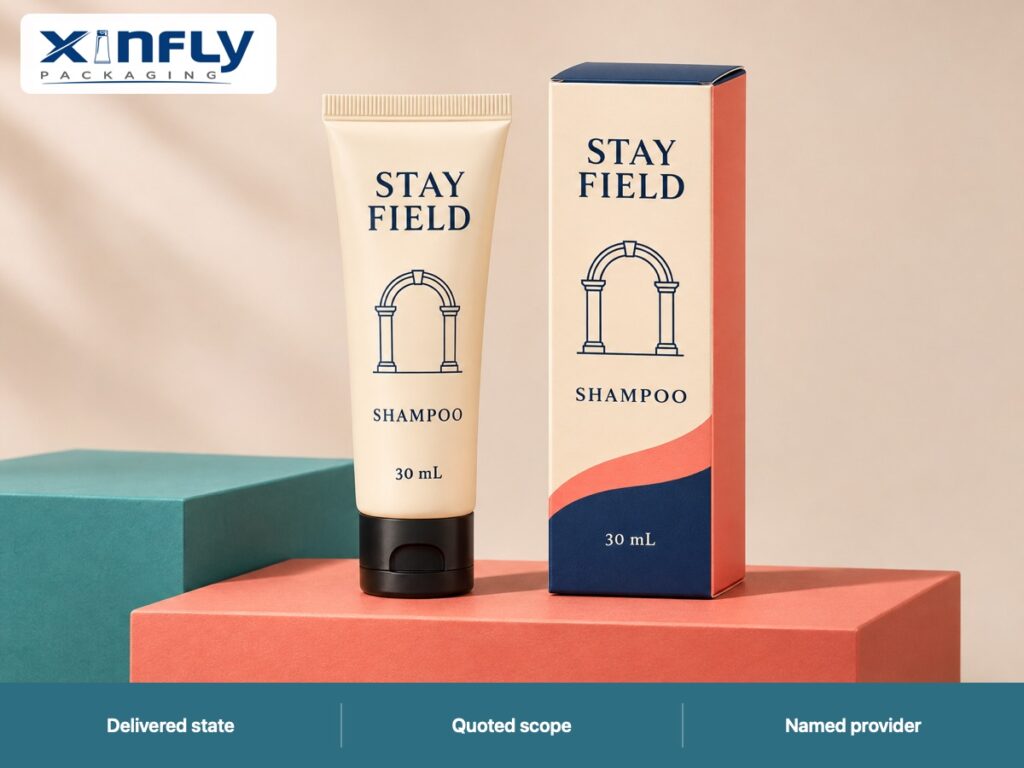
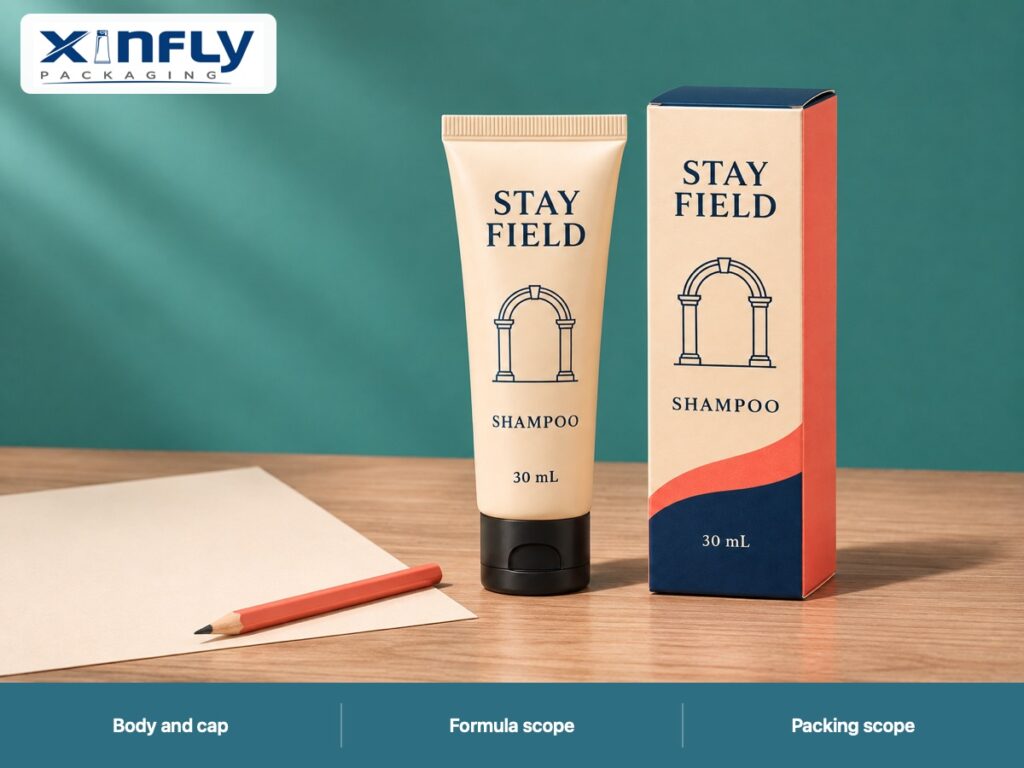
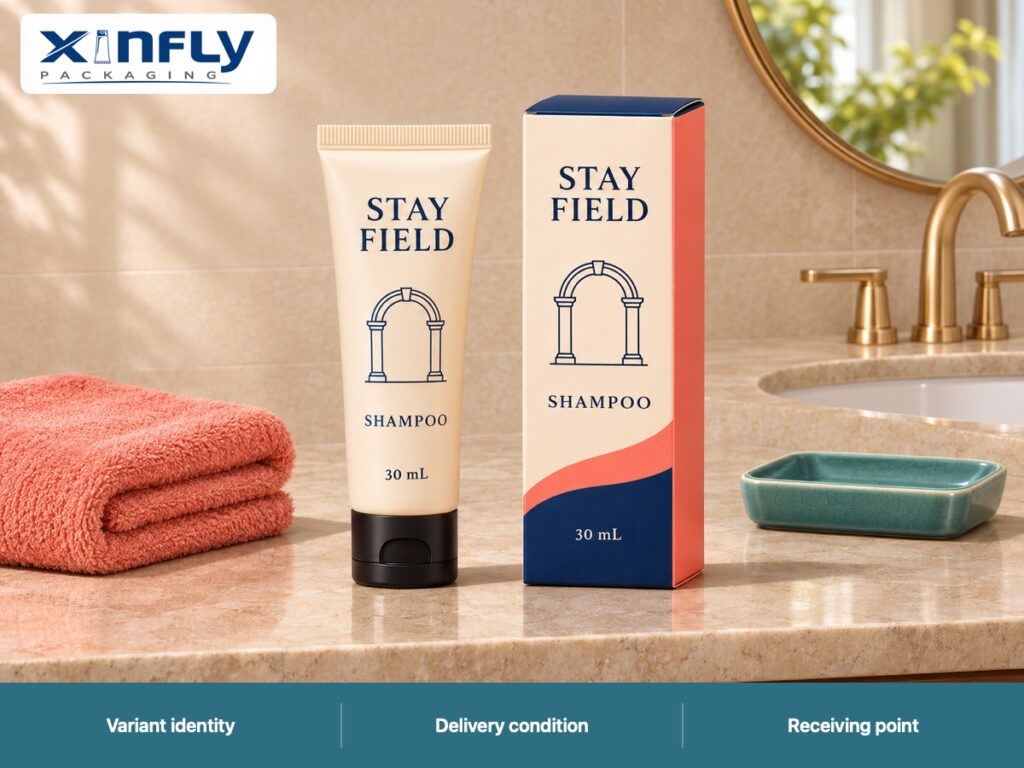
The STAY FIELD concept shown here uses a cream-colored PE body, molded shoulder, straight crimped display tail and short black flip-top. Navy screen-printed wording and an arch motif coordinate with a cream, coral and navy printed carton. These are external design details, not evidence of contents, an agreed filling method or a particular delivery condition.
When discussing 30ml squeeze tubes for hotel amenities, connect the nominal capacity request to the proposed drawing and filling review. The capacity printed in a concept image does not establish usable fill volume, manufacturing dimensions or the finished product's labeling requirements.
Make Cartons and Sets Visible in the Quote
Distinguish a Printed Box from Packing an Individual Product
Buying designed folding cartons and having someone place filled tubes inside them are separate deliverables. Ask whether the quotation includes carton manufacture, carton delivery, packing labor, an insert or another assembly step. Name each relevant item rather than using “with box” as a catch-all instruction.
Keep the tube and carton artwork references together. They should identify the same intended variant, even if the two components use different files and production processes. Review a combined arrangement when presentation matters, while leaving dimensional fit and packing approval attached to the actual proposed components.
Identify Whether the Order Is Loose Units or Prepared Sets
A carton containing loose tubes is not the same deliverable as a guest-room set. If sets are required, define their contents, individual quantities and outer presentation. Ask who assembles them and what that provider needs to perform the work. Do not add an unpriced assembly operation to a packaging-only purchase after approval.
Likewise, a shipment of shampoo tubes does not automatically include matching conditioner or body-wash stock. Keep variant quantities and any set assembly requirement in separate order fields. This makes later changes easier to assess without reopening every part of the specification.
Put the Filler's Requirements into the Handoff
Share the Proposed Pack Before the Commercial Release
Give the filling partner the proposed component references and sample state early enough to identify unanswered questions. Ask what specimen it needs for its own review. A packaging quotation can be commercially complete while the proposed components still await the filler’s acceptance for the intended operation.
Use sample development to discuss the physical references available for this handoff. Keep a record of what the sample represents and what it cannot demonstrate. An appearance specimen should not silently become evidence that the complete filled product has been qualified.
Record the Receiving Requirements
Delivery details should tell the receiving team what to expect without making it infer the order scope from a sales email. Link carton identification and packing instructions to the proposed item reference. Ask the receiver whether additional information is needed before approving dispatch.
| Field | Written information to request | Confirmation needed before release |
|---|---|---|
| Body reference | Drawing or specification revision and intended variant | Packaging provider and buyer agree the same item |
| Tail condition | State required for the next operation | Filler acknowledges the proposed supply state |
| Closure | Component reference and assembly condition | Parties identify any remaining assembly operation |
| Decoration | Approved tube and any carton artwork revisions | Correct variant files are attached |
| Packing form | Loose components, individual cartons or prepared sets | Quoted goods and assembly scope match |
| Receiving point | Named organization, address and receiving contact | Dispatch instructions use the approved destination |
Compare Commercial Offers on an Equal Basis
Normalize the Unit Being Quoted
Ask what the quotation's unit means. Is it one decorated empty tube and cap, one tube plus an unassembled carton, one filled individual product, or one prepared set? Copy that definition next to the quoted quantity. A shared quantity alone does not make two offers comparable.
For example, two hypothetical offers might each show 10,000 units. If one unit means an empty pack and the other means a filled amenity with an individual carton, their totals describe different scopes. This example supplies no price benchmark; it shows why the unit definition belongs in the comparison sheet.
Separate Confirmed Inclusions from Open Questions
Create a short unresolved-items list before asking for a revised proposal. Each item should identify the missing deliverable, the party expected to answer and the effect on scope. An unanswered filling question should remain visible rather than being converted into a buyer assumption because the packaging artwork is ready.
When a bidder revises an offer, ask for a new quotation reference or clearly identified revision. Keep the previous version as history. The purchasing team should be able to locate the accepted scope without reconstructing a sequence of informal messages.
Send a Brief That Can Be Answered Clearly
Put the Required Product State in the First Sentence
Try this opening: “Please quote decorated empty hotel shampoo packaging for delivery to our named filling partner; identify the body, cap, delivery state and packing inclusions.” If you need a filled product, change that sentence and ask the provider to identify its proposed scope and responsible parties. Neither wording assumes a service is available.
Attach the variant list, artwork status, proposed capacity and receiving requirements. Ask which details remain subject to drawing confirmation or sampling. This gives the supplier something concrete to answer and helps you compare subsequent proposals without overlooking an essential operation.
Keep a Short Acceptance Summary
Before issuing the order, summarize the accepted goods, excluded operations, component references and remaining approvals on one page. Share it with the people responsible for packaging, formula, filling and receiving as applicable. The purpose is to expose gaps while they can still be resolved.
You can send Xinfly Packaging your hotel tube scope brief with these fields and ask for a proposal against the stated packaging requirements. Confirm quantities, sample options, commercial conditions and service boundaries for the actual project rather than borrowing them from another order.
Frequently Asked Questions
Does “Hotel Amenity Tube” Mean the Formula Is Included?
The product description alone does not establish that inclusion. Ask whether the offer covers empty packaging, a filled product or another delivery state. Record formula supply, filling and release responsibilities separately when they are relevant. Compare the written proposal against your required deliverable before considering its commercial total.
Can I Use a Closed Display Sample to Specify Empty-Tube Delivery?
Use it to communicate appearance, with its limitations identified. Ask the filling partner to confirm the required production supply state and attach that description to the purchase specification. A closed display sample should not settle the tail condition or remaining assembly work through implication.
Is a Matching Printed Carton Automatically Included?
Confirm carton manufacture and any packing operation as separate quotation items. A coordinated illustration can show the desired visual family without establishing what the supplier is pricing. Identify the carton file, quantity, delivery form and party responsible for putting the product inside it.
Should Shampoo and Conditioner Share One Quotation Line?
They may appear in one commercial proposal, but give each variant an identifiable line with its artwork reference and requested quantity. This allows the provider to distinguish the components and operations. A combined total can remain useful as a summary after the individual requirements are clear.
What Should I Resolve Before Approving the Packaging Order?
Resolve the delivered product state, component references, decoration, variant quantities, packing scope and receiving instructions. Identify outstanding filler or other project approvals. Do not present an unanswered point as approved simply because another part of the pack has been accepted. Keep the final scope summary with the order.
Conclusion
A useful hotel amenity quotation makes the delivered goods and remaining operations easy to identify. Start with empty versus filled, separate formula and filling responsibilities, and define cartons, sets and delivery state explicitly. Then compare proposals on the same unit basis. Xinfly Packaging can review your packaging inquiry against a clear brief, while project-specific services, samples and commercial conditions remain matters for written confirmation.