
Published: .
The designer says the logo should sit 20 mm from the top. The supplier's layout uses a different starting edge. A sample arrives, and both teams believe they followed the instruction. The disagreement may begin with the word “top,” long before anyone discusses production accuracy.
A hand cream tube print position reference gives that instruction a shared meaning. Start with the proposed hand cream tube packaging, identify the drawing and product state, then name the exact point being positioned. This guide supplies a reference-agreement table and a sample observation sheet. The examples explain coordinate logic; they are not recommended dimensions, production tolerances or acceptance limits.
Replace “Move It Up” with an Identifiable Feature
Name the Artwork Point Being Positioned
A logo has a top edge, bottom edge and center. A text block can include several lines and a surrounding graphic. Ask the designer which point the position instruction addresses. A distance without that point can be interpreted differently even when everyone measures from the same physical reference.
Assign a simple feature name in the review file, such as front logo center or capacity-line baseline. Keep the definition attached to the artwork revision. If the artwork changes shape or includes an added line, review whether the same feature definition still identifies the intended point.
Name the Reference Edge in the Drawing
Ask the packaging supplier which drawing feature provides the starting reference. Avoid substituting a casual description such as cap edge, tube top or shoulder unless the drawing identifies exactly what that description means. A named reference lets the parties discuss one location without repeatedly interpreting a photograph.
You do not need to invent a formal drawing convention. Use the applicable supplier drawing and ask its owner to explain the references. The purchasing task is to preserve that explanation across the artwork, sample review and approved order rather than creating an independent coordinate system that nobody else uses.
Keep the Product State Visible
Identify What the Drawing Represents
A flat artwork layout and an assembled display tube do not present the same view. Ask whether the drawing describes a body before a later operation, a specified finished component or another identified state. Keep that answer with the position instruction so a reviewer knows what the reference actually belongs to.
For 30ml hand cream tubes, the nominal capacity is useful for identifying the inquiry, but it does not define the drawing's length, body boundary or print origin. Use the proposed component reference rather than borrowing the layout of another pack that carries the same capacity description.
Distinguish the Body from the Closure
If an instruction uses a cap-related reference, ask how the proposed closure and its assembly state relate to the drawing. A different closure can present a different visible boundary. Do not assume a visual distance to the cap is interchangeable with a distance defined on the body drawing.
Likewise, ask which shoulder or tail feature is relevant when those areas appear in the review. An image can help identify the location, but it should accompany the applicable definition. Keep the physical reference and the point on the artwork separate enough that both can be checked.
| Field | Information to agree | Why the field matters |
|---|---|---|
| Component identity | Drawing number, revision and proposed supply state | Keeps the instruction attached to the intended body |
| Artwork identity | File revision and named printed feature | Prevents a changed logo or text block being measured as the old one |
| Starting reference | Exact drawing feature used as the origin | Gives the distance a shared starting point |
| Direction and face | Direction of measurement and identified viewing face | Prevents opposite orientations being treated as the same instruction |
| Target point | Center, edge, baseline or another defined point | Makes the artwork location identifiable |
| Review basis | Required specimen state and agreed observation method | Connects the drawing discussion to the sample review |
Check That the Numbers Use the Same Origin
Work Through a Flat-Drawing Example
Imagine a purely illustrative flat drawing with reference A at one end of a 100 mm span and reference B at the other. A marked point lies 20 mm from A toward B. On that same straight span it lies 80 mm from B toward A, because 100 minus 20 equals 80.
The numbers 20 and 80 describe the same point only because the span, direction and references are defined. They are not hand cream tube dimensions or artwork recommendations. Do not transfer this arithmetic to a curved sample, a cap boundary or a differently defined drawing without the appropriate geometric explanation.
Ask for the Conversion Basis When Layouts Differ
If two files use different origins, ask the drawing or artwork owner to explain the relationship. Preserve the original references and the agreed translation. Manually replacing a number in one file can hide a disagreement rather than resolve it, especially if another feature or product state also changed.
Keep the Sign and Direction Explicit
“Up” depends on the view. State the direction on the identified face or drawing and ask the provider to confirm it. If a file uses a signed coordinate, retain that convention with its explanation. Do not drop a minus sign or reverse a direction because a preview has been rotated for presentation.
Review the Flat Artwork and Physical Sample for Different Questions
Use the Layout to Check the Instruction
The layout should make the chosen reference, target point and relevant dimensions understandable. Ask the designer and supplier to identify any discrepancy before a decorated specimen is treated as a position reference. A clear file can eliminate an ambiguity that a succession of sample photographs would only repeat.
Use the tube printing and design information to frame the decoration discussion, then retain the actual project layout. A general print-process page does not establish your particular origin or accepted position. Those details belong to the drawing, artwork and agreed project record.
Use the Specimen to Record What Was Observed
Identify the specimen and the condition in which it is reviewed. Ask the responsible reviewer how the relevant position should be observed against the agreed references. A photograph taken from an unknown angle may communicate an appearance concern while leaving the dimensional question unresolved.
Record the printed feature and the reference used before recording a distance. That order makes an observation easier to interpret. If the required reference is not accessible on the specimen, ask the relevant technical team for an appropriate review approach rather than guessing where the reference would be.
Separate Target Position, Observation and Acceptance
Keep the Requested Value Apart from the Observed Value
The drawing or approved layout describes the requested position. A sample review records an observation. Keep those fields distinct and identify the basis of each. Copying the target into an inspection column without an actual observation makes the record look complete while answering no sample question.
If no dimensional observation has been made, record a visual comment as a visual comment. It can still be useful to the design discussion. It should not be presented as a measured result or proof that a production requirement has been met.
Have the Responsible Parties Agree Acceptance
Ask the supplier and relevant project reviewers to define any applicable tolerance and review condition. This article supplies neither a universal position tolerance nor a passing specimen. A statement that a logo “looks centered” is not automatically the same decision as acceptance against a dimensional requirement.
| Review entry | What to record | Follow-up when unclear |
|---|---|---|
| Specimen identity | Sample reference and stage represented | Ask which component and artwork revisions apply |
| Printed feature | Agreed feature name and target point | Return to the layout if the feature changed |
| Reference used | Drawing feature and direction actually used | Resolve a different origin before comparing values |
| Observation type | Visual comment or identified dimensional observation | Do not present an unmeasured impression as a value |
| Requirement | Applicable approved position and agreed criteria | Ask the responsible parties to resolve an open criterion |
| Disposition | Accepted feature, requested revision or unresolved question | Preserve the scope of the decision |
Keep the Printed Tube and Carton Coordinated
Use Separate Layouts for Separate Components
A coordinated retail design can use the same name and motif on the tube and folding carton without sharing the same position coordinates. Keep each component's layout reference identifiable. An approved carton face should not silently become dimensional approval of the tube artwork.
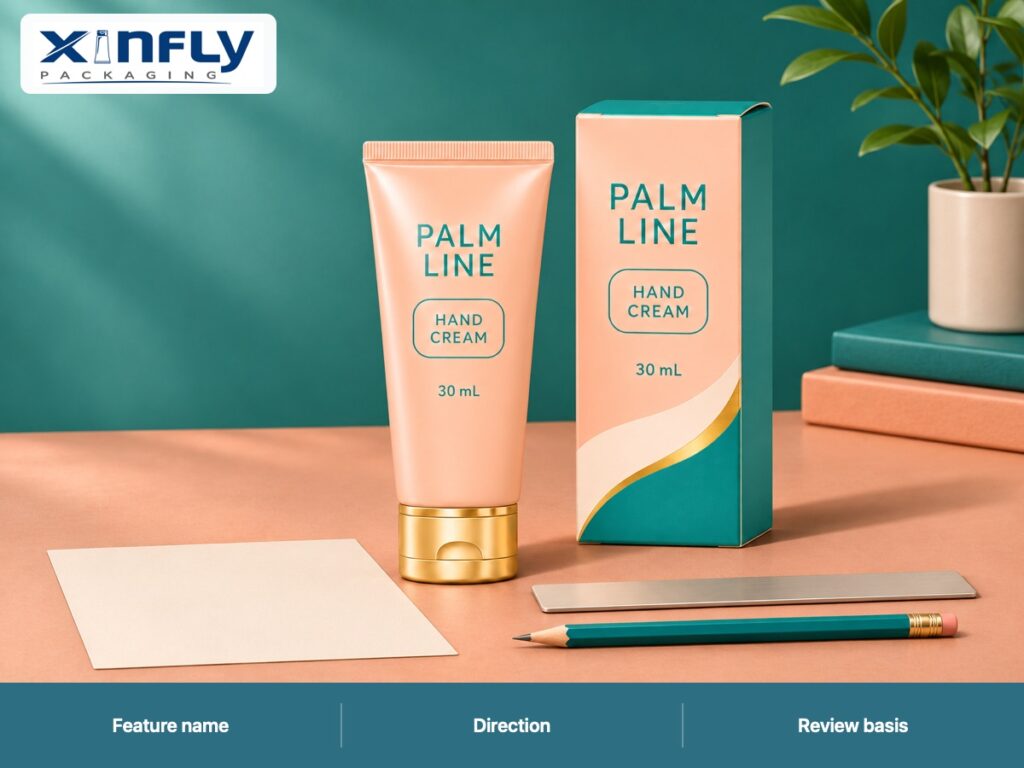
The PALM LINE concept shown here has a soft-apricot PE body, molded shoulder, straight crimped display tail and gold-colored round flip-top. Teal single-color screen-printed lettering and an outlined motif coordinate with an apricot, teal and cream printed carton. The illustration provides no measured print-position result.
Review the Combined Appearance Without Losing the Definitions
Place the proposed components together when the visual relationship matters. Record that presentation review separately from the drawing-based position requirement. This lets the team request a coordinated visual adjustment while remaining clear about which component and which printed feature must change.
For custom hand cream tubes, include the applicable decoration reference in any revised inquiry. Ask whether the requested adjustment affects the sample scope or other project details. Do not assume a changed artwork position has already been incorporated merely because the product name and colors remain familiar.

Close the Position Handoff Before Release
Keep the Current Definition with the Approved File
Store the drawing revision, artwork revision, reference explanation and accepted review record together. Identify the current versions so a later order does not inherit an old coordinate from a detached screenshot. An approval should tell the next person what was accepted and against which information.
Discuss the required development specimen with the supplier if the position cannot yet be reviewed on a representative sample. Ask what the proposed specimen will demonstrate and what will remain open. Do not expand an appearance approval into a broader production release through implication.
Send Xinfly Packaging a Defined Position Question
Share the intended tube, current drawing and artwork, named feature and reference question. Attach the observation or image that prompted the discussion, with its limitations identified. You can send Xinfly Packaging your print-position brief to ask which layout and specimen references can be confirmed for the project.
Frequently Asked Questions
Is “20 mm from the Top” a Complete Position Instruction?
Identify which top or drawing feature is meant, the direction of measurement, the artwork point and the relevant component state. The value alone leaves those questions open. The 20 mm example in this article illustrates coordinate logic, not a recommended location for a hand cream pack.
Can Two Different Distances Describe the Same Position?
They can when they use different defined origins on the same specified geometry. In the illustrative 100 mm straight span, a point 20 mm from A is 80 mm from B. The relationship requires the stated span and directions; it is not a conversion for every physical tube view.
Should I Measure from the Cap or the Body?
Use the applicable drawing and agreed review definition. Ask the supplier to explain the selected reference and any assembly condition involved. Do not replace a body-related coordinate with a visible cap boundary merely because that boundary is easier to see in a photograph.
Does a Visually Centered Logo Meet a Position Tolerance?
A visual impression and acceptance against a dimensional requirement are different records. Ask the responsible parties to define the applicable criteria and observation method. Keep visual comments useful without presenting them as measurements or evidence of compliance with an unconfirmed tolerance.
What Should a Reorder Carry Forward?
Retain the approved component drawing, artwork revision, named target point, reference explanation and relevant acceptance scope. Ask the supplier to identify changes affecting that basis. A familiar product name or carton image does not by itself preserve the tube's accepted position instruction.
Conclusion
Print-position discussions become clearer when the origin and target point are named before the distance. Connect the drawing, artwork and sample state, keep observations separate from acceptance, and preserve the current definition with the approved file. Xinfly Packaging can review that brief against the proposed pack so the next instruction describes an identifiable position instead of another ambiguous request to move the artwork up.