Published: .
Technical review: pending. Project-specific specifications and sample acceptance require confirmation by the responsible technical team.
An aluminum tube nozzle membrane brief should identify the condition of the tube mouth when supplied and the opening arrangement proposed for the complete pack. “Aluminum tube with screw cap” does not answer whether the mouth is open, whether a membrane is present or whether the closure includes a matching opening feature.
This guide gives buyers a specification checklist and an opening-review record. Membrane and closure variants are enquiry options requiring supplier confirmation for the actual project. No Xinfly stock configuration, opening force, seal-integrity result, tamper-evidence rating or certification is claimed here.
Describe the supplied mouth condition
Ask the supplier to state whether the proposed mouth is open or closed by a specified feature. Request the component drawing or a suitably identified detail photograph. Keep that information attached to the exact tube reference rather than assuming it from a general catalogue description.
When sourcing aluminum cosmetic tubes, identify the body, neck and closure together. The category covers a commercial packaging family. It does not establish which membrane or cap arrangement is available for your selected size, application or sample request. Confirm those details before treating a quote as a complete assembly proposal.
Distinguish a membrane from an applied seal
Ask how any closure across the mouth is formed and identified. Is it an integral membrane in the proposed tube, a separately applied seal, or another specified arrangement? Request the correct supplier terminology and a reference that makes the construction clear.
Do not use “sealed nozzle” as the only description when the project depends on the distinction. A proposed applied foil seal and a proposed integral mouth membrane need their own component or process references. Keep availability, preparation and sample requirements open until the supplier confirms the actual option.
Match the tube and cap as an assembly
Ask whether the proposed cap merely closes the neck or also provides an opening feature intended for the specified mouth condition. Record the exact closure reference. An external ribbed shape or a pointed-looking silhouette does not establish the function of a hidden feature.
The selected tube screw cap configuration should be reviewed with the neck and mouth condition it is intended to match. Do not substitute another cap solely because it appears to screw onto a similar tube. Ask the supplier to identify the complete proposed pairing and the relevant sample evidence.
Use external examples only to clarify the question
ALLTUB’s published closure examples distinguish a configuration with an integrated membrane and cap piercing feature from another with an open orifice. That illustrates why mouth condition and cap function belong in separate fields. It does not establish Xinfly’s options, dimensions, materials or availability.
Use the example to make your enquiry explicit. Ask what the supplier actually proposes for your tube. Do not copy another manufacturer’s thread designation, closure material or environmental claims into the Xinfly purchase specification without project-specific confirmation.
| Field | Information requested | Decision it should support |
|---|---|---|
| Tube reference | Body, neck and drawing revision | Identify the proposed component |
| Supplied mouth condition | Open or specifically described closure feature | Confirm the actual starting state |
| Membrane or seal identity | Construction description and reference, if applicable | Distinguish different mouth arrangements |
| Closure reference | Exact cap and relevant drawing | Identify the proposed paired component |
| Opening arrangement | Supplier's intended method and matching feature | Define what requires sample review |
| Supplied sample state | Empty, filled, open or otherwise prepared | Clarify what the sample can demonstrate |
| Opening-review purpose | Handling, appearance, dispensing or another agreed question | Select the appropriate evidence |
| Acceptance basis | Responsible technical owner and approved criteria | Avoid an invented pass or fail rule |
Ask for a drawing that shows the relevant features
The drawing should identify the mouth and neck features relevant to the proposed opening arrangement. Ask the supplier which view or detail is needed to explain the configuration. A complete assembly rendering can show appearance while leaving the important hidden relationship unresolved.
Use unique labels for the tube and cap references, and preserve their revision identifiers. If a cap drawing is separate, keep the relationship between the documents explicit. The buyer should be able to identify which closure was proposed for which tube without reconstructing the decision from several unconnected emails.
Keep a closed-cap illustration within its scope
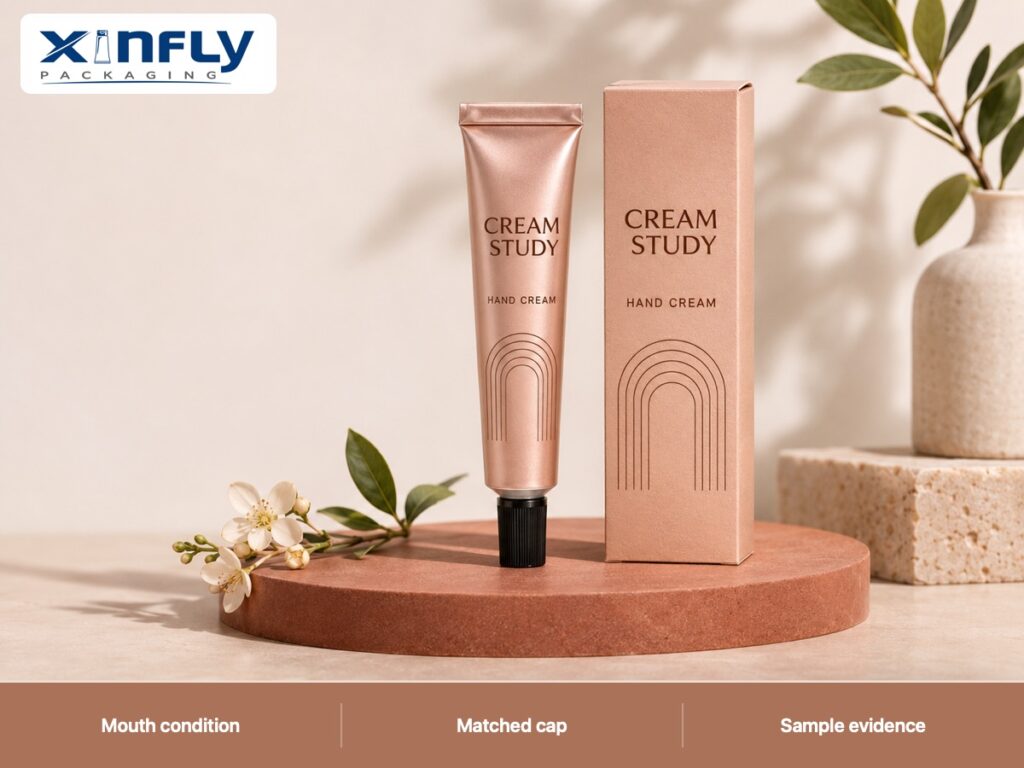
The packaging illustrations in this guide show a closed black screw cap, painted aluminium-style body, metal shoulder and folded tail. They do not show a hidden membrane or piercing feature. The visible print and closure shape therefore cannot be used as evidence of the proposed opening construction.
Ask for the actual project detail or sample needed to resolve that question. This separation is useful when design work begins before every technical option is confirmed. The visual can support the appearance discussion while the mouth configuration remains an explicit open item.

Define the sample state before requesting an opening review
State whether you need an empty component to discuss the mouth arrangement, a prepared assembly to examine the proposed opening action, or another specifically defined specimen. Ask who will prepare it and what it represents. Keep any differences from the proposed order visible in the review record.
For empty aluminum tubes, an appearance sample may have been prepared differently from the component intended for filling. Ask about its tail condition, mouth condition and closure. A finished-looking sample should not silently stand in for every incoming-component or finished-pack decision.
Keep unopened and previously opened samples separate
Identify whether a specimen has already been opened, manipulated or used in another review. An opened specimen cannot demonstrate its original unopened condition. It may still help explain geometry or another observation, provided the limitation is recorded.
Ask the responsible technical owner which sample states are needed and how they should be allocated. Do not repeatedly open and reclose one specimen while treating each observation as an independent first-opening event. Keep the actual sample history with any result or purchasing conclusion.
Agree the observations before the trial
Ask what the planned review needs to observe. The question may concern the intended opening action, the condition of the opening afterward, the relationship between the cap and mouth, or a later dispensing review. Define the purpose before asking someone to report a broad statement such as “opening is good”.
This guide does not prescribe a test apparatus, force threshold or operating technique. Those require the responsible technical team’s selection and review. The purchasing brief should identify the intended evidence, specimen and decision owner, without converting an enquiry checklist into an unapproved test procedure.
Record observations without expanding their meaning
A visual opening observation is not automatically a seal-integrity result. A cap that can be reclosed is not automatically evidence for an unopened-pack claim. Keep each conclusion tied to the actual review performed and the condition of the specimen.
If the project needs measured opening-force data, ask for the applicable method, units, specimen condition and acceptance basis. Retain the actual results and their scope. Do not insert a convenient numerical limit from an unrelated product, material structure or method summary.
| Record item | Information retained | Scope question |
|---|---|---|
| Specimen identity | Tube, closure and relevant revision references | Which exact proposed assembly was reviewed? |
| Preparation | Empty or filled state and preparation reference | How does it relate to the intended order? |
| Initial mouth condition | Identified unopened or previously opened state | What starting condition was actually present? |
| Review purpose | Agreed question and instruction reference | Which decision can the observation support? |
| Opening arrangement | Supplier-confirmed pairing and relevant feature | Was the intended configuration used? |
| Observation or measurement | Actual record, method and units where applicable | What was observed or measured? |
| Post-opening condition | Recorded condition relevant to the review purpose | Which follow-up questions remain? |
| Disposition | Responsible owner, decision and unresolved items | What may proceed and what remains pending? |
Keep compatibility and opening decisions connected
The opening arrangement is one part of aluminum tube cosmetic packaging. It does not replace review of the formula-contact materials, internal coating where applicable, filling process or finished-pack performance. Keep those project questions connected to the same assembly reference without treating one sample approval as approval of every characteristic.
If the proposed closure or mouth arrangement changes, ask which existing conclusions depend on it. The technical team should identify the affected sample work. Do not assume that a previously accepted appearance sample covers a new neck detail or opening feature that it never represented.
Request the necessary follow-up samples
Use a tube and closure sample development brief to identify the outstanding questions. Ask which samples can be provided, what preparation is required and what each sample will represent. Keep any unconfirmed option clearly labelled until the supplier replies.
For an enquiry about aluminum squeeze tubes for hand cream, include the proposed tube capacity, body finish, closure reference and mouth condition. These are enquiry parameters, not proof that the packaging is suitable for a particular formula. The relevant compatibility and pack assessments still need their own evidence.

Make the commercial scope explicit
Ask whether the quotation includes the exact proposed tube-and-cap pairing and any additional preparation associated with the selected mouth condition. If a detail is undecided, keep it outside the approved specification until resolved. Avoid a general description that conceals several technically different options under one price line.
Request confirmation of any proposed alternative before comparing it with the original brief. An open-mouth option and a membrane option should remain separately identifiable in the purchasing record. Commercial terms, sample availability and timing require the supplier’s project-specific reply.
Release the specification with its evidence references
Before order approval, connect the selected drawing, tube and cap references, mouth-condition description and relevant sample review. Record the accepted items and any remaining questions. The approval should state what configuration may proceed, rather than simply referring to the latest product image.
Xinfly Packaging can review an aluminium tube enquiry with those specific details and confirm the available project options. A clearly written mouth-condition and opening brief gives the supplier a practical starting point for the specification and sample discussion.
Frequently Asked Questions
Does every aluminium tube have a membrane?
Do not infer that from the material category. Ask the supplier to identify the supplied mouth condition for the exact tube reference. Keep open-mouth and membrane proposals separately described when both are being considered.
Can the cap's outside shape confirm a piercing feature?
No. Request the closure reference and the detail needed to identify its intended function. A closed-cap photograph can support an appearance review while leaving hidden features unverified.
Is an applied foil seal the same as an integral membrane?
Treat them as different proposed arrangements unless the supplier's actual construction description establishes otherwise. Ask how the feature is formed, identified and sampled for the project. Do not rely on the phrase “sealed nozzle” alone.
Does a successful opening observation establish seal integrity?
It supports only the actual question and review performed. A seal-integrity requirement needs its own applicable evidence and acceptance basis. Keep those conclusions separate in the purchasing record.
Which details should be sent with an initial enquiry?
Send the application, proposed tube and cap references, capacity request, supplied mouth condition, available drawings and the sample questions you need answered. Mark undecided membrane or closure options explicitly for supplier confirmation.
Conclusion
A clear nozzle brief identifies the supplied mouth condition and the matching opening arrangement before an assembly is approved. Connect the tube, cap, drawing and sample history, and keep each observation within its actual scope. This gives the buyer a concrete basis for confirming the proposed aluminium tube configuration.