Published: .
Two sunscreen tubes can look equally opaque on your desk and come with very different evidence. One supplier sends a photograph. Another sends a graph headed “light transmission.” Before you decide which pack protects your formula, ask a more useful question: what specimen did that graph actually measure?
A sunscreen tube light transmission report comparison starts with specimen identity, measurement scope and the decision you need to make. This guide helps purchasing teams request comparable information without turning appearance, material names or incomplete test documents into performance claims. Your formulation and testing teams must define the relevant requirement and decide whether the evidence supports the selected packaging.
Define the Packaging Question First
Ask What the Formula Team Needs to Know
When discussing sunscreen tube packaging, start with the concern your technical team has identified. Does it need information about a particular body structure, a decorated area, an unprinted region, or another component? Ask the team to describe the packaging question and the evidence it needs. “We need an opaque tube” leaves too much interpretation between purchasing, sales and the laboratory.
A buyer’s role is to preserve that question through the quotation and sampling process. Do not choose a wavelength range or acceptance threshold simply because another report uses it. Have the responsible technical reviewer define the appropriate evaluation. Then ask suppliers whether relevant data exist, what those data cover and what additional assessment would be needed for the proposed configuration.
Keep Appearance and Measured Transmission Separate
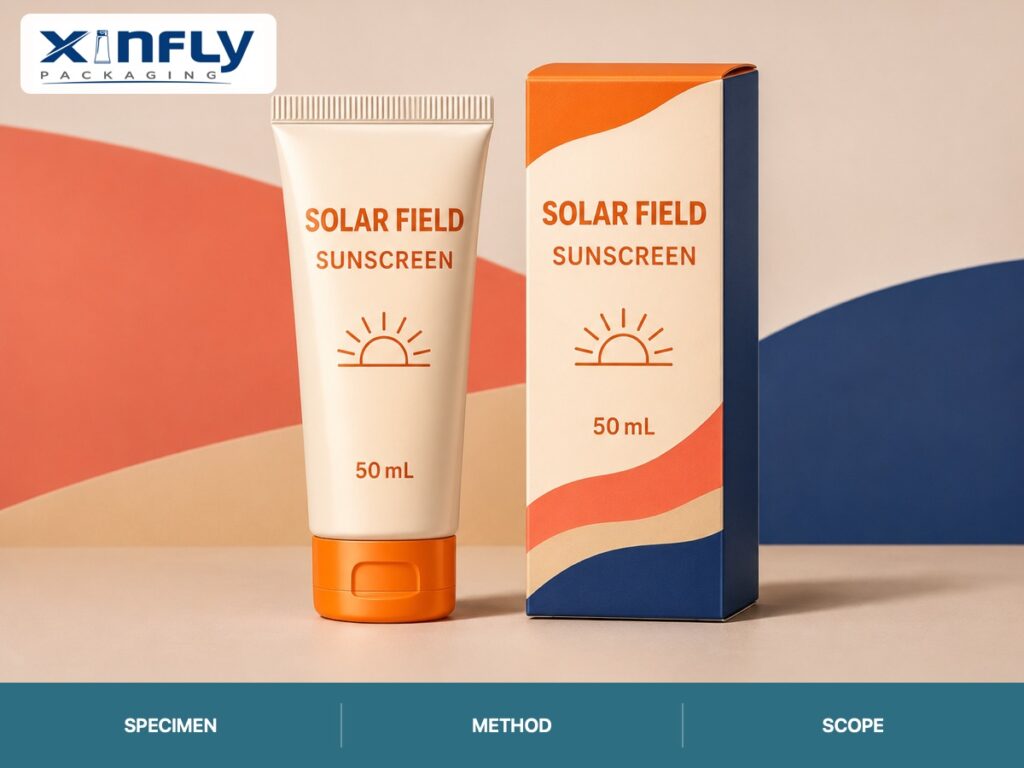
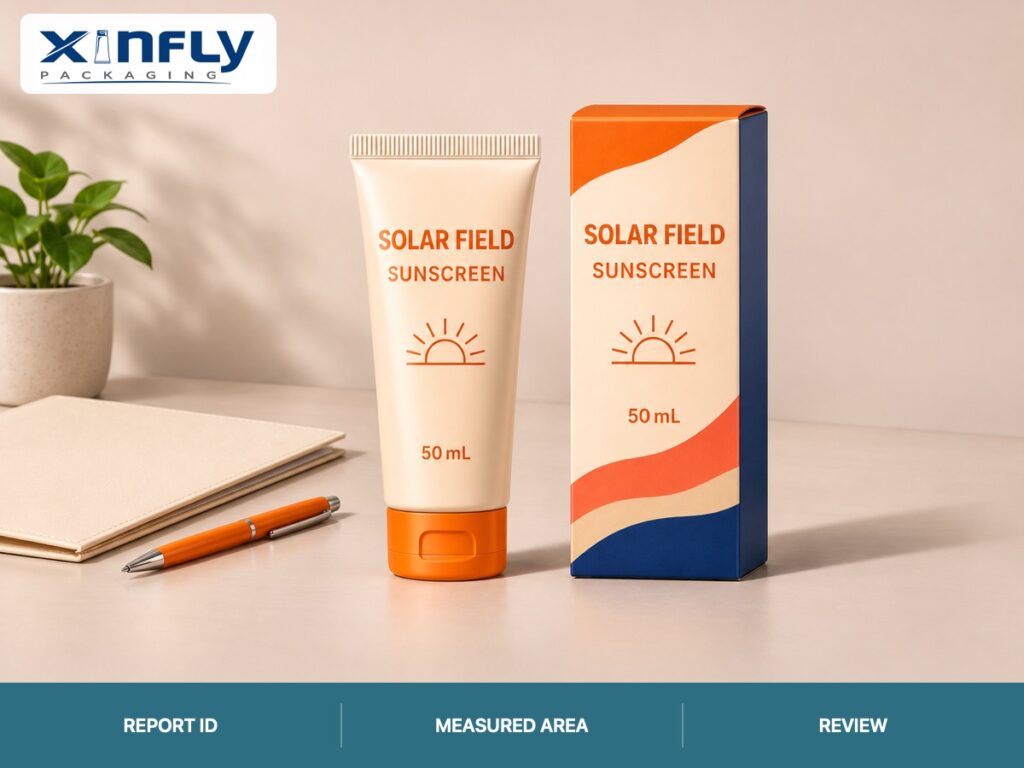
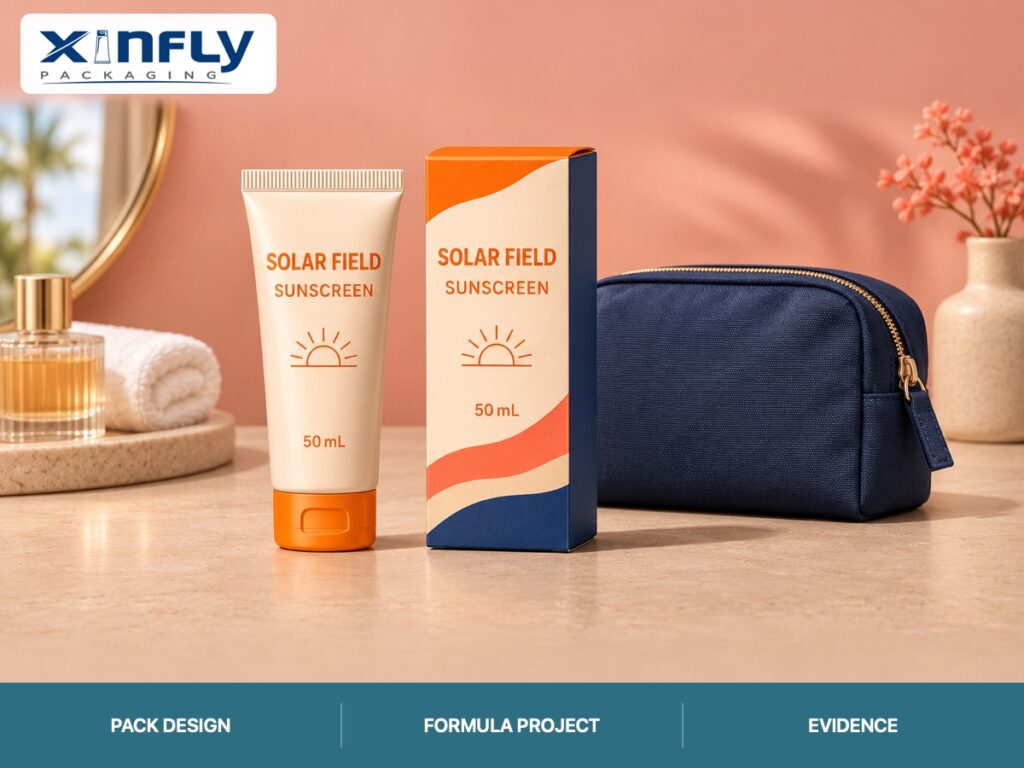
A studio photograph is useful for presentation, print and overall colour. It does not provide a numerical light-transmission result. The illustrations in this article show a fictional SOLAR FIELD pack: an ivory PE-style body, moulded shoulder, straight crimped display tail, orange round flip-top cap and burnt-orange single-colour screen-print-style artwork, with a matching printed carton. They illustrate packaging appearance only.
For custom sunscreen squeeze tubes, keep the appearance reference linked to the proposed body and decoration specification. If the material, colour or decoration changes, ask the reviewer which previous evidence remains applicable. A similar photograph is not a documented match between a test specimen and the item you intend to purchase.
Identify the Specimen Behind the Report
Match the Material and Construction
Request the tested specimen’s identifier and a description that can be connected to the quoted structure. Record the material construction, colour, relevant thickness information and decoration state available in the report or supporting record. Do not fill gaps with catalogue assumptions. If the supplier cannot establish the connection, record the document as background information rather than project-specific approval evidence.
Locate the Measured Area
A report on a flat material sample may answer a different question from a measurement involving a finished tube. Ask whether the specimen was a film, a prepared body section or another configuration. For a body section, request the location and preparation description. Also ask whether the measurement involved a single wall or another optical path. Let the laboratory explain the method and limitations.
| Field | What the buyer requests | Why it matters for the decision |
|---|---|---|
| Specimen identity | Report sample number and supporting reference | Connects the result to a specific submitted item |
| Construction | Described material and layer arrangement | Avoids substituting a generic material name |
| Colour and decoration | Tested colour and printed or unprinted state | Establishes which appearance configuration was evaluated |
| Thickness basis | Reported specimen thickness and its basis | Identifies a condition relevant to comparison |
| Measured location | Body area or other identified component | Limits the scope of the result |
| Preparation | How the specimen was presented for measurement | Helps the laboratory explain comparability |
| Quoted configuration | Drawing, material and artwork revisions | Connects the evidence to the proposed purchase |
Read the Axes Before Comparing the Curves
Confirm the Reported Quantity
Ask the laboratory to identify the quantity shown, its units and the measurement mode. Do not treat transmittance, reflectance and a visual opacity description as interchangeable. Shimadzu’s solid-sample spectroscopy explanation describes different reflection and transmission modes, including diffuse and specular contributions. This is a reason to clarify the reported measurement, not a tube acceptance rule.
Check the Wavelength Scope
Request the measured wavelength range and the data presentation relevant to the technical question. A result reported for one wavelength or one stated region does not describe every wavelength. Avoid filling missing parts of a graph with an assumption. Ask the reviewer whether the available range is sufficient, and request clarification from the laboratory when the report does not answer that question.
Make Graphs Traceable to the Original Record
A cropped graph can lose its sample key, measurement settings or explanatory notes. Keep the original report available internally and record which figure or table informed the decision. If purchasing uses a summary, include a reference back to the document and the reviewer’s interpretation. A clean comparison slide is useful only when someone can recover the evidence behind it.
Ask the Laboratory Whether Methods Are Comparable
Identify the Measurement Arrangement
Request the instrument and relevant measurement arrangement recorded for the specimen, including accessories when they affect the interpretation. Shimadzu’s accessory guide for solid samples distinguishes arrangements by sample characteristics and analytical purpose. The appropriate arrangement for your specimen should be selected and explained by the laboratory, rather than prescribed by a purchasing template.
Keep Uncertainty and Limitations Visible
If a report includes limitations, qualifications or a statement about results near its reporting capability, carry those notes into the review. Ask what the reported value means in that context. Do not change a qualified laboratory result into an absolute statement such as “no light passes through.” Purchasing should preserve the original wording and seek the responsible reviewer’s interpretation.
Use a Comparison Status Instead of a Premature Ranking
Mark Missing Information
It is tempting to place the lowest number at the top of a supplier shortlist. First establish whether the documents describe comparable specimens, conditions and quantities. Use a status such as “scope matched,” “clarification needed” or “additional project evaluation needed.” That keeps the sourcing decision moving without pretending that missing data have been resolved.
| Comparison point | Record A | Record B | Buyer follow-up |
|---|---|---|---|
| Specimen matches proposed pack | Enter documented connection | Enter documented connection | Request missing identifiers |
| Measured area and preparation | Enter report description | Enter report description | Ask laboratory about differences |
| Reported quantity and units | Copy accurately | Copy accurately | Resolve unlike quantities |
| Wavelength coverage | Enter stated scope | Enter stated scope | Technical reviewer confirms relevance |
| Method and arrangement | Enter available references | Enter available references | Laboratory assesses comparability |
| Limitations and qualifications | Preserve report notes | Preserve report notes | Reviewer interprets their effect |
| Decision status | Pending or documented outcome | Pending or documented outcome | Name reviewer and remaining action |
The entries are fields for your records. No measurements, thresholds or supplier rankings are supplied here. Where documents differ, explain the difference before calculating or comparing anything. A result can be genuine and still be outside the question your project needs answered. That distinction protects both the buyer and the supplier from an overextended conclusion.
Do Not Convert Packaging Data into an SPF Claim
Separate Package Properties from Formula Performance
A packaging light-transmission result concerns the tested specimen under the stated conditions. It does not, by itself, establish the SPF of a sunscreen formula, the formula’s stability in the finished pack or the product’s shelf life. Refer those decisions to the applicable formulation and testing programme. The buyer should request the relevant evidence rather than infer those outcomes from a material name or graph.
Likewise, “empty sunscreen tubes” describes the purchased packaging, not a finished sunscreen product. When requesting samples of empty tube configurations, identify the intended formula project and the evidence question. The supplier can then explain what its existing information covers and which project-specific reviews remain. Do not ask a packaging illustration to carry a claim that belongs to a different evaluation.
Keep Marketing Statements Within the Evidence
Before adding a protection statement to a product page, brochure or carton, ask which record supports the exact wording and scope. A document on one body specimen should not silently become a claim about every size, colour, closure and decoration in a range. Record the approved wording and the configurations it applies to, with a named decision owner.
Plan the Next Sample Around the Missing Answer
Request a Representative Configuration
A useful next sample is the one that resolves an identified gap. If the existing report cannot be connected to the quoted structure, request the information or specimen needed for that connection. If the method differs, ask the laboratories and technical team how to obtain a meaningful comparison. Do not order repeated samples without stating the unanswered question.
Keep Commercial and Technical Decisions Connected
A supplier may quote more than one proposed construction. Keep each offer associated with its own drawing or material reference, decoration and evidence status. Ask whether additional evaluation is included or separately quoted, without assuming availability, cost or timing. The quality assurance discussion should identify the responsible reviewers and the conditions required for release.
Prepare a Light-Transmission Data Request
Send a request such as: “Please identify any light-transmission information relevant to the proposed sunscreen tube configuration. State the tested specimen, construction, colour, decoration, measured area, preparation, wavelength scope and method reference. Please explain the documented connection to our quoted item and identify any gaps requiring project-specific evaluation.” Attach the selected configuration reference so the supplier has a concrete item to discuss.
Add the responsible technical contact and the purpose of the request. Ask for the original report or an authorised technical summary with enough information for review. Keep commercial confidentiality requirements explicit. A short, precise request often exposes a comparability problem earlier than a large collection of unrelated certificates. The objective is an answer to your packaging question, not a thicker document folder.
Frequently Asked Questions
Can I compare tubes by holding them against a lamp?
You can record a visual observation under stated conditions, but that is not a numerical transmission report. Use it for the limited appearance question it answers. If your project requires measured information, have the technical team and laboratory define the appropriate evaluation and evidence.
Does an ABL or PBL name replace a light-transmission report?
No material category alone provides a project-specific measurement. Ask what construction was proposed and whether the available evidence applies to it. Keep size, colour, decoration and other relevant configuration details connected to the review rather than treating a category name as a universal result.
Is a flat-film result automatically valid for a finished tube?
Ask the responsible reviewer. Record how the specimen was prepared and how it relates to the selected pack. A flat material result may provide useful information, but the applicable scope and any additional finished-pack evaluation must be established for the actual project.
What if the supplier sends only a cropped graph?
Request the underlying document reference, specimen key, axes, units, method and relevant notes. Do not rank the offer until the missing context is resolved. Keep a record of the information still required and the person responsible for reviewing the complete evidence.
Can Xinfly Packaging help organise the request?
Send the intended application, selected tube configuration, artwork reference and the technical question. Ask Xinfly Packaging to identify relevant available information and the gaps needing project review. The scope, sample requirements and any additional evaluation should be confirmed for your specific order.
Conclusion: Match the Evidence Before Choosing the Pack
A useful sunscreen tube comparison connects the quoted configuration to the measured specimen, method and relevant scope. Preserve limitations, involve the responsible technical reviewer and keep packaging data separate from formula claims. Contact Xinfly Packaging with your configuration and evidence question to discuss the information and samples needed for an informed sourcing decision.