Published: .
“It is a thick facial scrub” tells a packaging supplier the product family, but leaves much of the selection question open. What does the available viscosity information describe? What is known about the particles? Which formula version will the sample represent, and who will evaluate the complete proposed pack?
A facial scrub tube particle information brief brings those questions into one purchasing conversation. Begin with the proposed squeeze tubes for facial scrub, then connect the formula information to identifiable component options and a sample request. This guide provides a handoff checklist and observation matrix. It does not recommend an opening diameter, establish a dispensing method or claim a qualified package for your formula.
Identify the Formula Being Discussed
Give the Development Formula a Reference
A product name can remain unchanged while a development formula changes. Attach a formula reference and relevant revision to the packaging inquiry through the agreed information-sharing process. Ask the formula owner which details can be shared and which need a confidential technical discussion.
Keep the reference with the physical specimen as well as the written description. If a sample arrives without an identifiable formula version, ask what it represents before comparing it with another sample. A supplier should not have to infer that identity from the color or texture visible through a jar.
Describe the Intended Evaluation Stage
Say whether the formula is an early development version, a proposed production formula or another identified stage. This helps reviewers understand what a packaging observation could support. An evaluation of a changing development specimen should not silently become acceptance for a later formulation with different relevant characteristics.
Identify the next decision you want to make. You may be choosing component options to investigate, requesting samples for a defined activity or reviewing an identified observation. A clear decision prevents an initial sourcing discussion being treated as a completed compatibility or dispensing qualification.
Ask the Formula Owner What Particle Information Exists
Keep Reported Size Descriptions Identifiable
If particle-size information is available, retain its units, terminology, method and scope. Ask what a typical, average, range or upper-size description actually means in that record. Do not relabel one as another to make a purchasing form easier to fill out.
Where information is unavailable, record the gap and ask the responsible formula team what characterization is appropriate for the intended review. This article provides no measurement procedure or required particle-size threshold. Its purpose is to make the available information usable without inventing missing technical data.
Include the Relevant Formula Context
Ask which particle descriptions, concentration information or other formulation details the responsible team considers relevant to the packaging discussion. Keep the answer connected to the formula reference. An ingredient name on a marketing brief may not supply the information needed to assess a proposed dispensing assembly.
Avoid describing the formula as “uniform” or “stable” unless an applicable basis supports that statement. Ask the formula owner how the supplied specimen should be understood and handled for the planned review. Preserve any relevant condition or preparation instruction with the specimen identity.
| Information field | What to request from the responsible team | What to preserve |
|---|---|---|
| Formula identity | Reference, revision and development stage | Connection between the written brief and specimen |
| Particle information | Available size description, units and scope | Original terminology and source reference |
| Relevant composition context | Information the team considers appropriate to share | Applicable formula version and stated limitations |
| Viscosity information | Available value or description with its measurement context | Method, condition and units supplied by the owner |
| Specimen preparation | Instructions relevant to the planned activity | Preparation responsibility and sample condition |
| Open information | Missing details and who can resolve them | Visible question rather than an invented value |
Read Viscosity Information with Its Context
Keep the Method and Conditions with the Description
If the formula owner supplies a viscosity result, retain the associated method and conditions rather than copying only a number. Ask whether a comparison between two descriptions is appropriate. The packaging file should preserve the information needed by the responsible technical reviewers to interpret it.
This guide does not convert a viscosity value into a required opening size. The proposed body, closure, relevant passages and actual specimen all remain part of the project discussion. A purchasing spreadsheet should make those items identifiable instead of presenting one formula field as an automatic selection rule.
Distinguish a General Guide from a Project Decision
The orifice-size and formula-viscosity guide can frame an initial question. For a particle-containing scrub, share the relevant particle information as well and ask which component options should be evaluated for the actual project. Do not copy a generic example into the order as a qualified diameter.
Keep “Wide Orifice” as a Request to Clarify
When asking about wide-orifice tubes for exfoliating cream, request the proposed drawing and identifiable flow-path features. The descriptive phrase alone does not specify a dimension, a closure reference or an accepted dispensing result. Ask the supplier to explain exactly which option it is proposing.
Identify the Complete Component Option
Ask Which Parts Define the Proposed Dispensing Path
Request enough component information to understand the proposed body, shoulder, outlet and closure arrangement. Ask which relevant passages or features need review. Do not assume that a single dimension copied from a catalog identifies the complete assembly that will accompany the sample.
Give each proposed option a reference. If two options differ in several ways, list those differences instead of attributing an eventual observation to one visible feature. The buyer does not need to conduct an independent engineering analysis; it needs a clear record of what is actually being compared.
Keep Material and Decoration Identity Attached
Record the proposed construction and relevant decoration state. Ask which features of the sample are representative and which remain provisional. An appearance specimen can be useful without demonstrating every component or material detail that matters to a project evaluation.
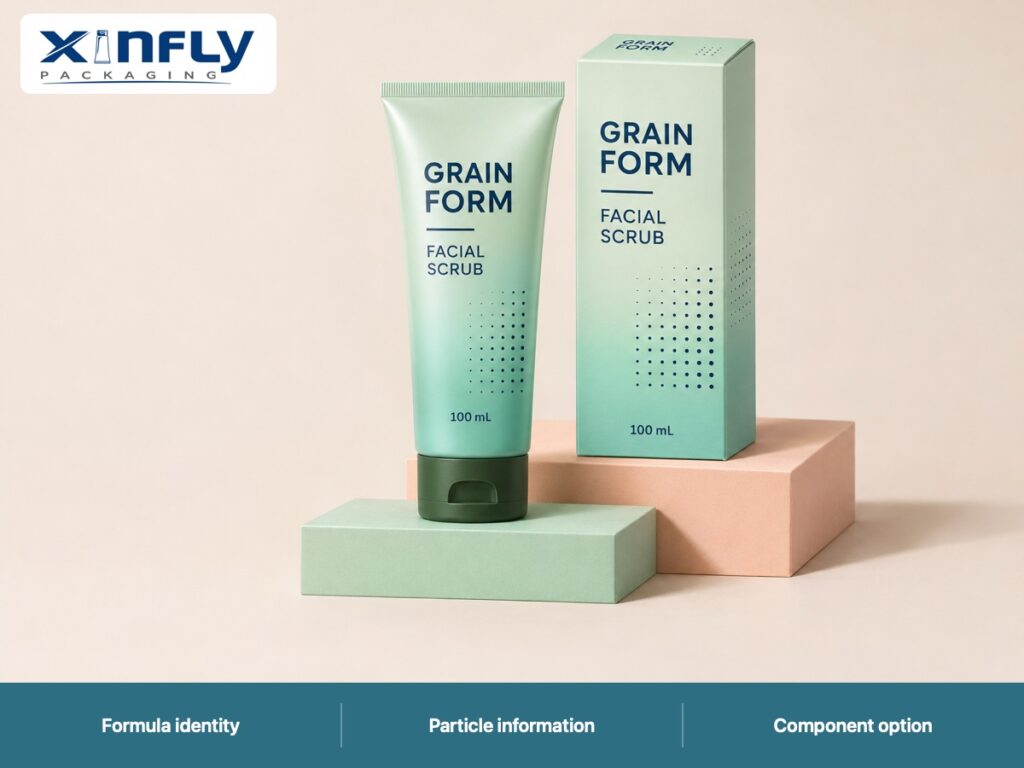
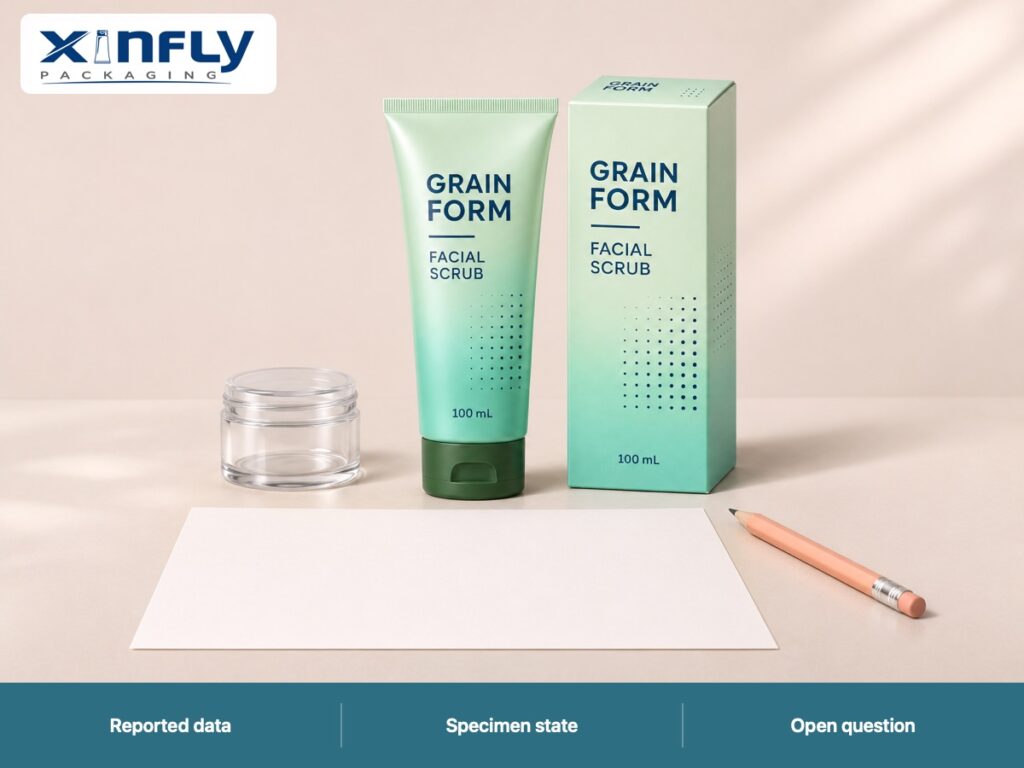
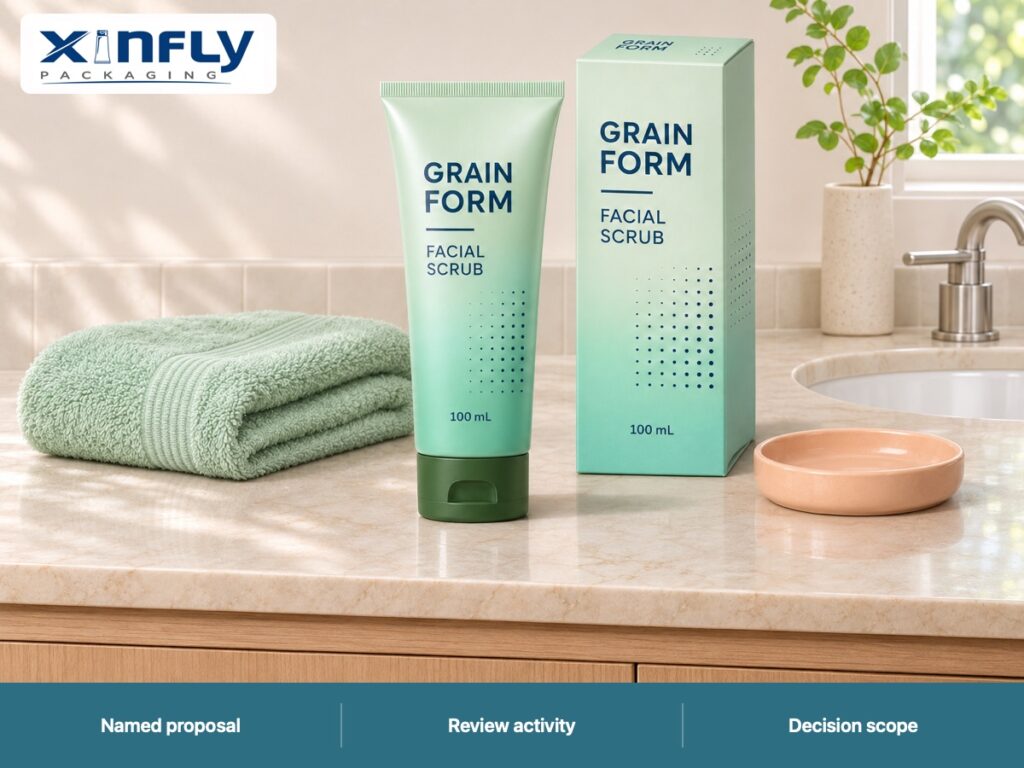
The GRAIN FORM illustration uses an opaque PBL-style body, molded shoulder, straight crimped display tail and dark-green round flip-top. A mint-to-seafoam gradient, navy wording and dot pattern form an offset-print concept coordinated with a printed carton. No internal layer schedule, outlet dimension, formula contents or particle-flow result is represented by the illustration.
Make the Sample Request Answer the Actual Question
Ask the Evaluator to Define the Required Specimen
The person performing the review should identify the required specimen state, preparation, quantity and relevant conditions. Keep those instructions with the request. Do not assume a closed display pack is suitable for a filling activity or that an empty tube can answer a question requiring the intended filled assembly.
Use sample development to discuss which references can be provided. Identify who prepares any filled specimens and how they are connected to the formula and component references. Confirm availability and commercial conditions rather than presenting a proposed sample request as a supplier commitment.
Keep Comparative Differences Visible
If the planned review compares options, give the evaluator the relevant differences and ask how they should be handled in the activity. A change in formula version, sample preparation or component construction can complicate interpretation. Record those differences rather than hiding them under a shared product name.
The goal is a traceable observation, not a claim that one option is universally better. Keep the reviewer’s conclusion attached to the specific specimens and conditions represented. Ask what further work remains before that conclusion can support a purchase decision.
Record Observations Without Inventing Results
Use Defined Questions for the Planned Activity
The matrix below suggests questions to discuss with the responsible evaluator. It supplies no test method, passing value, required sample count or actual outcome. Adapt it to the project and retain the evaluator's instructions separately from the purchasing checklist.
| Question area | Information to identify before the activity | Record to request afterward |
|---|---|---|
| Dispensing observation | Formula, component option and preparation state | What was observed under the stated conditions |
| Particle-related question | Relevant formula-owner information and agreed question | Specific observation with any limitation identified |
| Closure condition | Exact closure and handling state | Identified condition or concern, not an assumed cause |
| Remaining product question | Scope of any planned end-of-use review | Observation tied to that activity and specimen |
| Component comparison | Differences between options being evaluated | Conclusion limited to the represented comparison |
| Decision scope | Requirement and responsible reviewer | Accepted feature, further work or unresolved point |
Separate Observation, Explanation and Release
An observation describes what happened in the identified activity. An explanation addresses why it may have happened. Release records whether the relevant requirement is accepted. Keep those stages distinguishable so a purchasing note does not turn an unexplained observation into a technical conclusion.
If a question remains unresolved, retain the specimen references and ask the responsible teams what should happen next. Do not assign a failure mechanism from an image alone or describe a revised component as successful before the relevant work has been completed.
Keep the Information Current Through Procurement
Review Relevant Changes Before Reusing an Earlier Decision
If the formula owner changes relevant particle or base-formula information, identify the new version and ask which prior decisions need review. Similarly, keep a changed body or closure proposal distinguishable from the earlier component option. A familiar artwork file does not establish the same technical proposal.
For broader face wash tube packaging, keep a particle-containing scrub inquiry identifiable rather than merging every cleanser into one specification. The shared application family is useful context, while the actual formula and component references govern the project discussion.
Send Xinfly Packaging a Focused Particle-Information Brief
Share the intended capacity, proposed application, relevant formula information available for review, component preferences and sample question. Identify missing data and the team expected to answer it. You can send Xinfly Packaging your facial scrub tube brief with the two worksheets adapted to the project.
Ask for the proposed component references, representative sample scope and remaining confirmation steps. Keep any resulting quotation connected to those references so the commercial decision does not become detached from the formula and sample discussion that produced it.
Frequently Asked Questions
Is “Thick Scrub” Enough Information to Select a Tube?
Use it as an initial application description, then ask the responsible formula team which viscosity, particle and specimen information is relevant. Identify the proposed components and evaluation question. This guide does not turn a general texture description into an opening-size recommendation or a qualified package.
Should I Report Average or Maximum Particle Size?
Preserve the terminology and scope of the actual information supplied by the formula owner. Ask what it describes and what further characterization the reviewers need. Do not rename an average as a maximum or invent a missing value to complete the packaging inquiry.
Does “Wide Orifice” Identify the Complete Dispensing Assembly?
Request the applicable drawing and component references. Identify the proposed outlet, relevant passages and closure arrangement through the supplier's explanation. The descriptive phrase alone does not establish a complete dimensioned proposal or a successful dispensing result for a particular scrub.
Can I Compare Samples from Different Formula Versions?
Identify the difference and ask the responsible evaluator what comparison is appropriate. Keep preparation and component differences visible as well. Do not attribute an observed change solely to the tube when relevant formula or specimen conditions also changed without an agreed interpretation basis.
What Belongs with the Final Purchasing Record?
Retain the accepted component proposal, applicable formula reference, specimen identities, relevant reviewer conclusions and unresolved limitations. Keep the commercial request connected to the same scope. An attractive decorated sample or an available stock tube should not silently replace the proposal that was actually reviewed.
Conclusion
A practical facial scrub tube inquiry connects formula identity, available particle information, viscosity context and identifiable component options. Ask the responsible teams to define the sample and evaluation needs, then preserve the scope of their observations and decisions. Xinfly Packaging can review that brief with you so a purchase is based on a clear proposal rather than an unexplained texture description or an assumed opening size.