Published: .
“Please quote a medium outlet for a face wash gel.” The request sounds clear until two suppliers send different assemblies. One describes the opening in the tube head. The other describes the opening in the closure. Neither quotation identifies the complete path the product will travel through. You still do not know whether the proposals solve the same dispensing need.
A face wash tube outlet size RFQ replaces that vague description with a drawing and sample question. Begin with Xinfly Packaging’s facial cleanser tube packaging, then identify the outlet, closure and formula the project actually needs to review. This guide provides a drawing-request sheet and a comparison record, without assigning a universal hole diameter to every gel or cream.
Define the Dispensing Question First
Describe the Intended User Action
Explain how the product is intended to be dispensed and what the brand wants to assess. Is the concern an unexpectedly large amount, difficult control, residue around the outlet or another observed behavior? State the question using the actual formula and proposed assembly. “Easy squeeze” is a useful intention but an incomplete specification for comparing quotations.
Keep the dispensing question separate from the filling operation. The opening through which a user dispenses the product may not be the opening through which the filler fills the tube. Ask the supplier and filler to identify the relevant ends and parts on the drawing. That avoids solving a filling problem with an unrelated dispensing-outlet change.
Treat Gel and Cream as Product Descriptions
A marketing category does not provide all the information needed to select an outlet. Give the responsible teams the actual formula revision and the preparation information relevant to their assessment. If viscosity information is supplied, retain the stated measurement conditions rather than forwarding an isolated number with no method or context.
Ask the formula owner which other characteristics matter to the intended dispensing review. Keep that input tied to the proposed product. Do not borrow a suggested outlet from an unrelated cleanser solely because both products are called gels, contain similar headline ingredients or have the same nominal fill volume.
Identify the Complete Flow Path
Distinguish the Head Opening from the Closure Outlet
Ask the supplier to show which dimensions describe the tube head or neck and which describe the closure. Include relevant inserts or other features if they form part of the proposal. A single hole dimension can be useful only when everyone knows where it is measured and which assembly it belongs to.
For 100ml face wash tubes with flip-top caps, retain the cap reference alongside the body and head. The flip-top description does not identify every internal feature or mating relationship. If one supplier changes the closure while keeping the body description, request that alternative separately rather than assuming the outlet proposal remains unchanged.
Name the Dimension Instead of Guessing from a Photograph
Request a controlled drawing or clearly identified technical description. Have the supplier label the relevant feature, nominal dimension, applicable tolerance or confirmed control basis, units and revision. If some of that information is provisional, keep its status visible. A project can discuss a proposal before every value is final without presenting an estimate as a released specification.
Confirm Diameter, Radius and Shape
If the intended opening is circular, make sure a value refers to diameter rather than radius. If it is another shape, ask how it is specified. Do not measure a perspective photograph and call the result an approved dimension. Ask the supplier which features and measurement approach belong in the actual drawing and inspection record.
| RFQ item | Information to request | Why it matters |
|---|---|---|
| Assembly references | Body, head, cap and relevant insert identities | Keeps the outlet tied to a complete proposal |
| Flow-path features | Identified openings or passages relevant to dispensing | Prevents unlike locations being compared |
| Dimension definition | Feature label, shape and diameter or other relevant measure | Makes the number interpretable |
| Units and control basis | Stated units, confirmed tolerance or provisional status | Distinguishes a proposal from a released specification |
| Formula reference | Actual formula revision and relevant supporting information | Connects selection to the intended product |
| Sample purpose | Specific dispensing question and agreed preparation | Defines what the sample comparison should answer |
Use Geometry Carefully During the Discussion
A Larger Diameter Does Not Give a Complete Dispensing Prediction
Geometry can help explain why a small-looking dimension change deserves review. For a circular opening, area is proportional to diameter squared. As a calculation example only, a 4 mm circle has about 1.78 times the area of a 3 mm circle. These dimensions are hypothetical teaching inputs, not suggested outlets for the illustrated tube or any particular cleanser.
That area ratio is not a prediction that the product will dispense 1.78 times as fast. It does not account for the actual formula, complete flow path, user action or other relevant conditions. Keep the geometry calculation labeled as geometry. Use representative samples and the project’s assessment plan for the actual dispensing decision.
Do Not Let One Dimension Hide Another Change
When comparing outlet alternatives, ask which other features differ. A new cap, head geometry, body specification or another assembly feature can change what the team is reviewing. Keep a side-by-side proposal record so the buyer knows whether the trial compares one controlled difference or two substantially different packs.
If several features change together, that can still be a useful comparison of complete packaging options. Describe it accurately. Do not attribute an observed difference to the outlet diameter alone when the trial record shows that other relevant inputs changed as well. The purpose is a sound purchasing choice, not a claim that the comparison isolated a single cause.
Plan Samples Around the Actual Question
Define Preparation and Operating Conditions
Agree the sample state, formula, relevant preparation and how the reviewer will dispense the product. Record orientation and other operating conditions the responsible teams identify. Ask which observations or measurements are needed. A quick demonstration can help frame a question, but it should not silently become a complete qualification plan.
Xinfly’s orifice-size selection guide provides background for the discussion. Use the actual drawing and formula information to determine what applies to the project. General examples should not replace the supplier’s proposed construction or the criteria agreed by the people responsible for the product.
Record the Complete Assembly Behind Each Observation
Give each candidate sample an identifier linked to its drawing and formula. Describe what was observed: control of the intended amount, interruption of dispensing, residue at a specified location or another relevant feature. Ask the appropriate owner to assess the cause and acceptance. Avoid diagnosing a formula or component issue from the observation alone.
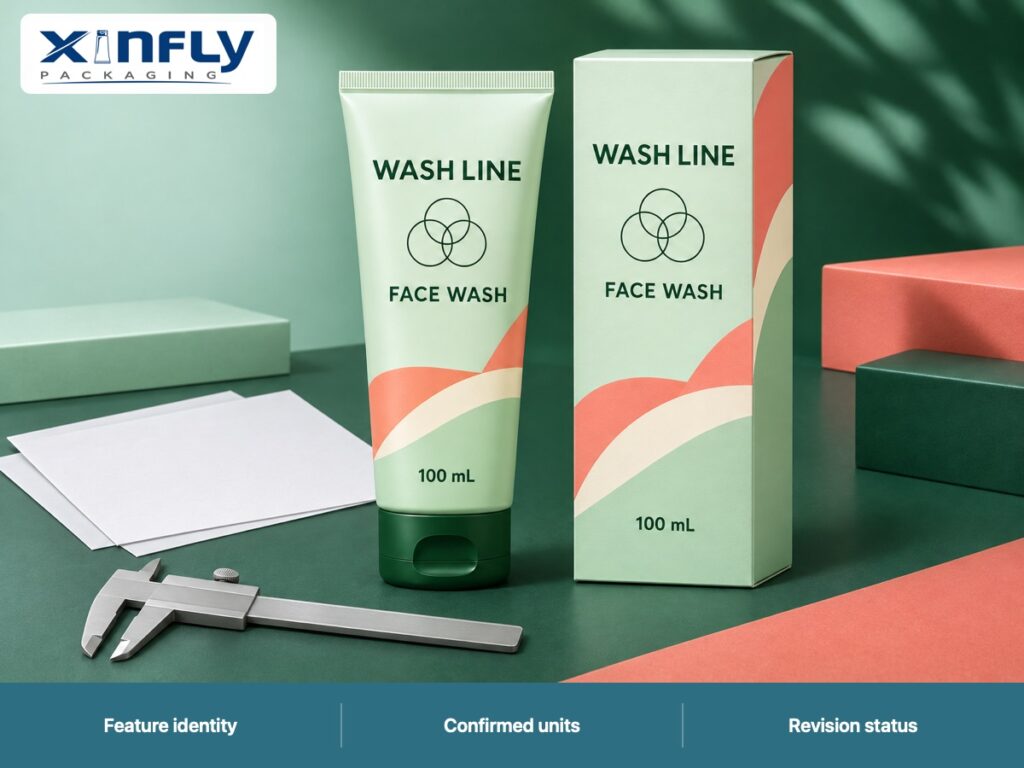
The WASH LINE illustrations show a nominal 100 mL mint PE body, molded shoulder, straight sealed display tail and forest-green flip-top. Forest, coral and cream artwork represents a screen-print concept with a matching printed carton. The images do not show a specified internal outlet or establish a tested dispensing rate. The relevant opening needs its own controlled reference.
Preserve the Closing Relationship
Review the Outlet with Its Mating Closure Features
If the proposed change affects how the closure contacts or covers the outlet, ask the supplier which fit and closing checks are relevant. Keep that question separate from whether the formula dispenses in the desired way. An alternative that looks promising in a short dispensing review still needs the other project requirements to be assessed.
For empty face wash tubes, confirm which assembled parts are included in the delivered state and which operations remain with another party. The actual cap and head references should travel with the quotation and sample record. A loose component from another sample should not be substituted during approval without identifying the change.
| Comparison field | Candidate record to retain | Decision it supports |
|---|---|---|
| Drawing revision | Complete assembly and outlet-feature references | Confirms what is being compared |
| Changed features | Outlet and every other relevant difference | Defines the scope of the comparison |
| Formula and preparation | Identified product and agreed sample conditions | Makes observations interpretable |
| Operating method | How the reviewed dispensing action was carried out | Separates method differences from pack differences |
| Observations | Specific findings linked to individual samples | Gives the responsible owner evidence to review |
| Other requirements | Required fit, closing, filling and qualification records | Keeps a dispensing observation within its scope |
| Release decision | Accepted references, remaining work and responsible owner | Identifies the assembly available for the order |
Compare the Commercial Scope After the Technical Proposal
Ask Whether an Alternative Uses Existing Parts
An outlet alternative may involve a different existing component, a proposed modification or another development route. Ask the supplier to identify the actual route and its commercial scope. Do not assume that changing one drawing value is automatically a no-cost adjustment or that it always requires a new tool.
For face wash tube packaging, distinguish quotation assumptions from confirmed production details. Ask which sample preparation, decoration, assembly and review activities are included. Confirm quantities, availability, costs and timing for the actual proposal instead of importing the terms from another tube size or closure configuration.

Send Xinfly Packaging a Drawing-Based RFQ
Include the Requirement and the Unresolved Question
Send the formula information needed for review, desired nominal fill, proposed body and cap references, artwork, target market and quantity. Attach an existing drawing or marked reference where available. State whether you need help defining the outlet or comparing identified alternatives. That makes the inquiry more actionable than asking for a “medium hole” on a generic cleanser tube.
Use sample development to discuss preparation and responsibilities. If a component change is proposed, connect it to the relevant caps and closures reference and sample scope. Send Xinfly Packaging your outlet RFQ with the filler’s requirements so the team can identify missing information and the next useful comparison.
Frequently Asked Questions
Can I choose the outlet from the word gel or cream?
That description alone is insufficient for the full decision. Provide the actual formula reference and relevant conditions, then review the proposed assembly and samples with the responsible teams. Keep any suggested dimension identified as a proposal until its scope is confirmed.
Is the cap outlet always the same as the tube-head opening?
Do not assume they refer to the same feature. Ask the supplier to label the relevant locations on the complete assembly drawing. A dimension without a feature reference can make two quotations appear comparable when they describe different parts.
Does a 4 mm opening dispense 1.78 times as fast as a 3 mm opening?
The example ratio concerns circular area only. It is not a dispensing-rate prediction. Actual behavior requires assessment of the formula, complete flow path, operating conditions and other relevant assembly features under an agreed plan.
Can the outlet change be approved from an empty sample?
An empty sample can support the features it represents, such as identified geometry or assembly review. It cannot demonstrate dispensing with the intended formula. Keep the approval limited to the reviewed scope and identify any filled-sample work still needed.
What should be referenced on the production order?
Use the released complete assembly drawing, outlet and cap references, material and artwork revisions, relevant sample records and actual approval scope. Identify any proposed substitution before supply. A nominal capacity and a photograph do not replace that record.
Conclusion
A useful outlet RFQ names the feature, units, complete assembly and dispensing question. Keep geometry calculations separate from flow predictions and review samples with the actual formula. With those references in place, Xinfly Packaging and your buying team can compare face wash tube proposals on a clear technical and commercial basis.