Published: .
One supplier quotes a development charge for your lip gloss tube. Another says the same-looking project needs no new mold. Are they offering different prices for the same work, or different work altogether? Until you identify the proposed assembly and deliverables, the two totals are difficult to compare.
A custom lip gloss tube tooling quote scope separates decoration, existing components, proposed component changes and any dedicated tool development. Begin with Xinfly Packaging’s custom lip gloss tubes, then define which parts of the packaging are actually changing. This guide gives buyers two practical comparison tables. It does not establish a mold price, tooling ownership arrangement or production commitment for a particular project.
Start with the Difference from an Existing Assembly
Describe the Change Part by Part
List the tube body, shoulder or head, applicator, closure and any relevant inserts as identifiable parts. Ask the supplier which existing references it proposes and which features would change. A new printed name on a familiar body is a different development request from a new applicator geometry. The RFQ should let the supplier explain that difference plainly.
Do not use “custom tube” as the only description of the project. It can mean custom decoration, an existing component in a requested color, a modified component or a newly developed assembly. Those routes can require different work. Keep the complete proposal visible before comparing a charge labeled “mold,” “setup” or “development.”
Ask Whether the Offered Parts Already Exist
Request supplier component references or drawings for the proposed baseline. If the design can use an existing assembly, ask what customization is included and what remains to be checked. If the supplier proposes a new part, ask why it is needed and which requirement it addresses. This helps the buyer decide whether the extra development serves the product brief.
The answer should not depend only on a product photograph. Two samples can look similar while using different tip, neck or cap references. Equally, a new color and print design can make an existing geometry look unfamiliar. Use part identity and drawings to establish the development scope instead of guessing from appearance.
Separate Tooling from Decoration and Setup
Put Different Charges on Different Lines
Ask the quotation to distinguish the activities relevant to the actual proposal. These may include design work, tooling, print preparation, color development, samples and production setup. Do not require a supplier to invent separate charges for work it genuinely bundles, but ask it to describe what the bundle includes. A comparable description matters more than matching invoice labels.
Xinfly’s custom tube-head tooling guide provides background on one development route. Use it to discuss the part and deliverables in your proposal rather than treating general examples as a current quotation. Confirm quantities, costs and timing for the actual specification and supplier response.
Identify Which Part Each Tool Would Produce
A reference to “one mold” is incomplete if nobody identifies the component it produces. Ask for the proposed tool’s function, associated part drawing and relevant configuration. The supplier should clarify which details are available at the quotation stage and which remain subject to development. Do not infer the number of tools needed from the number of visible parts in a poster.
| Proposed route | What the supplier should identify | Buyer’s comparison question |
|---|---|---|
| Existing assembly with new decoration | Component references and printing scope | Does the requested change concern artwork rather than geometry? |
| Existing component with a proposed change | Baseline drawing and changed features | Which work and verification does the change require? |
| New applicator or head proposal | Proposed part drawing and development deliverables | Which product requirement justifies the new part? |
| New closure proposal | Closure and mating-part references | Is the complete fit relationship included in review? |
| Broader assembly development | Included parts, tools and sample stages | What complete pack is the proposal intended to deliver? |
Define Deliverables Before Approving a Development Payment
Ask What Will Be Available for Review
For each proposed stage, identify the deliverable and the decision it supports. A dimensional drawing, appearance model, component sample and decorated assembled tube do not answer the same questions. Ask the supplier to explain what each can represent, including any differences from the intended production construction or process.
Avoid approving a broad milestone such as “sample accepted” without identifying the sample and scope. A buyer might accept the shape of a model while formula contact, cap fit or filling work remains unresolved. Keep those decisions separate so that the next stage does not inherit an approval the team never actually gave.
Keep Changes and Repeat Sample Work Visible
Ask how revisions will be handled after the initial proposal. Which changes are included in the agreed scope, which need another quotation, and who authorizes them? Record the answer before development begins. This is especially useful when the brand expects several design rounds but the supplier has planned a more limited sample sequence.
Do not assume that an iteration is free or chargeable in every case. Ask the supplier to define the treatment of the actual change. Keep the revised requirement, impact on deliverables and commercial response together. A clear change record is easier to manage than a disagreement over what “custom development” was supposed to include.
Clarify Tool Use, Access and Retention in Writing
Separate Payment from the Agreed Commercial Arrangement
Ask the parties to document who may use the tool, for which parts and under what agreed conditions. Clarify storage, maintenance responsibilities, access to records and the treatment of relevant design information. Do not infer these arrangements from the fact that a development payment appears on an invoice. The actual agreement needs to state them.
If a transfer or release of a tool or drawing matters to the buyer, raise it before accepting the proposal and seek the appropriate commercial or legal review for the intended agreement. This guide lists purchasing questions; it does not determine legal ownership or imply that one standard arrangement applies to every supplier.
Connect the Arrangement to an Identified Tool and Part
Use the same references in the quotation, development record and any agreed tool register. Where a reference is still provisional, identify it as such and update it at the appropriate stage. A general note saying “customer mold” is hard to use later if nobody can identify the tool, part revision or approved application it describes.
| Record item | Question to resolve | Evidence or wording to retain |
|---|---|---|
| Part scope | Which component and revision does the work cover? | Identified drawing and change description |
| Deliverables | What is provided at each development stage? | Stage description and review purpose |
| Commercial scope | Which work is included and which needs separate agreement? | Current quotation and stated assumptions |
| Revision treatment | How are changes and repeat samples authorized? | Agreed change process and responsible owners |
| Use arrangement | Who may use the identified tool and for what purpose? | Actual written commercial arrangement |
| Retention and maintenance | Who handles storage, care and relevant records? | Agreed responsibilities and available records |
| Acceptance | Which criteria and sample scope close the stage? | Actual review findings and release decision |
| Order handoff | Which approved assembly may enter the production order? | Released references linked to the order |
Keep the Complete Applicator Assembly in the Review
A New Tip Still Has to Match the Mating Parts
For lip gloss squeeze tubes, preserve the relationships between the applicator, shoulder or neck and cap. Ask the supplier which interfaces are affected by the proposed change. A visually attractive tip does not settle fit, closing or dispensing questions for the finished assembly. Assign those questions to the relevant sample and review plan.
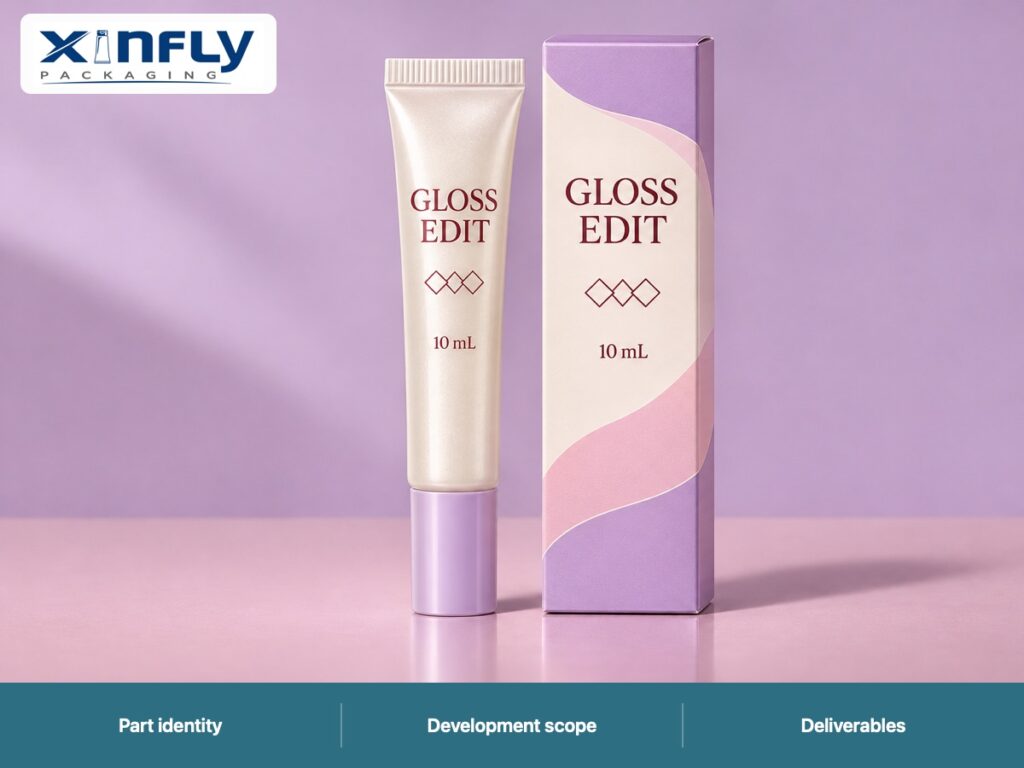
The GLOSS EDIT illustrations show a nominal 10 mL ivory PE body, molded shoulder, slanted applicator beneath a lavender cylindrical screw cap, straight sealed display tail and burgundy one-color diamond artwork. Its carton repeats the design. These are packaging illustrations, not evidence that a dedicated tool exists, that a particular design is available or that an applicator has passed testing.
Include the Filler and Formula Owners at the Right Stage
Give the relevant teams the proposed assembly references and intended sample state. Ask what information or samples they need to assess the product’s filling and use requirements. A tooling milestone should not be mistaken for formula qualification. Record which work has actually been completed and which decisions still belong to another stage.
Compare First-Order and Reorder Scope
Ask Which Charges or Work Recur
For custom lip gloss squeeze tubes, identify which quoted items concern the current development stage and which relate to later orders. Ask what a repeat order would need to reference and whether any assumptions depend on unchanged components, artwork or process. Do not calculate a future unit cost by assuming that every initial charge disappears or recurs automatically.
If a supplier offers a commercial adjustment linked to future quantities, ask for the exact conditions in the quotation. Treat it as a proposal to review, not as a universal tooling practice. Purchasing should be able to see the relevant quantities, scope and decision points without reconstructing them from several informal messages.
Avoid Comparing Unlike Supply Stages
A quotation for an empty decorated component is different from one that includes more assembly, additional sampling or another service. Keep the supplied state alongside the price basis. The buyer can then compare offers that solve the same project need instead of choosing a lower total that leaves essential work unquoted.
Send Xinfly Packaging a Reviewable Tooling Brief
Include a Baseline, a Change and an Intended Use
Share the existing sample or drawing reference, the specific feature you want to change, formula information relevant to review, nominal fill, closure preference, artwork and order scope. Use Xinfly Packaging’s OEM and ODM process to discuss how the project would be organized. Identify which development question must be answered before you can approve the next stage.
Ask about available stages through sample development, including who reviews each sample and what it represents. Send Xinfly Packaging your lip gloss tooling brief with the proposed change and commercial questions. A concrete brief gives the supplier a better basis for explaining whether existing components, a modification or another development route should be considered.
Frequently Asked Questions
Does custom printing mean that a new mold is needed?
Not automatically. Ask which components already exist and which geometry, if any, must change. Keep decoration preparation separate from component development in the proposal. The supplier needs the actual brief to confirm the appropriate route.
Does paying a tooling charge establish ownership of the tool?
Do not infer the arrangement from payment alone. Ask the parties to document the intended use, ownership or access terms and responsibilities in the actual agreement, with appropriate review where needed. This guide does not establish a legal outcome.
Can an appearance model approve the finished applicator?
It can support the features it meaningfully represents. Identify the model’s purpose and differences from the intended production construction. Fit, dispensing, formula and filling decisions may need separate representative samples and acceptance records.
What makes two tooling quotations comparable?
Compare the same part change, deliverables, sample stages, supplied state, revision treatment and stated commercial assumptions. A shared heading such as “mold cost” is not enough when the work included differs between proposals.
What should a reorder reference after development is complete?
Use the released assembly and part drawings, relevant tool references, material and artwork revisions, sample records and actual commercial arrangement. Identify any proposed change before supply. Keep the original development history available without treating it as approval of an altered pack.
Conclusion
A useful tooling quotation explains which part changes, what work is included and which deliverables support the next decision. Keep tool-use arrangements explicit and connect the released assembly to the order. With that scope visible, Xinfly Packaging and your buying team can compare development proposals on their actual content instead of relying on one ambiguous line labeled “mold.”