Choosing a cosmetic tube manufacturer can feel easy until two quotations arrive with different tubes, different caps and different assumptions about printing. The lower unit price may exclude the decoration you approved. The beautiful sample may use a closure that is unavailable for your production run. A supplier comparison only works when everyone is answering the same question.
This cosmetic tube manufacturer comparison guide puts Xinfly Packaging beside other suppliers using a buyer-controlled request for quotation (RFQ), a sample review and a documented decision scorecard. It does not claim that Xinfly wins every project. The right supplier depends on your formula, market, timing, artwork and tolerance for risk. Start with Xinfly's cosmetic tube manufacturer capabilities and ask every shortlisted factory for evidence against the same brief.
Begin With One Purchase Decision
Fix the Reference Pack Before Inviting Quotes
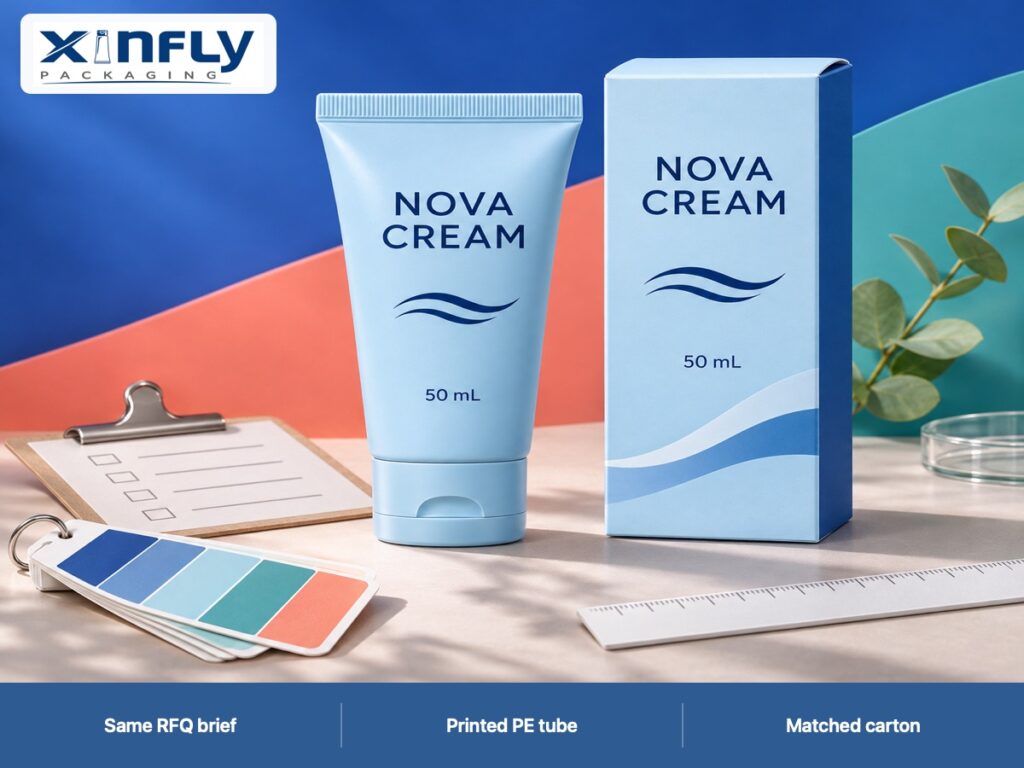
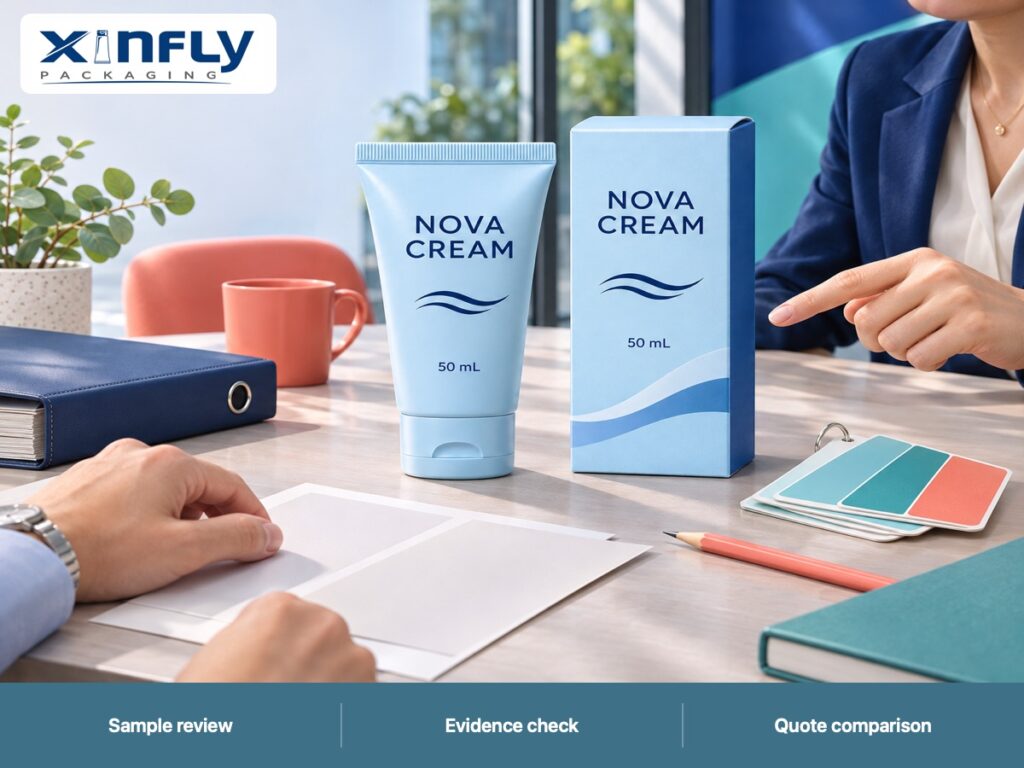
Imagine a 50 mL face-cream tube for a premium skin-care launch. The reference concept shown here is a powder-blue extruded PE tube with a molded shoulder, straight heat-sealed tail, hinged flip-top cap and one-color navy screen print. Its folding carton carries the same NOVA CREAM name and wave artwork. It is an illustrative design for this comparison, not a stocked Xinfly SKU, a customer product or an approved production sample. The formula, fill process and destination market still need to be specified by the buyer.
Send each supplier a drawing or marked reference image. Include nominal fill, target body diameter and length, cap orientation, outlet preference, color target, print file, carton dimensions and expected filling method. If a number is undecided, mark it “propose and explain.” That makes the difference between a useful proposal and a silent substitution. A bidder may have an excellent alternative, but you should see its effect on appearance, tooling, test plan and price.
Separate Must-Haves From Negotiable Choices
Classify requirements before anyone quotes. A cap that fits the brand's one-handed-use brief might be mandatory; a particular shade of blue may have an approved tolerance. A screen-printed tube may be essential for the visual concept, while a different carton board could be acceptable after a packout trial. Put the distinction in the RFQ. Otherwise a supplier can appear cheaper by changing a feature that your team never meant to trade away.
Compare the Same Supply Scope
Ask whether the quote covers only the printed empty tube or also the cap, carton, artwork proof, freight and sample rounds. Specify whether the factory supplies the shoulder and closure as one assembly. For custom cosmetic tubes, even a small difference in body construction or cap sourcing can change which tests are relevant. A cosmetic tube supplier comparison breaks down when unlike prices go into one spreadsheet.
| Decision point | What to request from Xinfly Packaging | What to request from every other supplier |
|---|---|---|
| Tube construction | Named body structure, material and approved drawing | The same details or a clearly marked alternative |
| Closure and outlet | Cap drawing, sample identification and proposed outlet | Matching cap data and any fit or tooling change |
| Decoration and carton | Print method, color target, proof and carton scope | Equivalent artwork and secondary-pack scope |
| Filled-pack verification | Proposed sample plan for the actual formula and filler | Test method, sample count and acceptance criteria |
| Commercial scope | Itemized tooling, decoration, packout and freight assumptions | The same cost boundaries and quotation validity |
Inspect Capability, Not Just a Product Gallery
PE, Laminate and Barrier Choices Need a Reason
A manufacturer may offer several tube structures, yet the relevant question is whether it can explain the proposed structure for your formula. A PE tube may suit one design; a laminated tube may be considered where a different barrier or graphic treatment is needed. Neither choice should be inferred from a website photograph. Ask for the layer construction, resin identification, sample drawing and the reason for the recommendation. Xinfly's PE tube range is a starting point for a PE brief, not proof that a specific formula has already passed compatibility testing.
Request one sample representing the material and decoration you intend to buy. If the first sample is a plain white stock tube, record which later features still need to be represented: pigment, print, shoulder, cap and tail. This matters when comparing a cosmetic tube supplier whose sample process uses near-final assemblies against one that supplies attractive mockups but leaves crucial parts undecided.
Printing Must Be Judged on the Curved Tube
An artwork PDF can hide the most important issue: where the print lands after the tube is formed and the tail is sealed. Ask for the printable area, artwork orientation, registration target and approved color reference. Inspect small type at normal viewing distance. Place the tube beside its printed carton under the same light. The two substrates need not look chemically identical, but the difference should be one the brand knowingly accepts. Xinfly's printing design options help frame the discussion; the final proof must match your chosen body material and ink process.
Do not assume that “custom printed cosmetic tubes” means unlimited color, a particular finish or guaranteed batch-to-batch identity. State how color will be approved and how later production will be compared with the signed sample. If a supplier proposes a new printing process to save cost, request a physical proof before treating it as equivalent.

The Cap, Shoulder and Tail Are Three Separate Decisions
Squeeze the assembled sample with the intended formula, then inspect the closure, shoulder connection and tail separately. Residue under the lid and residue at the shoulder do not have the same likely cause. A neat heat seal on an empty display sample says little about sealing on the actual filling line. Ask the filler to confirm tube handling, fill temperature, tail-clearance area and sealing setup. Agree who owns a repeat trial if any part changes.
Use the Actual Filler's Conditions
An OEM cosmetic tube manufacturer can supply a technically tidy component that still causes trouble on a third-party line. Ask both parties to review tube dimensions, cap-down stability where relevant, orientation marks, fill opening and tail-seal geometry. Send the same assembly drawing to the supplier and the contract filler. If either proposes a change, update the drawing and sample ID before running a trial. This avoids a familiar procurement trap: approving “the tube” while supplier and filler are picturing different assemblies.
Make Samples Earn Their Place in the Scorecard
Request Identified, Production-Representative Samples
Every sample should have a clear revision, material description, cap identification and artwork version. Photograph the front, back, shoulder, cap and tail. Ask what will change between prototype and production, including whether the cap or carton came from a temporary source. Xinfly describes a sample development process; ask the same stage-by-stage questions of every factory. A sample that is labeled accurately is more valuable than a flawless-looking sample with no traceable specification.
Define Acceptance Before You Test
Choose checks that reflect the launch: fill and storage compatibility, dispensing, cap closing, tail integrity, artwork appearance, carton fit and transport handling. Set the formula, fill quantity, sample count, orientation, temperature and observation period with the brand and filler. Write down what counts as acceptable before results arrive. That prevents a team from calling a borderline result “good enough” only because a supplier offers a compelling price.
For the NOVA CREAM illustration, a sensible physical review would put the printed tube into its matching carton, remove it repeatedly, check whether the lid catches a flap and compare the printed front with the approved artwork. The illustration itself is not a test result. The method becomes useful only when applied to real, identified samples under recorded conditions.
Ask for Evidence That Matches the Exact Component
Certificates can be useful, but the report number alone is not a pass for your finished package. As a document-review example, SGS report GZHL260603010501OT dated June 26, 2026 records a Pass for the four-metal test under Article 5(4) of Regulation (EU) 2025/40 on a submitted white soft-plastic tube body. It does not establish results for the cap, print, NOVA CREAM concept, another SKU or the whole regulation. Ask Xinfly and any competing supplier which current report corresponds to your selected body, closure and decoration. Record the evidence gap rather than filling it with a blanket “certified” claim.
Build a Scorecard That Does Not Predetermine the Winner
Weight Risks to Your Own Project
If a new launch depends on an existing cap mold, tooling fit may matter more than a tiny price difference. If the product enters a tightly regulated market, a clear component-level evidence pack may weigh heavily. Assign weights *before* reviewing final quotes and let cross-functional colleagues challenge them. The weighted score is a decision aid, not a substitute for a failed mandatory test.
| Criterion | Suggested buyer question | Evidence to keep |
|---|---|---|
| Specification fit | Does the proposed body, cap, print and carton match the brief? | Signed drawings and annotated exceptions |
| Sample and test readiness | Can the supplier provide identified parts for the actual filler trial? | Sample IDs and agreed test plan |
| Quality and change control | How are revisions, defects and substitutions recorded? | Written process and approved reference sample |
| Total landed cost | What is included beyond the tube unit price? | Itemized quotation and freight terms |
| Delivery risk | Which dates depend on art, tooling, approval or filler availability? | Shared milestone plan with owners |
Give each bidder a documented score for each criterion using your own scale, such as 0–3, and attach the underlying evidence. Apply your project weights consistently. Keep “unknown” distinct from “failed”: an unanswered question may be resolvable, while a failed essential test may disqualify a proposal. Never turn the matrix into a public ranking of unnamed competitors without their verified, current quotations.
Compare Total Landed Cost, Not One Unit Price
Ask for the tube price at your order quantity, printing setup, new tooling or tooling change, color-match rounds, cartons, assembly, export packing, freight terms and any testing charge. Confirm currency, quotation validity, payment terms and who pays for a rejected sample round. A unit price that excludes caps or cartons is not directly comparable with an assembled-pack quote. If annual volume is uncertain, ask each supplier to price the same initial quantity and optional repeat-order scenario.
Do the same for time. Request dates for artwork sign-off, physical sample, filler trial, production approval and shipment, with dependencies named. Avoid assuming a website's “fast turnaround” describes your specific construction. A slightly longer but transparent path may be easier to plan than a short promise that quietly depends on an unapproved cap mold.
Where Xinfly Packaging Fits in the Shortlist
Use Public Capabilities as Questions to Verify
Xinfly Packaging presents custom tube design, OEM/ODM support, sampling and quality-assurance workflows on its site. Those are useful reasons to invite a quotation; they are not a substitute for a project-specific drawing, samples and written terms. Ask the team to identify the manufacturing route, proposed tube material, print process, cap source, approval points and test responsibilities for your exact brief. Compare the answers with the same evidence from alternative suppliers.
If you need an OEM and ODM packaging workflow, clarify which party owns artwork, component drawings and final sign-off. If you need a separate contract filler, put them in the approval loop before a production order. For quality review, use Xinfly's quality assurance overview as a question list and ask for the records relevant to your batch and assembly. A good supplier conversation should reveal both what is known and what still needs testing.
Send a Brief That Produces a Comparable Reply
To request a comparison-ready proposal from Xinfly Packaging, share the product category and formula type, destination market, nominal fill, desired tube structure, approximate dimensions, cap and outlet, artwork file, carton scope, forecast quantity, target milestones and filler details. Mark any field that needs a recommendation. Ask for a written assumptions list and sample plan. Send the Xinfly packaging team your RFQ and issue the same brief to other shortlisted cosmetic tube manufacturers. That way, your decision is based on the package you will actually buy.
Frequently Asked Questions
Is Xinfly Packaging cheaper than other cosmetic tube manufacturers?
No honest general answer exists without matching specifications, quantity, scope and delivery terms. Ask for itemized quotations on the same brief and compare total landed cost alongside sample and quality evidence.
Should I choose a factory with the widest material catalogue?
Breadth helps only if the supplier can explain the selected structure and deliver a representative sample. A narrower, well-documented proposal can be better for a specific formula and filler. Check fit, evidence and change control.
How many suppliers should I compare?
Use a shortlist small enough to evaluate properly. Send each the same controlled brief, then ask for the same drawing, sample identification, test plan and itemized quote. The quality of comparison matters more than the number of logos in a spreadsheet.
Can a test report for one tube cover every color and cap?
No. Read the report's named sample, tested component, method and date. Ask whether the proposed production body, pigment, print and closure match that scope or need additional evidence. Do not translate one component result into a complete-pack claim.
What should I approve before placing the purchase order?
Approve the assembly drawing, material and decoration specification, cap and outlet, identified physical sample, filled-pack trial plan, carton artwork, acceptance criteria, quotation scope and change-control route. Put any open issue and its owner in writing.
Conclusion
A useful Xinfly Packaging vs other cosmetic tube manufacturers comparison begins with a controlled brief and ends with a traceable decision. Give every bidder the same package, examine representative samples, separate tested facts from assumptions and compare the full commercial scope. Xinfly may be a strong fit for your project, but the evidence should make that conclusion clear to your purchasing, product and quality teams. Start with one specific RFQ, request the same proof from every supplier, and let the finished package—not a marketing claim—decide.