

Laminate Tubes for Facial Scrub
Custom laminate tubes for facial scrub, face exfoliator, cream scrub and particle-containing facial cleansers. Xinfly Packaging manufactures PBL, EVOH and ABL squeeze tubes with particle-friendly openings, flexible tube bodies, flip-top closures and custom decoration for skincare brands.
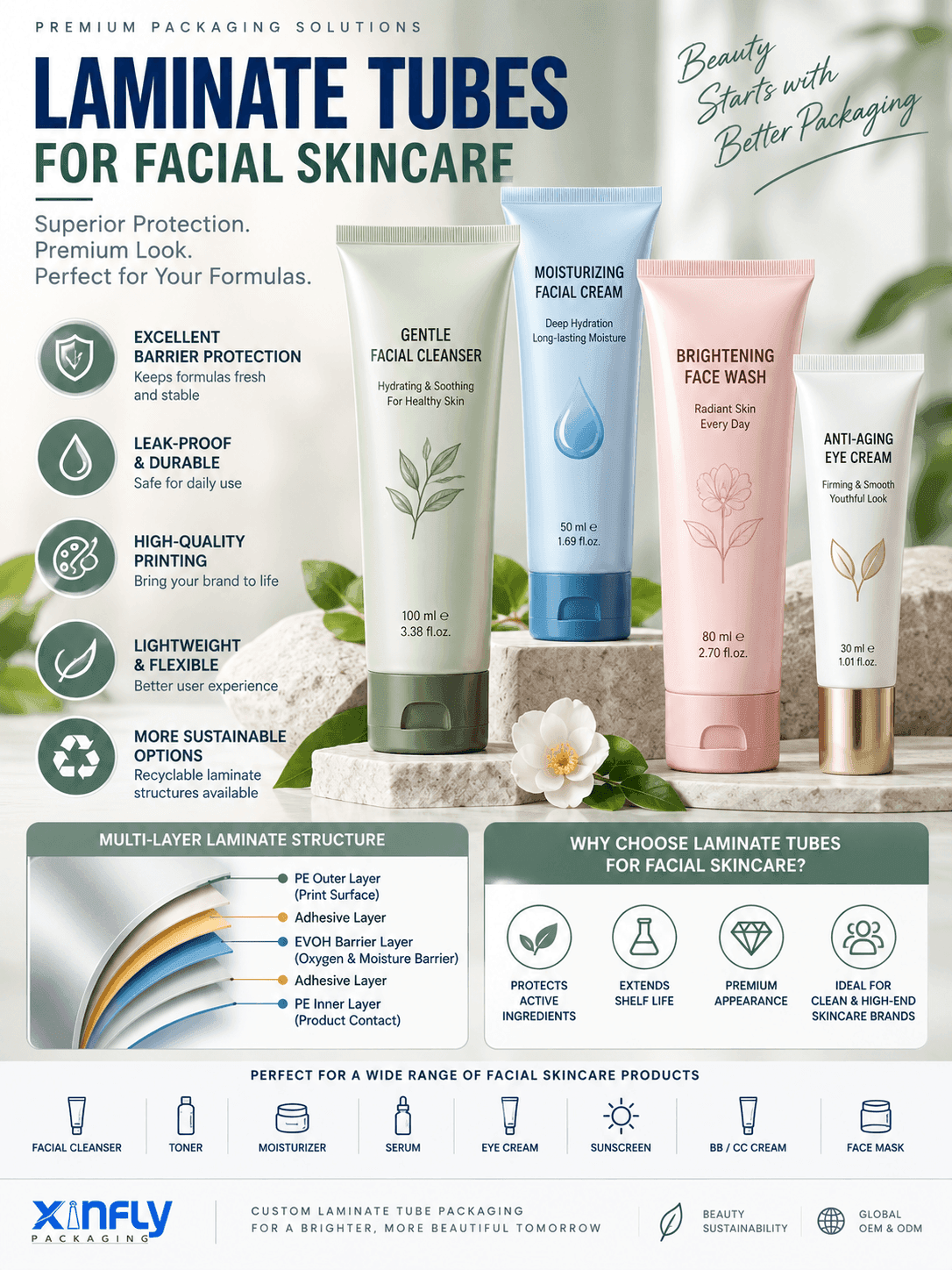
Custom Facial Scrub Tube Packaging
Facial scrubs create a specific packaging challenge: the tube must dispense both the cream or gel base and its suspended exfoliating particles consistently. Particle size, concentration, formula viscosity, tube softness and orifice diameter should therefore be evaluated as one complete dispensing system.
Particle-Friendly Flow
Custom openings help scrub particles pass through the dispensing path consistently.
Controlled Squeeze
Tube softness can be matched to thick gel and cream scrub formulas.
Closure Reliability
Flip-top and screw caps can be tested for residue, leakage and repeated use.
Retail Decoration
Matte, soft touch, CMYK, silk screen and hot stamping are available.
Facial Scrub Products for Laminate Tubes
Laminate squeeze tubes can be customized for different exfoliating textures, ingredient systems and retail positioning.
Cream Facial Scrub
Rich cream-based exfoliating formulas.
Gel Facial Scrub
Gel-based scrubs with suspended particles.
Micro Scrub
Fine-particle facial exfoliating products.
Clay Scrub
Thicker mineral and clay-based textures.
Charcoal Scrub
Custom opaque packaging for dark formulas.
Brightening Scrub
Packaging for multi-active exfoliating skincare.
Men's Face Scrub
Custom retail tubes for men's skincare.
Travel Face Scrub
Compact 30–50 ml tube packaging.
Why Facial Scrub Tubes Need Special Dispensing Design
A standard cosmetic tube opening may work well for a smooth cream but perform poorly when the same formula contains exfoliating particles. The dispensing system should account for the largest particles, not only the average formula viscosity.
Particle Size
Measure the approximate maximum particle size and check whether particles remain uniform during storage and dispensing.
- Maximum particle diameter
- Particle shape
- Particle hardness
- Concentration in formula
Orifice Diameter
Select an opening that allows the formula and particles to pass without excessive pressure or inconsistent dispensing.
- Reduced clogging risk
- More consistent flow
- Comfortable consumer squeeze
- Controlled dosage
Tube Softness
High-viscosity facial scrubs may require a softer squeeze profile than lightweight cleansers.
- Lower squeeze force
- Better evacuation
- Comfortable daily use
- Improved end-of-use dispensing
Facial Scrub Formula & Tube Design Guide
Different scrub textures create different dispensing and package-validation requirements.
| Facial Scrub Type | Texture | Packaging Priority | Key Test |
|---|---|---|---|
| Micro Facial Scrub | Medium / Fine Particles | Controlled dispensing | Dosage consistency |
| Gel Facial Scrub | Medium / Suspended Particles | Leakage + particle flow | Inverted leakage test |
| Cream Facial Scrub | Medium–High | Tube softness + larger opening | Squeeze-force test |
| Clay Facial Scrub | High | Evacuation + flow path | End-of-use test |
| Particle-Rich Scrub | High / Coarser Particles | Wide particle-compatible opening | Repeated clogging test |
| Multi-Active Scrub | Varies | Formula-specific barrier | Compatibility & stability |
PBL vs EVOH vs ABL Tubes for Facial Scrub
Scrub particles determine dispensing requirements, but they do not determine barrier requirements. Material selection should be based on the complete formulation, desired appearance and package performance.
PBL Facial Scrub Tubes
Plastic Barrier Laminate is suitable for skincare brands seeking strong artwork reproduction, smooth appearance and good squeeze recovery.
- Premium cosmetic appearance
- Good squeeze recovery
- High-quality printed artwork
- Suitable for many retail facial scrubs
EVOH Facial Scrub Tubes
EVOH multilayer structures provide enhanced oxygen barrier while maintaining flexible PE-based squeeze characteristics.
- Enhanced oxygen barrier
- Flexible squeeze
- Good recovery
- Suitable for formula-specific applications
ABL Facial Scrub Tubes
Aluminum Barrier Laminate can be considered when the complete facial scrub formula requires stronger oxygen and light protection.
- Excellent oxygen barrier
- Excellent light barrier
- Strong laminate structure
- Use when formulation requires it
Facial Scrub Tube Sizes & Orifice Guide
50–120 ml is a useful range for facial scrub packaging. The final opening should be validated with the actual formula and largest exfoliating particles.
| Capacity | Typical Application | Suggested Diameter | Orifice Starting Point* |
|---|---|---|---|
| 30 ml | Travel / Trial Facial Scrub | Φ25–30 mm | Approx. 2–3 mm |
| 50 ml | Compact Facial Scrub | Φ30–35 mm | Approx. 3–5 mm |
| 75 ml | Standard Facial Scrub | Φ35 mm | Approx. 3–5 mm |
| 100 ml | Main Retail Face Scrub | Φ35–40 mm | Approx. 4–5 mm |
| 120 ml | Large Facial Scrub | Φ40 mm | Approx. 4–5 mm |
| 150 ml | Large / Face & Body Scrub | Φ40–45 mm | 5 mm or custom |
*These values are development starting points only. Final opening size depends on formula viscosity, maximum particle size, particle concentration and target dosage.
Closure Options for Facial Scrub Tubes
Closure selection should consider particle residue, opening diameter, repeated use and intended storage orientation.
Flip-Top Cap
Flip-top closures are convenient for rinse-off facial scrub products used frequently in the bathroom.
- One-hand operation
- Stand-up tube design
- Multiple opening options
- Convenient repeated use
Screw Cap
Screw closures provide a clean and secure option for smaller or premium facial scrub tubes.
- Secure transportation
- Simple appearance
- Suitable for travel sizes
- Custom colors available
Wide-Orifice Closure
A wider dispensing path may be required for coarse-particle or high-viscosity scrub formulas.
- Reduced clogging risk
- Lower squeeze resistance
- Improved particle flow
- Formula-specific development
How to Develop a Custom Facial Scrub Tube
For particle-containing skincare, packaging development should begin with the formula rather than selecting the tube from capacity alone.
Review Formula
Identify the cream or gel base, oils, surfactants and active ingredients.
Measure Particles
Record maximum particle size, shape and approximate concentration.
Measure Viscosity
Determine the squeeze force and dispensing behavior required.
Select Tube Structure
Compare PBL, EVOH, ABL or PE according to the complete formula.
Optimize Orifice
Match the dispensing path to particle size, viscosity and dosage.
Test Filled Samples
Validate clogging, leakage, squeeze force and closure performance.
Engineer Recommendations for Facial Scrub Tubes
The biggest packaging risk with a facial scrub is often not barrier performance. It is whether the complete formula can be dispensed consistently through the selected tube and closure.
Ask an EngineerDo not select the opening based only on average particle size. A small number of larger particles can still create clogging.
The opening should allow both the base formula and exfoliating particles to move through consistently.
A tube that feels comfortable with water may become difficult to use after filling with a high-viscosity scrub.
Scrub particles can remain around the orifice and potentially interfere with clean cap closure.
If particles settle during storage, dispensing behavior may differ between the beginning and end of product use.
Tube, shoulder, closure, formula, tail seal and decoration should be validated together.
Facial Scrub Tube Testing & Validation
Particle-containing formulas benefit from repeated dispensing tests rather than relying only on standard empty-package inspection.
Formula Compatibility
Evaluate the actual formulation against the tube body, shoulder and closure.
Clogging Test
Dispense repeatedly to confirm particles pass through the opening.
Squeeze-Force Test
Check how much pressure is required to dispense the filled scrub.
Leakage Test
Evaluate upright, inverted and transport-related package conditions.
Closure Cycling
Repeatedly open and close the cap with realistic product residue around the opening.
Evacuation Test
Determine how easily consumers can dispense the remaining scrub near end of use.
Custom Facial Scrub Tube Specifications
Xinfly Packaging can customize tube structure, diameter, capacity, squeeze softness, opening size, closure, color and decoration.
For the most useful technical recommendation, provide the formula viscosity, maximum scrub particle size, particle concentration, target fill volume and preferred closure.
Request Technical SupportInformation to Send Your Facial Scrub Tube Supplier
Providing technical formula information early can shorten tube development and reduce unnecessary sampling rounds.
Formula
Formula type, viscosity and relevant compatibility information.
Particles
Maximum particle size, shape and approximate concentration.
Pack Size
Target fill volume, tube diameter and preferred dimensions.
Branding
Artwork, Pantone colors, surface finish and decoration requirements.
Why Choose Xinfly Packaging for Facial Scrub Tubes
Custom cosmetic tube manufacturing for facial scrubs, cleansers, exfoliating skincare and beauty brands.
Particle-Focused Development
Opening size can be evaluated around scrub particle characteristics.
Multiple Tube Structures
PE, PBL, EVOH and ABL options for different formula requirements.
Custom Orifice Sizes
2 mm, 3 mm, 5 mm and formula-specific dispensing options.
Flexible Tube Sizes
30–150 ml facial scrub packaging with multiple diameters.
Premium Decoration
Matte, soft touch, silk screen, offset printing and hot stamping.
OEM & ODM Support
Packaging development for brands and contract manufacturers.
Explore Related Facial Cleansing Tubes
Build stronger topical coverage across facial cleansing and exfoliating packaging.
Exfoliating Cream Tubes
Custom packaging for cream-based exfoliators, scrub creams and rinse-off skincare.
Exfoliating Cream Tubes
Facial Cleanser Tubes
Laminate packaging for facial cleansers, cleansing gels and cream formulas.
Facial Cleanser Tubes
Face Wash Tubes
Custom squeeze tubes for face wash, cleansing gels and daily facial cleansing.
Face Wash Tubes
Cleansing Foam Tubes
Tube packaging for cleansing foam and foaming facial wash formulas.
Cleansing Foam Tubes
Acne Treatment Tubes
Packaging for blemish care, spot treatments and acne skincare formulas.
Acne Treatment Tubes
Facial Skincare Tubes
Explore Xinfly's complete laminate tube range for facial skincare applications.
Facial Skincare Tubes
Facial Scrub Tube FAQ
Common B2B sourcing questions about custom laminate tubes for facial scrub packaging.
Are laminate tubes suitable for facial scrub?
Can facial scrub particles clog a cosmetic tube?
What orifice size is suitable for facial scrub tubes?
What size tube is commonly used for facial scrub?
Can I use a 100 ml tube for facial scrub?
Can I use a 120 ml tube for facial scrub?
Are flip-top caps suitable for facial scrub?
Do facial scrub tubes need ABL?
How can facial scrub tube clogging be reduced?
Can facial scrub tubes use matte or soft-touch finishes?
What is the MOQ for custom facial scrub tubes?
What information should I provide for a facial scrub tube quotation?
Develop Your Custom Facial Scrub Tube
Send Xinfly Packaging your facial scrub viscosity, maximum exfoliating particle size, particle concentration, target capacity, preferred PBL, EVOH, ABL or PE structure, closure, artwork and estimated quantity. Our team can help evaluate a suitable tube, opening and dispensing configuration.