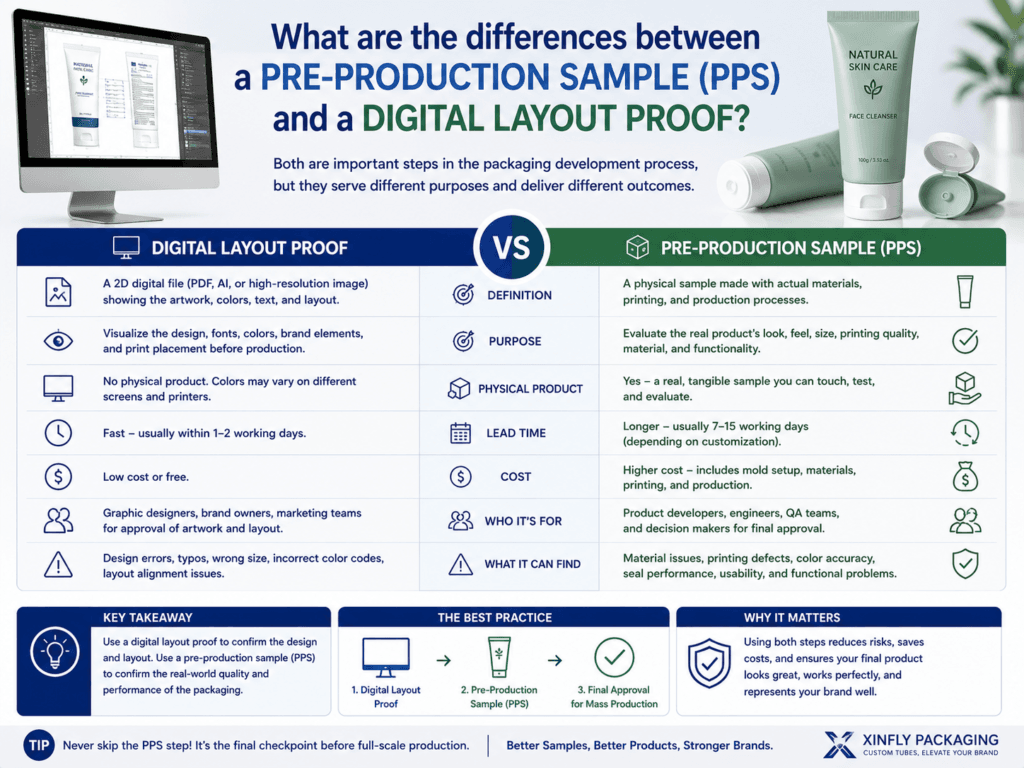
A digital layout proof is a visual artwork confirmation file, while a pre-production sample (PPS) is a physical sample made before bulk production using the approved materials, tube structure, cap, printing, and finish. In cosmetic tube manufacturing, these two approval steps serve different purposes and should not be confused.
The digital layout proof helps confirm artwork position, logo size, dieline, color references, text direction, barcode location, and printing area. The PPS helps confirm real packaging performance, including tube size, hand feel, cap fit, color appearance, printing adhesion, leakage resistance, formula compatibility, and final retail look.
Quick Answer
A digital layout proof is a 2D design file used to approve the artwork before production. A pre-production sample (PPS) is a physical tube sample used to approve the real product before mass production. Buyers should approve the digital proof first, then review the PPS before allowing the factory to start bulk production.
| Item | Digital Layout Proof | Pre-Production Sample (PPS) |
|---|---|---|
| Format | Digital file, usually PDF, AI screenshot, or artwork mockup | Physical tube sample made before mass production |
| Main purpose | Confirm artwork layout and printing position | Confirm real packaging appearance and function |
| Checks color? | Only approximate screen color or Pantone reference | Real molded color, printed color, finish, and visual effect |
| Checks cap fit? | No | Yes, including thread, torque, plug seal, and opening feel |
| Checks formula compatibility? | No | Yes, if filled testing is performed |
| Approval stage | Before sample making or printing setup | Before bulk production |
What Is a Digital Layout Proof?
A digital layout proof is a visual file prepared by the manufacturer or artwork team to show how the design will be positioned on the cosmetic tube. It usually includes the tube dieline, front panel, back panel, safe zones, barcode, logo, text, ingredient area, cap color reference, and printing method notes.
| Digital Proof Element | What It Confirms | Common Error It Prevents |
|---|---|---|
| Dieline | Tube diameter, length, printable area, tail-seal zone | Artwork too close to shoulder, cap, side seam, or tail seal |
| Logo placement | Front artwork position and visual balance | Logo too high, too low, off-center, or rotated |
| Text and barcode | Back panel readability and code position | Small text, wrong direction, unreadable barcode |
| Color reference | Pantone, CMYK, foil, or varnish specification | Wrong brand color or unclear printing instruction |
| Decoration method | Silk screen, offset, hot stamping, label, matte, glossy, soft-touch | Using an unsuitable printing method for the design |
What Is a Pre-Production Sample (PPS)?
A pre-production sample, or PPS, is a physical tube sample made before mass production. It should be as close as possible to the final product. For cosmetic tube packaging, a PPS normally checks the real tube body, cap, tube color, material structure, printing, surface finish, shoulder, orifice, and overall assembly quality.
| PPS Check Item | Why It Matters | What Buyers Should Review |
|---|---|---|
| Tube body | Confirms size, softness, wall thickness, and hand feel | Diameter, length, squeeze force, standing stability |
| Material structure | Confirms PE, PCR, EVOH, ABL, PBL, or special material choice | Flexibility, barrier direction, opacity, recyclability positioning |
| Cap system | Confirms closure compatibility | Torque, hinge, plug seal, thread fit, opening comfort |
| Printing and finish | Confirms real decoration effect | Color accuracy, registration, hot stamping, coating, scratch resistance |
| Formula compatibility | Confirms packaging performs with real formula | Leakage, swelling, paneling, odor, discoloration, clogging |
Why the Digital Proof Cannot Replace the PPS
The digital layout proof is useful, but it cannot show the real material behavior. A computer screen cannot accurately represent tube softness, molded color, metallic foil reflection, matte coating texture, cap torque, leakage performance, or formula compatibility. This is why a PPS is important before starting bulk production.
- Screen color is not real production color: Monitor display cannot replace Pantone matching or physical color samples.
- 2D layout does not show tube curvature: Artwork may look different when wrapped around a round or oval tube.
- Digital proof cannot test leakage: Cap, orifice, thread, and tail-seal performance require physical samples.
- Digital proof cannot test hand feel: PE softness, wall thickness, and soft-touch coating must be reviewed physically.
- Digital proof cannot test formula compatibility: Real formula may affect tube wall, cap, coating, or printing.
Why the PPS Cannot Replace the Digital Proof
A PPS is also not a substitute for digital proof approval. If the artwork is wrong before sample making, the PPS may reproduce the same mistake physically. The digital proof prevents basic layout errors before the factory spends time and cost on plates, screens, samples, color matching, and decoration trials.
| Without Digital Proof Approval | Possible Result | Cost Impact |
|---|---|---|
| Wrong artwork direction | Logo or text appears rotated or misplaced | New proof, new sample, delayed timeline |
| Incorrect dieline | Artwork enters tail-seal or shoulder area | Printing plates or screens may need remake |
| Missing Pantone code | Color trial becomes unclear | Extra color matching time and disputes |
| Unconfirmed barcode area | Barcode may not scan after printing | Retail compliance and relabeling risk |
| Unclear decoration instruction | Wrong finish, wrong foil, or wrong print method | Sample remake and production delay |
Approval Sequence for Custom Cosmetic Tubes
The safest process is to approve the packaging step by step. This reduces the chance of artwork errors, wrong materials, cap mismatch, leakage problems, and final production disputes.
| Step | Approval Item | Buyer Should Confirm |
|---|---|---|
| 1 | Specification confirmation | Tube capacity, diameter, material, cap type, orifice, finish, MOQ, target market |
| 2 | Digital layout proof | Artwork position, dieline, text, barcode, Pantone, decoration notes |
| 3 | Physical sample / PPS | Tube appearance, cap fit, color, print, finish, hand feel, real assembly |
| 4 | Compatibility testing | Fill real formula and test leakage, aging, drop, compression, dispensing |
| 5 | Mass production approval | Approve PPS, final artwork, quantity, packing, delivery term, QC standard |
Digital Proof Checklist
- Artwork file: Confirm AI, PDF, or EPS vector file with outlined fonts.
- Dieline: Check printable area, front panel, back panel, shoulder area, and tail-seal safe zone.
- Logo position: Confirm alignment, centerline, front direction, and cap orientation if needed.
- Text: Check ingredients, claims, warnings, barcode, batch-code space, and language version.
- Color: Confirm Pantone, CMYK, foil color, varnish, matte, glossy, or soft-touch notes.
- Printing method: Confirm silk screen, offset, hot stamping, label, spot UV, or other decoration method.
PPS Checklist
- Tube size: Check diameter, length, fill volume, shoulder shape, and headspace.
- Tube material: Confirm PE, PCR, sugarcane PE, 5-layer EVOH, ABL, PBL, or other structure.
- Cap fit: Check screw torque, flip-top hinge, plug seal, orifice, leakage, and opening comfort.
- Print quality: Check color, registration, logo sharpness, hot stamping, coating, and scratch resistance.
- Surface feel: Check matte, glossy, pearlized, soft-touch, metallic, or textured finish.
- Filling performance: Fill with real formula and check squeeze force, dosage, clogging, and tail sealing.
- Shipping durability: Run drop, compression, vibration, and carton packing checks when needed.
Common Differences in Buyer Responsibility
| Responsibility | Digital Layout Proof | Pre-Production Sample |
|---|---|---|
| Artwork approval | Buyer must approve layout, text, logo, and color references | Buyer checks whether physical sample matches approved artwork |
| Technical review | Buyer confirms specifications shown in the file | Buyer checks real performance and packaging function |
| Formula testing | Not possible | Buyer or filling factory should test with real formula |
| Final production release | Should not release bulk production alone | Can release bulk production after PPS and test approval |
How Each Approval Step Affects Lead Time
Digital proof approval is usually faster than PPS approval, but both affect the production schedule. A delayed digital proof delays sample making. A rejected PPS delays mass production. Clear specifications, print-ready artwork, and fast feedback help keep the project on schedule.
| Approval Step | Typical Time | Delay Risk |
|---|---|---|
| Digital layout proof | 1–3 working days after artwork review | Missing fonts, wrong dieline, unclear Pantone, incomplete text |
| Custom sample / PPS | 7–10 working days for many standard sample projects | Color change, cap change, finish correction, material change |
| PPS compatibility test | Project-specific | Formula leakage, swelling, paneling, printing adhesion, cap cracking |
| Mass production | 25–35 days after sample approval for many projects | Late artwork changes, new tooling, raw material or cap changes |
Engineer’s note: A digital proof answers “Is the artwork correct?” A PPS answers “Can this package be manufactured and used correctly?” Both approvals are important for custom cosmetic tube projects.
Common Mistakes to Avoid
- Treating a digital proof as a final sample: It cannot confirm real color, finish, cap fit, or leakage.
- Skipping PPS to save time: This increases the risk of mass production errors.
- Approving PPS without filling formula: Formula compatibility cannot be judged from empty tubes only.
- Changing artwork after PPS approval: This may require new proofing, plates, screens, and samples.
- Ignoring cap and tube fit: A beautiful printed tube can still fail if the cap leaks or the orifice is wrong.
- Not recording approval standards: Keep approved proof, PPS photos, color references, and test results for production comparison.
Best Practical Recommendation
For custom cosmetic tubes, buyers should approve the digital layout proof first to confirm artwork, dieline, text, barcode, colors, and decoration instructions. Then they should approve a PPS to confirm the real tube, cap, printing, material, finish, and functional performance.
For high-risk products such as sunscreen, eye cream, retinol cream, Vitamin C cream, facial cleanser, hair removal cream, toothpaste, and essential-oil formulas, the PPS should be filled with real formula and tested for leakage, aging, cap compatibility, dispensing, drop resistance, and printing durability before bulk production.
Summary
A digital layout proof is a 2D artwork approval file. It confirms the design before sample making or printing setup. A pre-production sample (PPS) is a physical packaging sample made before bulk production. It confirms real appearance, material, cap fit, print quality, finish, and functional performance.
The digital proof prevents artwork and layout mistakes. The PPS prevents physical production and compatibility mistakes. Both are necessary for reducing risk in custom printed cosmetic tube projects.
Learn more: Sample Development, Printing Design, Custom Cosmetic Tubes, Custom Printed Tube Lead Time, Request Free Samples for Compatibility Testing, Quality Assurance.
Need Digital Proof and PPS Support for Custom Cosmetic Tubes?
Xinfly Packaging helps beauty brands review artwork files, prepare digital layout proofs, develop pre-production samples, test tube and cap compatibility, confirm printing quality, and approve custom cosmetic tube packaging before bulk production.