
How to Choose Hair Removal Cream Tubes for Strong Alkaline Formulas
Hair removal cream formulas are usually more aggressive than ordinary skincare creams. Strong alkaline ingredients, sulfur odor, high viscosity and sensitive active systems can challenge tube material, inner layer compatibility, sealing strength, cap leakage and printing durability. This guide helps depilatory cream brands choose the right squeeze tube packaging before sampling, filling and mass production.
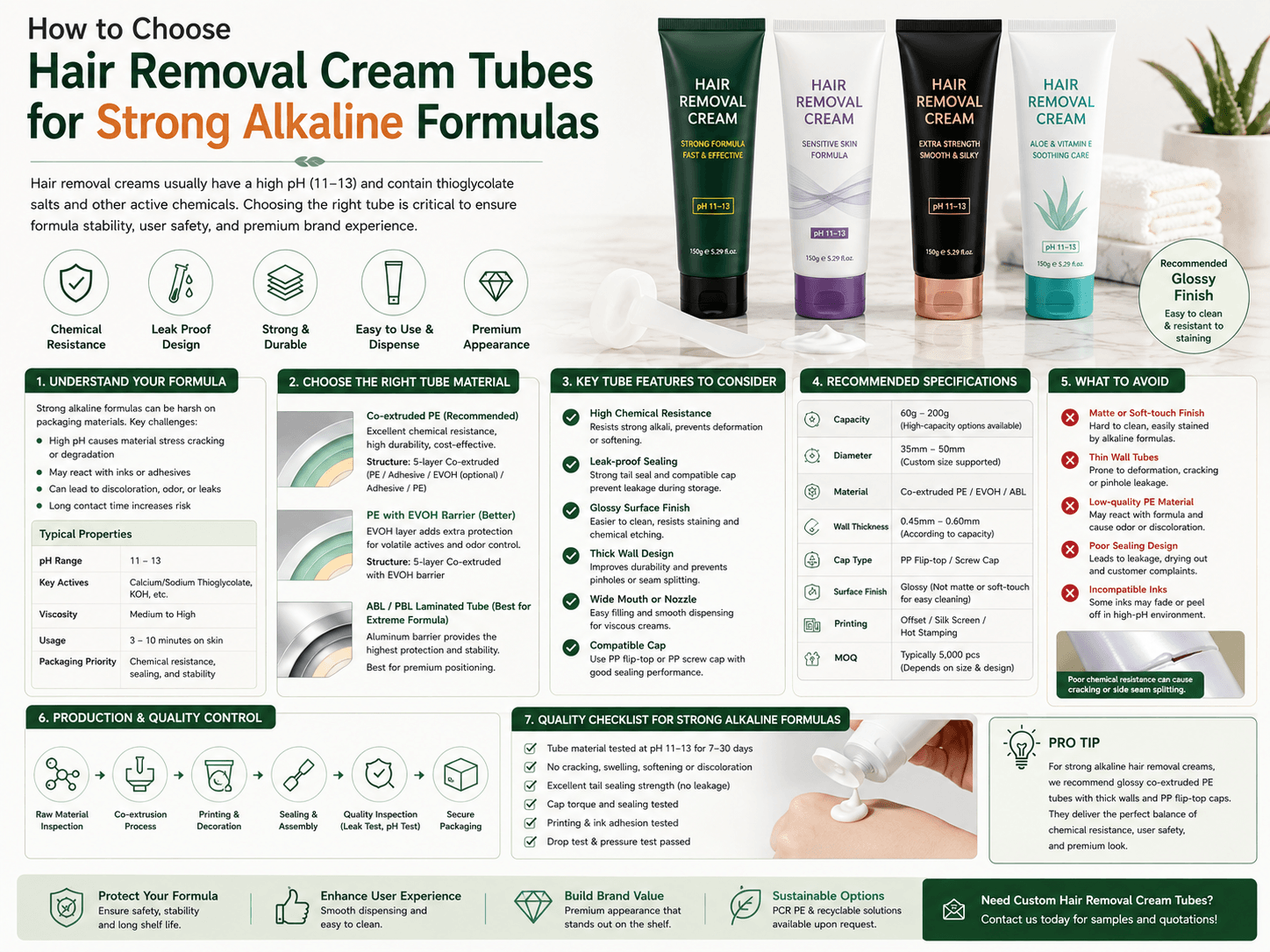
Common Purchasing Pain Points for Hair Removal Cream Tube Packaging
Depilatory cream tube packaging must handle stronger chemical stress than normal body lotion or hand cream tubes. The biggest risks usually come from formula compatibility, odor, leakage, tail sealing and surface contamination.
The formula may attack the inner tube layer
Hair removal creams often contain strong alkaline systems. If the tube inner layer is not compatible, the tube may soften, swell, discolor or show abnormal odor after storage.
Sulfur odor may migrate through packaging
Some depilatory formulas have a strong smell. Poor barrier performance may lead to odor migration, carton contamination or an unpleasant first impression for customers.
Tube leakage during shipping or bathroom storage
Hair removal cream is often used in bathrooms and shipped through e-commerce channels. Cap sealing, orifice size and tail sealing strength must be tested carefully.
The cream is difficult to squeeze evenly
Thick depilatory cream requires proper tube softness, wall thickness and diameter. If the tube is too rigid, consumers may struggle to apply the product smoothly.
Matte or soft-touch finish may get dirty easily
Hair removal cream tubes are often handled in wet bathrooms. Glossy finish is usually easier to clean and better for maintaining a fresh retail appearance.
Printing may scratch or fade during use
Depilatory products need clear safety information, usage instructions and warning text. Printing adhesion and varnish protection must be reliable.
Choose Hair Removal Cream Tube Structure Based on Formula Risk
Xinfly engineers usually review formula pH, alkaline strength, sulfur odor, fragrance, viscosity, filling temperature, storage condition and shelf-life target before recommending a tube structure.
| Formula Type | Main Packaging Risk | Recommended Tube Structure | Factory Engineer’s Suggestion |
|---|---|---|---|
| Standard hair removal cream Common depilatory formula | Alkaline compatibility, odor, leakage | Multi-layer PE tube or tested 2-layer PE tube | Start with formula compatibility testing. Do not confirm bulk production based only on tube appearance. |
| Strong alkaline depilatory cream | Inner layer stress, swelling, softening, odor migration | High-compatibility PE inner layer or barrier tube structure | Test inner layer resistance under accelerated storage before mass production. |
| Fragrance-added hair remover cream | Fragrance loss, odor mixing, aroma change | EVOH PE, ABL or PBL tube after compatibility test | Use barrier options when odor control and fragrance retention are important. |
| Thick cream formula | Difficult squeezing, uneven output, residue around cap | Soft PE squeeze tube with suitable orifice | Choose larger orifice and proper tube softness to improve dispensing comfort. |
| Retail / e-commerce depilatory product | Transport leakage, carton odor, surface scratches | PE or barrier tube with reliable flip-top or screw cap | Run leakage, drop, compression, heat storage and carton odor tests before shipment. |
Factory Engineer + Packaging Designer Solutions
A good hair removal cream tube should protect the formula, reduce odor risk, squeeze smoothly, seal strongly and communicate safety instructions clearly.
Engineer’s Solution for Strong Alkaline Formulas
From a production engineering view, depilatory cream tube selection should focus on inner layer compatibility, sealing strength, odor barrier and bathroom-use leakage resistance.
- Use tested PE inner layers for strong alkaline formula compatibility.
- Consider EVOH, ABL or PBL structures when odor control and barrier performance are important.
- Choose suitable tube softness and diameter for thick cream dispensing.
- Use reliable flip-top or screw caps with strong sealing performance.
- Run compatibility, odor migration, leakage, drop, heat storage and tail sealing tests before bulk production.
Designer’s Solution for Depilatory Cream Packaging
Hair removal cream packaging should look clean, safe and easy to understand. Because the product requires careful usage instructions, the layout must balance branding and warning information.
- For clean beauty style: white glossy tube, soft pastel accents and clear benefit icons.
- For sensitive skin formula: light blue, beige or soft green design with calm medical-style typography.
- For salon / professional use: stronger contrast, large product name and simple technical layout.
- For e-commerce: bold front claim, readable usage instruction and scratch-resistant glossy varnish.
- For strong alkaline formulas: reserve enough space for cautions, patch test note and usage time instructions.
How to Choose Hair Removal Cream Tube Capacity, Diameter and Cap
Hair removal cream tubes are usually medium to large capacity because consumers apply the product to legs, arms, underarms or body areas. Tube size and cap opening should match usage volume and cream viscosity.
| Product Positioning | Common Capacity | Suggested Diameter | Recommended Cap | Best For |
|---|---|---|---|---|
| Trial hair removal cream | 30ml, 50ml | Ø25mm – Ø30mm | Screw cap or small flip-top cap | Trial kits, travel products, sample promotion, online testing packs |
| Retail depilatory cream | 80ml, 100ml, 120ml | Ø35mm – Ø40mm | Flip-top cap or screw cap | Daily retail hair removal cream, private label body care brands |
| Body hair removal cream | 150ml, 200ml | Ø45mm – Ø50mm | Large flip-top cap | Legs, arms, body-use depilatory cream and bathroom products |
| Professional salon formula | 200ml, 250ml | Ø50mm | Large flip-top cap or screw cap | Salon, spa, professional body care and high-use depilatory products |
Quick Recommendation: Which Tube Material Is Best for Hair Removal Cream?
The best depilatory cream tube should be chosen by compatibility testing first, then by squeeze feel, odor control, cap structure and decoration style.
You need flexible daily-use packaging
PE tubes are suitable for many hair removal cream products when compatibility testing confirms stable performance. They offer good squeeze feel, flexible customization and cost control.
You need better odor and formula protection
EVOH, ABL or PBL tubes can be considered when the formula has stronger odor, fragrance retention needs or higher formula protection requirements.
You need a cleaner bathroom-use surface
Glossy finish is often better than matte or soft-touch for hair removal cream because it is easier to clean and less likely to look dirty after wet-hand use.
6-Step Process to Choose Hair Removal Cream Tubes
This process helps personal care brands avoid formula compatibility failure, odor migration, cap leakage and poor user experience.
Check Formula
Confirm pH level, alkaline strength, sulfur odor, viscosity, filling temperature and shelf-life target.
Select Structure
Choose PE, multi-layer PE, EVOH, ABL or PBL based on compatibility and odor control needs.
Match Size
Select 80ml, 100ml, 120ml, 150ml or 200ml according to usage area and market positioning.
Choose Cap
Use flip-top or screw cap based on viscosity, leakage risk and bathroom-use convenience.
Confirm Artwork
Prepare AI/PDF files, warning text, usage instructions, printing method and glossy surface finish.
Test Samples
Run compatibility, odor, leakage, heat storage, tail sealing, drop and printing adhesion tests.
Mass Production
Xinfly controls tube extrusion, printing, cap matching, inspection and export packing.
Final Inspection
Check tube size, wall thickness, cap fit, printing quality, sealing area and carton protection.
Build Your How to Choose Packaging Knowledge Cluster
Continue reading related Xinfly guides to compare PE squeeze tubes, barrier tubes, surface finishes, private label customization and cosmetic tube material options.
FAQ: Choosing Hair Removal Cream Tubes
These questions help depilatory cream brands quickly confirm material, cap, size, finish and testing before requesting samples.
What tube material is suitable for strong alkaline hair removal cream?
PE tubes, multi-layer PE tubes, EVOH tubes, ABL tubes or PBL tubes may be considered, but the final choice must be confirmed by formula compatibility testing because strong alkaline formulas can stress the inner tube layer.
Do hair removal cream tubes need barrier protection?
Barrier protection is recommended when the formula has strong odor, fragrance retention needs or higher stability requirements. EVOH, ABL or PBL structures can help improve odor and formula protection.
Which surface finish is best for hair removal cream tubes?
Glossy finish is usually recommended because hair removal cream tubes are often used in bathrooms and handled with wet hands. Glossy surfaces are easier to clean than matte or soft-touch finishes.
What size is common for hair removal cream tubes?
80ml, 100ml, 120ml, 150ml and 200ml are common sizes. Smaller sizes are suitable for trial or travel packs, while larger tubes are suitable for body-use depilatory products.
Which cap is better for depilatory cream tubes?
Flip-top caps are convenient for bathroom use, while screw caps can provide a more secure feel for travel or strong formula products. The final choice depends on viscosity, leakage risk and brand positioning.
How do I prevent leakage in hair removal cream tubes?
Leakage prevention depends on cap fit, orifice size, shoulder design, tail sealing strength, filling process and formula viscosity. Xinfly recommends leakage, drop, heat storage and tail sealing tests before bulk production.
Need Help Choosing Hair Removal Cream Tubes?
Share your formula pH, viscosity, odor level, filling volume, cap preference, artwork style and expected order quantity. Xinfly Packaging can recommend suitable PE, EVOH, ABL, PBL or glossy depilatory cream tube solutions with engineering and artwork support.