

How to Choose Sunscreen Tubes for SPF Formulas
Sunscreen formulas are more demanding than ordinary skincare creams. UV filters, oils, fragrance, alcohol, pigment, high-viscosity texture and outdoor storage conditions can all affect tube material, barrier performance, printing durability and leakage control. This guide helps sunscreen brands, purchasing managers and private label teams choose the right sunscreen tube packaging before sampling and mass production.
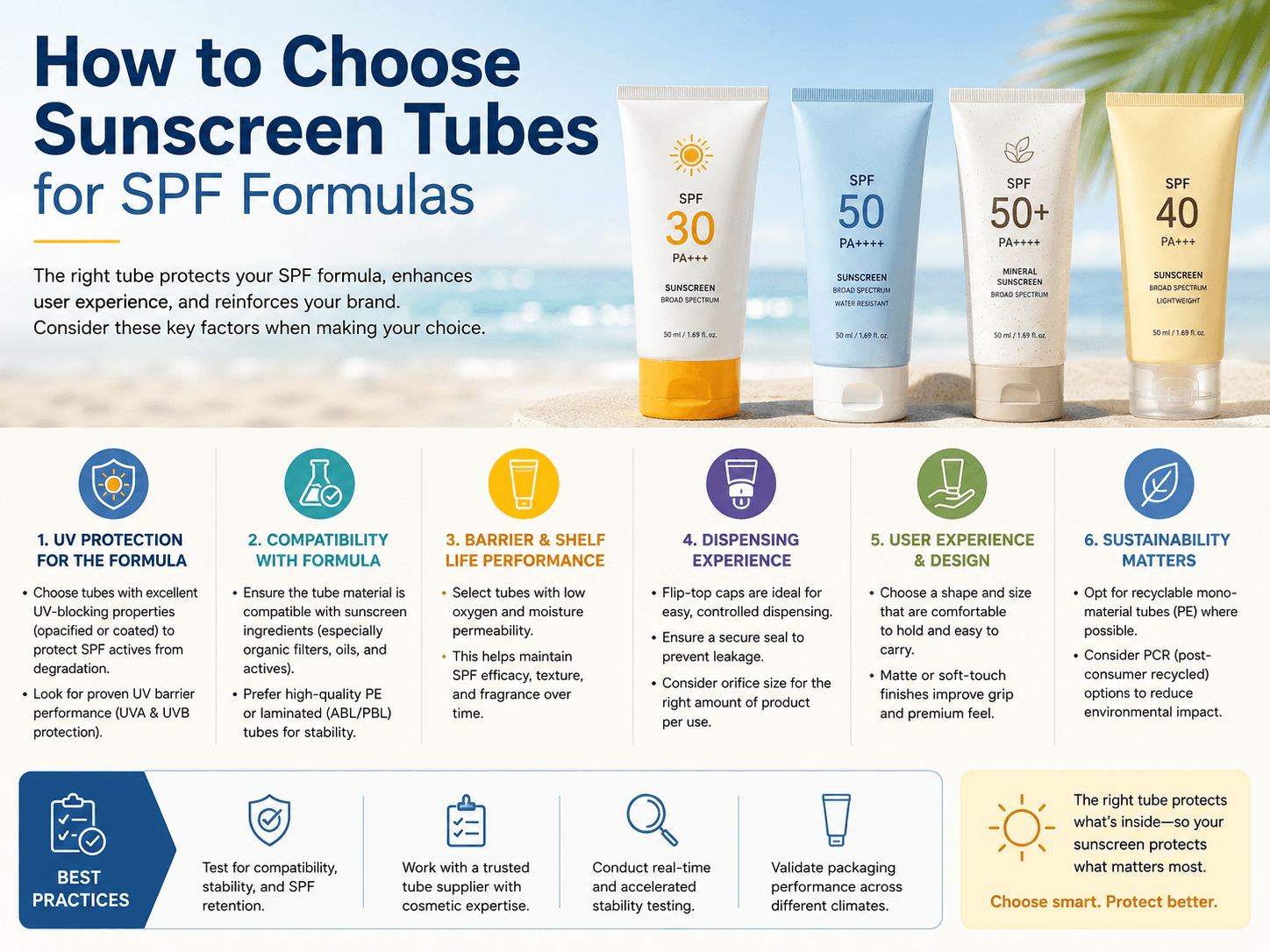
Common Purchasing Pain Points When Buying Sunscreen Tubes
Many sunscreen packaging problems do not appear during quotation. They appear after filling, sealing, transportation, retail display or customer use. Choosing only by tube size and unit price can cause formula instability, leakage, printing scratches and brand complaints.
SPF formula attacks the tube wall
Chemical sunscreens, oils, fragrance and solvents may migrate into plastic layers, causing odor change, tube softening, swelling or loss of active performance.
Fragrance and oil loss over time
Sunscreen products often require better oxygen, aroma and oil barrier than standard cleanser or lotion tubes, especially for high-value SPF products.
Leakage during hot weather shipping
Sunscreen is often used outdoors and shipped in warm seasons. Cap matching, shoulder design, sealing strength and formula viscosity all affect leakage performance.
Printing scratches after transport
Matte, glossy, soft-touch, hot stamping and silk screen printing behave differently during carton friction, retail display and consumer handling.
PCR or eco material uncertainty
Buyers want PCR, sugarcane PE or recyclable tubes, but SPF formulas may need extra testing for odor, color consistency, barrier and mechanical strength.
The tube looks too ordinary
A premium sunscreen product needs a packaging structure, color, finish and artwork layout that communicates SPF protection, outdoor use and skincare value.
Choose Sunscreen Tube Materials Based on SPF Formula Type
The first decision should not be tube color or cap style. It should be material compatibility. Xinfly engineers usually review formula type, oil phase, UV filter system, fragrance level, filling temperature and shelf-life target before recommending tube structure.
| SPF Formula Type | Main Packaging Risk | Recommended Tube Structure | Engineer’s Suggestion |
|---|---|---|---|
| Mineral sunscreen Zinc oxide / titanium dioxide formulas | High pigment load, thick texture, possible squeezing difficulty | PE tube, EVOH co-extruded tube, or PBL tube | Use suitable diameter and larger orifice. Avoid too small tube head for thick formulas. |
| Chemical sunscreen Oil-rich UV filter system | Oil migration, fragrance loss, formula compatibility risk | EVOH barrier PE tube, ABL tube or PBL tube | Do formula compatibility testing before mass production, especially for high SPF formulas. |
| Kids sunscreen Gentle and family-use formula | Leakage, easy dispensing, safe handling | Soft PE tube with flip-top cap | Choose soft squeeze feel, rounded shoulder and reliable cap sealing for daily family use. |
| Sport / outdoor sunscreen | Heat exposure, pressure change, travel leakage | Multi-layer PE, EVOH PE or laminate tube | Run drop test, vacuum leakage test and heat storage test before shipment. |
| Premium facial sunscreen | Brand image, active ingredient protection, shelf appeal | EVOH barrier tube, airless pump tube or soft-touch PE tube | Combine barrier structure with premium finish such as silk screen, hot stamping or soft-touch coating. |
Factory Engineer + Packaging Designer Solutions
A good sunscreen tube is not only a container. It is a balance of formula safety, squeeze performance, shelf appearance, printing durability, filling efficiency and total cost.
Engineer’s Solution for Sunscreen Tube Selection
From a factory engineering view, sunscreen tube selection should begin with formula behavior and production risk, not only appearance.
- Use EVOH, ABL or PBL when fragrance retention and oil barrier are important.
- Use PE tubes for standard sunscreen when formula compatibility is stable.
- Use larger orifice caps for thick mineral sunscreen formulas.
- Confirm tube shoulder, cap torque and tail sealing strength before filling.
- Run compatibility, leakage, drop, compression and heat storage tests before bulk production.
Designer’s Solution for Premium SPF Packaging
Sunscreen packaging should clearly communicate protection, trust and outdoor performance. Our artwork team helps brands avoid printing mistakes before plate making.
- For clean clinical sunscreen: white or light color tube, blue or silver accents, simple typography.
- For beach and sport sunscreen: bright color blocks, high-contrast SPF number, durable glossy finish.
- For luxury facial SPF: soft-touch finish, hot stamping, pearlized effect or silk screen details.
- For eco sunscreen: PCR color tone, kraft-style carton, recyclable message and minimal decoration.
- For Amazon or retail shelves: large SPF value, clear “broad spectrum” area, strong front-facing brand block.
How to Choose Sunscreen Tube Size, Diameter and Cap
Tube size affects user experience, carton packing, filling speed and perceived product value. For sunscreen formulas, tube diameter and cap opening should match viscosity and usage scenario.
| Product Positioning | Common Capacity | Suggested Diameter | Recommended Cap | Best For |
|---|---|---|---|---|
| Travel sunscreen | 10ml, 15ml, 30ml, 50ml | Ø19mm – Ø30mm | Screw cap or small flip-top | Hotel amenities, travel kits, sample packs, promotional SPF products |
| Daily facial SPF | 40ml, 50ml, 60ml | Ø25mm – Ø35mm | Screw cap, flip-top or airless pump | Skincare brands, facial sunscreen, makeup base SPF |
| Family sunscreen | 80ml, 100ml, 120ml | Ø35mm – Ø40mm | Flip-top cap | Kids sunscreen, beach sunscreen, daily body SPF |
| Sport / body sunscreen | 150ml, 200ml | Ø45mm – Ø50mm | Large flip-top cap | Outdoor, sport, high-use sunscreen lotion |
6-Step Sunscreen Tube Selection Process
This process helps purchasing teams avoid repeated sampling, wrong material selection and artwork rework.
Confirm Formula
Check SPF type, oil content, fragrance, viscosity, filling temperature and shelf-life target.
Select Structure
Choose PE, EVOH PE, ABL or PBL based on barrier, flexibility and sustainability needs.
Match Size
Confirm capacity, diameter, length, shoulder shape and carton packing efficiency.
Choose Cap
Select flip-top, screw cap or airless pump according to viscosity and usage scenario.
Design Artwork
Prepare AI/PDF artwork and confirm printing method, finish, logo position and tail sealing area.
Test Before Bulk
Run filling, sealing, leakage, drop, compatibility and transportation tests before mass production.
Mass Production
After sample approval, Xinfly controls tube extrusion, printing, cap assembly, inspection and packing.
Final Inspection
Check appearance, dimensions, printing adhesion, cap fit, sealing area and carton protection.
Build Your How to Choose Packaging Knowledge Cluster
Continue reading related Xinfly Packaging guides to compare materials, tube types, printing methods and sustainable options before starting your sunscreen tube project.
FAQ: Choosing Sunscreen Tubes for SPF Formulas
These questions help buyers quickly confirm material, cap, decoration and testing decisions before requesting samples.
What is the best tube material for sunscreen formulas?
For standard sunscreen, PE tubes may be suitable. For oil-rich, fragrance-sensitive or high SPF formulas, EVOH co-extruded tubes, ABL tubes or PBL tubes are recommended after compatibility testing.
Do all sunscreen formulas need EVOH barrier tubes?
Not all formulas need EVOH, but EVOH is useful when the formula requires better oxygen, fragrance or oil barrier. The final choice depends on formula composition, shelf-life target and brand positioning.
Which cap is better for sunscreen tubes?
Flip-top caps are popular for family, body and sport sunscreen because they are convenient. Screw caps are suitable for travel sizes or premium facial SPF. Airless pump tubes can be considered for high-value skincare sunscreen.
Can PCR material be used for sunscreen tubes?
Yes, PCR can be used, but sunscreen formulas should be tested for odor, color stability, tube strength and compatibility. For high-barrier needs, PCR may be combined with multi-layer structures depending on the project.
How can I prevent sunscreen tube leakage?
Leakage control depends on cap matching, orifice size, shoulder design, tail sealing, formula viscosity and filling process. Xinfly recommends leakage testing, drop testing and heat storage testing before mass production.
What artwork file is required for custom sunscreen tube printing?
Vector artwork files such as AI, PDF or EPS are preferred. The design should include correct dieline, color references, logo position, sealing allowance and printing method requirements.
Need Help Choosing the Right Sunscreen Tube?
Share your SPF formula type, filling volume, target market, artwork style and expected order quantity. Xinfly Packaging can recommend suitable PE, EVOH, ABL, PBL, PCR or airless sunscreen tube solutions with engineering and artwork support.