
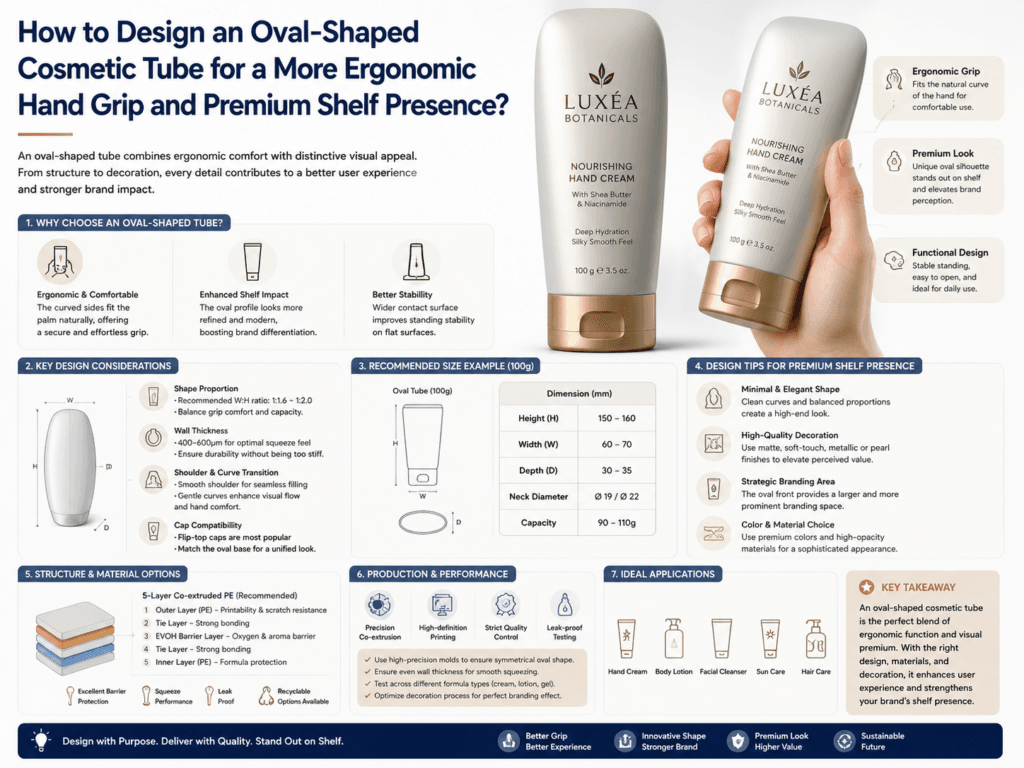
To design an oval-shaped cosmetic tube for better ergonomic hand grip and premium shelf presence, brands should optimize the oval ratio, tube width, wall thickness, shoulder transition, cap base, squeeze force, artwork layout, and filled stability together. An oval tube is not only a visual upgrade from a round tube. It changes how the package feels in the hand, how it stands on the shelf, how the formula is dispensed, and how the decoration appears from the front.
Oval cosmetic tubes are especially suitable for skincare, sunscreen, hand cream, facial cleanser, body lotion, hair care, and premium personal care products. Compared with round tubes, oval tubes often provide a wider front-facing panel, a flatter grip surface, and a more distinctive retail appearance.
Why Choose an Oval Cosmetic Tube?
| Design Goal | How an Oval Tube Helps | Best Application |
|---|---|---|
| Better hand grip | Flatter sides fit more naturally between fingers and palm | Hand cream, sunscreen, lotion, cleanser |
| Premium shelf presence | Wider front panel creates a stronger visual display | Luxury skincare, premium body care, salon products |
| Brand differentiation | Oval shape looks more customized than standard round tubes | Private label, high-end cosmetic lines, hero SKUs |
| Improved artwork visibility | Front panel provides more usable logo and claim area | Minimalist design, large logo, premium typography |
| Better standing impression | Oval body with suitable cap base can look stable and structured | Retail display and e-commerce product photography |
Oval Ratio: The Most Important Design Parameter
The oval ratio means the relationship between the tube’s front width and side depth. If the tube is too close to round, the ergonomic and shelf-display benefits are limited. If the tube is too flat, it may become difficult to squeeze evenly, harder to fill, or more likely to deform during transport.
| Oval Shape Type | Design Character | Recommendation |
|---|---|---|
| Slight oval | Close to round, mild ergonomic improvement | Good for conservative brands or easy transition from round tubes |
| Balanced oval | Clear oval appearance with good squeeze performance | Best practical choice for most cosmetic tubes |
| Flat oval | Very wide front panel and thin side depth | Use carefully; requires stronger material and stability testing |
Practical note: A premium oval tube should look elegant from the front, feel comfortable in the hand, and still squeeze smoothly after filling. Shape alone is not enough; material and structure must support the design.
How to Improve Ergonomic Hand Grip
- Use a balanced oval profile: The tube should be flatter than a round tube but not so flat that squeezing becomes uneven.
- Choose a comfortable width: The front width should match the target user’s hand size and fill volume.
- Control side depth: Enough depth is needed for formula capacity and stable squeeze recovery.
- Add a soft-touch or matte finish: These finishes improve grip and create a premium tactile feel.
- Avoid sharp transitions: Smooth shoulder and side curves reduce pressure points in the hand.
- Test with the real formula: Thick formulas require more force and may need a softer tube body or larger outlet.
How Oval Tubes Improve Shelf Presence
Oval tubes often look more premium because they create a broader front-facing area for branding. This makes logos, product names, benefit claims, and decorative finishes easier to display. In retail environments, the front panel can appear cleaner and more structured than a round tube, especially when combined with matte, soft-touch, pearlized, metallic, or hot-stamped decoration.
| Shelf Design Element | Oval Tube Advantage | Design Tip |
|---|---|---|
| Logo placement | More stable front-facing visual area | Place logo in the central flat front zone |
| Product claims | Better readability than on narrow curved surfaces | Keep claims away from side curves and shoulder transition |
| Premium decoration | Hot stamping and silk screen effects look more controlled | Use foil or spot decoration on the front panel |
| Retail alignment | Oval tubes can face forward more clearly | Pair with a stable cap base and suitable carton tray |
Material Choice for Oval Cosmetic Tubes
Oval tubes need good material balance because the body does not deform the same way as a round tube. If the material is too soft, the flat front panel may dent or panel. If the material is too rigid, the tube may be difficult to squeeze. A balanced PE structure or multi-layer co-extruded structure is often used to achieve both premium appearance and functional squeeze performance.
| Material Structure | Benefit | Best Use |
|---|---|---|
| Single-layer PE | Simple, flexible, cost-effective | Basic skincare and personal care tubes |
| 2-layer PE | Better structural balance and decoration support | Daily-use cosmetic oval tubes |
| 5-layer EVOH co-extruded tube | Better barrier protection with flexible body | Sunscreen, active skincare, fragrance-rich creams |
| LDPE/HDPE blend | Adjustable stiffness and squeeze force | Stand-up oval tubes needing stronger body support |
Wall Thickness and Shape Stability
Wall thickness is important for oval tubes because flat surfaces can be more sensitive to paneling, dents, and uneven recovery. A tube that is too thin may look premium when empty but deform after filling, transport, or retail display. A tube that is too thick may feel rigid and hard to squeeze. The best wall thickness depends on capacity, formula viscosity, oval ratio, and shipping requirements.
| Design Situation | Wall Thickness Direction | Reason |
|---|---|---|
| Small oval tube | Moderate wall thickness | Maintains squeeze comfort and front panel appearance |
| Medium skincare oval tube | Balanced strength and flexibility | Supports daily use and premium shelf look |
| Large oval lotion tube | Slightly stronger wall or multi-layer structure | Reduces paneling, splitting, and transport deformation |
| Flat oval tube | Requires careful thickness and material tuning | Flat panels need extra stability without losing squeeze comfort |
Shoulder and Cap Design
The shoulder and cap must match the oval body. If the shoulder transition is too sharp, it can look awkward and create stress points. If the cap is too small, the tube may not stand well. If the cap is too large, it may visually overpower the tube. A premium oval tube should have a smooth body-to-shoulder transition and a cap base that supports both function and shelf stability.
| Component | Design Requirement | Why It Matters |
|---|---|---|
| Shoulder | Smooth transition from oval body to neck | Improves appearance and reduces stress concentration |
| Neck | Matched to formula viscosity and cap system | Controls dispensing and filling performance |
| Cap base | Wide and flat enough for stand-up display | Improves shelf stability and product photography |
| Cap style | Flip-top, screw cap, acrylic cap, or special closure | Affects usability, premium image, and MOQ/cost |
Artwork Design for Oval Tubes
Oval tubes offer a strong front panel, but artwork still needs to consider curves, shoulder transition, tail sealing, and printing registration. Important logos and text should stay within the safest central front area. Decorative patterns can extend toward the sides, but small text should not be placed where the tube curves sharply.
- Keep the main logo centered: Use the widest front panel for brand identity.
- Avoid side-curve text: Curved areas can distort small typography.
- Leave shoulder and tail safe zones: Prevent artwork distortion during heading and sealing.
- Use premium finishes selectively: Hot stamping, silk screen, matte, and soft-touch work well on oval fronts.
- Approve decorated samples: Oval surfaces may affect registration and visual alignment.
Round vs. Oval Cosmetic Tubes
| Feature | Round Tube | Oval Tube |
|---|---|---|
| Hand grip | Familiar and easy to squeeze | Flatter grip and more ergonomic feel |
| Front display area | More curved, smaller flat visual zone | Wider front panel for branding |
| Shelf presence | Standard and practical | More distinctive and premium |
| Production complexity | Simpler and more common | Requires better control of shape, printing, and stability |
| Best use | General cosmetic and personal care tubes | Premium skincare, sunscreen, lotion, and hero products |
Testing Before Mass Production
| Test | Purpose | What to Check |
|---|---|---|
| Filled squeeze test | Confirms real-use dispensing performance | Squeeze force, recovery, paneling, product flow |
| Stand-up stability test | Checks retail shelf performance | Tilting, cap base stability, center of gravity |
| Drop and compression test | Simulates transport and storage stress | Dents, splitting, shoulder cracks, cap damage |
| Artwork registration test | Checks print alignment on oval surface | Logo position, text readability, side-curve distortion |
| Aging and compatibility test | Confirms formula-package stability | Paneling, swelling, leakage, fragrance or color change |
Common Mistakes to Avoid
- Making the oval shape too flat: It may look premium but squeeze poorly or deform easily.
- Ignoring formula viscosity: Thick creams need better squeeze control and suitable outlet size.
- Using a weak cap base: The tube may not stand reliably on the shelf.
- Putting small text on curved sides: It can become distorted or hard to read.
- Choosing wall thickness only by cost: Thin walls may cause paneling, dents, or transport damage.
- Skipping filled samples: Empty oval tubes do not show real grip, squeeze, and shelf performance.
Best Practical Recommendation
For a premium oval-shaped cosmetic tube, use a balanced oval ratio, comfortable grip width, smooth shoulder transition, stable cap base, and material structure that provides both flexibility and front-panel stability. For skincare, sunscreen, hand cream, and lotion products, a 2-layer PE or 5-layer EVOH co-extruded structure is often a strong choice depending on barrier needs.
Before mass production, confirm the design with real filled samples, artwork proofing, squeeze-force testing, stand-up stability testing, and transport simulation. This ensures the oval tube looks premium, feels comfortable, and performs reliably in retail and consumer use.
Summary
An oval-shaped cosmetic tube can improve ergonomic hand grip and premium shelf presence by offering a flatter body, wider front display area, stronger brand visibility, and more distinctive packaging shape. However, oval tubes require careful control of oval ratio, material stiffness, wall thickness, shoulder design, cap base, artwork layout, and squeeze performance.
The best oval tube is not simply wider or flatter. It must balance beauty, comfort, stability, dispensing performance, formula compatibility, and international transport durability.
Learn more: Oval Tubes, Round vs Oval Cosmetic Tubes, Oval vs Flat Oval Tubes, Customize Cosmetic Tubes, Tube Decoration, Quality Assurance.
Need a Premium Oval Cosmetic Tube Design?
Xinfly Packaging helps brands develop oval and flat-oval cosmetic tubes with ergonomic grip, premium shelf presence, optimized wall thickness, stable cap matching, barrier options, and high-quality decoration.