
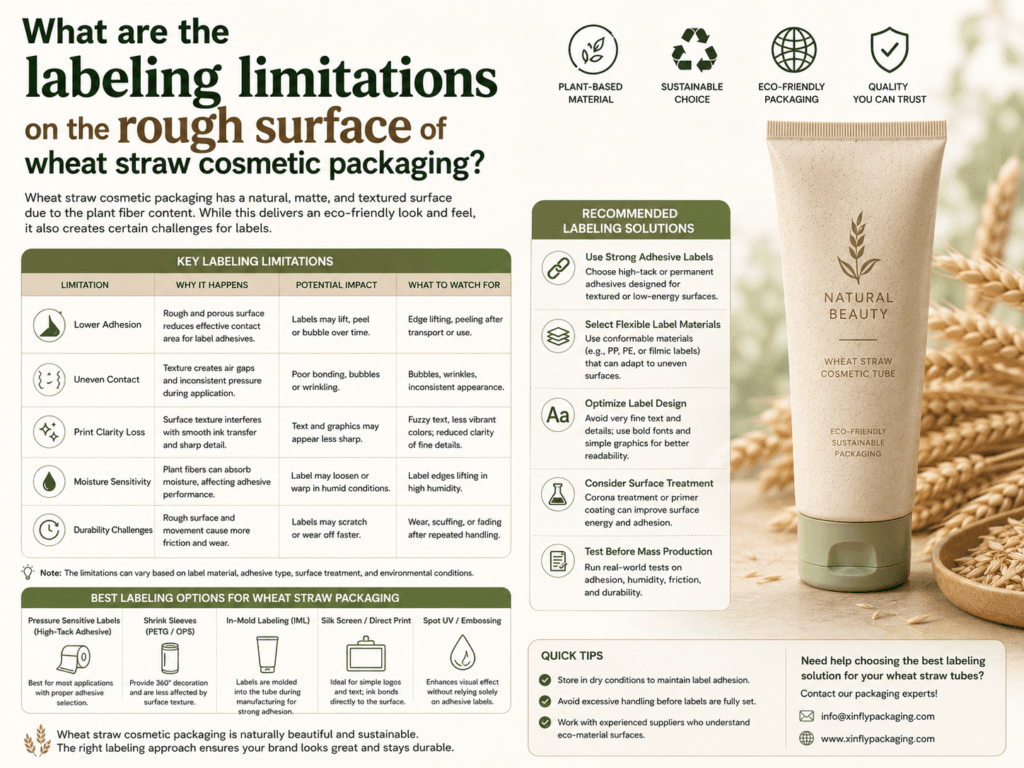
The rough surface of wheat straw cosmetic packaging creates several labeling limitations compared with smooth virgin PE tubes. Because wheat straw tubes are usually made from a natural-fiber and plastic composite, the tube surface is often less uniform, slightly porous in appearance, and more variable in surface energy. This can reduce label wet-out, lower initial tack, and make premium label application more difficult.
In practical packaging production, wheat straw tubes can still be labeled successfully, but they usually need stronger adhesive selection, better label material matching, tighter application control, and more pre-production testing than standard smooth cosmetic tubes.
Main Labeling Limitations on Rough Wheat Straw Surfaces
| Limitation | Typical Result | Why It Happens |
|---|---|---|
| Lower initial adhesion | Label may not bond immediately and firmly | Rough surface reduces full adhesive contact area |
| Edge lifting | Label corners or edges may rise over time | Uneven surface prevents complete edge sealing |
| Air bubbles or voids | Small trapped air pockets under the label | Surface texture interrupts smooth laydown |
| Reduced visual smoothness | Premium label may look less flat or less luxurious | Substrate texture can telegraph through thin label films |
| Inconsistent long-term adhesion | Performance may vary between batches | Natural-fiber composites often have more surface variation than virgin plastic |
Why Wheat Straw Tubes Are More Challenging for Labeling
- Rougher surface profile: Pressure-sensitive labels perform best when the adhesive can fully wet out the surface.
- Mixed surface energy: Natural fibers and plastic matrix may not present a perfectly uniform bonding surface.
- Natural appearance variation: Texture and color differences can make label alignment and finish look less consistent.
- Curved flexible tube body: Combining rough texture with squeeze-tube curvature makes label application more demanding.
Which Labels Are Most Affected?
| Label Type | Risk Level on Wheat Straw Surface | Notes |
|---|---|---|
| Thin clear film labels | High | Surface texture shows through more easily |
| Premium glossy labels | Medium to high | Can highlight bubbles, edges, or uneven contact |
| Paper labels | Medium | Can hide texture better, but need correct adhesive |
| Thicker conformable film labels | Lower | Usually better at following textured and curved surfaces |
How to Improve Labeling Performance
- Use high-tack adhesive systems designed for textured or low-surface-energy plastics.
- Choose thicker or more conformable label materials to reduce telegraphing of the rough substrate.
- Control application pressure so the adhesive can flow into the micro-texture better.
- Test label performance under storage conditions including heat, humidity, and transport simulation.
- Consider direct printing instead of labeling when premium appearance or long-term adhesion is critical.
Labeling vs Direct Printing on Wheat Straw Tubes
| Decoration Method | Advantage | Limitation |
|---|---|---|
| Labeling | Flexible for small batches and multiple SKUs | More sensitive to surface roughness and adhesion issues |
| Silk screen / direct printing | No label edge lifting risk | Still requires surface-treatment and print optimization |
| Offset printing | Good for volume production and integrated decoration | Needs careful control of surface consistency |
Best Practice for Beauty Brands
If your wheat straw tube project uses a strong sustainability story and a more natural brand aesthetic, labeling can work well with the right material and adhesive system. But if the project requires a very clean luxury look, crystal-clear label edge, or perfect flat visual finish, you should test whether direct decoration or a different sustainable substrate gives a better result.
Summary
The main labeling limitations on the rough surface of wheat straw cosmetic packaging are lower initial tack, edge lifting, trapped air, reduced visual smoothness, and more variable long-term adhesion. These issues come from the textured, fiber-containing surface of the substrate, which reduces full adhesive contact.
With the correct adhesive, label construction, and application process, wheat straw tubes can still be labeled successfully. But compared with smooth PE tubes, they require more careful engineering and validation.
Learn more: Wheat Straw Plastic Cosmetic Tubes, Wheat Straw Plastic Tubes, Labeling Tubes, Printing Options, Does the Texture of Wheat Straw Tubes Affect Printing?, Printing Defects on Wheat Straw Packaging.
Need Better Decoration Options for Wheat Straw Tubes?
Xinfly Packaging helps brands evaluate labeling, silk screen, offset printing, and other decoration methods for wheat straw cosmetic tubes based on appearance goals, MOQ, and long-term adhesion performance.