
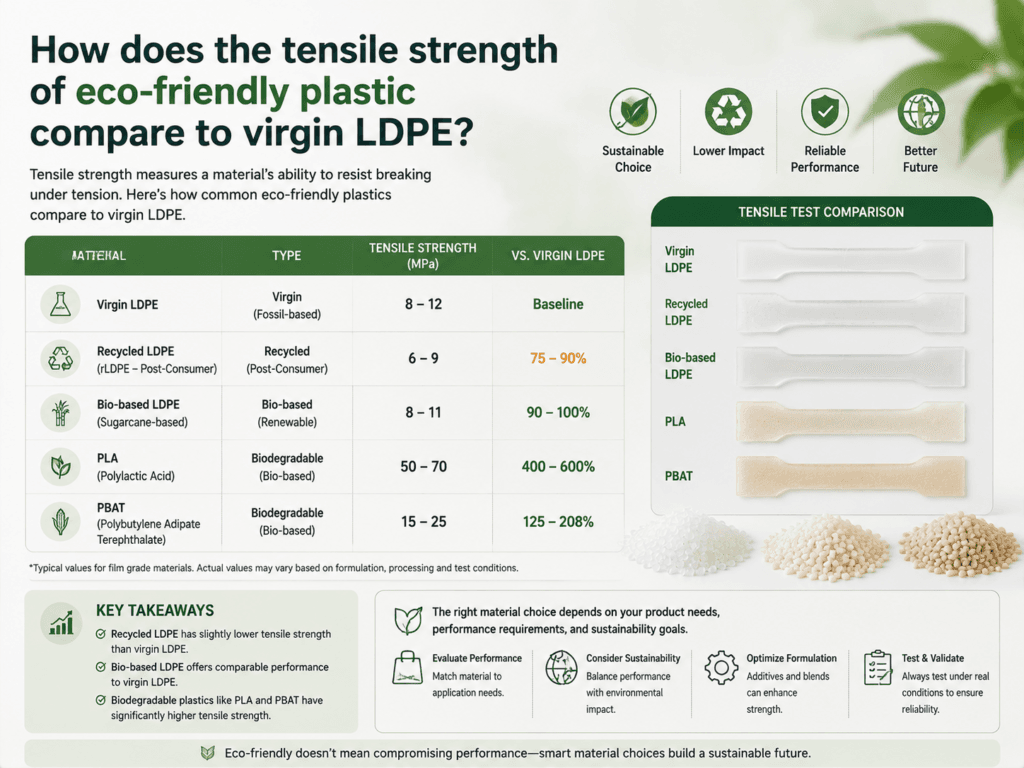
The tensile strength of eco-friendly plastics is generally lower or slightly comparable to virgin LDPE, depending on the specific material type and formulation. Eco-friendly plastics is a broad category that includes PCR (recycled PE), bio-based PE (such as sugarcane PE), PLA blends, and other bioplastics—each with different mechanical performance levels.
Virgin LDPE (Low-Density Polyethylene) is a highly stable, well-controlled material with consistent molecular structure, which gives it reliable tensile strength and flexibility in cosmetic tube applications.
Tensile Strength Comparison Overview
| Material Type | Relative Tensile Strength | Key Characteristics |
|---|---|---|
| Virgin LDPE | High & consistent | Stable molecular structure, excellent flexibility |
| PCR PE (recycled LDPE/HDPE blend) | Medium to high | Slight variability depending on recycling quality |
| Sugarcane-based PE (bio-PE) | Similar to virgin LDPE | Chemically identical to PE, same performance |
| PLA or mixed bioplastics | Lower to medium | More rigid, less flexible, brittle under stress |
Why Virgin LDPE Performs So Consistently
- Uniform polymer chains: Controlled manufacturing ensures consistent strength
- High elongation at break: Excellent flexibility for squeezing applications
- Stable processing window: Reliable performance in high-speed filling lines
- Low contamination risk: No recycled impurities affecting structure
Why Eco-Friendly Plastics Can Differ
- PCR variability: Recycled feedstock may vary in quality and molecular weight
- Processing degradation: Multiple heating cycles can slightly reduce strength
- Bio-based blends: Some bio-plastics prioritize sustainability over flexibility
- Additive differences: Stabilizers and fillers affect final mechanical properties
Practical Performance in Cosmetic Tubes
| Application Factor | Virgin LDPE | Eco-Friendly Plastics |
|---|---|---|
| Squeeze durability | Excellent | Good (varies by formulation) |
| High-speed filling stability | Very stable | Moderate to high (depends on type) |
| Drop resistance | High | Medium to high |
| Flexibility (tube rebound) | Excellent | Varies widely |
Key Insight
- Sugarcane PE performs almost identically to virgin LDPE
- PCR PE is slightly more variable but still suitable for most cosmetic tubes
- PLA and some bio-plastics may reduce flexibility in squeeze applications
- Final performance depends more on formulation than “eco label” alone
Summary
The tensile strength of eco-friendly plastics varies widely compared to virgin LDPE. Bio-PE (sugarcane-based) offers nearly identical performance, PCR materials show slightly more variability but remain suitable for cosmetic tubes, while certain bioplastics like PLA may have lower flexibility.
Overall, virgin LDPE remains the benchmark for consistent mechanical strength, but modern sustainable materials can closely match its performance when properly engineered.
Learn more: PE Tubes, PCR Tubes, Sugarcane Tubes, Sustainable Packaging.
Need High-Performance Sustainable Tubes?
Xinfly Packaging offers engineered PE, PCR, and bio-based cosmetic tubes that balance tensile strength, flexibility, and sustainability for global brands.