
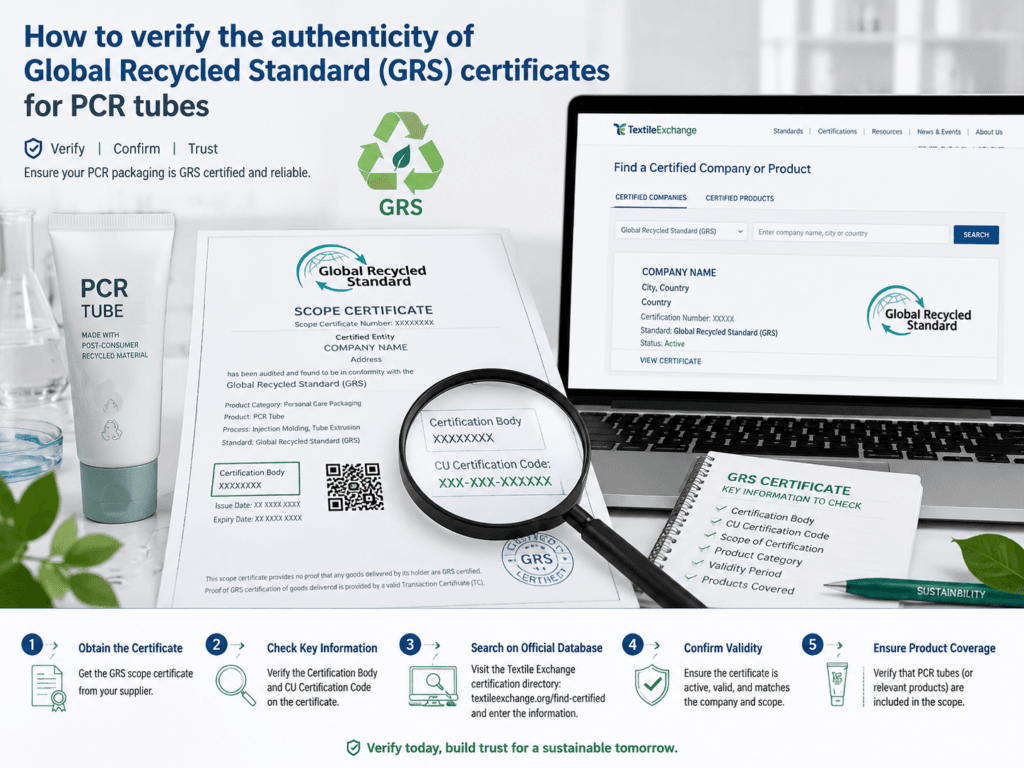
Verifying the authenticity of Global Recycled Standard (GRS) certificates for PCR tubes requires checking both the Scope Certificate (SC) and Transaction Certificate (TC) through official databases and certification bodies.
Because GRS is a chain-of-custody system, a document alone is not enough—authenticity must be confirmed through independent third-party verification and official registry systems.
Step 1: Understand the Two Key GRS Documents
| Document | What It Proves | Importance |
|---|---|---|
| Scope Certificate (SC) | Factory is certified to handle GRS materials | Confirms supplier eligibility |
| Transaction Certificate (TC) | Specific shipment contains GRS material | Confirms product-level authenticity |
Step 2: Verify Scope Certificate (SC)
- Check certificate number (e.g., CU, ITS, SGS codes)
- Confirm supplier name and factory address match exactly
- Check validity period (GRS SC is valid for 12 months only)
- Verify certified product scope matches PCR tube production
Use the official Textile Exchange database: “Find a Certified Company” to confirm the certificate is active and legitimate.
Step 3: Verify Transaction Certificate (TC)
- Ensure TC is issued by an accredited certification body (not the supplier)
- Check TC number against certification body records
- Confirm buyer name matches your company
- Verify product details: PCR percentage, quantity, and description
- Check shipment date aligns with production timeline
Step 4: Cross-Check Certification Body
| Verification Action | Why It Matters |
|---|---|
| Contact certification body (CU / ITS / SGS / TÜV) | Confirms document was officially issued |
| Validate TC number | Ensures shipment authenticity |
| Confirm supplier certification status | Prevents expired or fake certificates |
Step 5: Check Chain of Custody
- Every supplier in the supply chain must hold a valid GRS certificate
- If any link is uncertified, final PCR tube cannot claim GRS compliance
- Recycled content must be traceable from recycler to final packaging
Common Red Flags
- Only Scope Certificate provided, no Transaction Certificate
- Certificate number cannot be found in Textile Exchange database
- Expired certificate still used in marketing materials
- TC issued by supplier instead of certification body
- Mismatch between product description and certified scope
Best Practice Verification Process
- Request SC + TC together before order confirmation
- Verify SC in Textile Exchange database
- Cross-check TC with certification body directly
- Confirm PCR percentage and product scope match PO
- Keep documentation for audit and compliance review
Summary
To verify the authenticity of GRS certificates for PCR tubes, buyers must check both Scope Certificates and Transaction Certificates through official databases and certification bodies. A valid GRS claim always requires an unbroken chain of custody from recycler to final manufacturer.
Relying on certificates alone is not enough—real verification comes from cross-checking official records and ensuring every step in the supply chain is certified.
Learn more: PCR Cosmetic Tubes, Quality Assurance, Sustainable Packaging, Certifications.
Need Verified GRS PCR Tube Solutions?
Xinfly Packaging provides fully traceable PCR cosmetic tubes with valid GRS Scope Certificates and Transaction Certificates for global compliance requirements.