
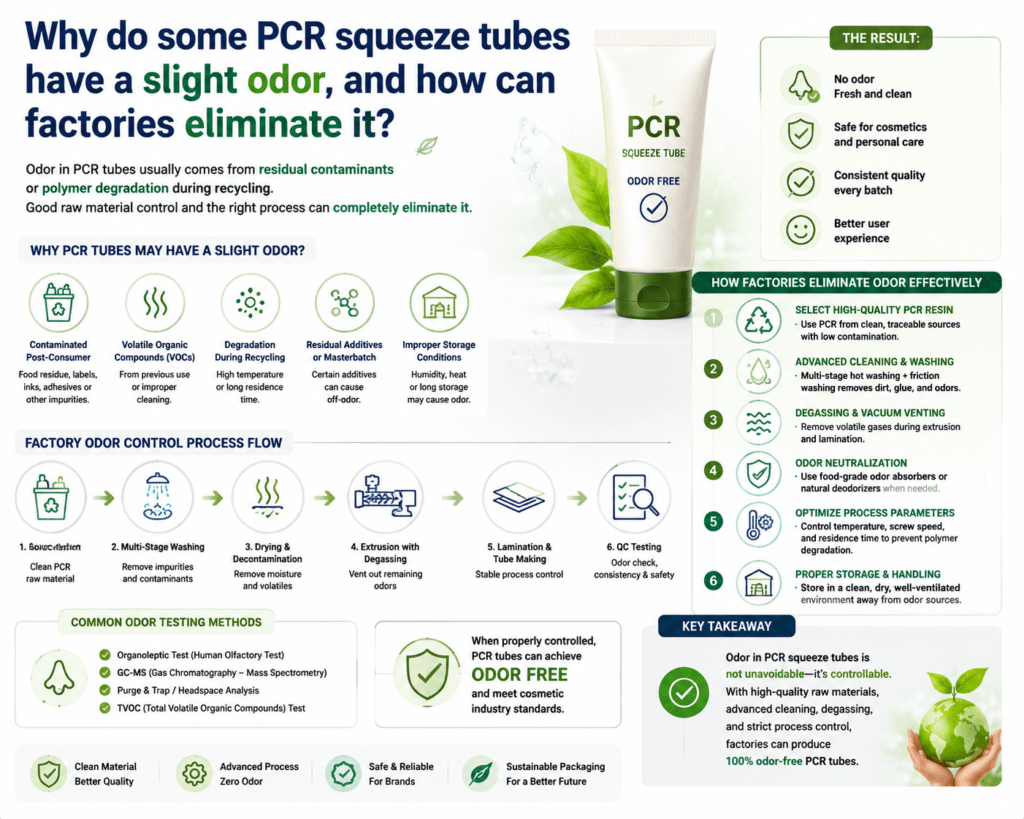
Some PCR squeeze tubes may have a slight odor, especially when using high percentages of Post-Consumer Recycled (PCR) plastic. This is a common material characteristic and does not affect product safety or performance when properly controlled.
The odor is mainly caused by residual compounds from recycled plastic streams and thermal processing during regranulation. However, modern manufacturing processes can significantly reduce or eliminate this issue.
Why PCR Tubes May Have a Slight Odor
| Cause | Explanation |
|---|---|
| Recycled feedstock residues | Trace organics or previous-use materials may remain in PCR plastic |
| Thermal processing | High-temperature melting can generate mild polymer odor |
| High PCR ratio | Higher recycled content increases likelihood of odor presence |
| Storage conditions | Improper storage of PCR pellets may absorb environmental odors |
How Factories Eliminate or Reduce PCR Odor
- Advanced deodorization processing: Vacuum degassing during extrusion removes volatile compounds.
- High-temperature purification: Multi-stage melting filters impurities from recycled resin.
- Odor-neutral masterbatch: Additives are used to neutralize remaining odor molecules.
- Material blending: Mixing PCR with virgin PE improves stability and reduces smell.
- Strict raw material selection: Using certified PCR suppliers with controlled recycling streams.
Impact on Cosmetic Products
- Normal PCR odor is usually very faint and non-transferable to product
- Does not affect cream, lotion, shampoo, or sunscreen stability
- Properly processed PCR tubes meet cosmetic packaging safety standards
- Odor disappears over time after production and ventilation
Best Practices for High-End Brands
| Solution | Benefit |
|---|---|
| Use 30%–70% PCR ratio | Balances sustainability and low odor risk |
| Request deodorized PCR resin | Minimizes initial packaging smell |
| Apply barrier layer (EVOH / ABL) | Improves stability and reduces interaction risk |
| Pre-production sample testing | Ensures odor meets brand requirements |
Summary
Some PCR cosmetic tubes may have a slight odor due to recycled material characteristics and processing conditions. However, with modern deodorization technology, material blending, and strict quality control, factories can effectively eliminate or significantly reduce this odor to meet cosmetic industry standards.
In most cases, properly manufactured PCR tubes are safe, stable, and suitable for global cosmetic packaging applications.
Learn more: PCR Cosmetic Tubes, PE vs PCR Tubes, Sustainable Packaging, Quality Assurance.
Need Low-Odor PCR Cosmetic Tubes?
Xinfly Packaging provides deodorized PCR tube solutions with advanced purification, blending technology, and strict quality control for global cosmetic brands.