
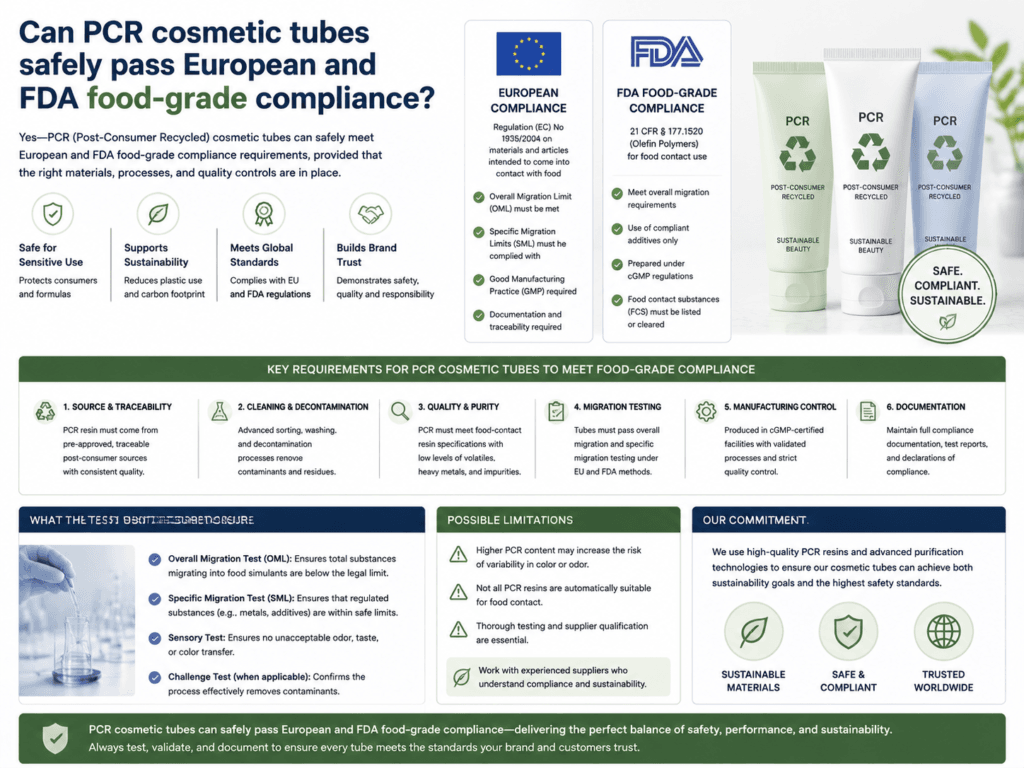
PCR (Post-Consumer Recycled) cosmetic tubes can be designed to meet both European and U.S. regulatory requirements, but compliance depends on the full packaging system, material sourcing, and intended product use.
In general, PCR tubes themselves are not automatically “food-grade certified” or “FDA approved.” Instead, compliance is determined by the base resin quality, recycling process control, and final application (cosmetic vs. food contact).
EU and FDA Compliance Overview
| Region | Requirement | PCR Tube Status |
|---|---|---|
| European Union (EU) | Regulation (EC) No 1935/2004 for food contact materials | Possible if PCR resin is fully traceable and migration limits are met |
| United States (FDA) | 21 CFR Food Contact Substances (FCS) | Allowed if recycled resin meets FDA compliance standards |
Key Factors for PCR Compliance
- Food-grade PCR resin sourcing: Must come from controlled and approved recycling streams.
- Migration testing: Ensures no harmful substances transfer into product formulations.
- Traceability: Full documentation of recycled material origin is required.
- Reprocessing control: Mechanical recycling must follow strict purification processes.
- Final application: Cosmetic use has different compliance thresholds than direct food contact.
Important Clarification
Most PCR cosmetic tubes are used for cosmetic and personal care products, not direct food contact. Therefore, they are typically evaluated under cosmetic packaging safety standards rather than full food-grade certification.
However, high-quality PCR materials used by professional manufacturers like Xinfly Packaging can still be produced to meet EU and FDA material safety expectations when required by premium global brands.
Best Practice for Global Brands
- Request full material compliance documentation from suppliers
- Use certified PCR resin with traceable supply chains
- Perform migration and stability testing for sensitive formulas
- Choose mono-material PCR tubes for better regulatory acceptance
- Work with experienced OEM/ODM manufacturers
Summary
PCR cosmetic tubes can be engineered to meet EU and FDA-related material safety requirements, but compliance depends on resin quality, traceability, and testing—not simply whether the tube contains recycled plastic.
For cosmetic applications, PCR tubes are widely accepted globally when properly manufactured and tested under strict quality systems.
Learn more: PCR Cosmetic Tubes, What is PCR Plastic?, Sustainable Packaging, Quality Assurance.
Need Compliant PCR Cosmetic Tubes?
Xinfly Packaging provides high-quality PCR cosmetic tubes with strict material control, traceability, and export-grade compliance support for EU and U.S. markets.