

About This Ranking
This Top 10 list is compiled from publicly available information found on manufacturer websites, online packaging resources and public company materials.
The purpose of this article is to help beauty brands, contract manufacturers, packaging engineers and procurement teams identify potential Chinese suppliers for refillable, reusable and refill-oriented cosmetic tube projects.
Suppliers were reviewed based on publicly presented capabilities relating to cosmetic tubes, airless packaging, reusable or replaceable packaging concepts, sustainable materials, custom component development, printing and OEM / ODM support.
Refillable cosmetic tubes remain a relatively specialized packaging category. Not every company in this guide necessarily promotes a standardized refillable tube platform as a permanent catalog product. Some may instead be relevant as custom-development partners for refill-oriented projects.
This is not an official industry ranking, audited market-share ranking, independent factory audit or third-party endorsement. Buyers should independently verify the current design, tooling, patent, material, test, MOQ and production capabilities of each supplier.
Version 2026.08 · Last Reviewed: August 29, 2026What Is a Refillable Cosmetic Tube?
A refillable cosmetic tube is a packaging system designed so that one or more major components can be reused while the product-containing portion is replaced or refilled.
In a conventional cosmetic tube, the complete tube, shoulder and closure are normally discarded after the formula is used. A refillable system instead aims to retain components such as the outer shell, pump, applicator or decorative housing across multiple product cycles.
A Refillable Tube Is a Packaging System — Not Just a Material
A tube made from PCR or recyclable PE is not automatically refillable. Refillable packaging requires a designed mechanism that allows the consumer or filling operation to replace or replenish the product-containing component.
Key Elements of a Refillable Cosmetic Tube
A durable shell, dispenser or decorative body designed to remain in service.
An inner tube, cartridge or reservoir that can be replaced when empty.
Thread, snap, bayonet or twist-lock geometry should prevent accidental separation.
Repeated removal and installation should not reduce sealing performance.
Refilling should be intuitive without requiring special tools.
Materials and component separation should be considered during design.
Refillable vs Recyclable vs PCR Cosmetic Tubes
These terms are frequently used together, but they describe different sustainability strategies.
| Packaging Type | What It Means | Main Sustainability Goal | Key Limitation |
|---|---|---|---|
| Refillable Tube | Major packaging components are reused while product is replenished or replaced | Reduce packaging used per product cycle | Requires durable and user-friendly refill design |
| Recyclable Tube | Package is designed for an applicable recycling stream | Improve end-of-life recovery | Actual recycling depends on local infrastructure |
| PCR Tube | Contains post-consumer recycled resin | Reduce demand for virgin plastic | PCR content does not automatically mean refillable |
| Mono-Material Tube | Main package components use compatible polymer families where practical | Simplify recycling design | Closure, pump or decorative parts may still differ |
| Bio-Based PE Tube | PE resin is partly or fully derived from renewable feedstock such as sugarcane | Reduce fossil feedstock dependence | Bio-based does not mean biodegradable or refillable |
Best Sustainability Strategy May Combine Several Approaches
A premium refillable package might use a durable reusable outer shell, a lightweight PE refill cartridge and recyclable or PCR-containing refill components. The optimal design depends on product use, actual refill frequency, component weight and available recycling infrastructure.
Main Types of Refillable Cosmetic Tube Systems
There is no single universal refillable tube architecture. Different systems are appropriate for skincare, foundation, eye cream, sunscreen, lotion and premium treatment products.
| Refill System | Basic Structure | Best Used For | Main Engineering Concern |
|---|---|---|---|
| Replaceable Inner Tube | Reusable outer shell + flexible inner refill | Premium cream, lotion, skincare | Dimensional fit and cartridge retention |
| Refillable Airless Tube | Reusable airless dispensing head + replaceable reservoir | Serum, foundation, eye treatment | Pump priming and air-tight sealing |
| Screw-In Refill Cartridge | Threaded replacement unit inside reusable body | Cream and treatment products | Thread wear and torque consistency |
| Twist-Lock Refill | Cartridge engages through bayonet or twist mechanism | Prestige cosmetic packaging | Locking accuracy and consumer usability |
| Reusable Applicator + Refill Tube | Applicator or dispenser reused while tube body is replaced | Specialized skincare and treatment | Hygiene and product-contact design |
| Refill-from-Pouch System | Consumer refills a durable dispenser from separate refill pack | Body lotion, cleanser, hair care | Clean transfer and contamination control |
Replaceable Cartridge vs Consumer Refill
For many cosmetic formulas, a sealed replaceable cartridge can offer more controlled hygiene and compatibility than asking consumers to pour or transfer formula into an existing primary package.
Material Guide for Refillable Cosmetic Tube Packaging
Material selection depends on whether the component is intended to be reused many times or replaced after each formula cycle.
| Material Direction | Potential Role | Advantages | Buyer Should Evaluate |
|---|---|---|---|
| PE | Flexible refill tube / cartridge | Squeeze performance, broad cosmetic use | Formula compatibility and recyclability design |
| PP | Reusable shell, pump or rigid mechanism | Rigidity and repeated-use durability | Component separation and resin compatibility |
| EVOH Multi-Layer | Higher-barrier refill reservoir | Improved oxygen / aroma barrier | Actual recyclability requirements |
| PCR PE | Refill tube or selected outer components | Reduced virgin resin use | Color, odor, mechanical consistency |
| PCR PP | Rigid outer shell or cap direction | Recycled-content positioning | Impact strength and visual consistency |
| Sugarcane PE | Flexible refill tube | Renewable feedstock direction | Supply documentation and sustainability claims |
For broader material selection, see Xinfly Cosmetic Tube Material Options .
Refillable Cosmetic Tubes, Sustainability & PPWR
Refillable packaging is increasingly discussed as brands prepare for stricter packaging-reduction, recyclability and reuse expectations in major markets.
However, simply labeling a package “refillable” does not automatically make it environmentally preferable. The complete system should be evaluated using packaging weight, refill frequency, transport, consumer behavior and end-of-life design.
Questions to Ask During Sustainable Refill Design
A heavy reusable shell only delivers benefit if consumers complete enough refill cycles.
The refill cartridge should ideally use materially less packaging than the original system.
Complex permanent assemblies can create end-of-life challenges.
PCR percentage, bio-based content and recyclability claims should be documented.
Sustainability should not reduce formula protection or consumer safety.
Regulatory and recycling conditions differ between regions.
PPWR Direction
For brands selling into the European Union, refillable and reusable packaging strategies should be reviewed together with current PPWR requirements, recyclability expectations, packaging minimization and applicable category-specific obligations.
Final regulatory decisions should be confirmed with qualified compliance professionals for the target market and launch date.
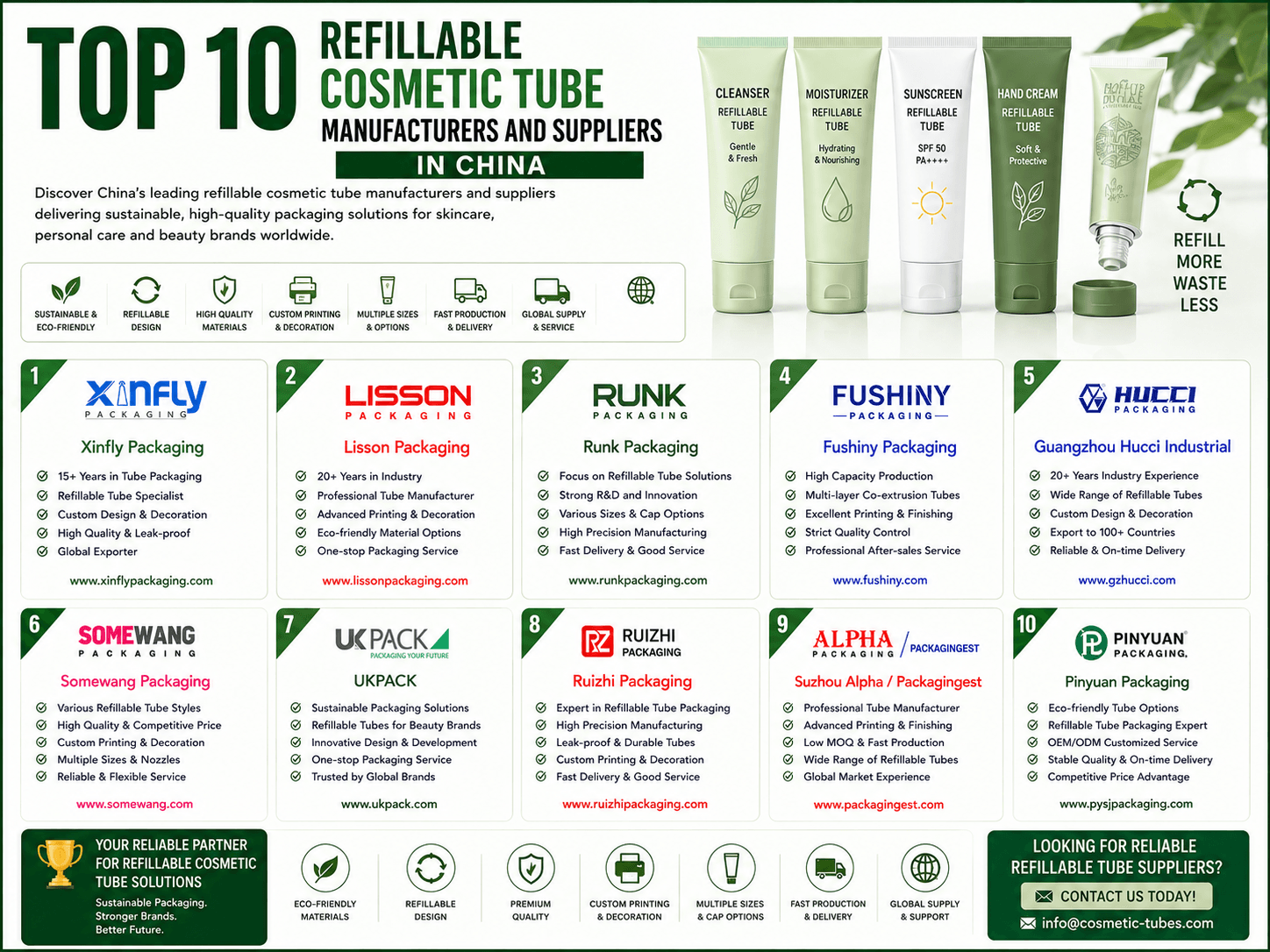
Top 10 Refillable Cosmetic Tube Manufacturers and Suppliers in China 2026
The companies below represent different sourcing and custom-development directions for refillable, reusable and sustainability-oriented cosmetic tube packaging.
Because refillable tubes are more specialized than standard cosmetic tubes, buyers should request current technical drawings, physical samples, refill-cycle testing data and tooling information before selecting a supplier.
Xinfly Packaging
Xinfly Packaging manufactures customized cosmetic tubes and supports OEM / ODM development for skincare, foundation, sunscreen, eye care, lip care and other cosmetic applications.
Refill-oriented projects can be evaluated around reusable outer components, replaceable flexible reservoirs, airless dispensing concepts, sustainable materials and customized tube / closure combinations.
- PE
- 2-layer PE
- 5-layer / EVOH
- PCR PE
- Sugarcane PE
- Mono-material development direction
- Replaceable inner tube concepts
- Airless tube systems
- Reusable outer housing concepts
- Custom pump / closure combinations
- Custom mold development
- Pantone tube colors
- Offset printing
- Silk screen
- Hot stamping
- Matte / glossy
- Soft-touch finish
- Packaging concept review
- Material recommendation
- Prototype / sample development
- Formula compatibility coordination
- Filling-line considerations
Lisson Packaging
Lisson Packaging publicly presents a broad range of customized cosmetic tube and beauty packaging solutions. Its tube customization and dispensing experience may make it relevant for selected refillable or replaceable-cartridge development projects.
- Custom cosmetic tubes
- Airless packaging directions
- Custom closures
- Printing and decoration
- OEM / ODM support
- Current refillable tube platforms
- Replaceable cartridge designs
- Refill-cycle durability
- Tooling ownership
- Patent / design freedom
Runk Packaging
Runk Packaging supplies customized cosmetic tubes across PE, multi-layer and sustainability-oriented material directions.
Its flexible tube and eco-material capabilities may be relevant when developing lightweight refill cartridges or replaceable inner tubes for reusable cosmetic packaging systems.
- PE
- Multi-layer tubes
- PCR
- Bio-based materials
- Custom decoration
- Refill cartridge geometry
- Reusable housing compatibility
- Wall thickness control
- Repeated installation performance
- Current MOQ and tooling
Fushiny Packaging
Fushiny Packaging provides customized cosmetic tube and beauty packaging solutions across multiple materials, shapes, closures and decoration technologies.
Its custom tube development capability may make it suitable for refill-oriented cosmetic packaging projects where a flexible replacement tube or cartridge must integrate with a reusable outer component.
- Custom PE cosmetic tubes
- Multi-layer tube structures
- Custom shoulders and closures
- Printing and decoration
- OEM / ODM development
- Current refill system experience
- Cartridge retention method
- Refill insertion tolerance
- Repeated assembly testing
- Custom tooling cost
Guangzhou Hucci Industrial
Guangzhou Hucci Industrial supplies customized cosmetic packaging across flexible tubes and related beauty packaging components. Its broad customization direction may be relevant for reusable housings, specialized closures and refillable cosmetic tube concepts.
- Custom tube shapes
- Specialized closures
- Custom color matching
- Surface decoration
- Packaging customization
- Refill lock geometry
- Component material selection
- Assembly torque
- Consumer opening force
- Production tolerance control
Somewang Packaging
Somewang Packaging supplies tubes, jars, bottles, airless packages and other beauty packaging formats. Its multi-category portfolio may be useful for brands developing a refillable skincare family rather than a single standalone tube.
- Cosmetic tubes
- Airless packaging
- Skincare packaging systems
- Custom decoration
- Multi-SKU sourcing
- Skincare product families
- Coordinated refill packaging
- Tube + bottle programs
- Premium beauty projects
- OEM packaging development
UKPACK
UKPACK publicly presents beauty packaging solutions across pumps, jars, bottles and sustainable material directions. It may be considered for brands looking at refillable or reusable packaging together with recycled-content components.
- Airless packaging
- PCR material options
- Custom closures
- Beauty packaging systems
- Sustainable packaging concepts
- Current refillable tube availability
- PCR percentage
- Material traceability
- Refill-cycle durability
- Component recyclability
Ruizhi Packaging
Ruizhi Packaging supplies cosmetic tube solutions across PE, PCR and bio-based material directions. Its sustainable tube experience may be relevant for lightweight refill cartridges or replaceable inner tubes.
- PE
- PCR PE
- Sugarcane PE
- Multi-layer tubes
- Custom color systems
- Wall thickness
- Refill cartridge stiffness
- Dimensional stability
- PCR appearance
- Filled transportation performance
Suzhou Alpha Packaging / Packagingest
Suzhou Alpha Packaging, also presented online through Packagingest, offers flexible tube packaging across conventional, recycled and renewable-material directions.
Its tube capability may be relevant where a refill system uses a lightweight flexible inner reservoir inside a reusable decorative package.
- PE tubes
- PCR tubes
- Sugarcane PE
- Custom printing
- Custom closures
- Refill interface dimensions
- Small-batch development MOQ
- Custom mold capability
- Assembly trials
- Long-term compatibility
Pinyuan Packaging
Pinyuan Packaging can be considered for customized cosmetic tube projects requiring custom dimensions, decoration and closure development.
For refill-oriented projects, buyers should confirm whether current standard components can be adapted or whether dedicated tooling is required.
- Custom tube dimensions
- PE structures
- Custom closures
- Printing
- OEM production
- Current refill-system experience
- Reusable shell options
- Tooling cost
- Prototype lead time
- Cycle testing capability
Top 10 Refillable Cosmetic Tube Manufacturers Compared
Refillable packaging should not be compared only by unit price. Development complexity, tooling, refill mechanism, test requirements and expected reuse cycles can materially affect total project cost.
| Manufacturer | Relevant Direction | Potential Best Fit | Buyer Should Verify |
|---|---|---|---|
| Xinfly Packaging | Flexible tubes, airless, PCR, custom refill-oriented development | OEM / ODM refillable tube projects | Final mechanism, mold and cycle testing |
| Lisson Packaging | Custom cosmetic tube and airless packaging | Premium skincare development | Current refill platform availability |
| Runk Packaging | PE / multi-layer / sustainable tubes | Lightweight refill cartridges | Cartridge integration |
| Fushiny Packaging | Custom tube structures and components | Custom refill development | Repeated assembly tolerance |
| Guangzhou Hucci Industrial | Custom tubes and closure directions | Twist / screw refill concepts | Locking mechanism performance |
| Somewang Packaging | Tube + airless + beauty packaging | Multi-format skincare programs | System-wide refill consistency |
| UKPACK | PCR and sustainable packaging | Eco-oriented premium beauty | Refill platform + sustainability claims |
| Ruizhi Packaging | PE / PCR / sugarcane PE | Lightweight sustainable refills | Mechanical stability |
| Suzhou Alpha / Packagingest | Flexible eco tube materials | Replaceable inner reservoirs | Prototype and tooling capability |
| Pinyuan Packaging | Custom cosmetic tubes | General custom development | Existing vs custom refill design |
How Refillable Cosmetic Tube Mechanisms Work
The refill mechanism determines whether the package is genuinely easy to reuse. A successful mechanism should be secure during transport but simple enough for consumers to replace without tools or excessive force.
The refill cartridge threads into a reusable pump, cap or outer shell.
Flexible retaining geometry clicks the refill component into position.
A short rotational movement locks the cartridge into a defined position.
The refill is inserted axially and retained by a mechanical catch.
The consumer transfers the pump assembly onto a replacement product reservoir.
A flexible tube is housed inside a more durable decorative structure.
Critical Mechanical Parameters
| Parameter | Why It Matters | Potential Failure |
|---|---|---|
| Insertion Force | Controls user experience | Refill is too difficult to install |
| Removal Force | Allows refill replacement | Consumer damages package |
| Retention Force | Keeps cartridge secure | Refill releases accidentally |
| Thread Torque | Controls screw-in assembly | Cross-threading or loose assembly |
| Seal Compression | Creates leak-resistant interface | Formula migration |
| Dimensional Tolerance | Maintains consistency across lots | Some refills fit while others fail |
Refillable Airless Cosmetic Tubes
Refillable airless tube systems are particularly relevant for premium skincare, foundation, eye cream, serum and treatment products where controlled dispensing and reduced air exposure are important.
In a typical refill concept, the pump or dispensing head may be retained while the product-containing tube or internal reservoir is replaced.
The higher-value pump mechanism remains in use across refill cycles.
The formula-contact chamber is supplied as a sealed refill.
Pump output can provide consistent application quantities.
A sealed refill can help avoid open pouring or direct formula transfer.
Important Airless Refill Test
After replacing the refill cartridge, verify pump priming time, dose consistency, residual air, leakage and evacuation efficiency. A reusable pump should perform consistently after multiple refill cycles.
Related comparison: Airless Pump Tube vs Airless Bottle .
Refill Cycle Durability & Repeated Assembly Testing
A reusable package should not be approved after only one successful refill. Critical parts should be tested across the expected number of consumer refill cycles.
Recommended Refill Cycle Test Sequence
- Assemble the original refill.
- Check leakage and dispensing.
- Remove the empty cartridge.
- Install a replacement cartridge.
- Repeat opening / closing operations.
- Inspect threads, clips and seals.
- Measure dispensing performance.
- Repeat for the target number of refill cycles.
- Run final drop and transportation tests.
- Compare against the original golden sample.
| Component | Potential Repeated-Use Failure | What To Check |
|---|---|---|
| Threads | Wear / cross-threading | Torque and visual damage |
| Snap Features | Fatigue or breakage | Retention force |
| Sealing Ring | Compression loss | Leakage after repeated assembly |
| Pump | Dose drift or failure | Output per stroke |
| Outer Shell | Cracking / cosmetic damage | Drop and handling resistance |
| Refill Cartridge | Deformation during insertion | Dimensional stability |
Define a Target Number of Reuses
The specification should state how many refill cycles the reusable component is intended to withstand. “Refillable” without a defined durability target is difficult to validate objectively.
Hygiene & Formula Compatibility in Refillable Cosmetic Tubes
Refill systems create additional interfaces between the consumer, package and formula. Hygiene should therefore be considered during the earliest design stage.
A prefilled sealed refill can reduce direct consumer contact with the formula.
Avoid designs that require consumers to pour viscous formulas manually.
Product-contact areas should be protected when a new refill is installed.
Crevices between reusable and replacement parts should not collect old formula.
Reusable seals and pumps may experience longer formula contact than single-use components.
The refill process should clearly explain which parts are replaced, reused or cleaned.
Formula Compatibility Must Reflect Longer Service Life
If a reusable pump or sealing component remains in service for multiple refill cycles, compatibility testing should consider the cumulative contact period rather than the lifetime of a single refill alone.
MOQ, Custom Mold & Tooling Cost for Refillable Cosmetic Tubes
Refillable tube projects are often more complex than standard squeeze tubes because they may require several precision-matched components.
MOQ and development cost depend on whether the project uses an existing refillable platform or requires a completely new mechanism.
| Project Type | Development Complexity | Typical Cost Drivers | Buyer Strategy |
|---|---|---|---|
| Existing Standard Refill System | Lower | Color, printing, decoration, component MOQ | Best starting point for faster launch |
| Modified Existing System | Medium | New cap, shell, shoulder or dimensional modification | Balance differentiation and tooling cost |
| Custom Refill Mechanism | High | Engineering, prototypes, molds and testing | Suitable for strategic long-term programs |
| Custom Airless Refill System | Very High | Pump development, sealing, reservoir and mold sets | Requires strong technical validation |
Main Tooling Cost Drivers
A unique reusable housing may require dedicated injection molds.
Screw, snap or bayonet mechanisms may need precision tooling.
The tube head may need a custom geometry to connect to the refill system.
Airless systems can require several tightly controlled molded parts.
Prototype or pilot tools may reduce risk before full production molds.
Repeated assembly and torque testing may require custom fixtures.
Best Way to Reduce Development Risk
Start with: existing platform → formula test → refill-cycle test → decoration sample → pilot production → custom modifications before investing in a completely new refill mechanism.
How to Choose a Refillable Cosmetic Tube Manufacturer in China
Choosing a refillable cosmetic tube supplier is more complex than sourcing a standard squeeze tube because the project involves both primary packaging performance and repeated-use mechanics.
Buyers should evaluate the supplier's ability to manage tube manufacturing, reusable components, refill interfaces, sealing, formula compatibility, tooling, quality control and consumer usability as one complete system.
Decide whether the project uses a replaceable inner tube, cartridge, reusable pump, screw-in refill or another system.
Define exactly which components remain with the consumer and which are replaced after each product cycle.
Provide viscosity, active ingredients, oils, alcohols, fragrance and other relevant formula data.
Define how many refill cycles the reusable shell, pump and sealing interfaces should survive.
Refill cartridges and reusable housings require reliable fit across mass-production lots.
Test the package after repeated assembly, not only when it is brand new.
Confirm PCR content, bio-based claims, recyclability and component material declarations.
Final mass production should be controlled against an approved functional sample.
Ask for More Than a Product Photo
For any refillable packaging concept, request technical drawings, component materials, assembly instructions, refill-cycle targets, leakage test methods and physical samples before commercial approval.
Common Refillable Cosmetic Tube Problems & Solutions
1. Refill Cartridge Is Loose Inside the Outer Shell
Dimensional variation between the refill and reusable housing can create movement, rattling or poor alignment.
- Define critical fit tolerances on engineering drawings.
- Measure multiple production cavities.
- Test cartridges from several production lots.
- Review shrinkage differences between materials.
2. Refill Is Too Difficult to Insert or Remove
Excessive insertion or removal force can make a technically refillable package frustrating for consumers.
- Define target insertion and removal force.
- Review snap, thread or bayonet geometry.
- Test with different hand strengths.
- Check dimensional variation after warm storage.
3. Leakage Appears After Several Refill Cycles
Repeated assembly can wear sealing surfaces, threads, clips or elastomer components.
- Test leakage after every planned refill cycle.
- Measure seal compression.
- Inspect worn interfaces under magnification.
- Review material fatigue and stress concentration.
4. Reusable Pump Stops Priming
Airless refill systems may fail to prime after changing the cartridge if air enters the dispensing pathway or the interface is not sealed correctly.
- Check pump-to-cartridge sealing.
- Measure the number of strokes required for priming.
- Test at multiple formula viscosities.
- Repeat after several cartridge changes.
5. Reusable Outer Shell Cracks
A decorative shell may look premium but still fail after repeated opening, transport or accidental drops.
- Run drop testing with a filled refill installed.
- Check wall thickness around locking features.
- Review resin impact strength.
- Test at low and high temperatures where relevant.
6. Thread Wear Causes Cross-Threading
Repeated screw-in refill replacement can damage fine threads or create incorrect engagement.
- Use suitable thread geometry for repeated use.
- Measure assembly torque.
- Run repeated screw / unscrew testing.
- Consider anti-cross-thread lead-in geometry.
7. Old Formula Accumulates Between Components
Product trapped between a reusable shell, pump or refill interface can create hygiene and appearance problems.
- Minimize formula-trap areas.
- Keep refill opening isolated from exterior surfaces.
- Use sealed prefilled cartridges where practical.
- Provide clear consumer refill instructions.
8. Refill Uses Almost as Much Material as the Original Package
A refill system can lose its sustainability advantage if each replacement unit remains heavy or overly complex.
- Compare refill weight with the original package.
- Lightweight non-reusable components.
- Reduce unnecessary decorative layers.
- Evaluate actual reuse frequency.
Why Choose Xinfly Packaging for Refillable Cosmetic Tube Development?
Xinfly Packaging supports customized cosmetic tube projects across material selection, tube structure, closure matching, airless dispensing, decoration, sustainable materials and OEM / ODM packaging development.
For refill-oriented projects, the development process can begin with an existing tube platform or move into a customized refill cartridge, reusable housing or dispensing concept depending on the brand's objectives.
PE, multi-layer, EVOH, PCR and bio-based tube directions can be evaluated for replacement refill components.
Explore Cosmetic Tubes →PCR PE, sugarcane PE and mono-material-oriented structures can support broader sustainability strategies.
Explore Tube Materials →Airless pump tubes can be evaluated for skincare, serum, foundation and other controlled-dispensing applications.
Explore Airless Pump Tubes →Custom projects can include material, structure, artwork, component and sample-development coordination.
OEM / ODM Services →Recommended Refillable Tube Development Workflow
Formula → Target Capacity → Refill Architecture → Reusable Components → Material Selection → Locking / Sealing Interface → Prototype → Formula Compatibility → Refill-Cycle Testing → Leakage Test → Filling Trial → Decoration Sample → Golden Sample → Pilot Production → Mass Production
Refillable Cosmetic Tube RFQ Checklist
Providing complete information at the RFQ stage helps suppliers determine whether an existing platform can be used or custom engineering is required.
- Product type: cream, serum, lotion, foundation, sunscreen, eye treatment or other.
- Target fill volume: for example 15ml, 30ml, 40ml, 50ml, 100ml.
- Formula viscosity: provide measured data if available.
- Formula composition: oils, alcohols, fragrance, actives and other compatibility-sensitive ingredients.
- Refill concept: replaceable cartridge, reusable pump, inner tube, twist-lock, screw-in or another architecture.
- Reusable components: define which components remain with the consumer.
- Replacement components: define which parts are supplied with every refill.
- Target reuse cycles: specify the minimum desired number of refills.
- Tube material: PE, EVOH, PCR PE, sugarcane PE or supplier recommendation.
- Outer shell material: PP, PCR PP or other required material.
- Dispensing: squeeze, airless pump, nozzle, applicator or custom dispenser.
- Locking mechanism: thread, snap, bayonet, twist-lock or supplier recommendation.
- Custom mold: state whether a proprietary package shape is required.
- Decoration: Pantone color, silk screen, offset, hot stamping, matte, glossy or soft-touch finish.
- Sustainability requirement: PCR percentage, bio-based content, lightweighting, recyclability or refill-reuse targets.
- Regulatory market: EU, UK, US, Australia, Middle East or other destination.
- Testing requirements: compatibility, leakage, drop, transport, torque, refill-cycle and pump performance.
- Estimated quantity: annual volume and quantity per production run.
- Number of SKUs: colors, formulas or artwork versions.
- Target launch date: include prototype, sample and production deadlines.
Developing a Refillable Cosmetic Tube for Your Beauty Brand?
Send Xinfly your formula, target capacity, refill concept, desired reuse cycles, materials, dispensing system, artwork and annual quantity. We can help evaluate standard tube platforms, sustainable materials, airless systems and custom refill-oriented development.
Frequently Asked Questions About Refillable Cosmetic Tubes
1. What is a refillable cosmetic tube?
A refillable cosmetic tube is a packaging system where one or more durable components are reused while the formula reservoir or refill component is replaced or replenished.
2. Is a PCR cosmetic tube the same as a refillable tube?
No. PCR refers to the use of post-consumer recycled resin. A PCR tube can still be single-use, while a refillable package requires a designed reuse or replenishment mechanism.
3. What types of refillable cosmetic tube systems are available?
Common concepts include replaceable inner tubes, screw-in cartridges, twist-lock refills, reusable pump heads, refillable airless systems and reusable outer shells with flexible inner reservoirs.
4. Which cosmetic products are suitable for refillable tubes?
Potential applications include skincare creams, lotion, serum, foundation, eye treatments, sunscreen and other products where the formula and dispensing system are compatible with the refill design.
5. Can airless pump tubes be refillable?
Yes. Some refill-oriented airless systems use a reusable pump or outer component together with a replaceable formula reservoir. Pump priming, sealing and refill-cycle performance must be tested carefully.
6. How many times can a refillable cosmetic tube be reused?
There is no universal number. The brand should define a target number of refill cycles and test the reusable shell, pump, threads, locking features and seals for that intended service life.
7. Are refillable cosmetic tubes more sustainable?
They can reduce packaging used per product cycle when durable components are actually reused and the refill uses substantially less material. The complete packaging system and real consumer behavior should be evaluated.
8. Can refill cartridges use PCR or sugarcane PE?
Depending on the formula and mechanical requirements, PCR PE or sugarcane-derived PE may be evaluated for selected flexible refill components. Claims and material performance should be verified.
9. Does a custom refillable tube require new molds?
Not always. Existing refill platforms may only need color and decoration customization, while proprietary refill mechanisms, shells, shoulders or closures can require new tooling.
10. How do I choose a refillable cosmetic tube supplier in China?
Evaluate cosmetic tube manufacturing, refill mechanism design, component tolerances, formula compatibility, refill-cycle testing, leakage performance, tooling, sustainable materials and OEM / ODM support.
Factors considered include publicly presented cosmetic tube capabilities, sustainable materials, airless packaging, custom component development, reusable or refill-oriented packaging directions, printing and OEM / ODM support.
Refillable cosmetic tubes remain a specialized and evolving packaging category. Inclusion in this article does not necessarily mean that every supplier currently offers a standardized refillable tube as a stock product.
The order shown above is not an official industry ranking, audited market-share ranking, independent factory audit or third-party endorsement.
Technical Suitability Disclosure: Buyers should independently verify current drawings, samples, tooling, refill-cycle durability, leakage performance, formula compatibility, patent considerations and manufacturing capability before commercial procurement.
Sustainability Disclosure: Terms such as refillable, reusable, recyclable, PCR and bio-based describe different packaging strategies. Environmental performance depends on actual package design, material weight, consumer reuse behavior, transport and available end-of-life systems.
Publisher Disclosure: Xinfly Packaging is both the publisher of this guide and one of the manufacturers included in the list. Buyers should use this page as a sourcing reference and independently evaluate all suppliers.
Edition: 2026 | Version: 2026.08 | Last Updated: August 29, 2026