
About This Ranking
This Top 10 list is compiled from publicly available information found on the internet, manufacturer websites and online packaging resources.
The article is designed as an editorial sourcing guide for adhesive brands, industrial-product companies, private-label businesses and procurement teams looking for flexible glue and adhesive tube packaging suppliers in China.
Suppliers were reviewed using publicly presented information relating to tube manufacturing, PE and laminate structures, nozzle closures, custom decoration, OEM / ODM support and broader packaging capability.
Not every supplier listed publicly specializes in every adhesive chemistry. Manufacturers should therefore be treated as relevant tube-packaging sourcing candidates whose suitability must be verified for the buyer's exact glue, adhesive, sealant or technical-paste formula.
This is not an official industry ranking and does not represent audited market share, independent certification or third-party endorsement.
Version 2026.08 · Last Reviewed: August 26, 2026What Is a Glue Packaging Tube?
A glue packaging tube is a flexible or collapsible package designed to dispense adhesives, bonding agents, sealants, repair compounds or other technical pastes.
Depending on the chemistry, glue may be packaged in PE, multi-layer barrier tubes, ABL, PBL or aluminum tubes. Precision nozzle closures are often used when controlled application is more important than high dispensing volume.
Glue Packaging Is a Formula-Compatibility Project
A tube that works perfectly for water-based craft glue may be unsuitable for a solvent-rich adhesive. Material selection should therefore begin with the actual chemical composition, viscosity, curing mechanism and shelf-life requirement.
Key Requirements for Adhesive Tube Packaging
The tube wall and closure should resist swelling, cracking, migration and formula attack.
Some adhesives may require protection against moisture, oxygen or solvent loss.
Nozzle diameter should match viscosity and the desired bead or drop size.
Closure design should reduce adhesive curing or drying around the outlet.
The sealed tail should withstand squeezing, transport and internal product pressure.
Tube stiffness should allow accurate dispensing without sudden product surges.
Relevant packaging options: Custom Nozzle Tubes , ABL Tubes and Aluminum Tubes .
Glue Type × Packaging Tube Material Guide
The following table provides a preliminary sourcing direction. Final material selection should always be confirmed with filled compatibility and shelf-life testing.
| Glue / Adhesive Type | Main Packaging Concern | Tube Direction To Evaluate | Critical Test |
|---|---|---|---|
| Water-Based Glue | Moisture + controlled dispensing | PE / PBL | Leakage + evaporation |
| Craft Glue | Cost + easy squeeze | PE | Squeeze + closure test |
| Acrylic Adhesive | Compatibility + barrier | PBL / EVOH / tested PE | Filled aging |
| Solvent-Based Adhesive | Solvent loss + polymer attack | ABL / Aluminum / validated barrier tube | Chemical compatibility |
| UV-Curing Glue | Light sensitivity | Opaque barrier / aluminum direction | Light protection |
| Nail Glue / Precision Adhesive | Very controlled application | Small PE / barrier nozzle tube | Tip flow + clogging |
| Technical Paste | High viscosity | PE / ABL / Aluminum | Squeeze force + orifice |
| Sealant / Repair Compound | Barrier + toughness | ABL / Aluminum / technical laminate | Burst + compatibility |
Important Material Warning
The table above is not a universal compatibility guarantee. Adhesive chemistry varies substantially even within the same product category. Always conduct filled-product testing with the exact formulation.
Glue Viscosity × Nozzle & Orifice Selection
Nozzle design determines how accurately adhesive can be applied. Selecting an opening that is too small can require excessive squeeze force, while an oversized opening may produce uncontrolled flow.
| Viscosity Direction | Dispensing Requirement | Nozzle Direction | Main Risk |
|---|---|---|---|
| Low Viscosity | Small controlled drops | Fine precision nozzle | Dripping / over-dispensing |
| Medium Viscosity | Controlled bead | Medium nozzle opening | Inconsistent dose |
| High Viscosity | Easy squeeze flow | Larger nozzle | Excessive squeeze force |
| Very Thick Paste | Heavy bead / spot application | Wide nozzle opening | Tube deformation |
| Fast-Drying Adhesive | Precision + resealing | Fine nozzle + sealing cap | Tip clogging |
Anti-Clogging Is More Than Nozzle Diameter
The cap-to-nozzle interface, residual adhesive around the outlet, formula curing behavior and storage orientation can all affect whether the package clogs between uses.
Explore: Custom Nozzle Tube Manufacturer and Orifice Size Selection Principles .
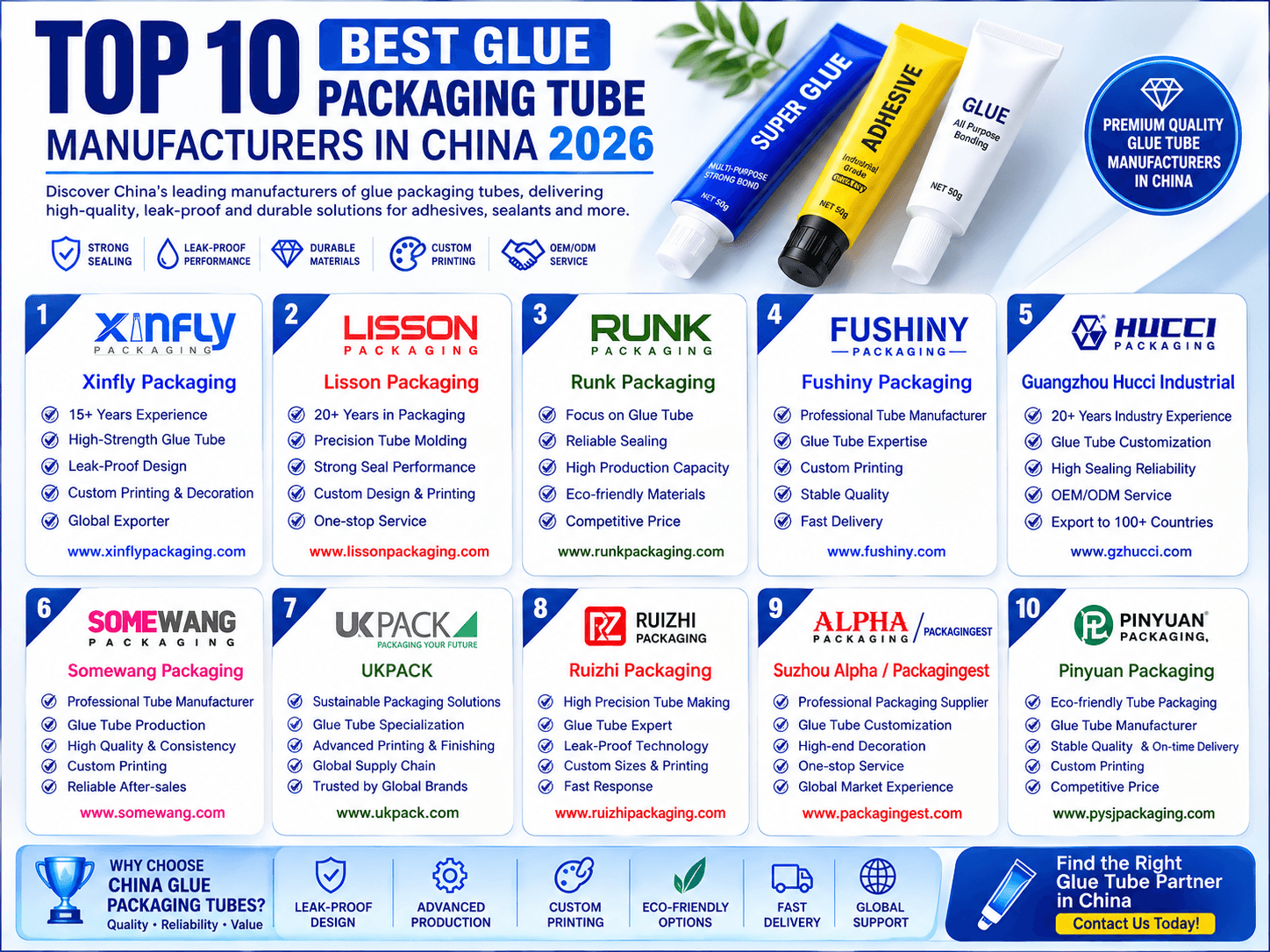
Top 10 Best Glue Packaging Tube Manufacturers in China 2026
The suppliers below represent different sourcing options for flexible tube, nozzle tube, laminate tube and specialty packaging projects that may be relevant to adhesives, glues and technical pastes.
Buyers should independently verify chemical compatibility and the supplier's actual experience with the specific adhesive chemistry before commercial production.
Xinfly Packaging
Xinfly Packaging manufactures custom flexible tubes and nozzle dispensing tubes across PE, EVOH, ABL, PBL and aluminum packaging directions.
Its tube manufacturing and closure customization capabilities can support glue, adhesive and technical-paste packaging projects after formula compatibility has been evaluated.
- PE squeeze tubes
- 5-layer EVOH
- ABL
- PBL
- Aluminum tubes
- Opaque tube options
- Precision nozzle
- Long nozzle
- Custom orifice
- Screw closure
- Specialty applicator concepts
- Offset printing
- Silk screen printing
- Hot stamping
- Custom Pantone colors
- Matte / glossy finishing
- Tube material comparison
- Nozzle selection
- Sample development
- Filling-line coordination
- Quality inspection
Lisson Packaging
Lisson Packaging provides custom tube and dispensing packaging solutions across beauty and personal-care markets. Its broad tube manufacturing capabilities may be relevant for selected glue and technical-paste packaging projects.
- Flexible plastic tubes
- Custom dispensing heads
- Tube decoration
- OEM / ODM development
- Multi-SKU packaging
- Adhesive compatibility experience
- Exact tube material
- Nozzle fit
- Tail-seal performance
- Filled aging tests
Runk Packaging
Runk Packaging offers tube packaging across PE, multi-layer and laminate structures, giving buyers several material directions to evaluate for technical paste or adhesive applications.
- 2-layer PE
- 5-layer PE
- PBL
- ABL
- Custom squeeze tubes
- Solvent resistance
- Nozzle compatibility
- Squeeze force
- Barrier requirements
- Tail seal
Fushiny Packaging
Fushiny Packaging manufactures plastic and laminate tube packaging across PE, multi-layer and barrier structures. These capabilities may be relevant for selected glue, adhesive and technical-paste applications where controlled dispensing and barrier performance are required.
- 2-layer PE
- 5-layer EVOH
- ABL
- PBL
- Custom tube dimensions
- Adhesive compatibility
- Solvent resistance
- Nozzle options
- Barrier requirement
- Tail-seal testing
Guangzhou Hucci Industrial
Guangzhou Hucci Industrial offers tube packaging across PE, laminate, eco-oriented and aluminum categories. Its broad material range may be useful for buyers comparing flexible and collapsible adhesive packaging structures.
- PE tubes
- ABL tubes
- PBL tubes
- Aluminum tubes
- Custom nozzle formats
- Exact material structure
- In-house production scope
- Closure compatibility
- Chemical test data
- MOQ by material
Somewang Packaging
Somewang Packaging provides customized packaging across tubes, bottles and other formats. For glue and adhesive projects, its broad packaging scope may be useful when buyers require several related components under one sourcing program.
- Custom tube packaging
- Custom closures
- Color customization
- Printing
- OEM / ODM support
- Multi-category packaging
- Private-label technical products
- Coordinated packaging systems
- Multi-SKU launches
UKPACK
UKPACK provides customized tube and packaging options with color, closure and surface-finishing support. Selected tube formats may be relevant to glue and technical-paste projects after compatibility validation.
- Custom plastic tubes
- Custom colors
- Closure customization
- Logo decoration
- OEM packaging support
- Industrial adhesive experience
- Barrier structure
- Precision dispensing
- Filled-product testing
- Storage stability
Ruizhi Packaging
Ruizhi Packaging offers soft tube packaging across PE, laminate, PCR and other material directions. These options may provide several starting points for low-to-medium viscosity technical products.
- PE
- ABL
- PBL
- PCR
- Specialty tube options
- Tube swelling
- Weight loss
- Nozzle clogging
- Seal strength
- Squeeze force
Suzhou Alpha Packaging / Packagingest
Suzhou Alpha Packaging, also presented online through Packagingest, provides soft tube packaging across PE, laminate and sustainability-oriented structures.
- PE tubes
- ABL / PBL options
- Custom colors
- Printing
- Cap assembly
- Adhesive project experience
- Nozzle availability
- Chemical resistance
- Barrier requirement
- Tail-seal capability
Pinyuan Packaging
Pinyuan Packaging can be considered for customized tube packaging projects where flexible dispensing, printing and closure customization are required.
Adhesive suitability should be verified directly for the final tube material and glue chemistry.
- Custom tube formats
- Nozzle closure options
- Printing
- Material selection
- OEM support
- Current material capability
- Industrial-use testing
- MOQ
- Samples
- QC standards
Top 10 Glue Packaging Tube Manufacturers Compared
The best supplier depends on the glue chemistry, viscosity, required barrier, nozzle design, filling process and storage environment.
| Manufacturer | Relevant Tube Direction | Best Fit | Buyer Should Verify |
|---|---|---|---|
| Xinfly Packaging | PE / EVOH / ABL / PBL / Aluminum / Nozzle | Custom technical tube development | Formula-specific compatibility |
| Lisson Packaging | Flexible tubes + custom heads | Custom dispensing projects | Adhesive experience |
| Runk Packaging | PE / multi-layer / laminate | Material comparison projects | Chemical resistance |
| Fushiny Packaging | PE / EVOH / ABL / PBL | Barrier-oriented projects | Solvent compatibility |
| Guangzhou Hucci Industrial | PE / laminate / aluminum | Multi-material sourcing | Exact structure + testing |
| Somewang Packaging | Custom tubes + broader packaging | Multi-category programs | Tube-specific QC |
| UKPACK | Custom plastic tubes | General custom packaging | Industrial-use suitability |
| Ruizhi Packaging | PE / laminate / soft tubes | Low / medium viscosity products | Swelling + seal testing |
| Suzhou Alpha / Packagingest | PE / laminate | Custom soft tubes | Adhesive testing |
| Pinyuan Packaging | Verify by RFQ | Custom projects | Current technical capability |
Packaging Cost Should Not Be Compared Without Matching Chemistry
A simple PE craft-glue tube is not equivalent to an ABL, aluminum or specialty barrier package designed for solvent-based adhesive.
PE vs EVOH vs ABL vs PBL vs Aluminum for Glue Packaging
Material selection should balance flexibility, chemical resistance, barrier performance, squeeze behavior and cost.
| Material | Main Strength | Potential Limitation | Glue Packaging Direction |
|---|---|---|---|
| PE | Soft squeeze + cost efficiency | Limited barrier for some solvents | Water-based / craft glue |
| 5-Layer EVOH | Improved gas barrier | Not universal solvent resistance | Selected acrylic / specialty adhesives |
| PBL | Barrier + smooth printable surface | Compatibility depends on laminate | Premium / technical adhesive products |
| ABL | Strong light and gas barrier | More permanent collapse | Barrier-sensitive adhesives |
| Aluminum | Strong barrier + collapsibility | Denting / permanent deformation | Solvent-sensitive and technical formulas |
Barrier Performance ≠ Chemical Resistance
A material may provide an excellent oxygen or moisture barrier and still be unsuitable for a particular solvent or reactive adhesive. Always validate both properties independently.
Chemical & Solvent Compatibility Testing for Glue Tubes
Adhesive packaging should normally undergo filled compatibility testing before mass production because failures can develop gradually during storage rather than immediately after filling.
Monitor whether the tube wall expands, softens or changes dimensions.
Look for cracks around the shoulder, neck, tail and heavily flexed areas.
Excessive weight loss may indicate evaporation or solvent permeation.
Check viscosity, color, odor, curing behavior and performance.
Verify that the nozzle, plug and cap do not swell or crack.
Inspect tail seal integrity during extended storage.
Accelerated Testing Is Useful, but Real-Time Storage Still Matters
Elevated-temperature aging can help identify problems faster, but final shelf-life validation should reflect the product's actual formulation, storage temperature and intended lifetime.
How to Reduce Nozzle Clogging in Glue Packaging Tubes
Nozzle clogging is one of the most common usability problems with fast-drying and curing adhesives.
Openings that are too small can retain adhesive and accelerate blockage.
Some closure designs use a plug or pin that seals inside the nozzle opening.
Reducing dead space can help minimize product left exposed to air.
Cap-up or cap-down storage can affect how adhesive remains around the outlet.
A poor cap seal allows air or moisture to enter the nozzle region.
Moisture-cure, UV-cure and solvent-evaporation products require different closure strategies.
Glue Tube Filling & Tail Sealing Requirements
High-viscosity adhesive filling can place greater mechanical demands on tube handling and tail sealing than many cosmetic formulas.
High-viscosity glue may require pressure-assisted filling equipment.
Adhesive contamination in the sealing zone can weaken the tail seal.
Adequate headspace helps prevent product intrusion into the sealing area.
Temperature, pressure and dwell time should match the exact tube structure.
Filled tubes should withstand expected squeezing and transport stress.
Artwork, eye marks and tail position may need to align with the filling machine.
General technical reference: Tube Filling & Sealing Line Parameters .
Storage & Transportation Testing for Glue Packaging Tubes
Industrial and consumer adhesive products may experience significant temperature changes during warehousing and international shipping. Packaging tests should reflect these conditions.
| Test Direction | What It Helps Evaluate |
|---|---|
| High-Temperature Storage | Tube softening, solvent migration, leakage and pressure |
| Low-Temperature Storage | Brittleness, cracking and seal stability |
| Inverted Storage | Nozzle and closure leakage |
| Drop Test | Cap, shoulder and tail impact resistance |
| Repeated Squeeze | Wall fatigue and decoration durability |
| Long-Term Filled Aging | Formula / package interaction and shelf-life performance |
Test the Final Filled Package, Not Just Empty Tubes
Adhesive chemistry can change package behavior over time, so empty-tube inspection alone cannot confirm suitability.
How to Choose a Reliable Glue Packaging Tube Manufacturer in China
Glue and adhesive tube packaging should be selected as a technical compatibility system rather than as a simple empty package. The supplier should understand tube materials, solvent exposure, barrier requirements, nozzle design, filling behavior, tail sealing and storage stability.
For industrial or reactive adhesives, buyers should place more weight on compatibility testing and dispensing performance than on appearance alone.
Provide the adhesive chemistry, viscosity, solvents, curing mechanism and expected shelf life.
Compare PE, EVOH, PBL, ABL and aluminum according to both barrier and chemical resistance.
Nozzle diameter, taper, plug design and cap seal influence dose control and clogging risk.
Closure plastic must also resist the adhesive, not only the tube wall.
Tube stiffness should match the viscosity and desired dispensing accuracy.
Filled tubes should pass seal-strength, burst and leakage testing.
Compatibility problems often appear only after weeks or months of storage.
Final supplier approval should use the actual adhesive whenever practical.
Common Buyer Pain Points When Sourcing Glue Packaging Tubes
| Buyer Pain Point | Possible Cause | What To Request |
|---|---|---|
| Tube becomes soft or swollen | Adhesive attacks the polymer | Filled compatibility test |
| Nozzle clogs after several uses | Residual glue cures around outlet | Anti-clogging closure test |
| Glue leaks from cap | Poor plug / thread / nozzle seal | Inverted leakage test |
| Solvent smell decreases over time | Solvent permeation or evaporation | Weight-loss and barrier test |
| Tail seal bursts | Overfill or weak seal | Burst + seal-strength test |
| Tube cracks near shoulder | Stress cracking / chemical attack | Filled aging + stress test |
| Glue dispenses too fast | Nozzle opening too large | Orifice trial |
| Glue is too hard to dispense | Tube too rigid or nozzle too small | Squeeze-force test |
Common Glue Packaging Tube Failures & Solutions
1. Solvent Attack Causes Tube Swelling
Some solvent-rich adhesives can soften, swell or distort certain plastic materials over time.
- Test the exact adhesive formula.
- Measure weight and dimensional change.
- Compare PE with barrier laminate or aluminum.
- Check closure material separately.
2. Nozzle Clogging After Opening
Fast-drying adhesives can cure inside or around the nozzle when air or moisture enters the closure.
- Use a tighter plug or internal sealing pin.
- Reduce dead space in the nozzle.
- Optimize orifice size.
- Test repeated open-close cycles.
3. Glue Leaks Around the Nozzle Cap
Leakage may result from poor thread fit, insufficient sealing contact or adhesive contamination.
- Check nozzle-to-cap geometry.
- Define cap torque.
- Run inverted storage tests.
- Test warm-storage conditions.
4. Solvent Evaporates Through the Package
A tube can remain physically intact while still allowing volatile components to migrate or evaporate.
- Monitor package weight over time.
- Compare PE with higher-barrier structures.
- Check closure vapor tightness.
- Run accelerated and real-time storage tests.
5. Tail Seal Bursts During Shipping
Thick adhesive, insufficient headspace and poor sealing parameters can place high stress on the tail.
- Control fill volume.
- Keep the sealing zone clean.
- Optimize sealing temperature and pressure.
- Perform squeeze and burst testing.
Related: Tube Filling & Sealing Parameters .
6. Tube Cracks Near the Shoulder or Neck
Chemical stress, rigid geometry or assembly force can cause localized cracking near the head.
- Check formula-package interaction.
- Review shoulder material.
- Reduce assembly stress where possible.
- Perform long-term filled storage.
Why Choose Xinfly Packaging for Custom Glue Packaging Tubes?
Xinfly Packaging supports custom tube development across multiple tube structures and dispensing systems, allowing buyers to compare packaging directions before committing to tooling or mass production.
PE, EVOH, ABL, PBL and aluminum directions can be evaluated for different adhesive applications.
Explore Tube Materials →Nozzle and orifice selection can be matched to formula viscosity and dispensing requirements.
Explore Nozzle Tubes →Tube color, printing, matte, glossy and other brand finishes can be customized.
Tube Decoration →Support can include tube selection, sample development, closure review and production coordination.
OEM / ODM Services →Recommended Glue Tube Development Workflow
Adhesive Chemistry → Viscosity → Barrier Requirement → Material Screening → Nozzle / Orifice → Closure → Filled Compatibility Test → Storage Test → Filling Trial → Tail Seal Test → Golden Sample → Mass Production
Glue Packaging Tube RFQ Checklist
- Adhesive type: water-based, acrylic, solvent-based, UV-curing, epoxy, craft glue, technical paste or other.
- Formula composition: provide solvent system or SDS where available.
- Viscosity: provide actual viscosity data if possible.
- Curing mechanism: air-drying, moisture-cure, UV-cure, two-component or other.
- Fill volume: required ml or gram quantity.
- Tube material: PE, EVOH, ABL, PBL, aluminum or supplier recommendation.
- Barrier requirement: oxygen, moisture, solvent or light protection.
- Nozzle style: precision tip, long nozzle, standard nozzle or custom head.
- Orifice size: specify target bead / drop if known.
- Closure: screw cap, sealing plug, pin cap or specialty closure.
- Tube color: opaque, white, black or custom Pantone.
- Printing: offset, silk screen, hot stamping or other.
- Order quantity: required units per SKU.
- Filling equipment: machine type and sealing method.
- Storage conditions: temperature range and expected shelf life.
- Transport conditions: sea freight, air freight, cold or hot climates.
- Testing requirements: compatibility, leakage, burst, drop, weight loss, aging or other tests.
- Launch date: sample and mass-production deadline.
Need a Custom Tube for Glue, Adhesive or Technical Paste?
Send Xinfly your adhesive chemistry, viscosity, required volume, preferred material, nozzle style and order quantity. We can help compare PE, EVOH, ABL, PBL and aluminum tube directions before testing.
Frequently Asked Questions About Glue Packaging Tubes
1. What material is best for glue packaging tubes?
It depends on the adhesive chemistry. PE may suit many water-based products, while ABL, PBL, EVOH or aluminum may be evaluated for formulas requiring stronger barrier or chemical resistance.
2. Can solvent-based glue be packaged in PE tubes?
Sometimes, but not universally. Compatibility testing is essential because some solvents can soften, swell or permeate PE.
3. Are aluminum tubes good for adhesives?
Aluminum provides strong barrier performance and can be suitable for some technical or solvent-sensitive formulas, subject to compatibility testing.
4. How do I choose the nozzle size for glue?
Nozzle size should be matched to viscosity, desired bead size, dispensing force and clogging risk.
5. Why does glue clog the nozzle?
Residual adhesive may dry or cure when exposed to air or moisture around the outlet.
6. Can glue packaging tubes be custom printed?
Yes. Tube colors, logos, instructions and decorative finishes can be customized.
7. How should glue tube compatibility be tested?
Useful checks include swelling, weight loss, cracking, leakage, viscosity change, nozzle behavior and tail-seal stability.
8. Why do glue tubes burst at the tail?
Possible causes include excessive fill volume, contaminated sealing areas, weak seal parameters or high internal stress during squeezing.
9. What information is needed for a glue tube quotation?
Provide adhesive chemistry, viscosity, fill volume, material preference, nozzle type, closure, decoration, quantity and required storage conditions.
10. How do I choose a glue packaging tube manufacturer in China?
Compare material range, chemical compatibility support, nozzle engineering, samples, filling compatibility, quality control, testing capability and export experience.
Factors considered include publicly presented flexible tube capabilities, laminate and aluminum tube options, nozzle and dispensing solutions, custom decoration, OEM / ODM support and general packaging experience.
The order shown above is not an official industry ranking, audited market-share ranking, independent factory audit or third-party endorsement.
Technical Suitability Disclosure: Not every supplier listed publicly specializes in every glue or adhesive chemistry. Suitability for solvent-based, reactive, UV-curing or other technical formulas should be verified through filled-product testing.
Publisher Disclosure: Xinfly Packaging is both the publisher of this guide and one of the manufacturers included in the list. Buyers should therefore use this article as a sourcing reference and independently verify each supplier before procurement.
Edition: 2026 | Version: 2026.08 | Last Updated: August 26, 2026