Published: .
A narrow nozzle can look ideal for scalp care in a supplier photograph. The real buying question is more specific: can the intended user guide it through a hair part, control the tube and replace the cap without an awkward sequence? A longer-looking tip does not automatically solve every handling problem.
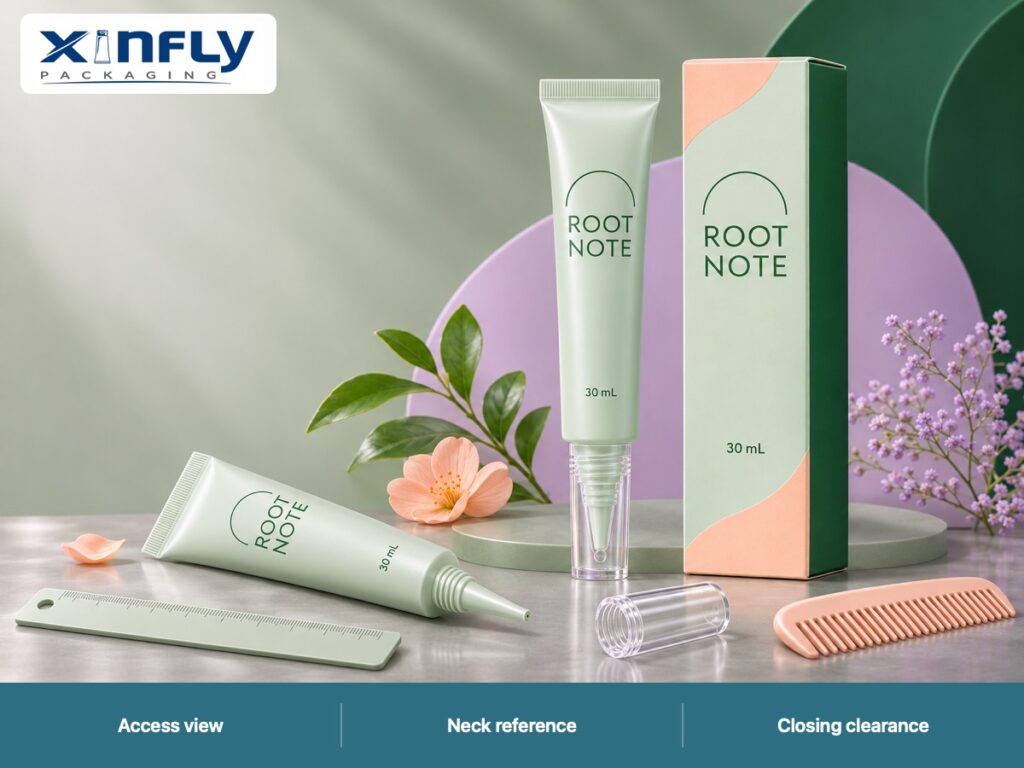
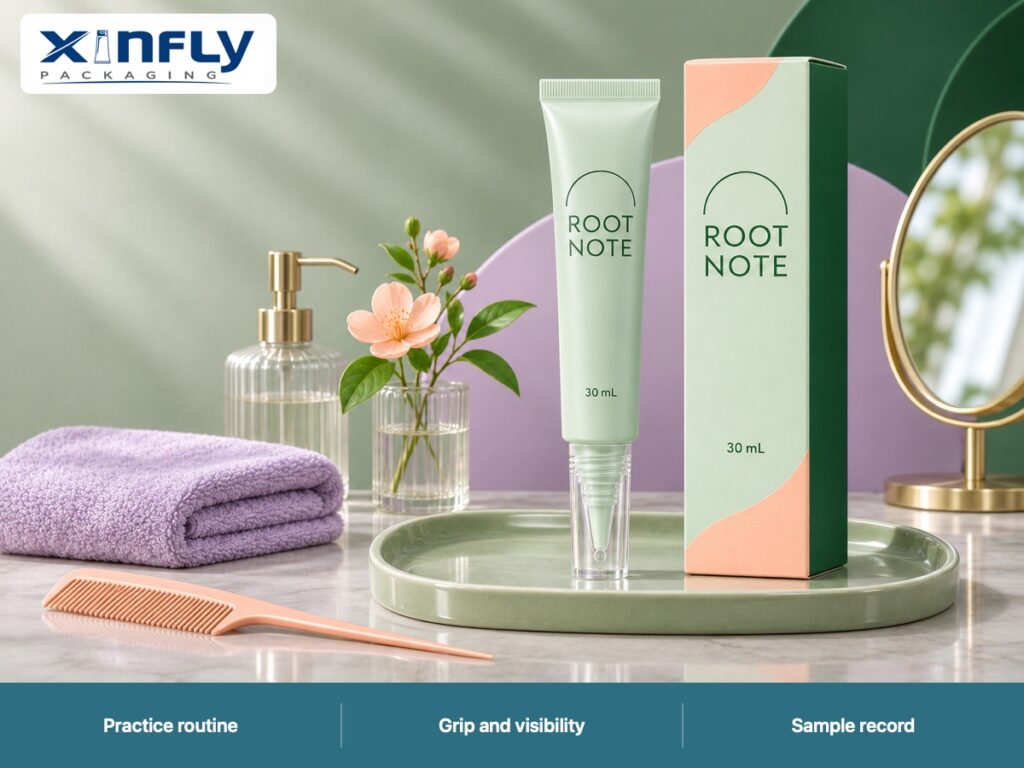
A scalp nozzle tube application access check helps turn that question into a sample brief. The illustrated ROOT NOTE concept uses a soft-sage 30 mL extruded PE body, molded shoulder, tapered nozzle, elongated clear screw overcap, straight heat-sealed tail and forest-green one-color screen print. Its designed carton repeats the name and arch motif. It is a packaging concept, not a stocked product, clinical demonstration or measured dispensing result. Start with the scalp care tube packaging application brief and confirm the proposed assembly with the supplier before ordering.
Describe the Application Task
Define What the Nozzle Needs to Reach
Ask the product team to describe the intended routine: hair parted at a mirror, application by another person, or dispensing onto a fingertip before use. Those scenarios place different demands on nozzle access and grip. A tip that can be positioned easily by a stylist may be awkward for someone working on the back of their own head.
Keep the initial task focused on package handling. A dry demonstration using a suitable practice model can help discuss access without making a product-performance claim. Any actual formula-use evaluation belongs in the brand's appropriate product program. Purchasing should not invent application instructions or therapeutic claims to make a packaging concept sound more complete.
Distinguish Access From Delivered Amount
Reaching the intended area and controlling the amount dispensed are separate decisions. A narrow nozzle does not make an ordinary squeeze tube a metered dispenser. Ask the brand to define the application amount and instructions it intends to support, then evaluate the package against that brief. Do not infer a fixed dose from the word precision in a product category.
For nozzle tubes for scalp serums, share the actual formula type and relevant behavior with the supplier. A relatively fluid product and a thicker treatment cream may require different sample work. Avoid choosing an outlet solely from a front photograph or the nominal 30 mL capacity.
Establish the Intended Contact Approach
Ask whether the product routine expects the nozzle to contact an application surface or remain above it. Record that choice in the brief and have the responsible product team review the instructions. Do not let the longest prototype silently become the final use method. Access, comfort, visibility and handling need to be considered together for the actual product.
| Field | Information to provide | Decision it supports |
|---|---|---|
| Use routine | Self-application, assisted use or indirect dispensing | Which handling sequence should the sample represent? |
| Access task | Intended hair part and application area | Can the nozzle be guided without an awkward grip? |
| Formula | Actual type and revision for later trials | Which dispensing work is relevant? |
| Assembly | Body, shoulder, nozzle, neck and cap references | What complete configuration is being compared? |
| Use instructions | Brand-reviewed contact and amount guidance | What behavior should the package support? |
Identify the Whole Nozzle Assembly
Request the Drawing Behind the Photograph
Ask for nozzle length, shape, outlet and neck dimensions on the proposed part drawing. Identify which features belong to the molded shoulder and which are separate components. The visible length in a photograph can be misleading when the body or overcap proportions differ. Use the actual drawing to compare alternatives.
The nozzle tube range can support that discussion, while the quoted part references define the sample. If the supplier proposes a different nozzle after seeing the formula, request a revised assembly drawing. A similar profile is not enough to establish that it fits the same cap or behaves the same way in use.
Check the Overcap Clearance and Engagement
The cap must fit around the nozzle and engage the intended neck. Ask the supplier to identify its internal closing arrangement and assembly method. Do not infer how it closes from the transparent outer appearance alone. A clear cap can make the nozzle visible while still leaving important internal contact details unclear in a photograph.
Open and replace the cap on an identified empty sample using the agreed method. Observe whether it starts smoothly, guides over the nozzle and seats as intended. Record any tendency to catch the tip or begin at an angle. Avoid forcing a poorly started cap into place and then treating the result as a normal closing trial.
Keep Body Grip in the Comparison
A slim body can be easy to hold in one orientation and harder in another. Ask users to demonstrate the intended motion with a dry prototype or appropriate practice arrangement. Observe where they place their fingers and whether they squeeze unintentionally while removing the cap. Record the body construction and finish, because a different surface or stiffness can alter the handling comparison.
Confirm the tube printing process on the proposed PE body. The ROOT NOTE design uses simple forest-green screen print, but a real project's finish and artwork may affect the available grip area. Review the decorated sample instead of assuming a plain white prototype represents every later surface treatment.
Run a Dry Access Review First
Use a Consistent Practice Arrangement
Define the practice model, hair-part arrangement and viewing position appropriate to the intended task. Keep those conditions consistent when comparing prototypes. Record whether the participant uses one hand to hold the hair part and the other to guide the tube. That can reveal a cap-handling problem that is invisible when both hands are free at a desk.
Ask the participant to show the full sequence: pick up the pack, remove the cap, position the nozzle, withdraw it and close the pack. Avoid evaluating only the final nozzle position. A design can reach the area well after several awkward preparatory steps that the first photograph never captures.
Observe Visibility and Approach Angle
Can the user see enough of the tip and application area to guide the pack? Does the tube body block the view or encourage a difficult wrist angle? Record the observation without declaring that one nozzle length is universally best. Different users and use contexts may prioritize different trade-offs.
Take consistent photographs of the pack and grip where appropriate, with the participant's agreement and a clear record of the prototype. Do not present an internal handling exercise as a clinical demonstration or a customer success story. Its purpose is to identify a packaging decision that deserves further review.
Include Cap Placement in the Sequence
Where does the cap go while the user handles the tube? Observe whether it is easy to set down and retrieve without confusing its orientation. If the routine requires two hands elsewhere, cap management can become part of the practical problem. The answer may involve a different closure format or revised instructions rather than simply extending the nozzle.
Add Formula Dispensing as a Separate Trial
Use the Actual Product and Defined Conditions
Once the access proposal is clear, have the product and quality teams define the relevant filled-sample work. Record the formula, fill, temperature or other conditioning specified by the method, and the complete assembly. Keep these observations separate from the earlier dry handling review. A dry prototype cannot establish output control or product compatibility.
For scalp treatment tubes with precision nozzles, observe how flow starts and stops under the agreed routine. Record any extra squeeze, unexpected ribbon or product remaining at the outlet. Do not turn a few consistent portions into a fixed-dose claim. If measured output is important, agree a suitable method and acceptance basis with the responsible team.
Inspect the Tip and Cap After Dispensing
Photograph the nozzle and neck before any cleaning step. Then replace the cap using the intended routine and inspect the relevant surfaces. Note where product remains and whether it affects handling or engagement. An observation at the outlet and one on the neck threads deserve different descriptions, even when the same formula is involved.
If the brand intends to give cleaning instructions, test the actual proposed routine through its product program. Do not improvise cleaning materials or changes to the formula during a supplier comparison. The packaging approval should be based on an identified, repeatable use sequence.
Keep Storage and Closure Work in the Release Plan
The access review does not establish sealing, transport performance or shelf life. Agree the relevant filled-pack and storage program for the actual formula and assembly. Identify the orientations, conditions, sample count and acceptance criteria before reviewing results. A transparent cap that looks well seated in an illustration is not evidence of an integrity test.
If the supplier changes the cap, nozzle or shoulder after a concern is reported, retain the old and new sample references. Ask which checks need repeating. Do not combine the preferred body from one prototype with the cap from another unless that complete assembly has been reviewed.
| Stage | Observation to retain | Next procurement question |
|---|---|---|
| Dry opening | Grip and cap removal sequence | Is access awkward before positioning begins? |
| Practice positioning | Visibility, wrist angle and nozzle approach | Which geometry deserves another prototype? |
| Withdrawal and closing | Cap placement and engagement | Can the user complete the routine comfortably? |
| Filled dispensing | Defined conditions and output observations | Does the formula require a different outlet or body? |
| Post-use review | Tip, neck and cap observations | Which part or instruction needs follow-up? |
Check the Carton and Distribution Presentation
Review Protection Around the Nozzle
Put the closed pack into the actual folded carton and any proposed insert. Check how the cap and body are supported and how the tube is removed. A package that presses on the overcap or encourages gripping it during extraction needs its own handling review. Do not assume that a narrow tube automatically fits any carton of similar capacity.
The ROOT NOTE scene illustrates a hair-care vanity with a sectioning comb. It does not establish real user outcomes or identify a tested production SKU. Use the project's actual tube, cap and carton for approval and retain the finished dimensions used by the carton supplier.
Put the Selected Assembly Into the RFQ
Include the formula type, nominal fill, body dimensions, nozzle drawing, cap, decoration, carton and use routine. Mark unconfirmed dimensions as proposals rather than promises. Ask bidders to quote the same complete configuration and identify any alternative part or process. A generic price for a 30 mL tube can hide the nozzle and closure assumptions that matter most.
Request the sample stages, tooling assumptions and additional review work as separate items where relevant. Clarify which approvals must be completed before production timing is confirmed. Do not infer a universal lead time or minimum order from the concept artwork or a product-family description.
Send Xinfly Packaging the Access Problem
Tell Xinfly Packaging what the intended user finds difficult: reaching the hair part, seeing the tip, controlling a squeeze or managing the cap. Request identified alternatives through the sample development process. Send the packaging team your scalp-care brief with the formula type, reference drawing and intended handling sequence. A clear access problem gives the supplier a practical basis for proposing the next sample.
Frequently Asked Questions
Does a longer nozzle always improve scalp access?
No universal preference is claimed. Compare reach, visibility, grip and closing with an appropriate practice arrangement and the brand's intended routine.
Can a precision nozzle guarantee a fixed dose?
An ordinary squeeze tube remains user-controlled. A defined-dose requirement needs an appropriate dispensing system and supporting verification rather than an assumption based on nozzle shape.
Should access be checked with a filled sample first?
A dry review can help isolate handling and geometry. Conduct the relevant filled-product work separately under the brand's appropriate method before making the release decision.
Why does the cap need its own drawing?
It must fit and close the selected nozzle and neck assembly. Similar outside dimensions do not establish matching internal clearance or closing features.
What changes require another review?
Review changes to formula, body stiffness, nozzle, outlet, shoulder, cap, surface finish or use routine. Repeat the affected checks on the revised complete assembly.
Conclusion
A scalp nozzle tube application access check connects the intended routine with the actual nozzle, body and cap. Review dry access first, examine filled dispensing separately and retain the complete assembly and use conditions behind the decision. Xinfly Packaging can propose a sample route when the brief describes the specific handling problem and the evidence your product team needs.