

Laser Laminate Sheet for Cosmetic Tubes
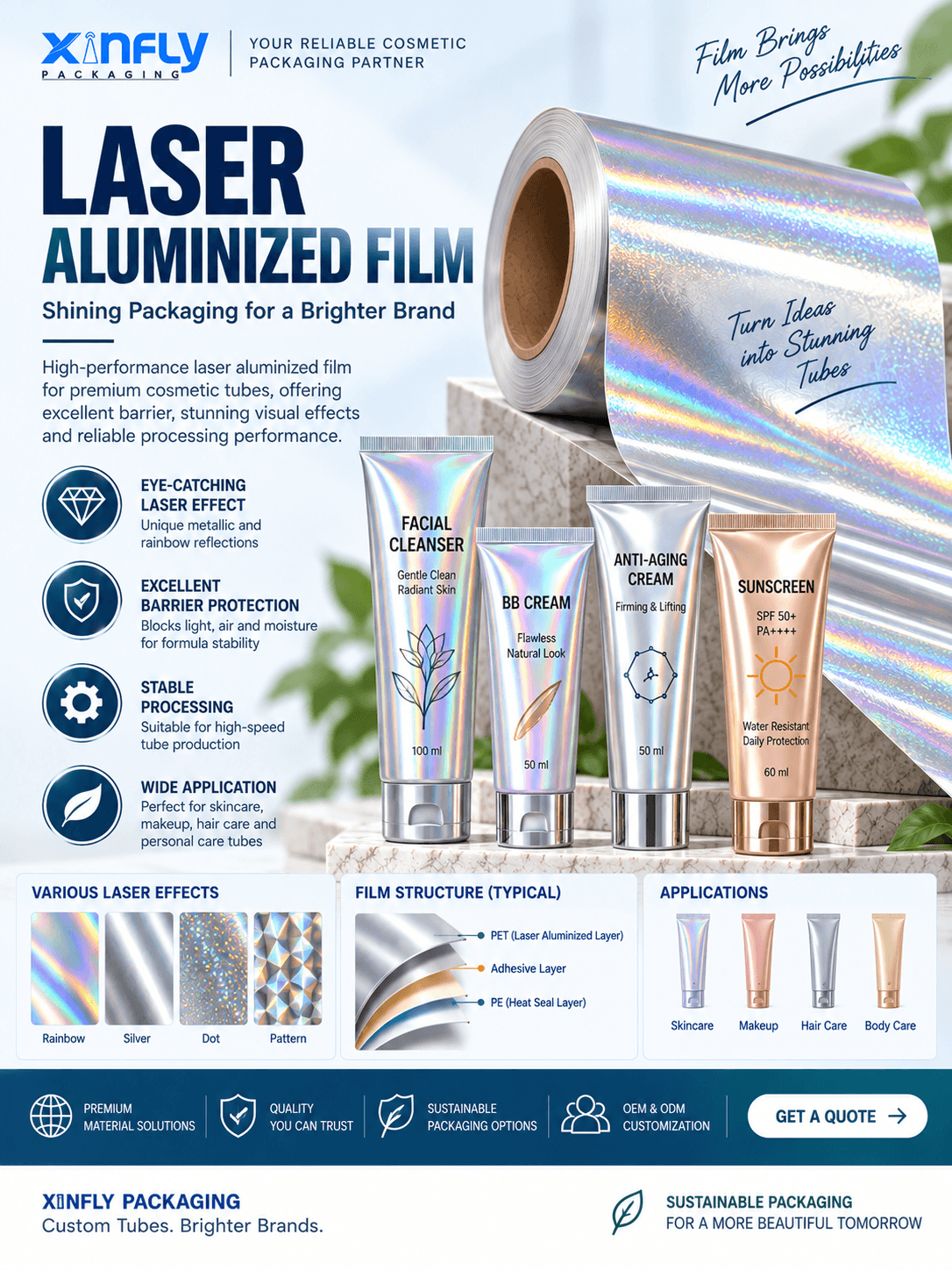
Laser Laminate Sheet is a decorative laminate material for cosmetic squeeze tubes requiring a distinctive laser magic effect, good flexibility, good elasticity and premium printed appearance. Xinfly Packaging supplies PE / Laser Aluminized Film / PE laminate in 350 μm and 400 μm total thicknesses with custom roll-film slitting.
What Is a Laser Laminate Sheet?
A laser laminate sheet is a multilayer material incorporating laser aluminized film to create a distinctive reflective optical effect. For cosmetic tube applications, Xinfly Packaging uses a PE / laser aluminized film / PE structure designed to combine decorative appearance with the flexibility required for squeeze packaging.
Laser Magic Effect
A changing reflective surface creates a distinctive premium appearance under different lighting and viewing angles.
Good Flexibility
The laminate maintains useful flexibility for cosmetic tubes that are repeatedly squeezed during product use.
Good Elasticity
The PE-based laminate structure provides elastic characteristics suitable for selected cosmetic tube applications.
Beautiful Printing Effect
Printed graphics can interact with the laser background to create distinctive packaging designs.
PE / Laser Aluminized Film / PE
The laser laminate structure supplied for these cosmetic tube applications consists of PE, laser aluminized film and PE.
Laser Laminate Sheet Specifications
Xinfly Packaging currently supplies 350 μm and 400 μm laser laminate, with roll specifications cut according to customer requirements.
350 μm & 400 μm Laser Laminate Sheet
Thickness should be selected according to the finished tube rather than simply choosing the thicker material.
350 μm Laser Laminate
Can be evaluated where the cosmetic tube project requires a balance of flexibility, elasticity, tube-body feel and laser appearance.
400 μm Laser Laminate
Provides a different stiffness and tube-body feel. Suitability depends on the tube diameter, capacity and required squeeze characteristics.
Laser Laminate Sheet with Custom Roll Slitting
Roll-film specifications can be cut according to customer requirements, helping buyers match the material to their tube-making process.
Confirm Required Width
Send the required web width or existing roll-film specification used by your tube conversion line.
Check Conversion Requirements
The selected width should correspond to the customer's forming and side-seam process.
Custom Slitting
The laminate roll can then be slit according to the confirmed customer requirement.
Why Use Laser Laminate Sheet for Cosmetic Tubes?
Laser laminate is particularly suitable when the packaging design needs to become part of the product's visual identity.
Premium Shelf Appearance
Reflective laser effects help create strong visual differentiation from conventional white or metallic tubes.
Flexible Tube Body
Good flexibility supports the repeated squeeze action required by cosmetic tube packaging.
Decorative Printing
The laser substrate can interact with artwork to create more complex visual effects.
Custom Tube Designs
Useful for skincare, makeup, sun care and other premium cosmetic tube concepts.
Common Problems When Buying Laser Laminate Sheet
The material may look simple on a specification sheet, but buyers frequently encounter problems when the laminate moves into printing and tube conversion.
350 μm or 400 μm?
The buyer does not know which thickness will produce the correct finished tube feel.
Start with the Finished Tube
Our engineers consider tube diameter, capacity, required stiffness and squeeze feel before recommending the laminate thickness.
Wrong Roll Width
The material width does not match the buyer's tube conversion equipment, causing waste or production difficulty.
Custom Slitting
Roll-film specifications can be cut according to the customer's confirmed production requirements.
Printed Color Looks Different
Pantone or CMYK colors can visually change when printed over a reflective laser background.
Control White Ink & Laser Areas
Artwork can separate opaque printed areas from exposed laser areas to better control the intended visual result.
Flat Sheet Looks Better Than the Tube
Curvature and tube forming can change how the reflective laser pattern appears.
Approve a Converted Tube Sample
For critical projects, evaluate the design on the actual tube instead of approving only a flat laminate sample.
Laser Pattern Runs the Wrong Direction
Directional optical patterns can appear incorrect after slitting and tube forming.
Lock the Web Direction
Pattern direction, artwork orientation, slitting direction and finished tube layout should be confirmed together.
Tube Becomes Too Stiff
Selecting material based only on appearance or maximum thickness can produce undesirable squeeze characteristics.
Evaluate Mechanical Feel
We consider flexibility and elasticity together with laminate thickness and finished tube dimensions.
Repeat Order Appearance Changes
Small changes in laser effect or printing may be highly visible on reflective packaging.
Maintain an Approved Standard
Approved laminate, artwork, pattern direction and finished tube samples can be retained as references for repeat orders.
Xinfly Engineer Solution: From Sheet to Finished Tube
Because Xinfly Packaging works with both laminate materials and cosmetic tube manufacturing, our engineers can evaluate the material according to the final package.
Tube Requirements
Confirm diameter, capacity, tube length and packaging application.
Material Selection
Evaluate the 350 μm or 400 μm laminate option.
Roll Width
Confirm the required web width for tube conversion.
Artwork Engineering
Coordinate laser areas, white ink, colors and pattern direction.
Tube Conversion
Evaluate forming, side seam and finished tube mechanics.
Sample Approval
Confirm appearance, printing, flexibility and squeeze performance.
Laser Laminate Sheet vs ABL vs PBL vs MPET
The laser laminate belongs in the broader laminate material family, but its key purpose and structure should not be confused with conventional ABL or PBL.
| Material | Key Structure / Layer | Main Characteristic | Current Xinfly Options |
|---|---|---|---|
| Laser Laminate Sheet | PE / Laser Aluminized Film / PE | Laser magic effect, flexibility and decorative printing | 350 / 400 μm |
| ABL | Aluminum foil barrier laminate | High light, air and moisture barrier | 220–390 μm; 12 / 20 μm foil |
| PBL | Plastic laminate with EVOH barrier | Gas barrier with white or transparent appearance | 310–400 μm; 8 / 15 μm EVOH |
| MPET | Metallized PET laminate | Glossy, mirror-like metallic appearance | 290 / 350 / 400 / 500 μm |
Laser Laminate Sheet RFQ Checklist
The following information helps Xinfly engineers evaluate and quote the material more accurately.
Send These Specifications
If you already use a laser laminate, an existing roll-film or finished tube sample can also be useful as a reference.
Related Laminate Materials
Build a clear material cluster by connecting Laser Laminate Sheet with the broader Xinfly laminate material pages.
Laser Aluminized Film
Learn about the laser aluminized film technology used in decorative cosmetic tube laminates.
Laser Aluminized Film →Aluminum Barrier Laminate
Explore aluminum foil barrier laminate for high-barrier tube applications.
ABL Web →Printed Laminated Web
Learn about custom printed laminated web for cosmetic tube conversion.
Printed Laminate →Laser Laminate Sheet FAQ
Common questions from cosmetic tube buyers, packaging engineers and sourcing teams.
1. What is a laser laminate sheet?
2. What is the structure of Xinfly laser laminate sheet?
3. What thicknesses are available?
4. Can laser laminate roll width be customized?
5. What are the main characteristics of laser laminate sheet?
6. Is laser laminate sheet suitable for cosmetic tubes?
7. Should I choose 350 μm or 400 μm?
8. Can laser laminate sheet be custom printed?
9. Why does printing look different on laser laminate?
10. Is laser laminate sheet the same as ABL?
11. Why is laser pattern direction important?
12. What information should I send for a quotation?
Looking for Laser Laminate Sheet?
Send Xinfly Packaging your required 350 μm or 400 μm thickness, roll width, tube diameter, capacity, laser appearance reference, printing artwork and order quantity. Our factory engineers can help evaluate the material from roll-film specification through finished cosmetic tube conversion.