

Laminate Tubes for Tinted Sunscreen
Custom laminate tubes for tinted sunscreen, mineral SPF, tinted facial SPF, BB/CC sunscreen and complexion-enhancing sun-care formulas. Xinfly Packaging manufactures ABL, PBL and EVOH barrier tubes with controlled dispensing, premium decoration and multiple capacity options.
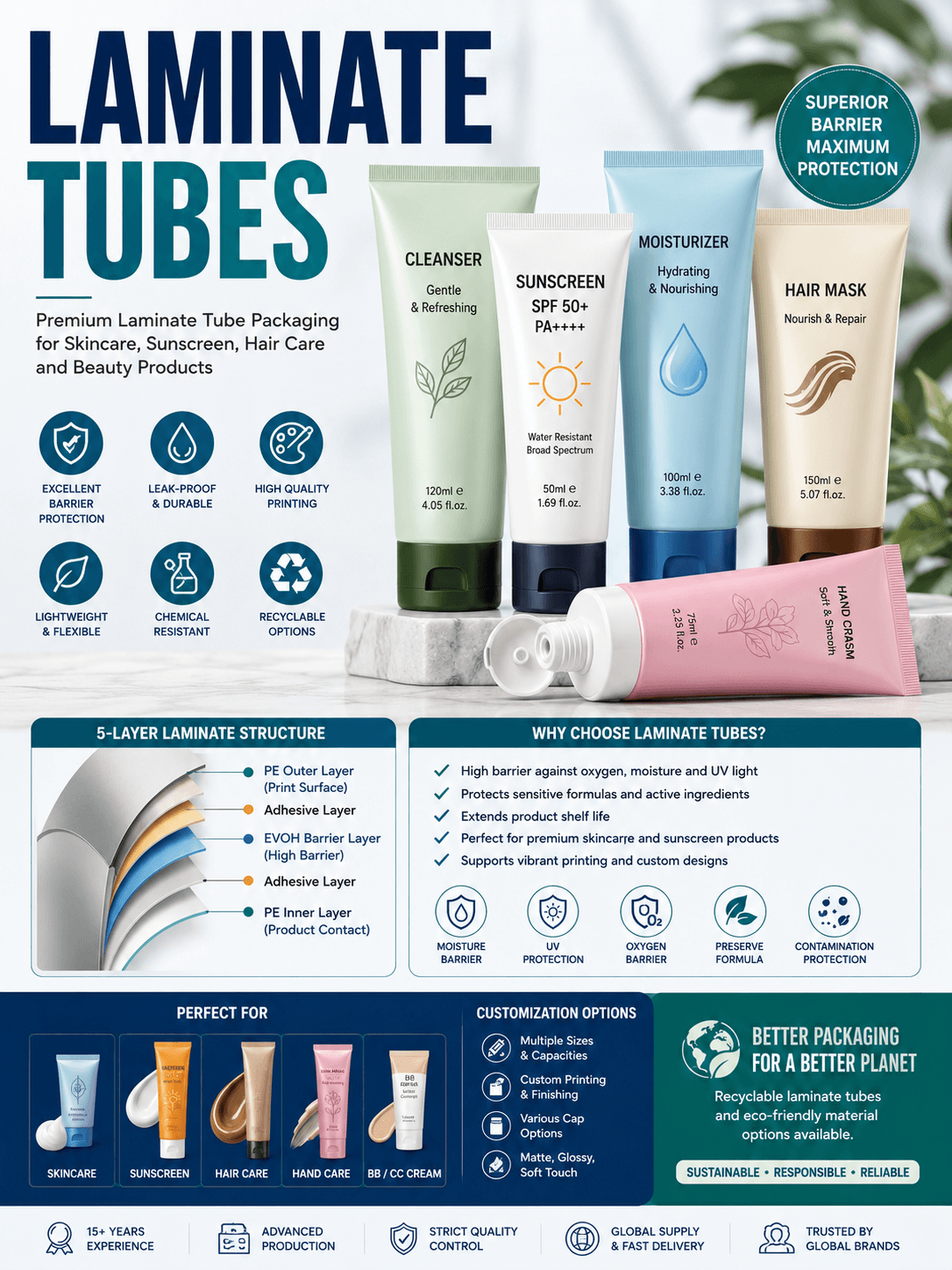
Packaging Designed for Tinted Facial Sunscreen
Tinted sunscreen combines sun protection with cosmetic coverage, tone correction or complexion-enhancing effects. This makes packaging requirements closer to both skincare and color cosmetics than conventional sunscreen alone.
Many tinted SPF formulas contain zinc oxide, titanium dioxide, iron oxides, pigments, emollients, dispersing agents and skincare ingredients.
Laminate tubes offer controlled dispensing, high-quality decoration and multiple barrier structures suitable for premium facial SPF, tinted mineral sunscreen and BB/CC-type sun-care products.
Discuss Your Tinted SPF FormulaPrecision Dispensing
Smaller openings help control pigmented formulas and reduce messy over-dispensing.
Pigment Compatibility
Tube structure and closure should be evaluated with iron oxides and the complete tinted formula.
Premium Appearance
Smooth laminate surfaces support cosmetic-style artwork and luxury skincare branding.
Barrier Protection
ABL, PBL and EVOH provide different protection levels for complex SPF formulations.
What Makes Tinted Sunscreen Packaging Different?
Tinted SPF combines sunscreen chemistry with pigments, creating additional packaging requirements around dispensing, cleanliness, compatibility and visual presentation.
Cleaner Dispensing Matters
Pigments can make residue around the tube opening more visible. A well-matched orifice and closure can help improve consumer cleanliness.
Premium Decoration Is Important
Tinted sunscreen often competes directly with foundations, BB creams and premium skincare, making surface finish and artwork quality important.
Compatibility Must Be Tested
UV filters, pigments, oils and dispersants may interact differently with tube and closure materials. Testing should always use the finished formula.
Best Laminate Tube Options for Tinted Sunscreen
ABL, PBL and EVOH each offer different combinations of barrier protection, squeezing characteristics and cosmetic appearance.
ABL Tinted Sunscreen Tubes
Aluminum Barrier Laminate provides excellent light and oxygen protection and may be selected for formulas requiring enhanced barrier performance.
- Excellent light barrier
- Excellent oxygen barrier
- Strong formulation protection
- Suitable for sensitive SPF systems
PBL Tinted Sunscreen Tubes
Plastic Barrier Laminate provides a smooth cosmetic appearance and excellent artwork reproduction, making it well suited to premium tinted SPF.
- Premium cosmetic appearance
- Excellent printing surface
- Good squeeze recovery
- Suitable for BB / CC style SPF
EVOH Tinted Sunscreen Tubes
EVOH multilayer tubes provide strong oxygen barrier performance while retaining the flexible squeeze characteristics of PE.
- Strong oxygen barrier
- Soft squeeze performance
- Good shape recovery
- Modern skincare positioning
How to Choose Laminate Tubes for Tinted Sunscreen
Do not select a tube only by capacity or appearance. The best package should be chosen around formula chemistry, viscosity, pigment loading and dispensing behavior.
Identify the UV Filter System
Determine whether the formula is mineral, organic-filter based or hybrid because barrier and compatibility requirements may differ.
Check Pigment Loading
Iron oxide concentration and other pigments affect viscosity, dispensing cleanliness and consumer perception.
Measure Actual Viscosity
Avoid choosing the opening based only on product category. Test the commercial formula at realistic temperatures.
Select Barrier Level
Choose ABL, PBL or EVOH according to oxygen sensitivity, light sensitivity, formula oils and shelf-life requirements.
Choose Dispensing Design
Narrow openings suit lighter facial formulas, while thicker mineral tinted sunscreen may need a medium or larger orifice.
Validate With Filled Samples
Test leakage, product flow, residue, cap cleanliness and tail sealing with the actual tinted sunscreen before mass production.
Tinted Sunscreen Formula Types
Different tinted SPF formulas can require different tube structures and dispensing systems.
Tinted Mineral Sunscreen
Zinc oxide, titanium dioxide and iron oxides can create relatively thick formulas. Softer tubes and medium openings are often useful.
Tinted Chemical Sunscreen
Organic UV filters may be combined with oils, emollients and pigments. Compatibility testing should evaluate the complete formula.
Hybrid Tinted SPF
Hybrid systems may combine multiple UV filters, pigments and skincare actives, increasing the importance of formula-specific testing.
Pigment & Iron Oxide Packaging Considerations
Tinted sunscreen formulas may contain iron oxides or other pigments that affect product flow, residue visibility and package cleanliness.
Cap Cleanliness
Darker tinted products can make residue more visible around the nozzle and cap. Closure geometry should minimize product accumulation where possible.
Dispersion Can Affect Viscosity
Pigment dispersion quality can influence flow behavior. Orifice selection should be based on the filled formula, not only on laboratory viscosity values.
Tube Color Should Not Distort Product Perception
For shade-based SPF products, packaging color and artwork should complement the product shade without causing confusing visual expectations.
Tinted Sunscreen Tube Applications
Custom laminate tubes can support multiple facial SPF and color-cosmetic hybrid products.
Tinted Facial SPF
Daily complexion-enhancing sunscreen packaging.
Tinted SPF30
Lightweight daily facial sun-care products.
Tinted SPF50
High-protection facial sunscreen packaging.
Tinted Mineral SPF
Packaging for zinc oxide and iron oxide formulas.
BB Cream + SPF
Tube solutions for coverage and sun protection hybrids.
CC Cream + SPF
Color-correcting skincare and sunscreen packaging.
Primer + SPF
Precision tubes for cosmetic primer and SPF products.
Moisturizer + Tint + SPF
Premium packaging for multifunctional skincare.
Recommended Sizes for Tinted Sunscreen Tubes
Tinted sunscreen is commonly packaged in facial skincare and cosmetic-style capacities.
| Capacity | Typical Application | Suggested Diameter | Positioning |
|---|---|---|---|
| 10–20 ml | Trial / Travel Tinted SPF | Φ19–Φ22 mm | Sample / Mini |
| 30 ml | BB / CC / Tinted Facial SPF | Φ25–Φ30 mm | Premium Cosmetic |
| 40 ml | Tinted Daily Sunscreen | Φ30 mm | Popular Facial Size |
| 50 ml | Tinted Mineral SPF | Φ30–Φ35 mm | Main Retail Size |
| 60–100 ml | Face & Body Tinted SPF | Φ35–Φ40 mm | Extended / Multi-Use |
Choosing the Right Orifice for Tinted Sunscreen
The opening should provide controlled application without making a pigmented formula difficult to dispense.
| Formula Type | Typical Texture | Suggested Approach | Engineering Goal |
|---|---|---|---|
| Tinted Fluid SPF | Low | Approx. 1.5 mm | Precise controlled dosing |
| Tinted Sunscreen Lotion | Low to Medium | Approx. 1.5–3 mm | Clean facial dispensing |
| BB / CC Sunscreen Cream | Medium | Approx. 3 mm | Balanced output |
| Tinted Mineral SPF | Medium to High | Approx. 3–5 mm | Lower squeeze resistance |
| High-Pigment Mineral Cream | High | Custom larger opening | Prevent difficult dispensing |
Engineer Recommendations for Tinted Sunscreen Tubes
Tinted sunscreen should be treated as both a sunscreen formulation and a pigmented cosmetic product.
Our engineering recommendation is to validate the tube using the exact commercial formula rather than relying only on generic SPF packaging specifications.
Ask an EngineerPigment dispersion, temperature and shear behavior can change the actual dispensing experience. Always run filled-tube dispensing tests.
Iron oxide and darker shades can make residue highly visible. Evaluate the closure after repeated open-close cycles.
UV filters, oils, dispersants and pigments can interact with packaging differently from the base emulsion.
A narrow internal flow path may increase dispensing resistance even when the external orifice looks large enough.
Sunscreen may be stored in warm bathrooms, handbags, cars or summer logistics environments. Temperature can change formula viscosity and leakage behavior.
Tube length, fill volume, headspace and tail sealing area must match the customer's filling and sealing equipment.
Common Packaging Risks With Tinted Sunscreen
Identifying these issues during development can prevent leakage, poor dispensing and appearance complaints after launch.
Formula Too Thick for the Orifice
Consumers may need excessive squeeze force, creating poor user experience or sudden product discharge.
Pigment Builds Up Around the Cap
Repeated use may leave visible tinted residue, particularly with dark shades and poorly matched closures.
Tube Decoration Does Not Match Premium Positioning
Tinted SPF often competes with premium makeup. Low-resolution printing or weak finishes may reduce shelf appeal.
Formula Softens Packaging Components
Oils or other ingredients may affect compatibility with certain tube or closure materials over time.
Filled Tube Shows Paneling or Deformation
Incorrect wall structure, filling conditions or storage conditions can affect package appearance.
Tail Seal Contamination
Product contamination in the sealing zone can reduce seal strength and create leakage risk during transport.
Custom Tinted Sunscreen Tube Specifications
Xinfly Packaging can customize capacity, tube diameter, laminate structure, color, shoulder, closure, dispensing opening and surface decoration.
For tinted SPF, the best specifications should be selected after reviewing pigment level, formula viscosity, shade range, filling method and expected consumer use.
Request Technical SupportClosure Options for Tinted Sunscreen Tubes
Closure selection directly affects dispensing cleanliness, product output and the premium appearance of tinted SPF.
Screw Cap
Compact screw caps create a clean cosmetic appearance for facial SPF, BB cream and CC cream packaging.
- Clean premium design
- Secure closure
- Suitable for small tubes
- Custom cap colors
Narrow Nozzle
Precision dispensing is useful for lighter tinted sunscreen and complexion products.
- Controlled product output
- Cleaner application
- Premium cosmetic appearance
- Useful for fluid SPF
Flip-Top Cap
Flip-top closures suit larger tinted sunscreen formats where convenient repeated application is more important than minimal styling.
- Easy opening
- Repeated daily use
- Multiple orifice sizes
- Suitable for 50–100 ml
Filling & Tail Sealing Advice for Tinted Sunscreen
Tube dimensions should be confirmed together with the filling process to reduce contamination and sealing defects.
Confirm Fill Volume
Nominal tube capacity and actual fill weight should leave sufficient headspace for clean tail sealing.
Prevent Product in Seal Area
Thick tinted cream can remain on the inner tube wall. Filling nozzles and withdrawal settings should reduce splash.
Match Sealing Parameters
Hot-air or ultrasonic settings should match the selected laminate structure and tube thickness.
Check Eye Mark Position
Artwork orientation and eye mark accuracy should match automatic filling and sealing equipment.
Test Seal Strength
Filled tubes should be checked for tail seal strength before compression and transportation testing.
Run Production-Line Samples
Final approval should include filled samples made under realistic production line conditions.
Buyer Checklist Before Ordering Tinted Sunscreen Tubes
Providing these details early helps shorten development time and reduces packaging revisions.
Mineral, chemical or hybrid UV filter system.
Provide actual viscosity or filled formula sample if possible.
One universal tint or multiple complexion shades.
30 ml, 40 ml, 50 ml or other retail size.
ABL, PBL, EVOH or request engineering recommendation.
Screw cap, nozzle, flip-top or other dispensing design.
Artwork, Pantone colors, matte, soft touch or metallic effects.
Provide sealing method and production-line requirements.
Why Choose Xinfly Packaging for Tinted Sunscreen Tubes
Packaging engineering support for tinted SPF, mineral sunscreen, BB/CC and premium facial sun-care brands.
Barrier Tube Expertise
ABL, PBL and EVOH structures are available for different tinted sunscreen requirements.
Dispensing Optimization
Tube flexibility, shoulder flow path and orifice size can be evaluated together.
Pigmented Formula Support
Packaging development can consider iron oxides, mineral filters and high-viscosity formulations.
Premium Decoration
Matte, soft touch, silk screen, CMYK and hot stamping support cosmetic positioning.
Sample Development
Samples support evaluation of color, dispensing, closure fit and artwork.
OEM & ODM Support
Support for skincare brands, cosmetic manufacturers and private-label sunscreen projects.
Explore Related Sunscreen Packaging
Compare facial, mineral and SPF50 packaging for different tinted sunscreen formulations.
Face Sunscreen Tubes
Explore laminate tube packaging for daily facial SPF and premium sun care.
View Face Sunscreen
Mineral Sunscreen Tubes
Explore tubes for zinc oxide, titanium dioxide and mineral SPF formulas.
View Mineral Sunscreen
SPF50 Sunscreen Tubes
Explore high-barrier laminate tubes for SPF50 facial and body sunscreen.
View SPF50 Tubes
Tinted Sunscreen Laminate Tube FAQ
Common questions from tinted sunscreen, mineral SPF and cosmetic skincare buyers.
What laminate tube is best for tinted sunscreen?
Are laminate tubes suitable for tinted mineral sunscreen?
Can iron oxide pigments affect tube selection?
What size is common for tinted sunscreen?
What orifice size is suitable for tinted sunscreen?
Can tinted sunscreen tubes use precision nozzles?
How can cap staining be reduced?
Can tinted sunscreen tubes have a matte finish?
Can BB or CC cream with SPF use laminate tubes?
Should tinted sunscreen be tested at high temperature?
What is the MOQ for custom tinted sunscreen tubes?
Can filled samples be tested before mass production?
Develop Your Custom Tinted Sunscreen Tube
Send us your tinted sunscreen formula type, UV filter system, pigment information, viscosity, target capacity, preferred laminate structure, closure, artwork and estimated quantity. Xinfly Packaging can help evaluate the most suitable ABL, PBL or EVOH tube solution for your project.